
Discover how a stolen fountain pen led Mahatma Gandhi to embrace a simpler, zero-cost way of writing. This charming anecdote from the Gandhiana archives highlights Bapu’s resourcefulness, his strict discipline with time, and his philosophy of non-possession. Learn why he crafted his own reed pen (kitta) from a wooden holder—and the surprising British figure who received the very first letter written with it.
“Most people have lost a pen at some time or the other. So did Gandhi.
He had a costly fountain pen which was pilfered. The pen was immediately replaced but the theft pained him.
Henceforth, he decided, he would not use anything so attractive that it would tempt someone to steal it.
He began using a pen-holder and a nib. But even this did not last forever. For the nib once got bent and he had to send Manubehn to get a new one. This was a loss of time when every moment was precious. Even a few minutes’ delay could upset a whole day’s schedule.
When Manubehn returned, she found Bapu sharpening the other end of the wooden holder.
“Why”‘ she wanted to know.
At which Gandhi said, “Now the point of my nib will never bend. In olden days, people used such kitta for writing purposes. Using them made the handwriting better, and they did not cost a paisa.”
So he now had a pen that would neither be stolen nor spoilt.
And do you know to whom the first letter to be penned with this kitta was addressed to — Lord Mountbatten.”
From: www.gandhiashramsevagram.com
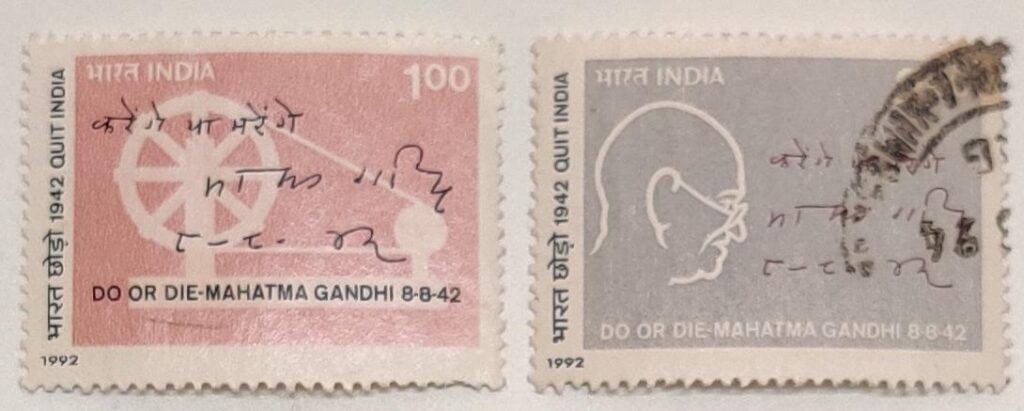
Images: Issued in 1992, these commemorative Indian postage stamps mark the 50th anniversary of the Quit India Movement launched on 8 August 1942. The stamps highlight Mahatma Gandhi and his famous “Do or Die” (Karo ya Maro) mantra. The pink and red stamp on the left features a charkha (spinning wheel) alongside Gandhi’s handwritten message in Hindi. The grey and purple stamp on the right displays a line-art profile of Gandhi next to the same slogan. Both stamps include the text “भारत छोड़ो 1942 QUIT INDIA” and the historic launch date, “8-8-42.”