Conversations on wisdom, life and the human condition
Parvati has heard the teachings. She has listened carefully, and she is still not satisfied.
That small moment, from a Shaiva Tantric text, is a good place to begin. Here is a goddess who will not accept an answer just because it comes from someone revered, and a god who answers her not with a defence but with something larger than an answer. Across scripture, epic and devotional tradition, Siva and Parvati return again and again to exchanges of this kind. One asks and the other responds. Then, unexpectedly, the roles turn.
This essay follows five of those conversations and one image that holds them together. They come from different texts and different traditions, and none of them is a transcript. But together they raise a question that is very close to our own: what happens when two people who see the world differently decide to keep talking?The conversations between Siva and Parvati belong to the rich world of Hindu scripture, philosophy and storytelling. In their traditional settings, these exchanges are sacred and philosophical, yet they also speak to deeply human questions—of knowledge, doubt, pride, suffering, responsibility and the art of living with one another.
Two who refuse to stay in their boxes
1
Siva is one of the most paradoxical figures in the Hindu imagination. He is the ascetic who lives beyond convention, and also the intimate companion and householder. He is the silent yogi and a teacher of profound insight. He is associated with destruction, yet destruction can make renewal possible. He can seem remote from the world and, at the same time, deeply compassionate towards those who suffer in it.
Parvati cannot be fitted into a single role either. She is the daughter of the mountains, a figure of determination and discipline, and a companion who watches closely, asks difficult questions and is not satisfied merely because an answer comes from someone revered. Puranic stories of persistence and devotion lead to their union. But union does not end the story. It begins another one: how an ascetic and a householder, a solitary seeker and a participant in life, learn to live with each other’s different ways of seeing.
One familiar reading gives Siva the perspective of detachment and transcendence, and Parvati the attention of someone who stays close to life, relationship and consequence. It is a useful reading, but it should be held lightly. Siva is also compassionate; Parvati is also a seeker of formidable discipline. What matters is that neither view is complete without the other. Their conversations do not merely trade answers. They show the limits of answers.
A question that opens a hundred doors
2
In the Vijnana Bhairava Tantra, the Goddess puts a series of searching questions to Bhairava, a name for Siva in his fierce and awakened aspect. What is the reality behind the world of forms? What is its essence? She is not asking for belief. She wants to know what is true.
That is worth pausing over. In many traditions, doubt is treated as a failing. Here the questioner’s doubt is a sign of seriousness. She will not take an answer on trust merely because it comes from a great source.
What follows, in the traditional count, is 112 methods of awakening attention: to the breath, to sound, to the gap between two thoughts, to a sensation arising in the body. None of them says, “Believe this.” Each says, in effect, “Look here.” The shift is from What should I believe? to What can I learn to see for myself?
A map is not the mountain, and the text knows it. But a good question can be a trailhead. Sometimes it opens a hundred doors.
Why does he look the way he does?
3
In the Anushasana Parva of the Mahabharata, Uma, as Parvati is also called, asks Siva about himself. Why the third eye? Why the many faces? Why the blue throat, the matted locks, the bow in his hand?
It is a delightfully direct set of questions, the kind a person asks of someone they love and still do not fully understand. And the answers, as tradition has preserved them, are not small. Each feature of the form carries a meaning, and generations of readers have drawn out more: the third eye as insight that sees beyond appearances, the blue throat as the one who holds poison so that others need not, the matted locks as a wildness that is also discipline.
These readings are reflections, not a claim that the ancient text set out to teach a modern psychological lesson. But the question itself carries a lesson. We cannot understand a person from the outside. We can see the appearance, and we can guess. To know, we have to ask, and asking takes a particular courage: the willingness to admit we do not yet understand someone we thought we knew.
The goddess who consulted the rivers
The questions do not only flow one way. In the Anushasana Parva, Siva asks Uma about stri-dharma, the duties and conduct proper to women. Her response is memorable. She does not simply pronounce. She says she has consulted the rivers, which are themselves feminine presences in the tradition, before answering.
Why would a goddess, of all beings, consult anyone? The text offers an idea worth keeping: no branch of knowledge is mastered by one unaided individual. Wisdom is gathered from many sources, and the wise are those who know that.
There are two kinds of humility here. One is Siva’s, who asks. The other is Uma’s, who, though fully capable of answering, shows how an answer is built from listening. Competence is not the same as completeness.
The subject of the conversation belongs to an ancient social world, and its prescriptions should be read in that light. What travels across the centuries is the manner of the exchange: a question put with respect, an answer offered with openness to other voices.
The day the world went hungry
Then there is the story of Annapurna, told in several forms across the tradition. In one familiar telling, Siva speaks of the material world as illusion, something to be seen through and set aside. Parvati, in response, withdraws nourishment from the world. The fields give nothing. Hunger spreads.
It is metaphysics meeting a hungry child.
The world is impermanent, yes. But hunger is real to the one who is hungry. So is the body, and so are childhood, grief and every meal that has ever been shared. To say that something is impermanent is not to say that it does not matter.
In the story, Siva comes to the door as a beggar, asking for food, and Parvati, as Annapurna, the one who is full of nourishment, feeds him. The ascetic accepts the meal. Transcendence, the scene suggests, is no excuse for indifference. A philosophy that cannot look at hunger has not yet finished its thinking.
And feeding, in this telling, is itself a philosophical act: perhaps the most eloquent one.
A game of dice, and a god who loses
In the Kedara-khanda of the Skanda Purana, the divine couple sit down to play dice. Siva loses. He does not at once accept it. Parvati insists, with some spirit, that she has defeated him.
It is a very human moment, and that is its charm. Who among us takes defeat gracefully, least of all in front of someone we love? The scene is about self-image: how much of who we think we are depends on winning, and what happens when we are shown, gently or otherwise, that we have not.
What the story assumes, without saying so, is a relationship with enough affection for laughter, enough trust for correction, and enough security for one person’s pride to be defeated without the relationship being defeated.
Two, yet not divided
4
Look back at what each conversation made possible. Parvati’s questions led to practices of attention that anyone could try. Siva’s questions led to a humility about where knowledge comes from. The hungry world reminded the ascetic that compassion has to be fed. The game of dice reminded both that love can survive a loss.
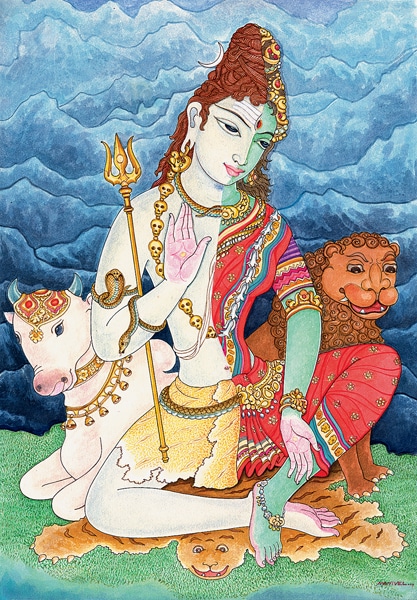
The tradition has an image that holds all this in a single form: Ardhanarishvara, the Lord who is half woman, with Siva and Parvati sharing one body. It is a visual meditation, not a puzzle to be solved. Two perspectives, each complete in itself, belong to one being.
Difference does not have to mean separation. Unity does not have to mean sameness.
For most of us, the lesson is smaller and closer. We need a companion who will show us where our understanding is incomplete, and who is secure enough to hear the same from us. You may see something I cannot yet see. If we can say that, and mean it, a great deal becomes possible.
Still worth listening
These stories come from an ancient world, with assumptions that are not ours. But the questions keep travelling. What is real? How do we come to understand someone? Where does wisdom come from? What does a philosophy owe to the hungry?
Parvati asks. Siva responds. Siva listens. Parvati reveals. Life tests them both.
Perhaps that is why, after so many centuries, it is still worth listening when Siva and Parvati speak.
Sources and further reading
The conversations above draw on five traditions:
the Vijñāna Bhairava Tantra, a Shaiva Tantric text associated with the traditions of Kashmir Shaivism;
selected Siva–Uma passages in the Anuśāsana Parva of the Mahābhārata;
the Siva–Parvati dice episode in the Kedāra-khaṇḍa of the Skanda Purāṇa;
Puranic and devotional traditions associated with Parvati as Annapurna;
and the established iconographic tradition of Ardhanarishvara.
These materials belong to different textual and cultural settings. They are therefore presented here as scriptural dialogues, epic passages, puranic narratives, devotional traditions and symbolic interpretations—not as historical transcripts of conversations.
The reflections that follow the stories are offered in that spirit: not as definitive explanations of what every tradition means, but as an invitation to wonder about what these ancient encounters might still have to say to us.
Image captions
Image 1: Siva and Parvati against a Himalayan landscape, featured on a customised postage label issued in 2010. Courtesy of Hindu Existence.
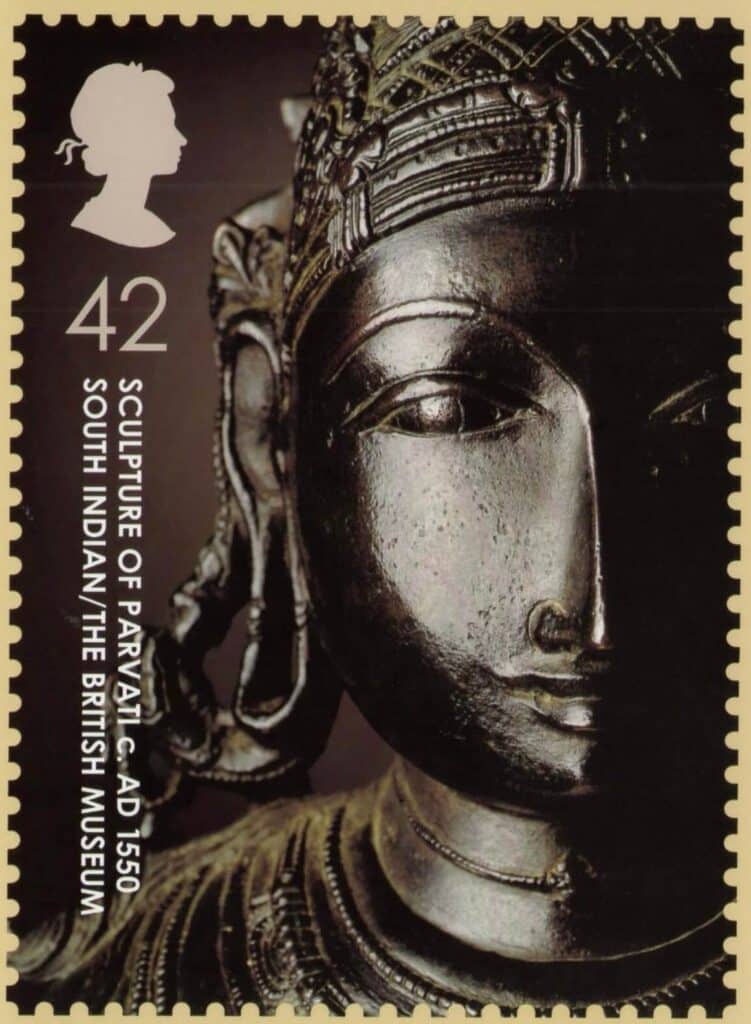
Image 2: A South Indian bronze sculpture of Parvati, attributed to the Vijayanagara period, depicted on a commemorative Royal Mail stamp issued in 2003. The original sculpture is in the collection of the British Museum.
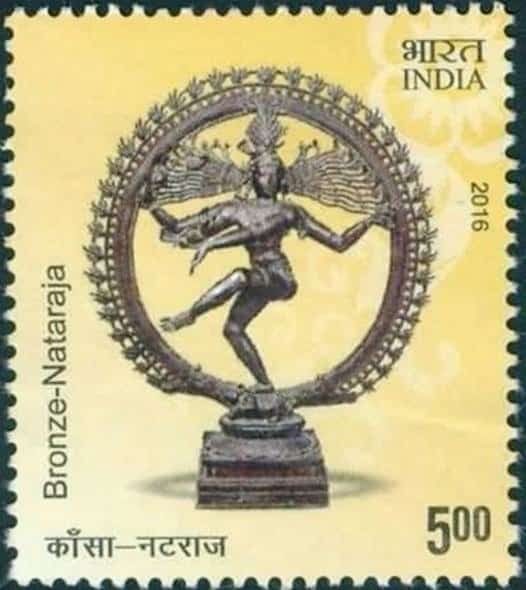
Image 3: Siva as Nataraja, Lord of the Dance, depicted on an Indian postage stamp issued in 2016. Courtesy of Wikimedia Commons.
Image 4: Ardhanarishvara, the composite form of Siva and Parvati, by the Indian artist Jayadeva Sinha. Image courtesy of Wikimedia Commons.