
A famous author, a toymaker and a neurosurgeon built a medical device for one injured child. It went on to help thousands of others.
In December 1960, a New York taxicab struck a pram carrying four-month-old Theo, the son of writer Roald Dahl and actress Patricia Neal. Theo survived, but with severe head injuries. He developed hydrocephalus, a build-up of fluid within the brain’s cavities. Surgeons implanted a shunt to drain the excess, but debris kept clogging its valve, and Theo needed operation after operation.
For his parents, surviving the accident had not ended the ordeal. The device meant to protect their child’s brain kept failing. So Dahl went looking for someone who could improve it.
After the family returned to Britain, Theo came under the care of paediatric neurosurgeon Kenneth Till at Great Ormond Street Hospital, London. Dahl also turned to Stanley Wade, a toymaker who built tiny hydraulic pumps to feed fuel to model-aircraft engines. A pump for a model plane was not a medical implant, but Wade brought a different kind of expertise: precision engineering on a miniature scale.
Till invited both men into his operating room so that they could see how shunts were used. Together they produced a stainless-steel valve with a moving disc in place of the silicone slits that were prone to clogging. They also designed an introducer to keep brain tissue out of the catheter during insertion.
By 1962, the Wade–Dahl–Till valve was ready. They supplied it at production cost, less than a third of the price of its predecessors, helping make the device more affordable.
Over the following years, it was used in an estimated 2,000 to 3,000 children—a substantial contribution at a time when shunt technology was still developing.
The valve had limitations, and newer designs eventually replaced it. But it had addressed a practical problem and provided another option for treatment.
By the time it became available, Theo’s hydrocephalus had stabilised. He never received the valve.
Other children did.
Roald Dahl (1916-1990) was born in Cardiff, Wales, to Norwegian parents. He flew as an RAF fighter pilot in the Second World War before turning to writing, and became one of the world’s best-loved children’s authors, with books including James and the Giant Peach, Charlie and the Chocolate Factory, Matilda, The BFG and The Witches. He also wrote darkly witty short stories for adults and film screenplays. His life was marked by loss and recovery: his daughter Olivia died of measles in 1962, and his wife, the actress Patricia Neal, suffered a series of strokes in 1965, after which he oversaw her rehabilitation. Those experiences shaped his later work as an advocate for vaccination and for the care of sick children.
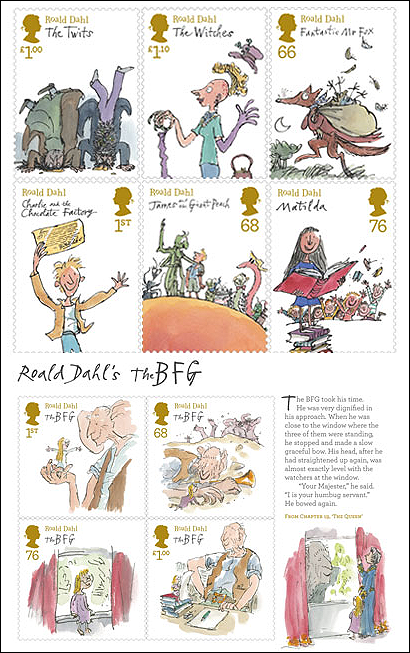
The UK Royal Mail issued a set of Roald Dahl postage stamps in 2012. The stamps feature original Quentin Blake illustrations of Dahl’s famous characters.
Image courtesy: https://www.roalddahlfans.com/