
Individual efforts, no matter how modest, hold profound power when driven by duty and collective purpose during moments of shared crisis.

“Among the Aztec people of Mexico, it is said that a long time ago there was a great fire in the forests that covered our Earth. People and animals started to run, trying to escape from the fire.
Our brother owl, Tecolotl, was also running away when he noticed a small bird hurrying back and forth between the nearest river and the fire. He headed towards this small bird.
He noticed that it was our brother the Quetzal bird, Quetzaltototl, running to the river, picking up small drops of water in his beak, then returning to the fire to throw that tiny bit of water on the flame.
The owl approached Quetzal bird and yelled at him: “What are you doing, brother? Are you stupid? You are not going to achieve anything by doing this. What are you trying to do? You must run for your life!”
The Quetzal bird stopped for a moment and looked at the owl, and then answered: “I am doing the best I can with what I have.”
It is remembered by our grandparents that a long time ago the forests that covered our Earth were saved from a great fire by a small Quetzal bird, an owl, and many other animals and people who got together to put out the fire.”
“Turning To One Another” by Margaret Wheatley
Source: http://www.rogerdarlington.me.uk/
Image above: Quetzal birds on the postage stamp of Antigua & Barbados, courtesy: birdtheme.org
Notes:
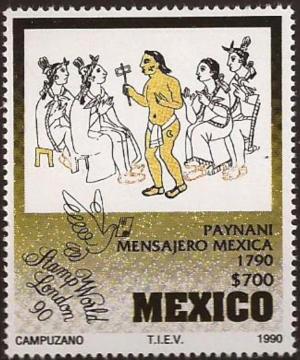
The Aztecs—who referred to themselves as the Mexica—were a Mesoamerican civilization that established a flourishing empire across central Mexico from the 14th to the 16th century, centred in their magnificent island capital of Tenochtitlan (modern-day Mexico City). Renowned for their sophisticated urban planning, engineering marvels like causeways and agricultural chinampas, complex calendar systems, and rich artistic traditions, the Aztecs developed a deeply religious society centred on cosmic balance and devotion to deities like Huitzilopochtli and Quetzalcoatl. Though their imperial rule was brought to an end by Spanish conquistadors and indigenous allies in 1521, their cultural legacy, language (Nahuatl), and architectural heritage remain fundamental pillars of modern Mexican national identity.
Image: A commemorative postage stamp issued by Mexico on May 3, 1990, for the International Stamp Exhibition Stamp World London 90. The stamp depicts a historical illustration dated 1790 of a Painani (Mensajero Mexica), an elite Aztec relay messenger and endurance runner. Chosen from the aristocracy and trained from youth, the Painani—meaning “the one who runs fast” in Náhuatl—formed the vital communication backbone of the Aztec Empire, swiftly conveying oral messages, pictographic codices, and essential goods across vast distances. Courtesy stampdta.com
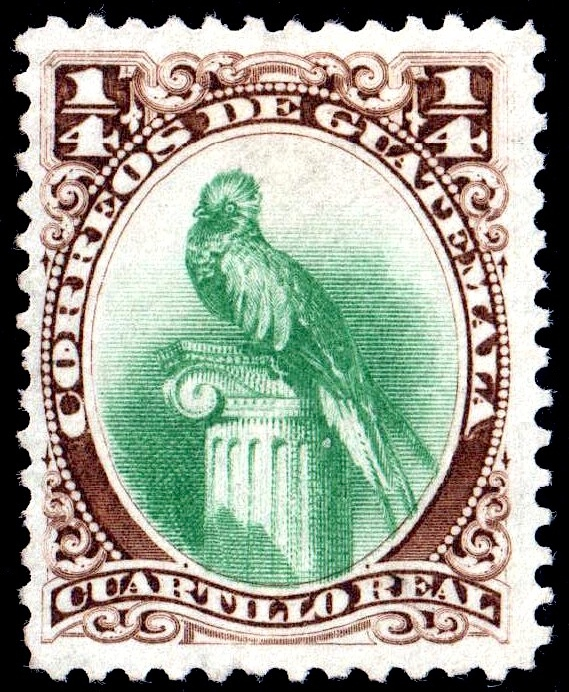
The resplendent quetzal (Pharomachrus mocinno) is a vibrant, forest-dwelling bird native to the cloud forests of Central America, celebrated for its brilliant emerald-green plumage, crimson chest, and exceptionally long, shimmering tail feathers on adult males. Revered as sacred by ancient Maya and Aztec civilizations, the quetzal was associated with the deity Quetzalcoatl and symbolised freedom, light and spiritual authority, as it was widely believed the bird would prefer death over captivity. Today, as the national bird and currency namesake of Guatemala, the quetzal remains an iconic emblem of Mesoamerican biodiversity and cultural heritage, though habitat loss makes its preservation a critical ecological priority.
Image: A vintage postage stamp of Guatamala dating back to 1879 illustrating the earliest engraved iterations of the quetzal bird. For more Guatamalan postage stamps on quetzal birds, please visit https://commons.wikimedia.org/wiki/Category:Resplendent_Quetzal_on_stamps