On 21 September 1915, Cecil Chubb entered the Palace Theatre in Salisbury, a cathedral city in southern England, for an auction. According to local legend, his wife, Mary, had sent him to buy dining chairs.
He came away with Stonehenge.
For £6,600, the local barrister bought the prehistoric monument and about 30 acres of surrounding land. The furniture story remains unverified. The purchase—and the generosity that followed—are matters of history.
What had he bought?
1
Stonehenge stands on Salisbury Plain, an open chalk landscape in Wiltshire, England. Its enormous upright stones, some joined by horizontal lintels, form the surviving remains of a monument built in stages. The first earthwork enclosure dates to around 3000 BCE, while the principal stone circle took shape around 2500 BCE. Its builders were Neolithic communities living in Britain long before written records could explain their intentions.
The stones were shaped and fitted with remarkable precision, with some brought from distant parts of Britain, including Wales. Stonehenge aligns with the midsummer sunrise and midwinter sunset, and archaeological evidence shows that it also served as a cremation cemetery. Its full purpose remains uncertain; describing it simply as an ancient calendar leaves much unexplained.
The wonder it inspires is hardly new. Medieval chroniclers Henry of Huntingdon and Geoffrey of Monmouth regarded Stonehenge as one of the world’s wonders. Today, UNESCO describes it as “the most architecturally sophisticated prehistoric stone circle in the world.”
Yet in 1915, this extraordinary inheritance was also an auction lot.
Why was Stonehenge for sale?
For centuries, Stonehenge had passed with the estates surrounding it. Once associated with nearby Amesbury Abbey, it entered secular ownership following Henry VIII’s dissolution of the monasteries in the sixteenth century. The Antrobus family acquired the estate in 1824.
The First World War brought a devastating break in the family’s succession. Its heir, Lieutenant Edmund Antrobus, was killed in Belgium in October 1914. His father, Sir Edmund, died the following year. The estate was subsequently divided into lots and offered for sale, with Stonehenge listed as Lot 15.
By then, Stonehenge already had statutory protection under the ancient-monuments legislation of 1913. Yet legal protection had not erased the damage caused over the years. Visitors had chipped away pieces of stone as souvenirs and scratched their names into the ancient surfaces. Two stones fell in 1900, and several leaning stones still depended on wooden supports.
Stonehenge needed careful stewardship. The auction presented an opportunity to secure its future, but there was no guarantee that its next owner would share that responsibility.
A local man raises his hand
Chubb had grown up in Shrewton, a village near Stonehenge, the son of a saddler and harness-maker. Education took him to Cambridge University and a successful legal career, but the stones remained part of the landscape of his childhood.
At the auction, bidding rose from £5,000. Another local bidder offered £6,500. Chubb’s bid of £6,600 secured the purchase.
He later explained his decision to a reporter without ceremony:
“While I was in the room, I thought a Salisbury man ought to buy it, and that is how it was done.”
Stories subsequently suggested that he feared a wealthy overseas buyer might acquire the monument. Such speculation circulated at the time, but his precise motives remain uncertain. What is clear is that Chubb soon assured others that measures would be taken to protect Stonehenge.
The purchase was unexpected. What he did with it three years later would prove far more consequential.
The gift that mattered more
2
On 26 October 1918, Chubb gave Stonehenge to the British nation. Explaining his attachment to the monument, he recalled visiting it in storms, moonlight and sunshine, saying that it had always held “an inexpressible charm.”
His deed of gift sought to preserve the monument and keep admission affordable, stipulating that visitors should not pay more than one shilling. Free access for eligible local residents arose through a separate arrangement concerning public rights of way, recorded in a parish-council resolution in 1921—not through the deed itself. That local-access tradition continues today through a residents’ pass scheme. General visitors now pay modern admission charges; Stonehenge is not universally free to enter.
National recognition followed. In 1919, during David Lloyd George’s premiership, Chubb became Sir Cecil Chubb, First Baronet of Stonehenge. The honour acknowledged his generosity in a manner more formal than any flattering anecdote could.
Major restoration work began in 1919, helping secure vulnerable stones. Later conservation, archaeological investigation and landscape protection built upon those early efforts. Chubb did not single-handedly save Stonehenge, but his gift marked an important turning point in its care.
A world heritage site—and a place to visit
3
Today, Stonehenge remains in public ownership and is cared for by English Heritage on behalf of the nation. The National Trust owns and protects substantial areas of the surrounding landscape. Since 1986, Stonehenge, Avebury—another great prehistoric stone-circle complex in Wiltshire—and their associated sites have together formed a UNESCO World Heritage Site. The designation recognises not merely two circles of stones, but landscapes containing burial grounds, ceremonial routes and other prehistoric monuments.
For travellers, the experience extends beyond photographing the famous silhouette. The visitor centre’s exhibitions and reconstructed Neolithic houses introduce the people behind the monument, while the wider landscape reveals how much of their world survives beyond the stones.
Ordinary visits follow a route outside the stone circle. Separately booked Stone Circle Experiences allow limited access among the stones outside normal opening hours. Solstice gatherings also give the site a continuing spiritual significance for many people.
Stonehenge matters both as an archaeological resource and as a meeting place between modern lives and a largely unwritten human past. Its builders left an achievement that still challenges our imagination. Cecil Chubb’s contribution was different, but enduring: he helped ensure that an ancient wonder would be held for the public rather than remain a private possession.
His story is ultimately one of stewardship—the recognition that some things are worth keeping, not for ourselves alone.
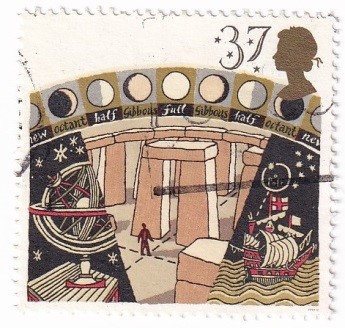
Image 1: A British postage stamp issued by Royal Mail in 1990 as part of the Astronomy set, titled Early Appreciation. Designed by Jeff Fisher, the artwork features Stonehenge alongside an astrolabe, moon phases, an old ship, and the silhouette of Queen Elizabeth II.
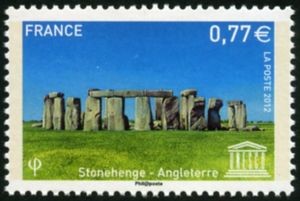
Image 2: A French postage stamp featuring the Stonehenge monument issued in 2012, as part of the UNESCO World Heritage Site series.
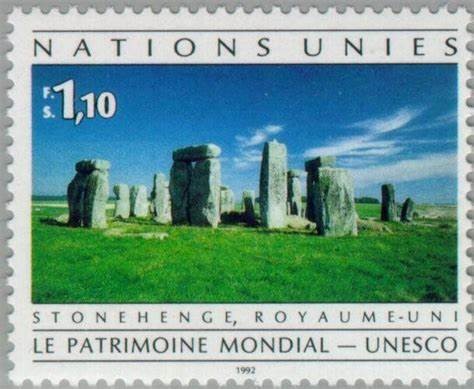
Image 3: A 1992 United Nations Postal Administration (UNPA) commemorative postage stamp featuring the Stonehenge monument, designated as a UNESCO World Heritage Site.