
Long before electric light became a part of daily life, illumination meant fragile flames, gas lines, and constant fire hazards. While Thomas Edison was not the first to imagine the incandescent bulb, his relentless experimentation with filaments and high-vacuum design transformed a fragile laboratory curiosity into a safe, commercially viable system that forever illuminated the night.
Let there be Light!
“Historians agree that Thomas Edison was not the inventor of the electric light bulb, but he did produce the first commercially viable one. Earlier, light bulbs were experimented with as far back as 1802; and there were 23 others who had invented light bulbs, some of whom were still working on them at the time of Edison’s work.
Three factors in combination are generally recognised as contributing to Edison’s success: (1) A durable incandescent material (2) Elimination of air from the bulb-a better vacuum, and (3) A filament material of high resistance.
Thomas Edison’s serious incandescent light bulb research began in 1878, filing his first patent later that year…’Improvement In Electric Lights’ in October 1878. His experiments involved the fabrication and testing of many different metal filaments, including platinum. Platinum was very difficult to work with, and prone to being weakened by heating and oxygen attack.
In addition, platinum was expensive, and too low in resistance; which would require heavy copper conductors in Edison’s electric distribution system he was designing to supply commercial installations of his bulbs. This system would later become the model for our modern electric utility power distribution system of today.Edison then resorted to a carbon-based, high-resistance filament. One year later, in October 1879, Edison successfully tested a filament that burned for 13.5 hours. Continuing to improve his design, by November 1879, he filed for a US patent for an electric lamp using “a carbon filament or strip coiled and connected … to platina contact wires.” The filament was made from a piece of carbonised thread.
By the New Year’s, he was demonstrating lamps using carbonised cardboard filaments to large crowds at the Menlo Park laboratory. It was not until several months after the patent was granted that Edison and his team discovered that a carbonised bamboo filament could last over 1200 hours. A year later, Edison began manufacturing commercial lamps using carbonised Japanese bamboo as filaments.
Throughout his career, Edison worked on many improvements to his signature invention, an invention that literally changed the way we live after dark. Prior to the light bulb, folks burned lamp oils or used manufactured natural gas for illumination, a rather dangerous way to provide illumination.
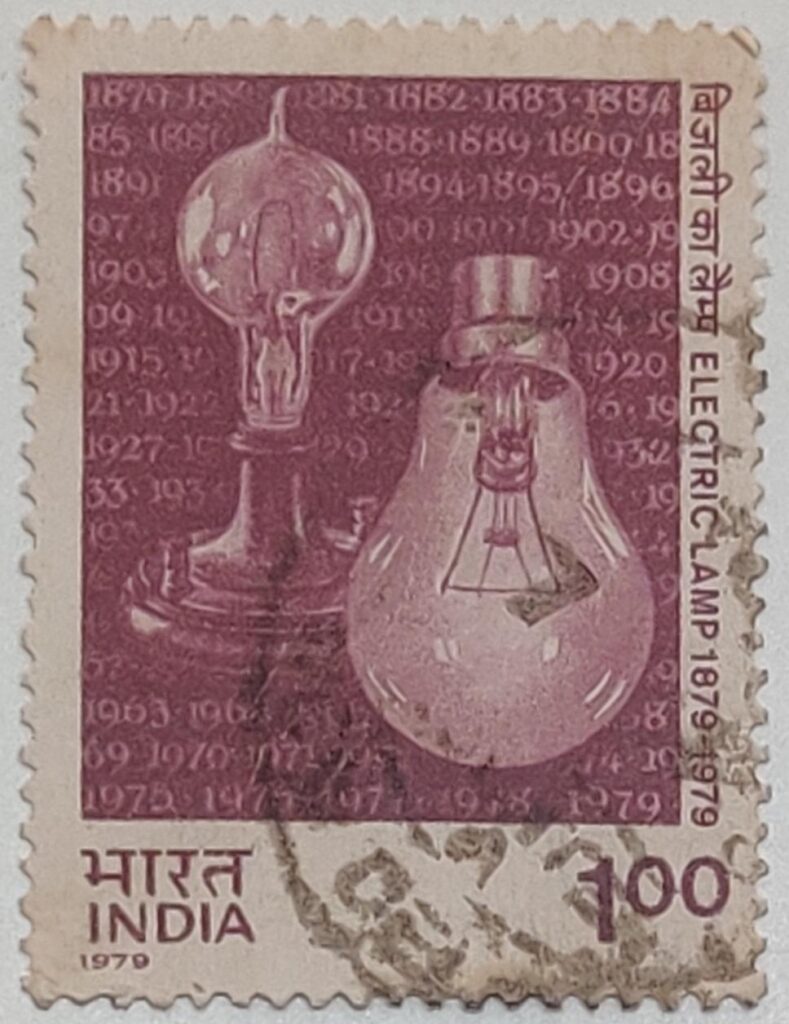
Electric lights became cheap, safe and convenient to use and the public and commercial concerns installed them in rapidly increasing numbers. The rest is history.
More on Edison at http://www.edisonmuckers.org/thomas-edison-lightbulb/
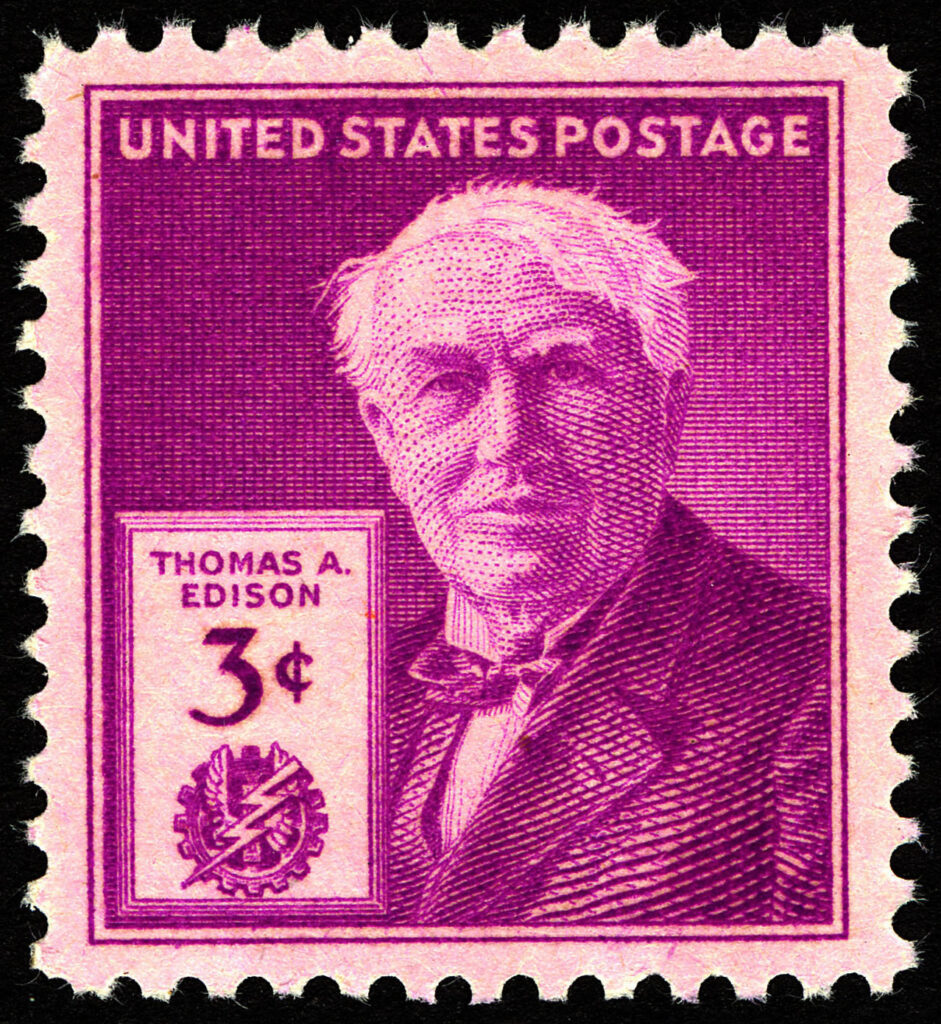
Postage stamp of Edison courtesy: Wikimedia Commons
Evolution of the light bulb after Edison
After Thomas Edison developed a commercially practical incandescent light bulb in 1879, electric lighting continued to evolve through several important stages.
Incandescent Bulb (1879 onward)
Edison’s bulb used a carbon filament inside a vacuum. Over time, improvements were made to the filament, vacuum, and manufacturing process.
Tungsten Filament Bulb (early 1900s)
Carbon filaments were replaced by tungsten, which could operate at higher temperatures and produced brighter light while lasting longer.
Gas-Filled Incandescent Bulb (1910s onward)
Inert gases such as argon were introduced inside bulbs. This reduced filament evaporation and improved the bulb’s lifespan and efficiency.
Fluorescent Tubelight (1930s onward)
Fluorescent lighting, commonly known as a tubelight, became an important alternative to incandescent bulbs. It produced light by passing electricity through a gas and using a phosphor coating to convert ultraviolet radiation into visible light. Tubelights provided more light while consuming less electricity than traditional incandescent bulbs.
Halogen Bulb (1950s–1960s onward)
Halogen technology improved upon the incandescent bulb by allowing the tungsten filament to operate at a higher temperature, producing brighter and whiter light.
Compact Fluorescent Lamp (CFL) (1970s–1990s)
Fluorescent technology was made compact enough to fit into conventional bulb sockets. CFLs consumed considerably less electricity than incandescent bulbs.
LED Bulb (2000s onward)
Light-emitting diode (LED) technology became practical for general lighting. LEDs were significantly more energy-efficient, durable and long-lasting than incandescent and fluorescent lighting.
Smart LED Lighting (2010s onward)
Modern LED bulbs added features such as dimming, adjustable color temperature, color-changing capabilities, sensors,and smartphone or voice control.
The overall evolution moved from producing light by heating a filament towards increasingly efficient methods of converting electricity into light.