
The spiritual landscape of the Indian subcontinent was profoundly transformed between the 7th and 17th centuries by the Bhakti movement, a magnificent socio-religious revolution that radically decentralised spiritual realisation. Originating in South India with the passionate Tamil hymns of the Alvars and Nayanars, this dynamic wave shifted the focus of religion away from abstract philosophies and exclusive rituals dominated by the elite, placing it squarely within the emotional, intimate sanctuary of the human heart. As the movement migrated northward across centuries, it sparked a historic vernacular revolution, swapping traditional Sanskrit for everyday regional dialects to cater to the common masses. Guided by an expansive network of nomadic poet-saints—ranging from householders and artisans to princesses and outcasts—the tradition championed absolute social equality and gender inclusivity while generating a rich, permanent literary legacy of prose, poetry and song that remains the ethical and cultural heartbeat of India today.
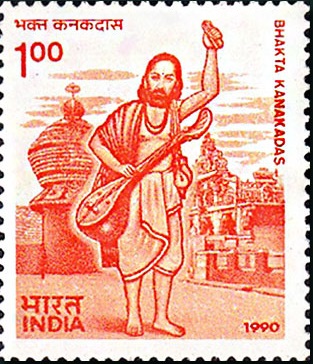
Kanakadasa (1509–1609) was a renowned poet-saint of Karnataka in South India. Though he was a high-ranking military officer, he renounced his wealth to follow the path of devotion to Lord Krishna.
Once, upon visiting the historic Sri Krishna Matha temple in Udupi, Kanakadasa was barred from entering by the temple priests because he belonged to a lower caste (Kuruba). Undeterred, he went to the back of the temple and stood outside, pouring out his heart through soul-stirring hymns and prayers. Legend has it that the intensity of his devotion was so powerful that the stone wall of the temple cracked, and the idol of Lord Krishna — which originally faced east — turned 180 degrees to the west to grant Kanakadasa darshan (a divine viewing) through a newly-formed opening.
To this day, the deity in the Udupi Krishna Temple remains facing west. The window through which Kanakadasa saw the Lord is preserved as Kanakana Kindi (Kanaka’s Window), and it is a tradition for pilgrims to catch their first glimpse of the deity through this very window.
Several such instances were recorded about other saint-poets through the ages:
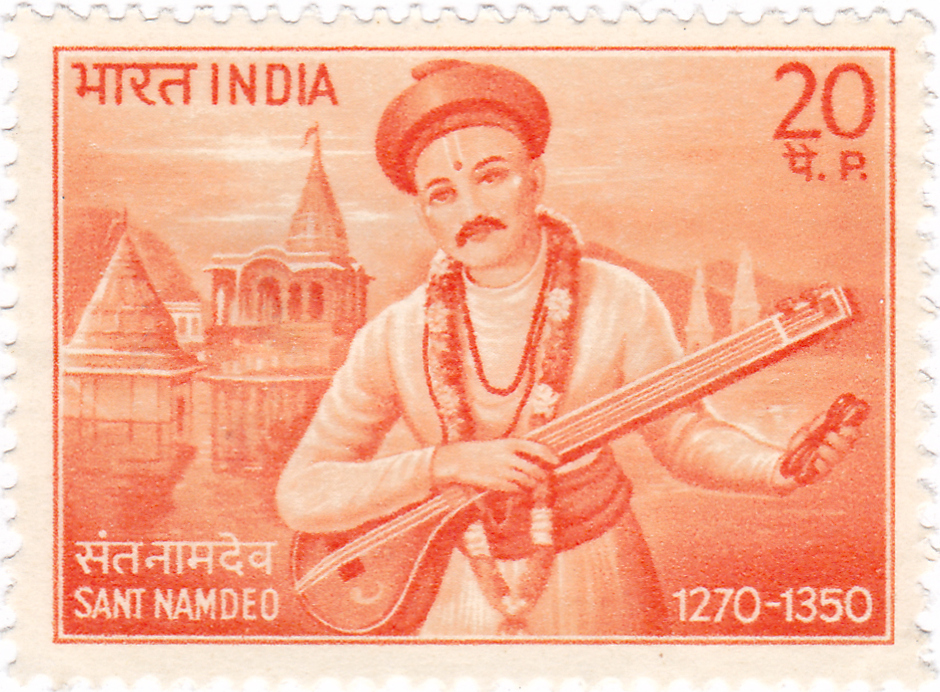
When Sant Namdeo (also Namev, a 13th-century tailor-turned-saint) was preparing to eat his rotis (flatbread), a hungry dog suddenly snatched one and ran away. Instead of getting angry, Namdeo grabbed a bowl of ghee (clarified butter) and chased the dog through the streets, shouting, “O Vitthala (Lord Vishnu), please don’t eat that dry bread! It will hurt your throat! Let me add some ghee to it.” This act of chasing “God in the form of a dog” stunned onlookers and remains a powerful symbol that divinity permeates every living creature.
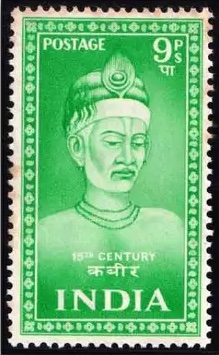
Another anecdote details how the 15th-century weaver-saint Kabir bypassed social barriers to find a Guru. As a Muslim, Kabir knew that the orthodox Brahmin saint, Ramananda, might not formally initiate him. So Kabir lay down on the steps of the Panchganga Ghat in Varanasi in the dark, early hours when Ramananda typically went to bathe in the Ganga. In the dim light, Ramananda accidentally stepped on Kabir. Startled, the Guru cried out, “Ram! Ram!” (the name of the Lord). Kabir immediately rose, thanked the Guru for the “beej mantra” (‘seed mantra’, the name of Ram), and declared himself a disciple. Ramananda, moved by Kabir’s cleverness and deep sincerity, eventually embraced him as his own.
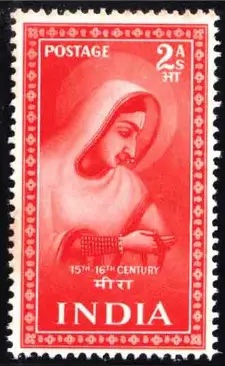
When her royal in-laws sent her a cup of poison to end her “scandalous” public devotion to Krishna, Meera Bai, a 16th century mystic poet and Krishna devotee, offered it to her deity and drank it. It is said that the poison turned into nectar, and she remained unharmed.
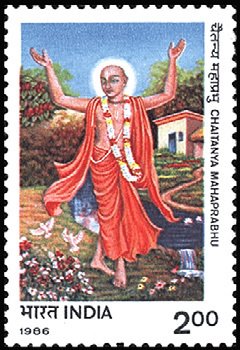
Chaitanya Mahaprabhu (1484-1534) of Bengal famously embraced a man from the “untouchable” class who was terrified of ‘polluting’ the saint with his touch. Chaitanya told him that God shines in every heart and that through love, they had become one.
The legend of Bhakta Ramadasu, born Kancharla Gopanna, centres on his 12-year imprisonment in the Golconda Fort after he used 600,000 rupees of government tax revenue to renovate the Bhadrachalam Rama Temple and craft exquisite jewellery for the deities. Serving as the Tahsildar under Sultan Abul Hasan Qutb Shah (Tana Shah), Gopanna was accused of embezzlement and subjected to severe torture and isolation in a dark cell, where he famously carved images of Rama and Sita into the stone walls. During his incarceration, he composed soul-stirring kirtanas (devotional prose-poems set to music) that shifted from desperate pleas and scolding the Lord for his indifference to total spiritual surrender. According to the legend, Lord Rama and his brother Lakshmana eventually appeared at the Sultan’s palace at night disguised as two young messengers, Ramoji and Lakshmoji, and repaid the entire debt in gold coins bearing Rama’s insignia. Upon discovering the divine coins and the receipt of payment the following morning, the Sultan realised Ramadasu’s saintly nature, immediately released him, and became a lifelong patron of the temple. This miraculous intervention established the enduring tradition where the state government continues to send royal gifts and pearls to Bhadrachalam every year during Sri Rama Navami festival.
Another famous anecdote involving Bammera Potana occurs during his translation of the Bhagavata Purana into Telugu, specifically during the Gajendra Moksham episode where Lord Vishnu rushes to save the elephant king. Potana had started a verse — the now-immortal “Ala Vaikunthapurambulo” — but struggled to describe the beauty of the Lord’s abode in heaven and eventually left his palm-leaf manuscript at home to go for a ritual bath in the nearby river. While he was away, Lord Vishnu (one of whose avatara is Lord Rama) is said to have appeared in the guise of Potana himself, spoke to the poet’s daughter, and completed the verse on the manuscript before vanishing. When the real Potana returned and found the stanza finished with such divine rhythm and beauty, his daughter insisted that he had been the one to return and write it just moments prior. Realising that the Lord had personally intervened to complete his work, Potana was moved to tears of devotion, reaffirming his famous belief: “Palikedidi Bhagavatamata, Palikinchedivaadu Ramabhadrundata” (It is the Bhagavatam (story of Lord Krishna) that is being said, but it is Lord Rama who makes me say it).

The legend of Pundarika (also known as Pundalik) centres on his profound transformation from a neglectful son into a paragon of filial piety, whose devotion to his parents was so absolute that it moved Lord Vishnu to descend from Vaikuntha to visit him. When the Lord arrived at Pundarika’s home in Pandharpur, the devotee was deeply engaged in massaging his father’s feet and refused to interrupt his service even for the Divine. Since the ground was muddy from the monsoon rains, Pundarika simply tossed a brick (Vit in Marathi) toward the Lord, requesting Him to stand on it and wait until his duty was complete. Deeply impressed by Pundarika’s unwavering focus on his parents as his primary deities, the Lord patiently stood on the brick with His hands on His hips, a posture that came to symbolise His pleasure with the devotee’s character. When Pundarika finally finished and sought forgiveness for the delay, the Lord granted him a boon, and at Pundarika’s request, He remained on that spot in that very pose to bless all who visit. This manifestation is known as Lord Vittala—literally “the one who stands on a brick”—and his temple in Pandharpur remains a testament to the belief that serving one’s parents is the highest form of spiritual worship.
All the above poet-saints belonged to the Hindu tradition of bhakti, or sublime devotion to God. And there are countless legends and miracles associated with the many bhakti poet-saints of India.
What is Bhakti?
At its heart, Bhakti is derived from the Sanskrit root word “Bhaj,” meaning “to share,” “to belong to,” or “to worship.” Unlike the rigid, ritualistic traditions of ancient Vedic religion, Bhakti represents a shift from “knowledge” (jnana) to “emotion” (bhava). It is the absolute surrender of the ego to a chosen deity, where the relationship between the human and the divine is treated as an intimate, personal bond. Accordingly, bhakti can be defined as intense devotion to God.
Key aspects of Bhakti
The “I-Thou” Relationship: Bhakti saints did not view God as a distant, abstract force. Instead, they envisioned God through human relationships: as a master (servant-lord), a friend (equal companionship), a child (parental love), or even a lover (the soul’s longing for the divine).
Saguna and Nirguna Bhakti: Saguna Bhakti focusses on a God with form and attributes, such as Siva, Vishnu, Rama or Krishna. This makes the devotion “personal” because the devotee can visualise, talk to and serve the deity. This form of bhakti was practiced and promoted by saints like Tulsidas and Meera Bai. Nirguna Bhakti focusses on a formless, omnipresent divine force, yet maintains the same level of intense personal passion and internal connection. Kabir and Guru Nanak were among those who practised and promoted Nirguna Bhakti.
Accessibility and Inclusivity: The most revolutionary aspect of bhakti tradition is its universality. While traditional paths to salvation often required literacy in Sanskrit or high-caste status, Bhakti defined devotion as an act of the heart. This meant that anyone — regardless of gender, caste or social standing — could achieve the highest spiritual state through pure devotion alone.
Physical Expression: Bhakti is rarely a silent, meditative practice. It is expressed through kirtana (also kirtan, keertana, or song), nritya (dance), and smarana (constant remembrance), turning the act of worship into a living, breathing cultural experience.
Origin of Bhakti movement
The Bhakti movement did not have a single founder; instead, it evolved as a series of regional waves that eventually transformed the spiritual fabric of the entire Indian subcontinent. Its origins can be traced through four distinct stages of development.
1. The Tamil revolution (7th – 9th Century CE)
The true ‘genesis’ of the movement occurred in South India (Tamilakam, ancient Tamil country) with two groups of poet-saints, the Alvars and the Nayanars, who sought to democratise religion (Alvar literally means ‘The Immersed’ and Nayanar means ‘Hounds (of Siva)’). They replaced Sanskrit with Tamil, composing passionate hymns that could be sung by the commoners. These saints came from all social strata — including ‘untouchable’ castes and women — preaching that God was accessible through simple love and devotion rather than birthright.
The Alvars (6th–9th century CE), a group of twelve Tamil poet-saints from South India, are revered as the early architects of the Bhakti movement who expressed intense, personal devotion to Lord Vishnu through their soulful poetry. Their collective works, known as the Naalayira Divya Prabandham (The 4,000 Divine Hymns), played a crucial role in reviving Vaishnavism and continue to serve as the spiritual and liturgical foundation for Srivaishnava traditions today. Prominent among the alvar poet-saints were Andal, Kulasekara Alvar, Nammalvar and Thirumangai Alvar.
The Nayanars (6th–8th century CE), a group of sixty-three Tamil poet-saints from South India, are celebrated as the early architects of the Shaivite Bhakti movement who expressed profound, intense devotion to Lord Shiva. Their collective hymns and hagiographies, compiled as the Thirumurai, played a pivotal role in the revival of Saivism and remain the guiding spirit for the Saiva Siddhanta tradition today. Prominent among the Nayanar poet-saints were Appar, Sundarar, Sambandar and Manikkavachakar.
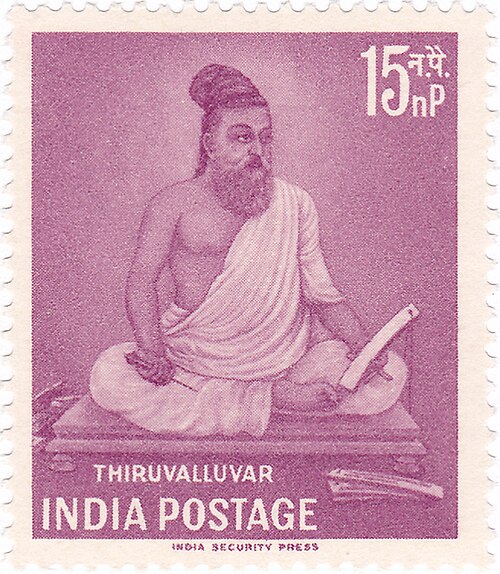
Thiruvalluvar (c. 4th century BCE–6th century CE), a celebrated poet and philosopher from Tamil Nadu, is revered as the “Daiva Pulavar” (Divine Poet) and the foundational pillar of Tamil moral literature. He authored the Thirukkural, a monumental collection of 1,330 couplets that distill the complexities of ethics, politics and love into universal, secular truths. By transcending religious and social boundaries to advocate for integrity, humility and non-violence, he attempted to democratise ethical living and established a literary legacy that remains the moral compass of Tamil culture and a global masterpiece of wisdom today.
Auvaiyar (also Avvaiyar, c. 1st or 2nd century BCE-CE), a legendary woman poet-saint from Tamil Nadu, is revered as the “Tamil Paatti” (Grandmother of Tamil) and the matriarch of ethical Tamil literature. She translated complex moral and spiritual codes into succinct, rhythmic maxims such as the Aathichoodi and Kondrai Vendhan, focussing on the virtues of education, charity and humility. By serving as a diplomatic mediator between warring kings and authoring foundational primers that still introduce every Tamil child to the alphabet today, she established a literary legacy that remains the ethical bedrock of the Tamil-speaking world. Avvaiyar means a ‘respectable old woman’ in Tamil, hence a generic title; her personal name is not known.
It is also to be noted that Avvaiyar is likely the title given to more than one women poet-saints in Tamil literature, whose contributions span from the Sangam era to the Chola period, and still serve as foundational primers for children.
2. Philosophical formalisation (11th – 13th Century CE)
In support of the emotional wave of the South, several great ‘acharyas’ (scholars) provided a solid philosophical foundation for Bhakti to challenge orthodox Vedic traditions:
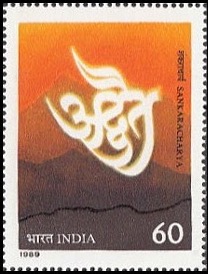
Adi Shankaracharya (c. 788–820), a philosopher, theologian and mystic from Kerala, is the central figure in the consolidation of Advaita Vedanta (Non-dualism) and the intellectual formalisation of Indian devotional life. While he championed Jnana (knowledge) as the ultimate path to liberation, he deeply enriched the Bhakti movement by composing numerous exquisite devotional hymns like the Bhaja Govindam and Saundarya Lahari, teaching that sincere devotion to a personal deity is an essential step toward purifying the mind and realising the ultimate non-dual Reality.
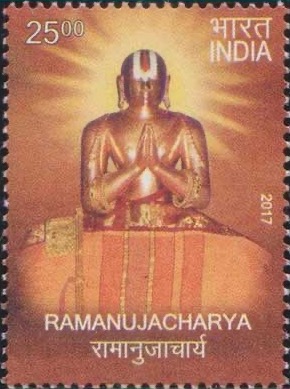
Ramanujacharya (c. 1017–1137), another theologian and philosopher from South India, provided the robust intellectual foundation for the Bhakti movement through his doctrine of Vishishtadvaita (Qualified Non-dualism). He bridged the gap between complex Vedic philosophy and emotional devotion by arguing that the individual soul and the material world are distinct yet inseparable parts of the personal God, Vishnu, while revolutionary social reforms were integrated into his teachings by opening the path of spiritual surrender (prapatti) to all seekers regardless of their caste.
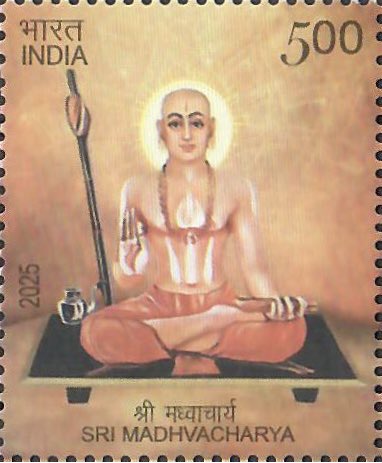
Madhvacharya (1238–1317), a philosopher and theologian from Karnataka, provided a rigorous intellectual framework for the Bhakti movement through his doctrine of Dvaita (Dualism), which asserts that the individual soul and the material world are eternally distinct from the supreme God, Vishnu. By establishing the Udupi Sri Krishna Matha temple and a network of monasteries, he formalised a structured system of devotion that prioritised the grace of God as the only path to liberation, directly inspiring the later Haridasa (“servant of Lord Hari”, Vishnu) movement and the works of poet-saints like Kanakadasa.
Nimbarkacharya (c. 11th–12th century), a medieval philosopher and theologian born in a Telugu Brahmin family from South India and who spent most of his life in Mathura, now in Uttar Pradesh, is the founding architect of the Dvaitadvaita (Dualistic Non-Dualism) school and a pioneer of the Krishna-centric Bhakti tradition. He bridged the gap between strict monism and dualism by teaching that the individual soul is simultaneously one with and distinct from the Divine, a philosophy he articulated in major works like the Vedanta Parijata Saurabha. By popularising the joint worship of Radha and Krishna, he shifted the focus of devotion toward the concept of “natural” divine love, providing a theological framework that deeply influenced the later development of the Kumara Sampradaya.
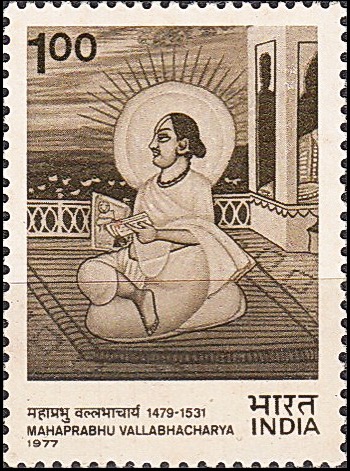
Vallabhacharya (c. 1479–1531), another preeminent philosopher and theologian born to a Telugu Brahmin family in Champaran, is the visionary founder of the Shuddhadvaita (Pure Non-Dualism) school and the devotional path known as Pushtimarg (The Path of Grace). By emphasising total surrender to the grace of Srinathji (Lord Krishna) and popularising a life of joyful service (seva), he profoundly shaped the devotional landscape of North and Western India, fostering a rich cultural legacy of music and poetry through the Ashtachap (eight poet-disciples).
3. Spread to other regions
The Bhakti movement evolved through distinct regional waves, each adapting the core philosophy of personal devotion to local cultural and social contexts.
Karnataka
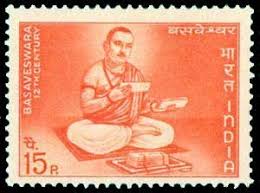
Basaveswara, also Basavanna (1131–1167), a philosopher, statesman and social reformer from Karnataka, founded the Lingayat faith and championed the idea of a classless society through his spiritual assembly, the Anubhava Mantapa (the Hall of Experience). He pioneered the vachana (extant rhythmic prose-poems) literature style, using simple poetry to spread messages of gender equality and the dignity of labour, encapsulated in his philosophy “work is worship.”
Literary works: A collection of approximately 1,400 vachanas written in Kannada, typically featuring his mudra (signature phrase), ‘Koodala Sangama Deva‘. His philosophical dialogues and the collective wisdom of his contemporaries are also preserved in the records of the Anubhava Mantapa, a spiritual and democratic academy he founded for radical social and philosophical discourse.
Akka Mahadevi (c. 1130–1160), a Kannada poet-saint and a prominent figure in the Virashaiva movement of Karnataka, is celebrated for her profound vachanas that express her intense and mystical devotion to Lord Shiva, whom she addressed as Chennamallikarjuna. Her life and poetry represented a radical challenge to the patriarchal and social norms of her time, as she renounced worldly possessions and societal expectations to seek direct spiritual union, making her an enduring icon of women empowerment and the Bhakti tradition.
Literary works: A collection of approximately 430 vachanas composed in Kannada, featuring her mudra, ‘Chennamallikarjuna‘. She is also credited with the Yoganga Trividhi, a poetic work focussed on the stages of spiritual evolution and the soul’s union with the divine.
Allama Prabhu (12th century), a profound Kannada poet-saint and mystic, served as the spiritual master and president of the Anubhava Mantapa within the Virashaiva movement of Karnataka. His vachanas are distinguished by their cryptic and metaphorical language, known as Bedagu (literally meaning charm, grace), which challenged intellectual pride and emphasised the pursuit of the ultimate truth and union with Lord Guheshwara through internal self-realisation rather than outward ritual.
Literary works: A collection of approximately 1,300 vachanas written in Kannada, known for their deep mystical and philosophical complexity, featuring his mudra, ‘Guheshwara‘. His contributions and spiritual dialogues are also central to the records of the Anubhava Mantapa.
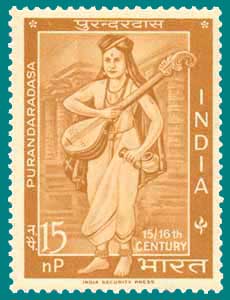
Purandaradasa (c. 1484–1564), a wealthy merchant-turned-ascetic from Karnataka, is revered as the “pitamaha” (grandfather) of Carnatic music of South India and a luminary of the Haridasa movement. He translated the profound tenets of Dvaita philosophy into simple, soulful Kannada kirtanas, focussing on intense devotion to Lord Vitthala of Pandharpur. By standardising the foundational exercises of South Indian classical music and preaching social equality through his songs, he democratised spiritual knowledge and established a musical legacy that remains the cornerstone of Indian classical tradition today.
Literary works: A prolific collection of an estimated 475,000 kirtanas, of which approximately 1,000 are extant, featuring his mudra, Purandara Vittala. His verses, which form the core of Dasa Sahitya, were preserved through oral and musical traditions. By integrating spiritual teaching with his systematised musical exercises, his compositions served as a vehicle for social reform.
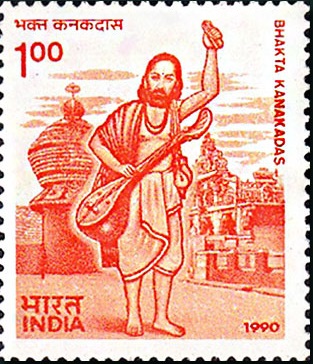
Kanakadasa (1509–1609), a renowned poet-saint, philosopher, musician and social reformer from Karnataka, is celebrated as another most influential figure of the Haridasa movement, which used devotional literature to promote social equality and spiritual growth. By integrating profound philosophical truths with relatable imagery, his compositions served as a powerful vehicle for social reform and spiritual democracy.
Literary works: A collection of approximately 240 extant kirtanas, including five major poetic works like Mohanatarangini and Ramadhanyacharite, featuring his mudra, Kagineleya Adikeshava. His verses, central to Dasa Sahitya, used simple Kannada and allegorical metaphors to advocate for an egalitarian society.
Maharashtra
Pundalik, also Pundarik (c. 7th–9th century), a spiritual pioneer and foundational devotee from Maharashtra, is celebrated as the historical founder of the Vaarkari movement, centred on the deity Vitthala. He is credited with establishing the initial site of worship at Pandharpur and defining the movement’s early focus on personal devotion (bhakti) over ritualistic orthodoxy. While he did not leave behind a body of Marathi poetry like the later poet-saints, he is renowned for establishing the spiritual groundwork that identifies Vitthala/Vithoba with the supreme divine, effectively bridging the gap between local folk traditions and the broader Bhakti movement of India.
Note: The term Vaarkari literally means “one who performs the Vari“, a periodic, recurring pilgrimage to the temple of Vitthala in Pandharpur.
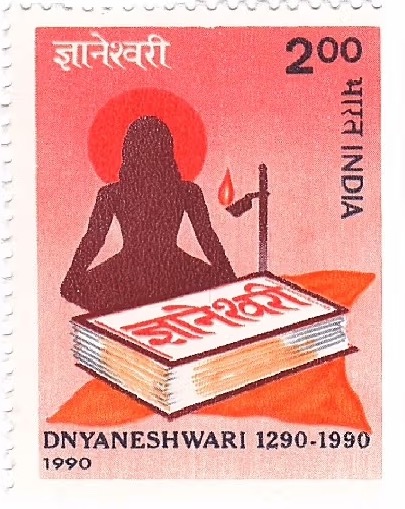
Dnyaneshwar, also Jnaneshwar (1275–1296), a philosopher, poet-saint and yogi from Maharashtra, is celebrated as the architect of the Vaarkari movement. A pioneer of Marathi literature, he is most renowned for Dnyaneshwari, a profound Marathi commentary on the Bhagavad Gita that brought spiritual knowledge to the common masses, and Amritanubhav, which remains a cornerstone of Indian non-dualist philosophy.
Literary works: Author of the monumental Dnyaneshwari (or Bhavartha Deepika), a 9,000-verse commentary on the Bhagavad Gita that translated Sanskrit wisdom into the Marathi language for the common people. His other seminal works include the philosophical treatise Amrutanubhav, the Changdev Pasashti, and the Haripath, a collection of 28 abhangas (devotional hymns) central to Vaarkari worship.
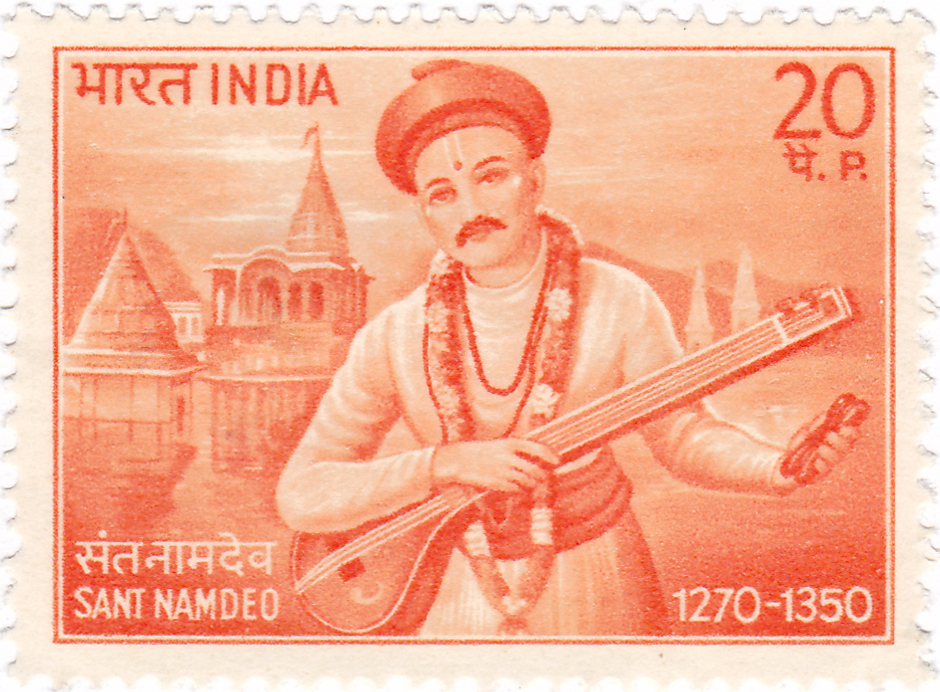
Namdeo, also Namdev (c. 1270–1350), another Marathi poet-saint and a key figure in the Vaarkari tradition, is revered for his intense devotion to Lord Vithoba (Vitthala) and his role in spreading the Bhakti movement to North India. He composed numerous abhangas in Marathi and is uniquely honoured in the Sikh tradition, with over sixty of his spiritual compositions included in the Guru Granth Sahib.
Literary works: A prolific composer of over 2,500 abhangas (devotional hymns) integrated into the Namdeo Gatha, featuring his mudra (signature phrase) ‘Nama’. By writing in a mix of Braj and Punjabi in addition to Marathi, his compositions bridged the cultural and linguistic gap between the South and North India, establishing a foundational ethic of equality across social boundaries.
Chokhamela (14th century), a Marathi poet-saint and a seminal figure in the Vaarkari tradition, is revered for his heartfelt abhangas that express an unwavering love for Lord Vitthala despite the severe social exclusion he faced. As one of India’s earliest dalit (oppressed class) poets, his work profoundly critiques the hypocrisy of the caste system by emphasising that spiritual purity is a matter of the heart rather than birth, and his legacy is immortalised by his memorial (samadhi) situated at the very entrance of the Vitthala temple in Pandharpur.
Literary works: A collection of numerous abhangas featuring his mudra ‘Chokha Nama’, which articulate the struggles of the “untouchable” community and the yearning for spiritual belonging. His verses, unique in Marathi literature, offer a raw, personal perspective on the conflict between his low social status and his high spiritual realisation within the Vaarkari tradition.
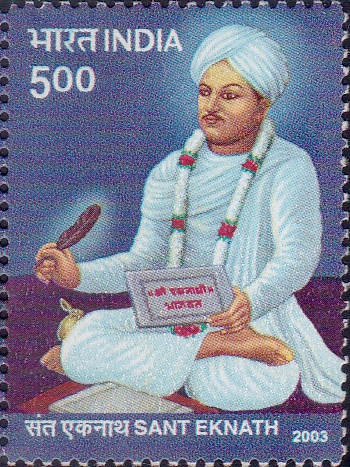
Eknath (1533–1599), another vital link in the Vaarkari tradition of Maharashtra, is celebrated for his monumental work, the Eknathi Bhagavat, and his numerous bharuds (allegorical folk songs) that simplified complex spiritual messages for the benefit of the common people. He lived as a “householder saint,” exemplifying the integration of worldly duties with deep devotion, and famously challenged social barriers by advocating for the spiritual equality of all individuals, including the marginalised, through both his writings and his compassionate actions.
Literary works: A prolific author known for the Eknathi Bhagavat, a Marathi commentary on the 11th skanda (section) of the Bhagavata Purana, and his version of the Ramayana titled Bhavartha Ramayana. He is also credited with restoring and editing the first definitive version of Dnyaneshwar’s Dnyaneshwari. Beyond scholarly texts, he pioneered the Bharud—secular, dramatic poems using everyday metaphors to teach spiritual lessons—and composed numerous abhangas featuring his mudra, ‘Eka-Janardana’.
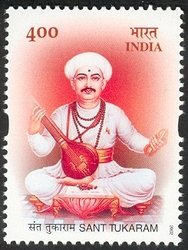
Tukaram (1608–1649) considered the spiritual pillar of the Vaarkari tradition, is celebrated for his thousands of abhangas (devotional hymns) that express an intimate and personal relationship with Lord Vitthala. His profound poetry, which emphasised simple devotion and inner purity over ritualism and caste hierarchies, remains a cornerstone of Maharashtrian culture and a powerful voice for social equality within the Bhakti movement.
Literary works: Author of the Tukaram Gatha, a seminal collection of over 4,500 abhangas featuring his mudra, ‘Tuka-Mane.’ By using the Ovi and Abhanga meters to express the raw emotional landscape of a householder seeking the divine, his literature democratised spiritual attainment and established him as the most recited poet-saint in the Vaarkari tradition.
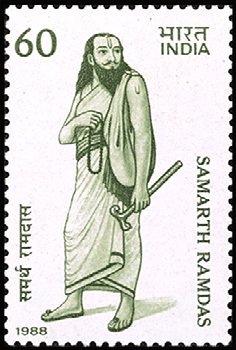
Samarth Ramdas (1608–1681), a poet-saint, philosopher and spiritual advisor from Maharashtra, is celebrated for his monumental work, the Dasbodh, on leadership principles, and his popular verses, the Manache Shlok on meditative techniques. He uniquely combined intense devotion to Lord Rama with a call for social awakening and physical fitness, establishing a network of Hanuman temples and monasteries across India to inspire a sense of duty, strength and spiritual discipline among the common people.
Literary works: Beyond his primary texts, he authored the philosophical treatise Atmaram and composed numerous aartis, most notably the ubiquitous Ganpati aarti “Sukhakarta Dukhaharta,” which often bears his mudra (signature phrase) ‘Ramdasa’. His writing is distinctive for its use of the Ovi meter to blend the Bhakti and Shakti traditions, emphasising “strength of character” alongside spiritual discipline.
Odisha/Bengal
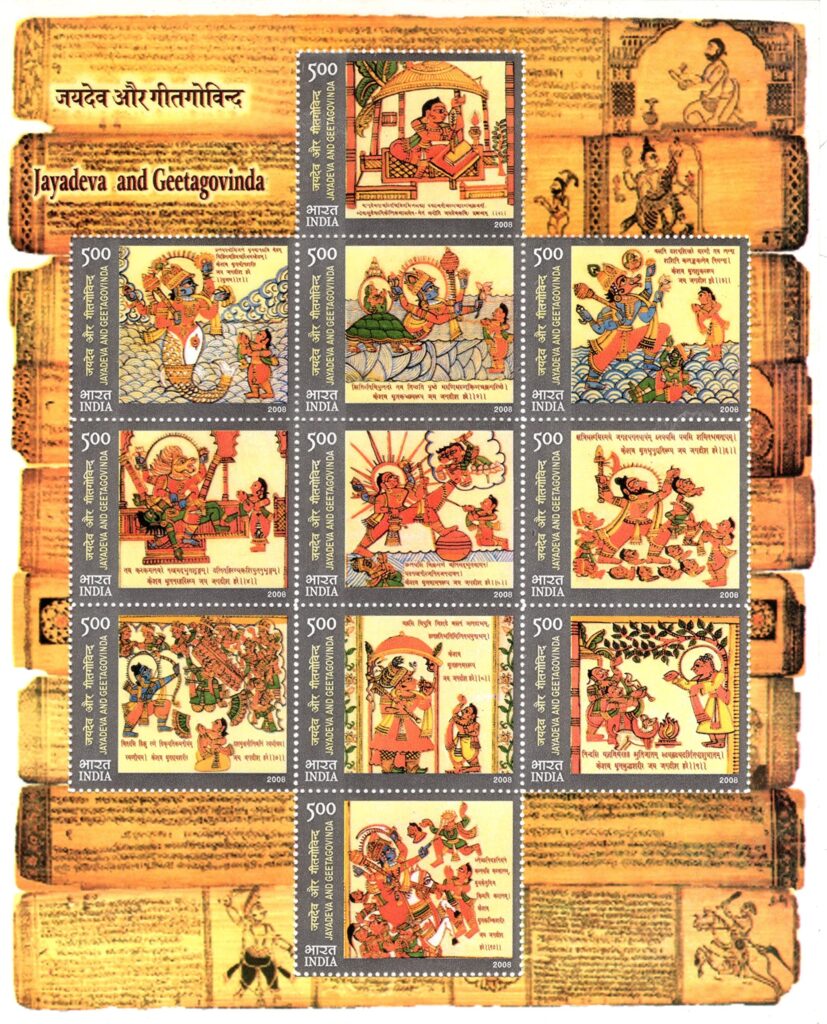
Jayadeva (c. 1170–1245) was a celebrated Sanskrit poet and saint who served in the court of King Lakshmana Sena of Bengal. He is most famous for composing the Gita Govinda (also Geeta Govinda), a lyrical epic depicting the divine love between Radha and Krishna that established her as the supreme devotee and laid the foundation for the later Bhakti movement, particularly Gaudiya Vaishnavism. His work has profoundly influenced Indian culture, forming the basis for Odissi music and dance while also impacting Bharatanatyam and Carnatic music. Jayadeva’s spiritual importance is further highlighted by the inclusion of his hymns in the Guru Granth Sahib, the primary scripture of Sikhism.
Literary works: Renowned for the unique structure of his twenty-four ashtapadis (eight-stanza songs) of Gita Govinda, his poetry blends high Sanskrit classicism with the rhythmic, melodic sensibilities of folk traditions. By providing a highly emotive and sensory framework for spiritual experience, his compositions became central to the theological evolution of various Krishna-centred movements across the Indian subcontinent.
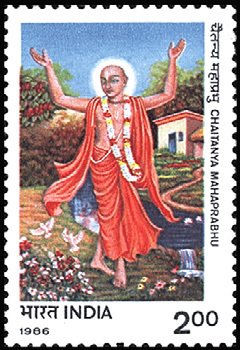
Chaitanya Mahaprabhu (1486–1534) was the chief proponent of the Gaudiya Vaishnavism tradition, which emphasises intense devotion to Radha and Krishna. He revolutionised the Bhakti movement by popularising sankirtana, the congregational chanting of the “Hare Krishna” mantra, as the primary means of achieving spiritual liberation. By prioritising emotional experience over formal writing, he fostered a literary tradition that shifted from complex dialectics to accessible, heart-centred poetry and biography.
Literary works: While he left behind only the Shikshashtakam—eight Sanskrit verses outlining the core philosophy of devotion—his teachings inspired a vast body of literature by his followers, the Six Goswamis of Vrindavan. These works, such as the Chaitanya Charitamrita and Chaitanya Bhagavata, codified his theological concepts like Achintya Bheda Abheda (inconceivable oneness and difference).
Assam
Sankaradeva (c. 1449–1568), a polymathic saint-scholar and cultural architect from Assam, is the towering founder of the Ekasarana Dharma (Refuge in One God) and the pivotal figure of the Neo-Vaishnavite movement in Northeast India. He revolutionised the spiritual landscape by advocating for the exclusive worship of Lord Krishna (as Vishnu) through the path of sravana-kirtana (hearing and chanting), a philosophy he simplified for the masses in his celebrated poetic works like the Kirtan Ghosha and the Bhagavata. By establishing the Namghar (community prayer hall) and the Sattra (monastic centre) as egalitarian spaces that transcended caste barriers, he created a unique socio-religious framework that integrated music, dance and drama to foster a deeply inclusive devotional culture that remains the heartbeat of Assamese identity.
Literary works: Beyond his foundational hymns, he pioneered the Ankia Naat (one-act plays) written in the artificial literary language Brajavali, which synthesised Assamese, Maithili, and Braj to reach a broader audience. His diverse output also includes the Bhakti-ratnakara, a Sanskrit compilation of devotional philosophy, and numerous Borgeets (devotional songs) that established a unique classical musical tradition for the region.
Gujarat
Dadu Dayal (c. 1544–1603), an Ahmedabad-born mystic who settled in Rajasthan, was the founder of the Dadu Panth and a key leader of the Nirguna Bhakti movement. He advocated for a “Middle Path” (Nipakh), rejecting external rituals and sectarian divides in favour of a direct, internal experience of the formless Divine. His poetic teachings, preserved in the Dadu Anubhav Vani, promoted universal brotherhood and absolute social equality, leaving a legacy of communal harmony that continues through his monastic tradition in Naraina today.
Literary works: Beyond his primary collection, his disciples compiled the Panchvani, an influential anthology that integrated his verses with those of other major Nirguna saints like Kabir and Namdev. Written in Braj Bhasha with a heavy influence of Rajasthani, his couplets (sakhis) and hymns (padas) utilised simple, folk-oriented language to critique religious hypocrisy and intellectual pride.
Kashmir
Lal Ded (c. 1320–1392), a Kashmiri mystic and celebrated saint-poetess, is one of the most prominent spiritual icons of the Bhakti and Sufi traditions. Her profound mystical verses, known as vakhs, express an intense personal search for the divine — often identified as Lord Shiva — and remain a cornerstone of Kashmiri language, culture and literature.
Literary works: Her contributions are defined by the Lalleshwari Vakyani, a collection of short, four-line aphoristic verses that blend the tenets of Kashmir Shaivism with Sufi mysticism. These poems utilised the everyday vernacular of the common people and domestic metaphors—such as the spinning wheel or the unbaked earthen pot—to transform complex yogic practices and the philosophy of non-dualism into a practical, lived experience accessible to all social classes.
Andhra
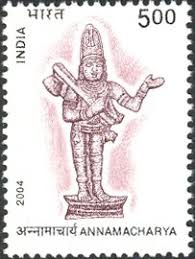
Annamacharya (c. 1408–1503), a legendary Telugu saint-composer from Tirupati, is revered as the Padakavita Pitamaha (Grandfather of Song-writing). He pioneered the sankirtana tradition in Telugu, composing 32,000 hymns in praise of Lord Venkateswara that blended deep Vedantic philosophy with emotional, personal devotion. Through songs like Brahmam Okkate, he rejected caste hierarchies and taught that divine grace is universal. By etching his work onto copper plates, he preserved a massive liturgical legacy that remains the spiritual heartbeat of the Tirumala temple in Andhra Pradesh today.
Literary works: While his 32,000 sankirtanas, divided into metaphysical (Adhyatma) and romantic (Sringara) hymns, are dedicated to Lord Venkateswara, other works include the Sringara Manjari (poetry), several shatakas, and the Sankirtana Lakshanam, a Sanskrit treatise on musical theory. His writing successfully merged complex Vedantic philosophy with Telugu folk traditions.
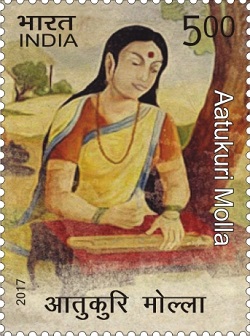
Atukuri Molla (c. 1440–1530), a pioneering Telugu poet-saint from a potter community, is the author of the Molla Ramayanam. She broke social and gender barriers by asserting that poetic talent is a divine gift rather than a result of formal Sanskrit education. By writing the Ramayana in a simple, lyrical Telugu style known as Janu Tenugu, she made the sacred epic accessible to the common masses. Her legacy stands as a powerful testament to the Bhakti ideal that pure devotion transcends both caste and gender.
Literary works: Molla Ramayanam, a work of approximately 870 verses, prioritised lyrical emotion over complex grammar. Known for its unique pacing, she condensed most of the epic while providing an expansive, detailed narrative of the Sundara Kanda. Despite lacking royal patronage and facing criticism from traditional scholars, her mastery of rhythm and accessible storytelling earned her the title Kavi Ratna and a permanent place in Telugu literature.
Bammera Potana (c. 1450–1510), a celebrated Telugu poet-saint from Bammera, is the revered author of the Andhra Maha Bhagavatam. He is distinguished by his profound spiritual integrity, famously refusing royal patronage to dedicate his masterpiece solely to Lord Rama. His primary contribution to the Bhakti movement was the lyrical adaptation of the Bhagavata Purana; by rendering its complex philosophy into accessible, melodic Telugu verse, he brought the stories of Lord Krishna’s divinity and the path of surrender (sharanagati) to the masses. His work remains the spiritual and literary heartbeat of the Telugu-speaking world today.
Literary works: Bhogini Dandakam, the earliest Telugu work in the dandakam meter (a rhythmic poetic form), and the Virabhadra Vijayamu, which highlights his early Shaivite influences. His masterpiece, the Andhra Maha Bhagavatam, is renowned for its musical alliteration and rhythmic flow, making complex philosophy accessible through song. By prioritising a sweet, melodic style over dense Sanskrit structures, he ensured that his verses could be easily memorised and recited by the common people.
Kancharla Gopanna (c. 1620–1688), popularly known as Bhakta Ramadasu, was a 17th-century Telugu saint-poet and a fervent devotee of Lord Rama from the Deccan region. He is most famous for constructing the Bhadrachalam Temple and his subsequent twelve-year imprisonment by the Sultan of Golconda for utilising state funds for this divine cause. He popularised Rama bhakti through his emotive sankirtanas and the Dasarathi Shatakam, a celebrated collection of 103 poems. By composing in a personal, conversational style (atmanivedana), he deeply influenced later composers like Tyagaraja and solidified the tradition of congregational chanting in South India.
Literary works: Dasarathi Shatakam, composed during his imprisonment, and Ramadasu Keertanalu, which allowed for raw emotional intimacy between the devotee and Lord Rama. By utilising simple language and rhythmic patterns, he standardised the sankirtana structure, bridging the gap between classical music and congregational chanting for the masses.
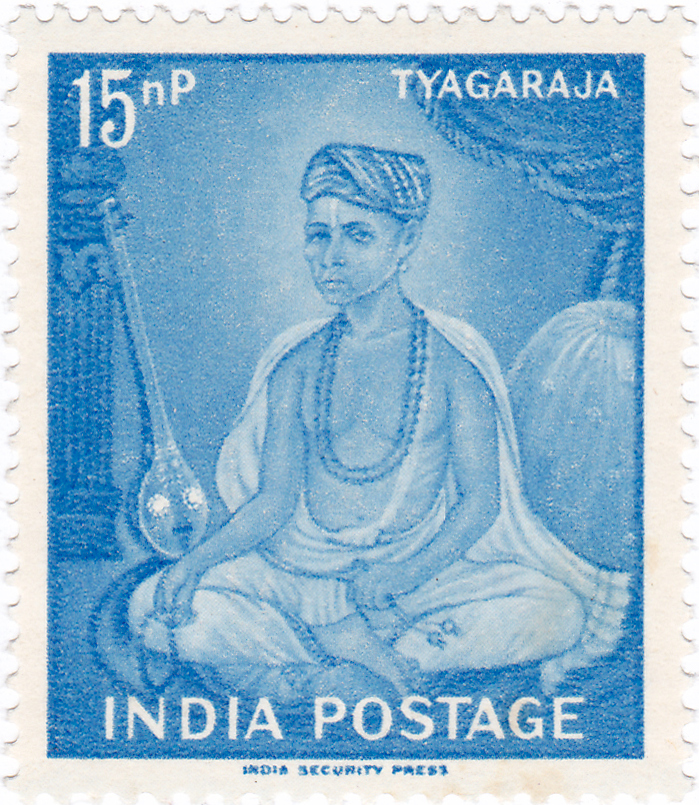
Tyagaraja (c. 1767–1847), a prolific saint-composer born to a Telugu family in Tiruvarur, is the satguru (true teacher) of Carnatic Music and a pivotal figure in the South Indian bhakti revival. He dedicated his life to nadopasana (worship through sound), viewing music not as entertainment but as a direct vehicle for God-realisation. By composing thousands of soulful songs on Lord Rama, he turned complex Vedantic philosophy into accessible melodic prayers. His rejection of royal wealth for a life of simple devotion and his masterpiece pancharatna kritis, established a spiritual-musical legacy that remains the cornerstone of Indian classical music today.
Literary works: Tyagaraja’s vast musical and literary legacy, primarily in Telugu and Sanskrit, is headlined by the Pancharatna Kritis, considered the pinnacle of Carnatic music. He also composed significant musical dramas, such as the Prahlada Bhakti Vijayam and Nauka Charitram. Through these works, he introduced structural innovations like the sangathi, successfully blending complex classical theory with accessible devotional chanting. In Telugu classical music (specifically Carnatic music), sangathi refers to a musical phrase or line of a composition—usually in a kriti—that is repeated multiple times with progressive melodic variations, embellishments or rhythmic changes.
4. The northward migration (13th – 17th Century CE)
The movement spread to North India primarily through the efforts of Ramananda, who is revered as the “bridge” between the South and the North. The arrival of Islam and the popularity of Sufism introduced ideas of monotheism and universal brotherhood, which blended with indigenous traditions to create the “Sant” tradition of Northern India.
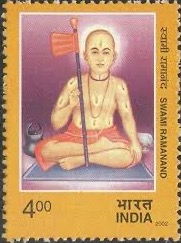
Ramananda (c. 1400–1470), a 14th-century pioneer of the Bhakti movement in North India, is celebrated for championing the use of vernacular Hindi to spread devotion to Lord Rama among the common people. His devotional poetry and hymns, most notably the Gyan-lila, emphasise personal devotion and the rejection of caste-based ritualism. He revolutionised social norms by accepting disciples from all walks of life — including Kabir Das and Ravidas.
Literary works: Beyond the Gyan-lila, Ramananda is credited with several influential works in both Hindi and Sanskrit. Notable among these are the Sanskrit treatises Vaishnava Matabja Bhaskara and the Ramarchana Paddhati, which outline the philosophical and ritualistic foundations of his sect, the Ramanandi Sampradaya. One of his hymns is preserved in the Guru Granth Sahib, where he expresses the Nirguna (formless) aspect of the divine.
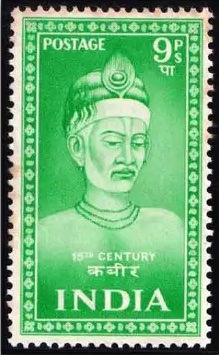
Kabir Das (1398–1448), a celebrated mystic poet and saint from Varanasi, played a pivotal role in the Bhakti movement by emphasising the oneness of God and the importance of inner spirituality over external rituals. His pithy couplets, known as dohas, continue to influence Indian culture and philosophy by criticising social hypocrisy and promoting harmony between different religious communities. He wrote in a language often described as Sadhukkari, a “seeker’s language” that blended various dialects like Braj, Awadhi and Punjabi, making his message of universal love and spiritual equality accessible to the common masses regardless of their literacy or social standing.
Literary works: Kabir’s vast body of work is primarily preserved through three major traditions: the Kabir Bijak, the Kabir Granthavali, and the Adi Granth (Guru Granth Sahib). The Bijak, the most authoritative scripture for the Kabir Panth sect, is known for its revolutionary and often blunt critiques of religious orthodoxies. His writings are typically categorised into three forms: sakhis (rhyming couplets or dohas meant to impart “witness” to the truth), shabdas (short lyrics or hymns set to music), and Ramainis (longer verse compositions).
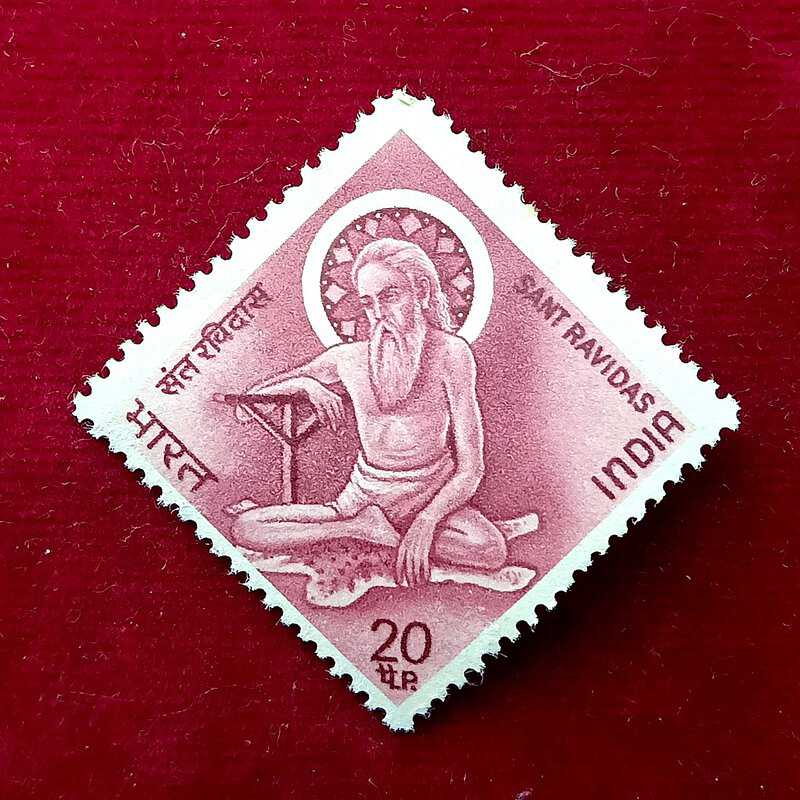
Ravidas (c. 1450–1520), another mystic poet-saint and social reformer from Varanasi, was a leading figure in the Bhakti movement who advocated for human rights and the abolition of the caste system. He is celebrated for his devotional hymns that reject social hierarchy and envision “Begampura”— a utopian city without sorrow or discrimination. His poetry often employs vivid metaphors, such as the famous comparison of God and the devotee to sandalwood and water, illustrating a deep, inseparable bond.
Literary works: Ravidas’s banis (devotional hymns) were composed in regional dialects like Braj Bhasha and Awadhi to reach the masses. The Guru Granth Sahib contains 41 of his hymns, making him one of the most prominent non-Sikh contributors to the scripture. His verses are also widely found in the Panchvani text of the Dadu Panthi tradition. Beyond his social critiques, his work explores the philosophical concept of Sahaj — a state of natural, mystical union with the divine — and emphasises the Nirguna (formless) devotion.

Guru Nanak (1469–1539), the founder of Sikhism and a profound spiritual visionary from the Punjab region, is revered as a poet-saint who preached the oneness of God (Ik Onkar) and the fundamental equality of all humanity. The hymns he composed, known as shabads, form the spiritual core of the Guru Granth Sahib, the living, eternal word of the Gurus and the ultimate spiritual authority for Sikhs. He rejected caste distinctions and ritualism, establishing the revolutionary practice of langar (community kitchen). His literature is unique for its emphasis on “truthful living” and active service to humanity as the highest form of spiritual practice.
Literary works: Among the 974 shabads of Nanak forming a part of the Guru Granth Sahib, his most celebrated composition is the Japji Sahib, a profound philosophical poem that serves as the opening of the Sikh scripture and outlines the essential principles of Sikhism. Writing primarily in Sant Bhasha, which incorporated elements of Punjabi, Persian and Hindi, he also composed the Asa di Vaar (‘A Ballad of Hope,’ a collection of 24 stanzas on spiritual awakening and transformation, also part of the Guru Granth Sahib) and the Siddh Gosht, a dialogue in verse form that records his theological debates with ascetic yogis.
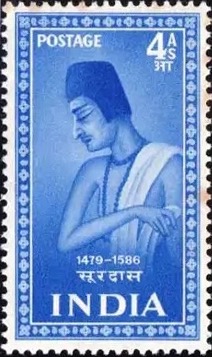
Surdas (c. 1478–1581), a legendary blind poet-saint and musician from the Braj region, is celebrated as one of the most prominent devotees of Lord Krishna within the Bhakti movement. He is best known for his magnum opus, the Sur Sagar, which features thousands of evocative compositions that beautifully capture the childhood of Krishna and his divine pastimes, profoundly influencing Hindi literature and North Indian devotional music. His verses are meticulously composed to follow classical Indian ragas (melodic frameworks), ensuring that they function as both high literature and devotional music that continues to define the bhajan tradition (singing of spiritual, religious songs that are often part of a larger, collective worship experience) of North India today.
Literary works: Beyond the Sur Sagar, Surdas is credited with the Sur Saravali, which serves as an allegorical summary of the creation and the deeds of Krishna, and the Sahitya Lahari, a collection of verses that showcases his mastery of poetic ornaments and complex imagery. Unlike the Nirguna (formless) poets, Surdas popularised the Vatsalya-bhava style — a form of devotion that focusses on the “parental love” for the child Krishna. His writing is synonymous with the Braj Bhasha dialect, which he elevated from a folk tongue to a sophisticated literary language.
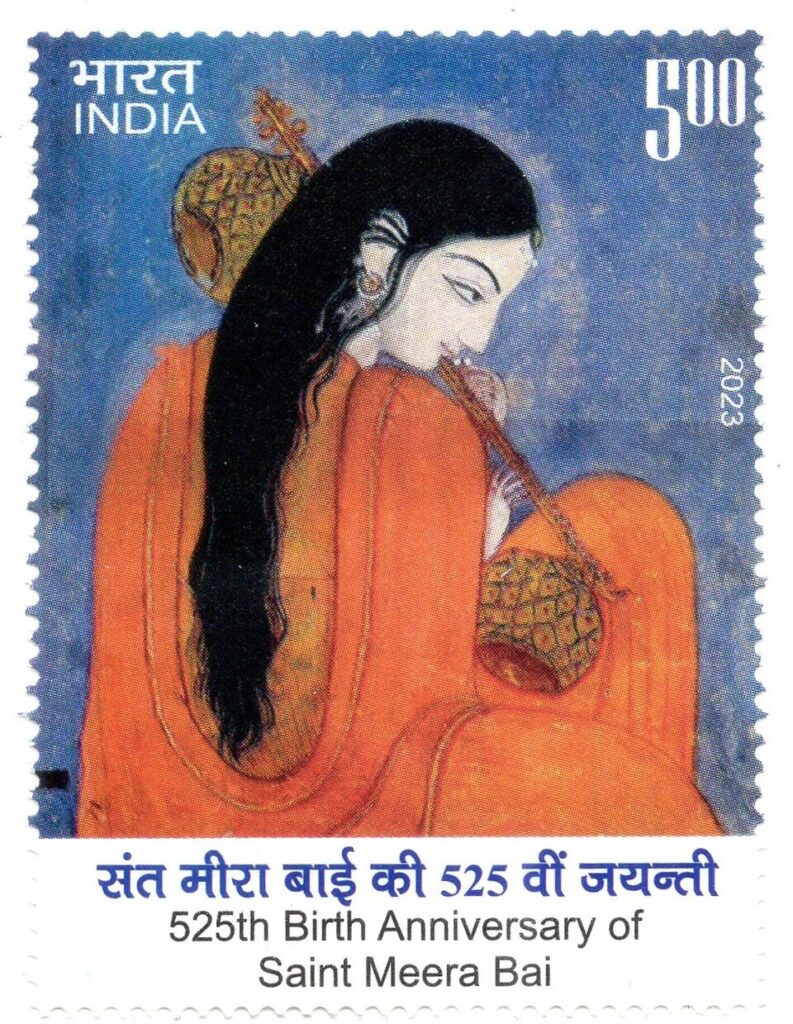
Meera Bai (1498–1547), a Rajput princess and celebrated devotee of Lord Krishna from Rajasthan, is one of the most prominent women icons of the Bhakti movement. Her soulful devotional padas and bhajans express an intense personal bond with the divine in the form of Lord Krishna and remain a cornerstone of Indian spiritual music and literature. Her writing style is a unique linguistic blend of Rajasthani, Braj Bhasha and Gujarati, reflecting the different regions of her life’s journey. Famous compositions like “Mere To Giridhar Gopal” bridged the gap between classical music and folk traditions, emphasising a path to the divine through total, uninhibited surrender.
Literary works: Meera Bai’s literary legacy is primarily anchored in thousands of padas (short lyric poems) that were passed down orally for generations before being compiled into various padavalis. Centred on the philosophical concept of Madhurya Bhava (devotion as a lover), her poetry portrays a radical defiance of societal norms, as she famously envisioned herself as the “bride of Krishna.” Her work is particularly celebrated for its focus on Viraha—the spiritual agony of separation from the beloved—and remains highly influential for its raw emotional vulnerability.
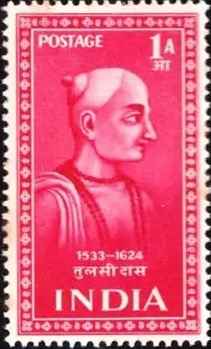
Tulsidas (1532–1623), a poet-saint and philosopher from the present-day Chitrakoot in Uttar Pradesh, is celebrated for his monumental work, the Ramcharitmanas, which retold the life of Lord Rama in the common Awadhi language. A pivotal figure in the Bhakti movement, his prolific literary contributions — including the widely recited Hanuman Chalisa — established him as one of the greatest poets in Hindi literature. His use of diverse poetic structures—ranging from the doha (couplet) and the chaupai (quatrain) to the Savaiya (4 lines based on syllables)—not only standardised Hindi grammar but also bridged the gap between complex Sanskrit theology and the devotional needs of the common person.
Literary works: While famously associated with Awadhi, Tulsidas was a versatile master who also wrote extensively in Braj Bhasha, most notably in the Kavitavali and Vinaya Patrika. The Vinaya Patrika is particularly significant as a deeply personal “petition of humility” to Lord Rama, showcasing a more intimate, soulful side of his devotion compared to the epic narrative of the Ramcharitmanas. He is also credited with the Dohavali, a collection of hundreds of couplets on ethics and devotion, and the Gitanavali, which adapts the story of Rama into musical songs.
Abdul Rahim Khan-i-Khanan, also Rahim, (1556–1627), a polyglot scholar, statesman and illustrious military commander of the Mughal court, is a celebrated poet-saint who uniquely harmonised Islamic mysticism with the Bhakti tradition as a profound exponent of Krishna Bhakti, viewing the Divine through a lens of deep personal humility and universal human ethics. He articulated his spiritual insights in the Braj Bhasha and Awadhi dialects through his renowned dohas, compiled in works like the Rahim Dohavali, Satsai, and the Sanskrit-influenced Madnashtak. By blending secular wisdom with spiritual yearning, he served as a vital cultural bridge, proving that the essence of devotion and the search for Truth transcend religious orthodoxy and social status.
Literary works: Beyond his devotional couplets, Rahim’s intellectual range extended into the realms of translation and technical scholarship. He is credited with popularising the Barvai meter in Hindi poetry—a short, rhythmic form he used masterfully in his work Barvai Nayika Bhed to explore human aesthetics and emotions. Much of this secular literature focuses on niti (practical ethics), offering timeless, pragmatic advice on friendship, social conduct and the transience of worldly power.
The Bhakti movement revolutionised medieval Indian society by promoting social equality, directly challenging the rigid caste system, and rejecting complex rituals in favour of personal devotion. It empowered lower castes and women, championed the use of regional, vernacular languages for spiritual expression, and fostered harmony between Hindus and Muslims.
What led to the Bhakti movement
The Bhakti movement emerged as a transformative socio-religious wave that redefined Indian spirituality between the 7th and 17th centuries. Its rise and spread were driven by a combination of internal religious dissatisfaction and external cultural influences.
Factors for the rise of the movement
Reaction to Orthodoxy: The movement was a direct response to the rigid caste hierarchy and the complex, expensive rituals dominated by the priestly class. Common people sought a simpler, more emotional path to salvation.
Decline of Rival Faiths: As Buddhism and Jainism became more ritualistic or lost royal patronage, a spiritual vacuum was created. The Bhakti movement filled this gap by offering a personal and accessible alternative within Hinduism.
Need for Personal Connection: There was a growing desire for an intimate “I-Thou” relationship with the divine, moving away from abstract Vedantic philosophies and toward the worship of personal deities like Shiva, Vishnu, Rama and Krishna.
Socio-Political Solace: In North India, political instability and invasions led many to seek comfort in a more internal and resilient form of worship that didn’t depend on large temples or state-sponsored rituals.
Factors that helped the spread
Vernacular Revolution: Instead of Sanskrit (the language of the elite), Bhakti saints composed their hymns in local/regional languages. This made spiritual knowledge instantly accessible to the masses.
Radical Inclusivity: By accepting disciples from all walks of life — including lower castes, artisans and women — the movement gained a massive, diverse following that standard orthodoxy could not reach.
Influence of Sufism: The arrival of Sufi mystics, who preached similar ideals of universal brotherhood, monotheism and divine love, created a syncretic environment. This interaction influenced “Nirguna” (formless) saints like Kabir and Guru Nanak.
Missionary Zeal of Saints: Many Bhakti leaders were nomadic. They travelled from village to village, using music (kirtans), dance and poetry to spread their message of equality and devotion directly to the common people.
Philosophical Foundations: Scholars like Ramanujacharya and Madhvacharya provided the intellectual justification for devotion, helping it gain acceptance even among traditional circles by bridging the gap between philosophy and emotion.
Sanction from scriptures
The Bhakti movement sought legitimacy by rooting its core tenets in existing sacred texts, reinterpreting them to emphasise personal devotion over ritualism. Key methods of scriptural sanction included:
- The Bhagavad Gita: Proponents emphasised the “Bhakti Yoga” (devotion) chapter, arguing that the Gita places devotional surrender (prapatti) as the highest path to salvation, superior to, or at least equal to, jnana (knowledge) and karma (action).
- The Bhagavata Purana: This text served as a primary source, advocating for Navavidha Bhakti (nine forms of devotion) and placing intense emotional love (prema) for a personal God (Vishnu/Krishna) above strict adherence to Vedic rituals.
- The Upanishads: Philosophers like Ramanujacharya reinterpreted Upanishadic texts to support Saguna Brahman (a personal God with attributes) rather than a strictly impersonal Nirguna Brahman. The Shvetashvatara Upanishad was frequently cited to support devotion to a supreme deity.
- The Prasthanatrayi: Medieval saints reinterpreted the Upanishads, Bhagavad Gita and Brahma Sutras to show that the ultimate goal of vedantic knowledge is absolute surrender and love for the Divine.
By rooting the focus on prapatti (self-surrender) and emotional love within these foundational texts, the Bhakti movement provided a strong scriptural basis for its challenge to orthodox ritualistic practices.
Social and cultural impact of Bhakti movement
Social Equality and Anti-Caste Movement: Bhakti saints, such as Kabir, Ravidas and Tukaram, rejected caste distinctions and birth-based discrimination, fostering a more inclusive society. The movement encouraged the inclusion of marginalised communities in spiritual life.
Empowerment of Women: Women were given a prominent space in the movement, with figures like Meera Bai, Andal, and Akka Mahadevi gaining recognition as revered saints.
Language and Literature: By rejecting Sanskrit in favour of regional vernaculars, the movement made religious texts accessible to the common people, leading to a boom in regional literature.
Religious Harmony and Syncretism: Saints like Kabir and Guru Nanak emphasised unity between Hindus and Muslims, condemning religious fanaticism and encouraging tolerance. This led to the creation of shared spaces, such as the langar (community kitchen) introduced by Guru Nanak, which promoted equality by having people of all backgrounds eat together.
Simplification of Religion: The movement moved away from elaborate ritualism and priestly, elite-dominated worship, emphasising a direct, personal and emotional bond between the devotee and a personal God.
Cultural Fusion: The movement helped create a composite Indian culture that blended devotional practices with artistic expressions like bhajans and kirtans.
Unique features of Bhakti tradition
Sant Bhasha
Sant Bhasha, or the “Language of the Saints,” was a hybrid literary dialect used by medieval Bhakti poets to transcend regional boundaries. It was not a formal language but a blend of Old Hindi, Punjabi, Rajasthani and Persian. This lingua franca allowed spiritual ideas to travel easily across Northern and Central India, ensuring that the message of social equality and devotion could be understood by the common masses, regardless of their mother tongue.
The most famous practitioners of Sant Bhasha include Kabir, Guru Nanak Dev, Ravidas and Namdev. While Namdev was native to Maharashtra and wrote primarily in Marathi, he used Sant Bhasha during his twenty-year stay in Punjab to reach a broader audience. These compositions were so influential that they were later preserved in the Guru Granth Sahib, making Sant Bhasha the primary vehicle for the “bani” or sacred utterances of the North Indian Bhakti movement.
Spiritual kinship
The relationships between Bhakti poets were primarily defined by spiritual kinship and a shared commitment to social equality, often prioritising these bonds over traditional caste or biological ties. These poets formed an “alternative family” or community of devotees, frequently recognising each other as spiritual peers. This sense of connection allowed figures from vastly different backgrounds — such as the cobbler Ravidas, the weaver Kabir, and the Rajput princess Mirabai — to be viewed as equals united by divine love. In many cases, these poets even used familial titles for one another, such as Akka Mahadevi, whose title “Akka” (elder sister) was granted by her spiritual contemporaries Basaveswara and Allama Prabhu.
Mentor-disciple bond
A foundational structure for these relationships was the Guru-Shishya (mentor-disciple) bond, which served as a major vehicle for spreading Bhakti philosophy across social boundaries. The 15th-century saint Ramananda is famously credited with a diverse group of disciples that included Kabir and Ravidas, effectively bridging Hindu and Muslim identities as well as various caste hierarchies. Similarly, Meera Bai is widely regarded as a disciple of Ravidas, showing how spiritual lineages could cut across royal and “untouchable” social classes. Other notable mentor-disciple pairs included Vallabhacharya and his blind disciple Surdas, as well as Janardanswami and his disciple Eknath.
Shared tradition
Furthermore, Bhakti poets maintained intellectual and philosophical connections through communal assemblies and literary dialogue. In the 12th century, Basaveswara established the Anubhava Mantapa (“Hall of Spiritual Experience”) in Karnataka, a democratic forum where poet-saints like Allama Prabhu, Chennabasavanna and Akka Mahadevi gathered to debate mystical experiences and social reform. Even across centuries and long distances, poets were linked by an “invisible thread” of shared tradition; for example, Guru Nanak and the subsequent Sikh Gurus preserved the verses of earlier saints like Namdev, Kabir, and the Sufi saint Baba Farid, in the Guru Granth Sahib, ensuring their spiritual relationship remained active for future generations.
Poetic forms and tropes of the Bhakti movement
Bhakti poets primarily employed vernacular and lyrical genres to bridge the gap between complex Sanskrit scriptures and the common people. By using everyday language and simple poetic structures, they transformed spiritual ideas into accessible, memorable verses often meant for singing and performance.
Core and regional poetic genres
Across India, the movement flourished through diverse forms that were often inseparable from local music and performance traditions:
- Doha (North India): Concise, rhyming couplets conveying philosophical or moral truths, famously mastered by Kabir.
- Pada (North India): Lyrical verses for passionate devotion; Mirabai’s padas to Krishna are iconic examples.
- Abhanga (Maharashtra): Rhythmic Marathi poetry with a continuous flow, used by Tukaram and Namdev.
- Vachana (Karnataka): Rhythmic prose-poetry or “sayings” used by Lingayat saints like Basaveswara to challenge rituals.
- Pasuram & Tevaram (Tamil Nadu): Formal devotional hymns of the Alvars and Nayanars, compiled in sacred canons like the Nalayira Divya Prabandham.
- Sankeertana & Padam (Telugu): Pioneer devotional songs and lyrical poetry. Annamacharya standardised the Sankeertana form for Lord Venkateswara, while Kshetrayya used the padam to blend romantic longing with spiritual devotion.
- Shatakam & Padyam (Telugu): A series of 100+ poems with a signature refrain; e.g., Ramadasu’s Dasarathi Satakam
- Vakh (Kashmir): Short, aphoristic “speech” verses used by the mystic Lal Ded for introspective devotion.
- Borgeet & Ankiya Naat (Assam): “Great songs” set to classical ragas and one-act devotional plays introduced bySankardeva.
- Padaavali & Mangal-Kavya (Bengal): Lyrical poems on divine love (Radha-Krishna) and long narrative poems celebrating local deities.
- Kirtan and Bhajan: Performative genres intended for congregational singing and group worship.
Essential literary tropes
Bhakti poets used specific bhavas (symbolic emotional frameworks) and metaphors to define the devotee’s relationship with the divine:
- Madhurya (Srungara) Bhava: The divine as a lover or bridegroom (e.g., Annamayya’s romantic songs or Andal).
- Vatsalya Bhava: The divine as a child (e.g., Surdas).
- Dasya Bhava: The devotee as a humble servant (e.g., Tulsidas or Ramadasu).
- Viraha Bhava: The agony of “longing in separation.”
- Ulatbansi (Upside-down Language): Paradoxical imagery used by Kabir (e.g., “a cow eating a tiger”) to show that spiritual truth defies worldly logic.
- Barahmasa: Describing the twelve months of the year to mirror the soul’s constant seasonal longing for God.
- Professional Metaphors: Using trades as spiritual symbols, such as the weaver’s loom (the body) or the potter’s clay (creation and surrender).
- Chhaap or Mudra: The “signature line” at the end of a poem (e.g., “Kahat Kabir” or “Tuka Mane”) acting as personal testimony.
- Ninda (Holy Critique): Using biting sarcasm or mockery to expose religious hypocrisy and ritualism.
- Nayika-Bheda: Casting the poet as a “heroine” (nayika) awaiting her divine “hero” (nayaka), often culminating in a metaphorical wedding representing death and union.
The legacy of Bhakti movement
The Bhakti movement was far more than a religious shift; it was a profound social revolution that continues to resonate in the fabric of contemporary society.
The movement laid the foundational stones for a more inclusive and democratic India. By challenging rigid caste hierarchies and religious orthodoxies—as seen in Kanakadasa’s defiance at Udupi and Kabir’s bridge between Islam and Hinduism — it championed social equality and secularism. The poet-saints democratised spirituality by using local languages and relatable metaphors, fostering a sense of national unity and shared cultural identity that transcended regional and class boundaries.
Today, the teachings of these saints remain deeply relevant as a guide for universal compassion and tolerance. Namdeo’s interaction with the hungry dog serves as a timeless reminder that divinity exists in every living being, promoting environmental and animal ethics. In an era often divided by ideology, the Bhakti movement’s emphasis on “Kanakana Kindi” — the idea that the divine is accessible to all regardless of status — continues to inspire modern movements for human rights and social justice.
The best of Bhakti literature
Alvars:
The Nalayira Divya Prabandham is a collection of 4,000 Tamil hymns (pasurams) composed by the 12 Alvars (Vaishnava poet-saints) between the 6th and 9th centuries, and compiled by Nathamuni in the 10th century. Here are some excerpts of Tamil hymns translated into English:
Andal
"Dawn is breaking.
The birds are chirping loudly announcing the rise of the sun.
Oh girl with eyes shaped like a honey bee!
What are you doing in bed?
Do you want to secretly dream of Krishna all by yourself?
Get up quickly and come with us to bathe!"
(Tiruppavai – 487)
----------------------------------------------------------------------------------
"My friend! I dreamt that Narayana is leading a thousand caparisoned
elephants to wed me. The entire village is decked up with colourful flowers
and people are holding golden pitchers filled with holy waters to welcome the Lord."
(Vaaranam Aayiram – 556)
----------------------------------------------------------------------------------
“O rain clouds
seeming like dark clay outside
liquid wax within,
rain down upon Venkatam
where the handsome lord dwells.
Help me to find within me
my beloved.
When he folds me in close embrace
melts my heart.
Then rain down upon us.”
(Translation by Vidya Dehejia)

Kulasekara Alvar
"I aspire not to watch the song & dance of Urvashi and Menaka.
All that I want is to meditate in the hill of Venkata where bees buzz loudly drunk with honey."
(Perumal Thirumozhi – 682)
----------------------------------------------------------------------------------
"May I be born as a door step in your temple that your devotees step over,
so that I can see your beautiful lips for ever."
(Perumal Thirumozhi – 685)
----------------------------------------------------------------------------------
"Peerless in the clan of Manu!
Both Kausalya and Sumithra who smell like honey, are broken hearted.
Taken in by the misleading words of the hunchback Manthara,
Kaikeyi banished you to the forest and you heeded her command."
(Perumal Thirumozhi – 739)

Tirumangai Alvar
"Oh mind, dwell on Tiruvenkadam!
The Lord who felled the Maruda trees,
who wields the mighty discus (chakra),
whose lotus-like feet are venerated by the devas
and who lifted the Govardhana mountain...
resides in Tiruvenkadam."
(Periya Thirumozhi – 1020)

Nammalvar
"By becoming servants of the Lord,
we have verily become,
as it were,
His sacred sandals."
(Tiruvantati-31)
----------------------------------------------------------------------------------
"Emancipated souls, though finite and small,
dwell in God and God is their food, wealth, mind,
wisdom, bliss and everything."
(Thiruvaimozhi)
----------------------------------------------------------------------------------
"Evening has come,
but not the Dark One.
the bulls,
their bells jingling,
have mated with the cows
and the cows are frisky.
The flutes play cruel songs,
bees flutter in their bright
white jasmine
and the blue-black lily.
The sea leaps into the sky
and cries aloud.
Without him here,
what shall I say?
how shall I survive?"
(Translation by A K Ramanujan)
Nayanars
The Tirumurai is a collection of twelve volumes of Tamil hymns composed by the 63 Nayanars (Shaiva poet-saints) between the 6th and 11th centuries, compiled by Nambiyandar Nambi in the 11th century. . Here are some excerpts of Tamil hymns translated into English:
Appar:
"Why chant the Vedas? Hear the Shastra's lore?
Why learn daily the books of right conduct?
Why know the six Vedangas again and again?
No release except to those who constantly meditate on the Lord."
----------------------------------------------------------------------------------
"To none are we subject! Death we do not fear!
We do not grieve in hell.
No tremblings know we, and no illnesses.
It's joy for us, joy day by day, for we are His.
Forever His, His; who does reign, our Sankara, in bliss."
(Translation by Zvelebil)
----------------------------------------------------------------------------------
"like the sweet-sounding Veena and cool night's moon,
like the gently breeze and the young spring
like a bee-humming lake
are my lord's twin feet's shadow."
----------------------------------------------------------------------------------
"Why bathe in Ganga's stream, or Kaviri?
Why go to Comorin in Kongu's land?
Why seek the waters of the sounding sea?
Release is theirs, and theirs alone, who call
In every place upon the Lord of all."
(Translation by F Kingsbury and G P Phillips)
Sundarar:
"Thou (Shiva) art half woman. Thyself
Ganga is in thy long hair,
Full well canst thou comprehend
Burden of woman so fair"
Sambandar:
"In the temple where he is throned, who bids us not lose heart
In the hour when our senses grow confused, the way grows dim,
Our wisdom fails, and mucus chokes our struggling breath,
In Tiruvaiyar, where the girls dance around, and the drumbeats sound,
The monkeys fear the rain, run up the trees, and scan the clouds."
----------------------------------------------------------------------------------
"The raging elephant charged down at Him;
O marvel! He but took and wore its hide;
Madman men think Him, but He is the Lord
Who in great Bramāpuram doth abide."
(Translation by F Kingsbury and G P Phillips)
Manikkavachakar:
"Let us place our trust in the time immemorial
repute of the magnificent One
of the Lord of Perunthurai
Whose nature is rare to be found in others and
Who coming in grace upon the victorious charger
and setting aside the faults of His devotees
but taking into account their good qualities only,
cherishes them and severs the clinging cords of their earthly ties.
Let us sing of the supreme bliss of Him to whom
we cling that our bonds of paasam may be severed.
Behold ! Ammaanaai!"
----------------------------------------------------------------------------------
"For Him Who is the Veda and the Sacrifice
For Him Who is the Real and the Unreal
For Him Who is the Effulgence and the Gloom
For Him Who is Affliction and Delight
For Him Who is the Half
For Him Who is the Whole
For Him Who is the Bond and the Release and
For Him Who is the First and the Last
Let us sing and pound for His bath the dust of gold."


Tiruvalluvar:
(English translation of select couplets from Tirukkural, his classic Tamil text)
Virtue & Character
On Compassion: "It is compassion, the most gracious of virtues, which moves the world".
On Righteousness: "Virtue is merely that which should be done, And vice is merely that which men avoid in life".
On Self-Control: "Keep the mind free of impurity. That alone is the practice of virtue. All else is nothing but empty display".
On Learning: "As the sand-well flows the more you dig, so the wise grow the more they learn".

Relationships & Conduct
On Good Speech: "To utter pleasant words with a brightly beaming smile, kindly light in loving eyes, and a sincere heart is a form of charity".
On Forbearance: "Even as the Earth bears with those who dig into her, To bear with those who revile us is the foremost of virtues".
On Gratitude: "It is impoverished poverty to be inhospitable to guests. It is stalwart strength to be patient with the foolish fools".
On Friendship: "Forsake not the friendship of those who have been your staff in adversity, Forget not the benevolence of the blameless".

Wisdom & Success
On Knowledge: "Those who have wisdom have all: Fools with all have nothing".
On Wealth: "Wealth doesn't last, so focus on actions and choices that do endure".
On Persistence: "Who aims at elephant, though dart should fail, has greater praise, Than he who woodland hare with winged arrow slays".

The Power of Actions
On Evil: "If people scrutinise their own faults as they do the faults of others, mankind will be freed of all evil".
On Good Deeds: "Let not a day pass without doing some good; for failing to do so is the boulder that will block your passage on the path to future benefits."
On Recompense: "To reprove a harm-doer, put him to shame by doing a good deed in return".
Auvaiyar:
(English translation of select compositions ranging from simple moral aphorisms for children to profound spiritual hymns)
"When doing good to a man, do not ask if he will return it.
Look at the tall-standing coconut palms:
They take water from the earth at their feet,
And return it as sweet nectar from their heads."
----------------------------------------------------------------------------------
"When the bund heightens, the water heightens;
When the water heightens, the paddy heightens;
When the paddy heightens, the citizens heighten;
When the citizens heighten, the sceptre (sengol, or rule of law) heightens;
When the sceptre heightens, the king heightens."
----------------------------------------------------------------------------------
"Rare is it to be born as a human;
Rarer still to be born without defects;
Even if born whole, rare is the acquisition of knowledge;
And rarest of all is the will to give and contemplate the Divine."
----------------------------------------------------------------------------------
"Sweet is solitude;
Sweeter is worshipping the Lord;
Sweeter still is the company of the wise;
But sweetest of all is to meet them in your dreams and then in reality."
Basaveswara:
(English translation of select vachana in Kannada in praise of personal deity Kudala Sangama, literally meaning Lord of the Meeting Rivers)
"I have a thought, it has another,
This way I pull, it pulls that way;
It grates and frets me too,
To toil and moil;
And when I long to meet Lord Kudala Sangama
It casts a darkness on my path
This Maya."
----------------------------------------------------------------------------------
"Upon the soil of piety
Sprouted Guru, the seed,
And Linga, the leaf, was born.
Then Thought came for the flower,
And Deed for tender fruit.
And knowledge for the ripened one,
And when the fruit of knowledge broke
Loose from the stalk and fell.
Look, Kudala Sangama,
Wanting it Himself Gathered it up."
----------------------------------------------------------------------------------
"Vyasa is a fisherman's son,
Markandeya of an outcaste born,
Mandodari, the daughter of a frog;
O, look not for caste; in caste,
What were you in the past?
Indeed, Agastya was fowler,
Durvasa, a maker of shoes,
Kasyapa, a blacksmith,
The sage, Kaundinya by name was,
as the three worlds know,
A barber—Mark ye all, the words
Of our Kudala Sangama;
What matters one is lowly born?
Only a Sivabhakta is well born."
----------------------------------------------------------------------------------
"What sort of religion can it be
Without compassion?
Compassion needs must be
Towards all living things;
Compassion is the root
Of religious faith;
Lord Kudala Sangama
does not care
For what is not like this."
(Translations by H. Thipperudraswamy)
----------------------------------------------------------------------------------
"The rich
will make temples for Shiva,
What shall I,
a poor man do?
My legs are pillars,
the body the shrine,
the head a cupola of gold.
Listen, O lord of the meeting rivers,
things standing shall fall,
but the moving ever shall stay."
(Translation by AK Ramanujan)
----------------------------------------------------------------------------------
"When the devotee (sharana) works with a sense of dedication,
That work itself becomes Kailasa (heaven), you see!"
----------------------------------------------------------------------------------
"Do not steal, do not kill,
Do not speak a lie,
Do not be angry with anyone,
Do not feel disgust for others,
Do not glorify yourself, do not humiliate anyone.
This is your inward purity, this is your outward purity.
This is the way to win our Lord Kudala Sangama."
----------------------------------------------------------------------------------
"All that is spoken - like the string of pearls - should be relevant.
All that is spoken - like the shining ruby - should be illuminating.
All that is spoken - like the diamond bar - should be rock solid.
All that is spoken - should be true - for the Divine to bear witness!
If there is no truth in the thoughts and the action,
how would the God be pleased, irrespective of what we do?"
Akkamahadevi:
(English translation of select vachana in Kannada)
"You can confiscate
money in hand;
can you confiscate
the body’s glory?
Or peel away every strip
you wear,
but can you peel
the Nothing, the Nakedness
that covers and veils?
To the shameless girl
wearing white jasmine Lord’s
light of morning,
you fool
where’s the need for cover and jewel?"
----------------------------------------------------------------------------------
"O brothers, why do you talk
to this woman,
hair loose,
face withered,
body shrunk?
O fathers, why do you bother
with this woman?
She has no strength of limb,
has lost the world,
lost power of will,
turned devotee,
she has laid down,
with the Lord, white as jasmine,
and has lost caste."
----------------------------------------------------------------------------------
"For hunger, there is the town’s rice in the begging bowl.
For thirst, there are tanks, streams, wells.
For sleep, there are ruins of temples.
For soul’s company I have you, O Lord."
----------------------------------------------------------------------------------
"I gave myself to Him, body and soul,
became a bell that the clear note of Him rang through.
Thoughts fixed on Him, I flew through the sky
And unlocked the mysteries of heaven and hell."
(Translations by AK Ramanujan)

Allama Prabhu:
(English translation of select vachana in Kannada)
"I saw the fragrance fleeing, when the bee came,

What a wonder!

I saw intellect fleeing, when the heart came.

I saw the temple fleeing, when God came."
(Translation by Shiva Prakash)
----------------------------------------------------------------------------------
"The tiger-headed deer, the deer-headed tiger,

Joined at the waist.

Look, another came to chew close by

When the trunk with no head grazes dry leaves,

Look, all vanishes, O Guheswara."
(Translation by Shiva Prakash)
----------------------------------------------------------------------------------
"If the mountain feels cold, what will they cover it with?

If the fields are naked, what will they clothe them with?

If the devotee is worldly, what will they compare him with?

O! Lord of the caves!"
(Translation by Subramanian)
----------------------------------------------------------------------------------
"Look here, the legs are two wheels;

the body is a wagon, full of things

Five men drive the wagon

and one man is not like another.

Unless you ride it in full knowledge of its ways

the axle will break,
O Lord of Caves!"
(Translation by AK Ramanujan)

Purandaradasa:
(English translation of Acharavillada Nalige (The tongue that lacks proper conduct) in Kannada)

Pallavi (The Refrain):
"O tongue that lacks proper conduct, give up your lowly and mean thoughts."

Anupallavi (The Sub-refrain):
"O tongue, you are always stretched out to criticise and insult others without any second thought or reflection."

Charanam (stanza) 1:
"Upon waking up in the early morning, why can't you utter the name of the Lord of Lakshmi (Siri-pati)? Always chant the name of our King and Father, the saviour of the fallen."

Charanam 2:
"I beg of you, O tongue, please do not carry evil tales or gossip about others. Instead, keep singing the name of Shri Rama, the sovereign of this world."

Charanam 3:
"Meditate upon Lord Hari; worship the half-man, half-lion Narahari. Always remember the lotus feet of the boon-granting King, Purandara Vitthala."
----------------------------------------------------------------------------------
(English translation of Manava Janma Doddadu (Human birth is great and precious) in Kannada)

Pallavi (The Refrain):
"Human birth is great and precious; O foolish people, do not waste it or cast it away."

Charanam (stanza) 1:
"When you have eyes, hands, feet, ears, and a tongue, why act like fools "eating mud" (pursuing worthless things)? Why do you starve yourself of the nectar of Lord Hari's name while chasing after gold and worldly lust?"

Charanam 2:
"When the messengers of Death come to drag you away by your feet, will they wait just because you ask them to? Earn the merit of Dharma before the end arrives; do not get trapped in the treacherous whirlpool of this worldly life (Samsara)."

Charanam 3:
"For what reason have you forgotten the Lord of the Yadus (Krishna)? Will your wealth, your grains, or even your children protect you at the end? At least now, worship the beautiful King Purandara Vitthala with a single-minded heart."
----------------------------------------------------------------------------------
"Is the untouchable outside, not inside the town?
You, who take the name of god (Hari) tell me.

One who does not practise self-discipline is untouchable,
One who does not listen to Lord's story is untouchable,
One who plots against his own government is untouchable,
One who runs after prostitutes is highly untouchable.

One who does not repay his debts is untouchable,
One who misbehaves in society is a great untouchable,
One who conspires against his own patron is untouchable,
One who acts wrong to please his umman (superior) is cowardly untouchable.

One who shirks charity while having wealth is untouchable,
One who poisons to eliminate his opponents is untouchable,
One who does not use soft language is untouchable,
One who prides over his purity of caste is untouchable.

One who promises and fails to keep his word is untouchable,
One who fails to help others when he can is untouchable,
One who spoils other's life by scheming is untouchable,
One who always passes contemptuous sneers is a mad untouchable.

One who knowingly flouts rules of conduct is untouchable,
One who craves for others' women is sinfully untouchable,
One who fails to pay respect to elders and learned is untouchable,
One who does not meditate on Purandara Vittala is untouchable.
(Translation from Kannada by MKV Narayan)
Kanakadasa:
(English translation of the poem Nee Mayayolago (Are you a creature of illusion?) in Kannada)

"Are you a creature of illusion? or illusion your creation?
Are you a part of the body? Or is the body a part of you?

Is space within the house? Or the house within space?
Or are both space and the house within the seeing eye?
Is the eye within the mind? Or the mind within the eye?
Or are both the eye and the mind within you?

Does sweetness lie in sugar, or sugar in sweetness?
Or do both sweetness and sugar lie in the tongue?
Is the tongue within the mind? Or the mind within the tongue?
Or are both the tongue and the mind within you?

Does fragrance lie in the flower? Or the flower in fragrance?
Or do both the flower and fragrance lie in the nostrils?
I cannot say, O Lord Adikeshava of Kaginele,
O! peerless one, are all things within you alone?"
(Translated by K. Narasimha Murthy, Courtesy: Poemhunter.com)
----------------------------------------------------------------------------------
" I shall go (to heaven) if my-self (my selfishness) goes (away) “
----------------------------------------------------------------------------------
"This body is Yours, so is the life within it;
Yours too are the sorrows and joys of our daily life.
Whatever sweet word or Veda or story of law that we hear,
The power to hear them is Yours.
The eye that gazes on the beauty of form,
That vision too is Yours."


Dnyaneswar (also Jnaneshwar):
(From the chapter ‘The Union of Shiva and Shakti’ of Amritanubhava in Marathi)

I offer obeisance to the God Shiva and Goddess Shakti,
The limitless Primal Parents of the Universe.

The lover, out of boundless love,
Has become the Beloved.
Both are made of the same substance
And share the same food.

Out of love for each other, they merge;
And again, they separate for the pleasure of being two.

They are not entirely the same,
Nor are they not the same.
We cannot say exactly what they are.

Their one great desire is to enjoy each other;
Yet they never allow their unity to be disturbed, even as a joke.

They are so averse to separation
That even their child, the Universe,
Does not disturb their union.

Though they perceive the Universe
Of inanimate and animate creation
Emanating from themselves,
They do not recognise a third.

They sit together on the same ground,
Wearing the same garment of light.
From time past remembrance they have lived thus, united in Bliss.

Difference itself merged in their sweet union
When, seeing their intimacy,
It could find no duality to enjoy.

Because of God, the Goddess exists;
And, without Her, He is not.
They exist only because of each other.

How sweet is their union!
The whole world is too small to contain them,
Yet they live happily in the smallest particle.

They regard each other as their own Self,
And neither creates so much as a blade of grass without the other.

These two are the only ones
Who dwell in this home called the Universe.
When the Master of the house sleeps,
The Mistress stays awake,
And performs the functions of both.

When He awakes, the whole house disappears,
And nothing at all is left.

They became two for the purpose of diversity;
And both are seeking each other. For the purpose of becoming one.

Each is an object to the other, And both are subjects to each other.
Only when together do they enjoy happiness.

It is Shiva alone who lives in all forms;
He is both the male and the female.
It is because of the union of these two complements
That the whole Universe exists.

Two lutes: one note.
Two flowers: one fragrance.
Two lamps: one light.

Two lips: one word.
Two eyes: one sight.
These two: one Universe.

Though manifesting duality,
These two – the eternal Pair –
Are eating from the same dish.

The Shakti, endowed with chastity and fidelity,
Cannot live without Her Lord;
And without Her,
The Doer-of-all cannot appear.

Since He appears because of Her,
And She exists because of Her Lord,
The two cannot be distinguished at all.

Sugar and its sweetness
Cannot be separated from one another,
Nor can camphor and its fragrance.

If there are flames,
There is also the fire.
If we catch hold of Shakti,
We have Shiva as well.

The Sun appears to shine because of its rays,
But it is the Sun itself, which produces the rays.
In fact, that glorious Sun and its shining
Are one and the same.

To have a reflection, one must have an object;
If we see a reflection, then we infer that an object exists.
Likewise, the supreme Reality, which is one,
Appears to be two.

Through Her, the absolute Void becomes the manifest world;
But Her existence Is derived from Her Lord.

Shiva Himself became His beloved;
But, without Her presence, no Universe exists.

Because of Her form, God is seen as the world;
But He created Her form of Himself.

Embarrassed by Her formless Husband
And Her own graceful form,
She adorned Him with a Universe
Of myriad names and forms.

In unity, there is little to behold;
So She, the Mother of Abundance,
Brought forth the world as a play.

She made evident the Glory of Her Lord
By spreading out Her own body-form;
And He made Her famous by concealing Himself.

He takes the role of Witness
Out of love of watching Her;
But when Her appearance is withdrawn,
The role of Witness is abandoned as well.

Through Her, He assumes the form of the Universe;
Without Her, He is left naked.

Although He is manifest,
He, Himself, cannot be seen.
It is only because of Her
That He appears as Universal Form.

When He is awakened by Her,
Shiva perceives the world;
Then He enjoys this dish She serves,
As well as She who serves.

While He sleeps, She gives birth
To the animate and inanimate worlds;
When She rests,
Her Husband disappears.

When He conceals Himself,
He cannot be discovered without Her Grace.
They are as mirrors, each to the other.

When He embraces Her,
It is His own Bliss that Shiva enjoys.
He is the enjoyer of everything,
But there is no enjoyment without Her.

She is His form,
But Her beauty comes from Him.
By their intermingling,
They are, together, enjoying this feast.

Shiva and Shakti are the same,
Like air and its motion,
Or like gold and its lustre.

Fragrance cannot be separated from musk,
Nor heat from fire;
Neither can Shakti be separated from Shiva.

If night and day were to approach the Sun,
Both would disappear.
In the same way, their duality would vanish
If their essential unity were seen.

In fact, [the duality of] Shiva and Shakti
Cannot exist in that primal unitive state
From which AUM emanates.

Jñānadev says, ‘I honour the primal pair of Shiva and Shakti
Who, by swallowing up the sweet dish of name and form,
Reveal their underlying unity.

Embracing each other, they merge into one,
As darkness merges into light at the breaking of dawn.

All levels of speech, from Para to Vaikari, merge into silence
When their true nature is realised,
Just as the ocean and the Ganges both merge
Into the primal Waters
When the universal Deluge comes.

Then, the air, along with its motion,
Merges into the universal Air;
The Sun, along with its brilliance,
Merges into the elemental Fire at that time.

Likewise, while attempting to see Shiva and Shakti,
Both the seer and his vision disappear.
Again and again, I offer salutations
To that universal pair.

They are like a stream of knowledge
From which a knower cannot drink
Unless he gives up himself.

When such is the case,
If I remain separate in order to honour them,
It is only a pretended separation.

My homage is like that
Of a golden ornament
Worshipping gold.

When my tongue says the word ‘tongue’,
Is there any difference between the Organ which utters the word
And the object signified by that word?

Although the Ganges and the ocean are different,
When they commingle,
Are their waters not the same?

The Sun is both the source
And the object of illumination;
Still, it is only one.

If moonlight illumines the Moon,
Or if a lamp is revealed by its own light,
Is there any separation here?

When the lustre of a pearl
Plays upon itself,
It only enhances itself.

Is the sound of AUM divided into three
Simply because it contains three letters?
Or is the letter ‘N’ divided into three
Because of the three lines by which it is formed?

So long as Unity is undisturbed,
And a graceful pleasure is thereby derived,
Why should not the water find delight
In the floral fragrance of its own rippled surface?

It is in this manner, I bow
To the inseparable Shiva and Shakti.

A reflected image vanishes
When the mirror is taken away;
The ripples on the water vanish
When the wind becomes still.

A man returns to himself
When he awakens from sleep;
Likewise, I have perceived the God and Goddess
By waking from my ego.

When salt dissolves [in the ocean],
It becomes one with the ocean;
When my ego dissolved,
I became one with Shiva and Shakti.

I have paid homage to Shiva and Shakti
By uniting with them;
Just as, when the outer covering
Of the hollow banyan tree is removed,
The inner space becomes united with the outer.
(Translation by Swami Abhayananda)
Namdeo (also Namdev):
(English translation of select compositions in Marathi, in Sant Bhasha and in Gurmukhi)

"The name of God is His form
and God’s form is His name!
Name and form are non-different!
There is no higher mantra than the Lord’s name!"
 ----------------------------------------------------------------------------------
"In the one and in the many,
He is pervading and permeating;
wherever I look, there He is.
God is everything, God is everything.
Without God, there is nothing at all.”
The waves of the water,
the foam and bubbles,
are not distinct from the water."
(Above as included in Guru Granth Sahib)
 ----------------------------------------------------------------------------------
"I am restless and unhappy.
As the cow is lonely without the calf;
Without water, the fish writhes in pain.
So is poor Namdev without the Lord’s name."
 ----------------------------------------------------------------------------------
"Service, Worship, Remembrance, Meditation—
all are false without God.
Fasts and pilgrimages serve worldly goals;
they are empty without faith.”
(Above as included in Guru Granth Sahib)
--------------------------------------------------------------------------
"My mind is the yardstick, my tongue the scissors.
I measure and cut the noose of death.
What do I care for caste? What do I care for lineage?
I chant the name of God day and night.
I dye what is to be dyed, I sew what is to be sewn.
Without God’s name, I cannot live for even a moment.
I perform my devotion, I sing my songs.
I, Nama, the tailor, have achieved the goal of my life."

Also,

"My mind is the yardstick,
and my tongue is the scissors.
I dye myself in the colour of the Lord,
and sew what has to be sewn...
My needle is gold, and my thread is silver."
(Above as included in Guru Granth Sahib)
----------------------------------------------------------------------------------
"Vitthala is the holy place of pilgrimage; Vitthala is the sacred land.
Vitthala is God; Vitthala is the very worship of God.
Vitthala is my mother; Vitthala is my father.
Vitthala is my kin; Vitthala is my lineage and clan.
Vitthala is my teacher; Vitthala is the teacher of the gods.
Vitthala is the treasure; Vitthala is the eternal, unchanging one.
Namdev says, I have found Vitthala.
Therefore, even in this age of Kali, I shall never fall.”
----------------------------------------------------------------------------------
"Like a mother bird who flies to the ground when her chick falls,
Like a mother cow who runs to her calf in a forest fire,
So do you run to me, O Vitthala!
Namdev says: I am thirsty for your love, like the bird waits for the rain."
(Above as included in Guru Granth Sahib)
----------------------------------------------------------------------------------
"All is God, All is God; without God, there is nothing at all.
As one thread holds hundreds of thousands of beads,
So is the Lord woven into all that exists.
The waves of the water, the foam and the bubbles—they are not different from the water.
Namdev says: Look at the creation with your soul, and you will find the Creator everywhere."
(Above as included in Guru Granth Sahib)
(Translations by Rohini Manushi-Punekar)
Chokhamela:
(English translation of select abhanga in Marathi by Rohini Mokashi-Punekar)

"Five elements compound the impure body;
All things mix,
Thrive in the world.
Then who is pure and impure?
The body is rooted in impurity.
From the beginning to the end,
Endless impurities
Heap themselves.
Who is it that can be made pure?
Says Chokha,
I am struck with wonder.
Can anyone be beyond pollution?"
----------------------------------------------------------------------------------
"The sugarcane is crooked,
but not its juice.
The bow is curved,
not the arrow.
The river is bent,
but not its water.
Chokha is twisted,
not his faith.
Why are you drawn
to the shape of the thing."
----------------------------------------------------------------------------------
"He pulled a wall for
Dnyaneshwar; made Changdev
famous; weeded the beds
for Savata the gardener
and fired pots for Gora.
He loves more than his own self
the goldsmith, the cobbler
and Namdev, the tailor.
He grinds the grain
at Jani’s home, sweeps the dirt
and brings the cow-dung in.
Says Chokha, he is so tender,
his devotees know him
as a fond mother."
----------------------------------------------------------------------------------
"They thrash me, Vithu,
now don’t walk so slow.
The Pandit’s whip,
some crime,
don’t know what:
How did Vithoba’s necklace come around your throat,
they curse and strike
and say I polluted you.
Do not send the cur at your door
away,
giver of everything.
You,
Chakrapani,
yours is the deed.
With folded hands
Chokha begs
I revealed our secret,
don’t turn away."
----------------------------------------------------------------------------------
"I cannot touch your threshold

I am of this marginalised caste.

How do I see you?

I am in you!

I will sit on these steps and sing

While you dance home, my friend

My sakha, Pandurang."
(Translation by Shruthi Veena Vishwanath)

Eknath:
(English translation of composition in Marathi)
"Say Hari while giving. Say Hari while accepting.
While smiling/laughing, playing, say Hari.
Say Hari while singing. Say Hari while eating.
While doing all the work, say Hari.
Say Hari while alone. Say Hari while among people.
In the end, while leaving the body, say Hari.
Say Hari while quarrelling. Say Hari while pounding (the grain).
While standing, sitting, say Hari.
Say Hari while amidst a crowd. Say Hari while in a deserted place.
Ekaa(Eknath) (the disciple) of Janardan (says), 'Say Hari.'"
(Translation by Sushama Joag)
Tukaram:
(English translation of select compositions in Marathi)
"My knowledge of you
Is reproduced
From
Learnt words:
It's like
A treasure
Extracted
From a mirror.
When will you become
Real for me,
O Lord?"
(Translation by Dilip Chitre)
------------------------------------------------------------------------------
"Can water drink itself?
Can a tree taste its own fruit?
The worshiper of God must
     remain distinct from
     Him.
Only thus will he come to
     know God's joyful love.
But if he were to say that God
     and he are one,
that joy and love would
     vanish instantly."
(Translation by Georg Feuerstein)
----------------------------------------------------------------------------------
"All men to me are god-like Gods!
My eyes no longer see
vice or fault.

Life on this suffering earth
is now endless delight;
the heart at rest, full,
overflowing.

In the mirror, the face and its reflection --
they watch each other;
different, but one.

And, when the stream pours into the ocean...
no more stream!"
(Translation by Ivan M Granger)
----------------------------------------------------------------------------------
"Without a worshipper, how can God assume a form and accept service?
The one makes the other beautiful, as a gold setting shows off a jewel.
Who but God can make the worshipper free from desires?
Tuka says, 'They are drawn to each other like mother and child.'"
(Translation by Dilip Chitre)
----------------------------------------------------------------------------------
"That we fell into sin is thy good fortune;
We have bestowed name and form on thee.
Had it not been we,
Who would have asked about thee,
When thou wast lonely, and unembodied?
It’s darkness that makes the light shine;
The setting that gives lustre to the gem.
Disease brought to light Dhanvantari [the god of medicine],
Why should a healthy man wish to know him?
It’s poison that confers value on nectar;
Gold and brass are high or lowly only in comparison with each other.
Tuka says: It’s because of us, God,
That you exist."
(Translation by Kashinath Balkrishna Marathe)
----------------------------------------------------------------------------------
"Saintliness is not to be purchased in shops,
nor is it to be had for wandering,
nor in cupboards,
nor in deserts,
nor in forests.
It is not obtainable for a heap of riches.
It is not in the heavens above,
nor in the entrails of the earth below.

Tuka says: It is a life's bargain,
and if you will not give your life to possess it, better be silent."
(Translated by Mahatma Gandhi)
----------------------------------------------------------------------------------
"The essence of the endless Vedas is this:
Seek the shelter of God and repeat His name with all thy heart.
The result of the cogitations of all the Shastras is also the same.
Tuka says: The burden of the eighteen Puranas is also identical.
(Translated by Mahatma Gandhi)
----------------------------------------------------------------------------------
"Merit consists in doing good to others, sin in doing harm to others.
There is no other pair comparable to this.
Truth is the only freedom; untruth is bondage, there is no secret like this.
God's name on one's lips is itself salvation, disregarding the name is perdition.
Companionship of the good is the only heaven, indifference is hell.
Tuka says: It is thus clear what is good and what is injurious, let people choose what they will."
(Translated by Mahatma Gandhi)
----------------------------------------------------------------------------------
"To arrange words
In some order
Is not the same thing
As the inner poise
That's poetry.

The truth of poetry
Is the truth
Of being.
It's an experience
Of truth.

No ornaments
Survive
A crucible.
Fire reveals
Only molten
Gold.

Says Tuka
We are here
To reveal.
We do not waste
Words."
(Translated by Dilip Chitre)
Sankaradeva:
(English translation of select compositions in Assamese)

Refrain:
"O sinful mind, keep thyself at the Feet of Rama.
Life is unstable.
As weapon against death,
Take the Name of Rama-Madhava."

Verses:
"Days, nights and life pass away,
And death approaches with thundering noise.
Thinkest thou of the decay of the body;
Forsake everything and take shelter under Rama.

O animal in man’s dress!
Entering the snare of cravings,
You now become a prisoner.
From this prison world none can rescue you
Save your own devotion to the Lord.

Devoutly I serve the great Lord Rama;
Let Him reside in my heart.
Rama is the greatest treasure.
O Lord, leave me not in the grip of death.
Prays the servant of Krsna."
(Translation by H. V. Sreenivasa Murthy)
----------------------------------------------------------------------------------
Refrain:
"O Uddhava, what shall we say?
How shall we express our hearts?
Without Govinda, Gokula has gone into complete ruins."

Verses:
"Our huts and the forest of Brnda have become a great void:
a moon-less night does not look bright.
He will no longer tend cows beside the black river (Yamuna);
nor will He play on flute below the kadamba tree.
The beloved of all gopis will be in Mathura;
how will our life hold without Kesava?
With separation from Madhava our senses are getting numb and life
is not keeping within the body.
Without Kesava the moon, sandal-paste and the soft Malaya breeze
rain poison on our bodies;
Madana is shooting his five arrows at us time and again;
the cuckoo is simply taking our life with its cooings;
lotus-leaves and cool water have also become harmful to us;
and clusters of bees are bringing veritable death upon us.
At such moments our beloved, our very life stays away at Madhupuri.
Such is the rasa Sankara, the servant of Krsna, sings."
(Translation by Maheswar Neog)
----------------------------------------------------------------------------------
Refrain:
"Hear! O Hear!
The cause of the destruction of the night-roamers,
the veritable enemies of the gods,
death in the form of Rama is arrayed for battle and proceeds."

Verses:

"The crowd of crores of monkeys,
capable of accomplishing arduous tasks,
rolls the hills with the stroke of their feet.
And crossing the sea-shore they rush to war
with mighty hills in their hands.
They surround Lanka on all sides,
extending along many a market-place and river-bank.
Huge shouts (- constant war cries -) and rumbling roars
strike terror to the hearers.
Calm and unruffled, the supreme warrior, Raghava,
the crest of the gods, pounces on thee, O Ravana!
Gods, men, kinnaras and the slithering snakes (nagas)
are trembling and the earth shakes in fear.
O Blind, deluded, ten-headed sinner!
Place Janaki on thy head and catch hold of the elevated Feet of Rama.
Sankara advises this as the only means of escape."
(Translation by Upendranath Sharma)
----------------------------------------------------------------------------------
Refrain:
"What have You done, O Gopala!
What have You done to my mind, O Lord!
All my days pass only in vain."

Verses:
"In the midst of this dense forest
we move about as deer
chased by Time’s hunter,
and mauled by dogs of passion and anger.
Helpless without the Lord’s kindness,
how will we get out of this maze
with hearts laden with fear?
Two tigers - one of greed and the other of desire
follow wherever we go.
And encircled as we are
and minds enfeebled,
we find no freedom from the shackles of gloom.
O Lord! I pray to Your Feet, get us out of this mesh,
Sankara prays for Your Grace."
(Translation by Amaresh Datta)
----------------------------------------------------------------------------------
Refrain:
"He is my Master through whom
the light of the Lord manifests itself,
I am his servant who recites His Name
and cherishes His image in heart."

Verses:
"The pandita parrots scriptures,
but the bhakta realises its essence,
just as water floats the lotus,
but the black-bee sucks its honey.
Where there is Devotion, there is salvation:
the bhakta alone knows this truth,
as it is only the jeweller who knows the philosopher’s stone
and speaks of its properties.
So Sankara, the servant of Krishna, says:
Offer thy love at the Feet of Govinda,
for he alone is a pandita, he alone is esteemed,
who sings the praises of Hari."
(Translation by BK Barua and Maheshwar Neog)
Samarth Ramdas:
(English translation of the popular Sukhkarta Dukhharta aartI (prayer) in Marathi)

Verse 1
"Dispeller of sorrows, Bestower of happiness, Vanquisher of all hurdles.
He fills our lives with love and showers us with His grace."
His beautiful body is adorned with fragrant sandalwood and saffron paste.
Around His neck, a necklace of sparkling pearls shines bright. "

Chorus
"Victory to You, O Lord! Victory to the Auspicious Idol!
Just by seeing You, all the heart's desires are fulfilled.
Victory to You, O Divine Lord."

Verse 2
"O Son of Gauri (Parvati), You sit upon a throne studded with jewels.
You are anointed with sandalwood, kumkum and saffron.
A crown shimmering with diamonds looks magnificent on Your head.
The trinkets and bells on Your feet tinkle melodiously as You move."

Verse 3
"O Big-bellied One, clothed in yellow silk, with a serpent tied around Your waist.
You have a straight trunk, a curved face, and three eyes.
I, the devotee of Rama, wait for You at my home.
Help me in times of trouble, protect me in the final moment,
O Lord worshipped by the Gods."


Jayadeva:
(English translation of Dasavatara Stotram in Sanskrit)

"In seas that rage as the aeon of chaos collapses,
You keep the holy Veda like a ship straight on course.
You take form as the Fish, Krishna.
Triumph, Hari, Lord of the World!

Where the world rests on your vast back,
Thick scars show the weight of bearing earth.
You take form as the Tortoise, Krishna.
Triumph, Hari, Lord of the World!

The earth clings to the tip of your tusk
Like a speck of dust caught on the crescent moon.
You take form as the Boar, Krishna.
Triumph, Hari, Lord of the World!

Nails on your soft lotus hand are wondrous claws
Tearing the gold-robed body of black bee Hiranyakasipu.
You take form as the Man-lion, Krishna.
Triumph, Hari, Lord of the World!

Wondrous dwarf, when you cheat demon Bali with wide steps
Water falls from your lotus toenails to purify creatures.
You take form as the Dwarf, Krishna.
Triumph, Hari, Lord of the World!

You wash evil from the world in a flood of warriors' blood,
And the pain of existence is eased.
You take form as the axeman Priest, Krishna.
Triumph, Hari, Lord of the World!

Incited by gods who guard the directions in battle,
You hurl Ravana's ten demon heads to the skies.
You take form as the prince Rama, Krishna.
Triumph, Hari, Lord of the World!

The robe on your bright body is coloured with rain clouds
And Jumna waters roiling in fear of your plow's attack.
You take form as the plowman Balarama, Krishna.
Triumph, Hari, Lord of the World!

Moved by deep compassion, you condemn the Vedic way
That ordains animal slaughter in rites of sacrifice.
You take form as the enlightened Buddha, Krishna.
Triumph, Hari, Lord of the World!

You raise your sword like a fiery meteor
Slashing barbarian hordes to death.
You take form as the avenger Kalki, Krishna.
Triumph, Hari, Lord of the World!

Listen to the perfect invocation of poet Jayadera,
Joyously evoking the essence of existence!
You take the tenfold cosmic form, Krishna.
Triumph, Hari, Lord of the World!

Fur upholding the Vedas,
For supporting the earth,
For raising the world,
For tearing the demons asunder,
For cheating Bali,
For destroying the warrior class,
For conquering Ravana,
For wielding the plow,
For spreading compassion,
For routing the barbarians,
Homage to you, Krishna,
In your ten incarnate forms."
(Translation into English by Barbara Stoler Miller)

Chaitanya Mahaprabhu:
(English translation of Sri Shikshashtakam, eight seminal verses of instruction in Sanskrit)

Verse 1
“The Holy Name of Krishna cleanses the mirror of the heart and extinguishes the fire of misery in the forest of birth and death.
As the evening lotus blooms in the moon’s cooling rays, the heart begins to blossom in the nectar of the Name.
And at last the soul awakens to its real inner treasure—a life of love with Krishna.
Again and again tasting nectar, the soul dives and surfaces in the ever-increasing ocean of ecstatic joy.
All phases of the self of which we may conceive are fully satisfied and purified, and at last conquered by the all-auspicious influence of the Holy Name of Krishna.”

Verse 2
“O my Lord, Your Holy Name bestows auspiciousness upon all.
And You have unlimited names such as Krishna and Govinda by which You reveal Yourself.
In Your many Holy Names You have kindly invested all Your transcendental potency.
And in chanting these names, there are no strict rules concerning time or place.
Out of Your causeless mercy, You have descended in the form of divine sound, but my great misfortune is that I have no love for Your Holy Name.”

Verse 3
“One who is humbler than a blade of grass, more forbearing than a tree. who gives due honour to others without desiring honour for himself is qualified to always chant the Holy Name of Krishna.”

Verse 4
“O Lord, I have no desires to accumulate wealth, followers, beautiful women, or salvation.
My only prayer is for Your causeless devotional service, birth after birth.”

Verse 5
“O son of Nanda Maharaja, I am Your eternal servant, yet because of my own karma, I have fallen into this terrible ocean of birth and death.
Accept this fallen soul and consider me a particle of dust at Your Holy Lotus Feet.”

Verse 6
“O Lord, when will tears flow from my eyes like waves? And my voice tremble in ecstasy.
When will the hairs of my body stand on end while chanting Your Holy Name?”

Verse 7
“O Govinda! Without You, the world is empty.
Tears are flooding my eyes like rain, and a moment seems like forever.”

Verse 8
“Krishna may embrace me in love or trample me under His feet.
He may break my heart by hiding Himself from me.
Let that debauchee do whatever He likes, but He will always be the only Lord of my life.”
(Translation courtesy Sri Chaitanya Saraswat Math)
Dadu Dayal:
(English translation of select compositions in Braj language by KN Upadhyaya)
"Saints are the true redeemers,
They make one see the Creator face to face.
Having themselves crossed the ocean
of the world, they take others across;
They are the saviours of beings.
Dyed in the colour of the Supreme Lord,
They have the blameless Name
as their support;
Always truthful, disciplined, blissful and contented,-
Their wisdom and reach knows no bounds.
In eternal love, in eternal ecstasy,
In eternal company with the essential Truth;
In eternal union, in eternal life,
In eternal knowledge and contemplation are they absorbed.
Crest-jewel of all, bestower of bliss to all,
They are rare in this world.
They are the Swans, the dwellers of the Ocean of Bliss,
Who come for the good of others, O Dadu."
----------------------------------------------------------------------------------
"One sits fearlessly by repeating God’s Name;
the Negative Power can never consume him.
When thou ridest the elephant, O Dadu,
then dogs bark in vain.
When love and devotion arise,
one is firmly established in blissful meditation.
With the grace of the Master,
he then drinks the divine Nectar, O Dadu.
By being dedicated to the Lord,
millions of obstacles are removed.
A tiny spark the size of a mustard seed
burns a huge amount of wood, 0 Dadu.
Impurities and blemishes of the mind
are burnt up in the fire of separation.
The separated lover will now see
the vision of the Beloved, O Dadu."
(From Encyclopaedia of Saints of India)
----------------------------------------------------------------------------------
"The Creator has many and diverse names:
Choose the name that comes to mind;
thus do all the saints practice remembrance.
The Lord who endowed us with soul
and body—worship Him in your heart;
Worship Him by that name
which best suits the moment."
----------------------------------------------------------------------------------
"Where Rama is, there I am not; where I am, there Rama is not.
This mansion is of delicate construction; there is no place for two.
While self remains, so long will there be a second;
When this selfhood is blotted out, then there is no other.
When I am not, there is but One; when I obtrude, then two.
When the veil of “I” is taken away, then does the One become as It was."
----------------------------------------------------------------------------------
"Ah me! Oft do I feel such pangs of separation from
my Beloved that I am likely to die unless I see Him.
Maiden, hearken to the tale of my agony;
I am restless without my Beloved.
In my yearning desire for the Beloved I break into song
day and night; I pour out my woes like the nightingale.
Ah me! Who will bring me to my Beloved?
Who will show me His path and console my heart?
Dadu says: O Lord, let me see Thy face,
even for a moment, and be blessed."
(Translations by WG Orr)
Lal Ded:
(English translation of select compositions in native Kashmiri)
"A king’s flywhisk, baldachin, chariot, throne
pageants, evenings at the theatre, a downy bed.
Which of these will endure
or blot out the fear of death?"
----------------------------------------------------------------------------------
"My master gave me just one rule:
Forget the outside, get to the inside of things.
I, Lalla, took the teaching to heart.
From that day, I’ve danced naked."
----------------------------------------------------------------------------------
"Whatever my hands did was worship,
whatever my tongue shaped was prayer.
That was Siva’s secret teaching:
I wore it and it became my skin."
----------------------------------------------------------------------------------
"God is stone, the temple is stone,
head to foot, all stone,
Hey priest-man, what’s the object of your worship?
Get your act together, join mind with life-breath."
----------------------------------------------------------------------------------
"The Lord has spread the subtle net of Himself across the world.
See how He gets under your skin, inside your bones.
If you can’t see Him while you’re alive,
don’t expect a special vision once you’re dead."
----------------------------------------------------------------------------------
"Wrapped up in Yourself, You hid from me.
All day i looked for You
and when i found You hiding inside me,
I ran wild, playing now me, now You."
----------------------------------------------------------------------------------
"What the books taught me, I’ve practiced.
What they didn’t teach me, I’ve taught myself.
I’ve gone into the forest and wrestled with the lion.
I didn’t get this far by teaching one thing and doing another."
----------------------------------------------------------------------------------
"Some, who have closed their eyes, are wide awake.
Some, who look out at the world, are fast asleep.
Some who bathe in sacred pools remain dirty.
Some are at home in the world but keep their hands clean."
----------------------------------------------------------------------------------
"I, Lalla, came through the gate of my soul’s jasmine garden
And found Shiva and Shakti there, locked in love!
Drunk with joy, I threw myself into the lake of nectar.
Who cares if I’m a dead woman walking!"
(Translations by Ranjith Hoskote)

Annamacharya:
(Translation of Sanskrit/Telugu kirtana Deva Devam Bhaje (I Worship the God of Gods))

Pallavi (Refrain):
"I worship the God of Gods, the one of divine power,
The enemy of Ravana, the supreme warrior in battle—Lord Rama."

Charanam (Stanza) 1
"The crest-jewel among kings, the moon of the Solar dynasty,
The one with long arms (reaching his knees) and a body like a blue cloud,
The master of the King’s bow (Kodanda) and the supreme teacher of all vows,
The lotus-eyed one—Lord Ramachandra."

Charanam 2
"The one whose body glows like a dark rain-cloud,
With a broad chest and a pure lotus-like navel,
The one who struck down the seven Saal trees, the establisher of Dharma,
The Lord of the Earth, who reclines on the serpent Adisesha—Lord Rama."

Charanam 3
"The supreme Narayana, praised by Lord Brahma (the one seated on a lotus),
The one who broke the bow of King Janaka, which was gifted by Lord Shiva,
The one who withered (destroyed) Lanka and protected Vibhishana with affection,
The Lord of Venkatadri (Venkateswara), praised by the virtuous and the wise—Lord Rama."
(Translation by PR Ramachander)
---------------------------------------------------------------------------------
(Translation of Telugu kirtana Inni chaduvulela? (Why all these studies?))

"Why all these studies? Why all this searching?
It is as simple as opening the eyes and closing them.

"I want" is one word; "I don't want" is another.
The mind is the target for the troubles caused by these two.
Desire leads to bondage; detachment leads to liberation.
For the wise who understand, this is the only path.

Being born is one event; passing away is another.
The body is the target for the struggles between these two.
Birth is an uncertainty (a cycle); death is a certainty.
For the true seekers, this is the only comparison.

The Supreme is one; the worldly world is another.
The soul (Jiva) is the witness to the riches of both.
Lord Venkateswara is the master of both this world and the beyond.
For those who surrender to Him, He is the only eternal truth."
(Translation by VVS Sarma)
----------------------------------------------------------------------------------
(Translation of the Telugu kirtana Naanati bathuku… (The life we live day by day…)

Pallavi:
"The life we live day by day is but a drama,
The liberation (Salvation) we attain is that which is seen without seeing."

Charanam 1:
"Birth is a truth... Death is a truth,
Everything that happens in between is but a drama.
This world that stands right before our eyes (is temporary),
The ultimate and final destination is liberation (Salvation)."

Charanam 2:
"The food we consume and the clothes we wrap around us,
These middle-path chores are but a drama.
The dual karmas (good and bad) we have gathered—
Only when we cross their boundaries is liberation (salvation) attained."

Charanam 3:
"Sin does not perish, nor does merit reach an end,
This time spent laughing and rejoicing is but a drama.
The Lord Sri Venkateshwara is the supreme ruler above,
And the ultimate liberation (salvation) lies beyond the skies."
(Translation by VVS Sarma)
Atukuri Molla:
(English rendering of select stanzas from Ramayana authored in native Telugu by Velcheru Narayana Rao and David Shulman)

"Many have penned this tale with love, a story told of old,
Why write again of Rama’s path, a legend often scrolled?
Does man refuse his daily food because he ate before?
So is this song of Rama’s grace—we seek it more and more."
----------------------------------------------------------------------------------
"When translating from Sanskrit into clear Telugu,
if nothing is understood, will it be tasteful
to show off one's knowledge
by again speaking in grand Sanskrit?"
----------------------------------------------------------------------------------
"As honey sweetens the mouth readily,

a poem should make sense right-away.
Obscure sounds and sense are no better
than the dumb and the deaf conversing."
----------------------------------------------------------------------------------
"When simple words and proverbs
are beautifully put together and narrated in native Telugu,
that becomes an ornament, a delight,
and a feast for the ears of the wise."
----------------------------------------------------------------------------------
“'The dust from Rama's feet once touched a stone,
And behold, it transformed into a beautiful woman.
If this same dust now touches my wooden boat,
What might it become?'—with this doubt in his soul,
And filled with a growing fear, Guha washed
The lotus feet of Rama with utmost care."
----------------------------------------------------------------------------------
"Flourishing as an ocean of grace and valorous light,
The mighty Lord Rama, who shields the earth with might;
For the tongue that sings his praise, so pure and divine,
Can it ever desire to flatter a petty king's line?
Having tasted the sweetness of ginger and jaggery combined,
Does it crave the cheap lures that small minds find?
Just as one who knows true sweetness won't settle for less,
A soul steeped in Rama seeks no worldly caress."


Bammera Potana:
(English translation of select compositions in Telugu)

"'Tis the Bhagavata being told, they say;
'Tis Lord Rama who makes me tell it, they say;
If told, it shatters the cycle of birth, they say;
I shall speak this—why tell of any other story?"
----------------------------------------------------------------------------------
"Dwelling in the sweet fragrances of Hibiscus flower
Will a Bumblebee ever go to Datura or a poison flower?
Flying near the clear pristine waters of the Mandakini river
Will a royal swan ever go to dry, dirty, and mud-luscious waters?
Eating the ripe leaves of a clean mango tree
Will a Cuckoo ever go to a wild tree with fragrance-less flowers?
Drinking the nectar (of moonlight) in the full moon
Will a chakor bird ever go to drink thick snow?
At the divine lotus feet of Lord Narayana (Vishnu)
drinking heavenly nectar
Will a devoted mind ever think and learn of anything else?
Oh Father, you with such good qualities, why any other words?"
(Translation by Narasimha)
----------------------------------------------------------------------------------
"Do not doubt that He is here and not there;
The Lord (Chakri) is omnipresent and all-pervading.
O King of Demons! Listen, wherever you search for Him,
You shall find Him right there."
----------------------------------------------------------------------------------
"Were there not kings before? Did they not have kingdoms?
Did they not swell with the heights of pride?
Where are they now? Could they bundle their wealth
And carry it away from this earth?
Do even their names remain?
Yet Shibi and the great ones, who gave with love,
Live on forever in the body of their fame;
They granted every heart's desire—
Does the world forget them, even now, O Bhargava?"
----------------------------------------------------------------------------------
"In that city of Vaikuntha, amidst forests of countless Mandara trees,
Within a radiant gem-palace hidden by flowering lotus vines,
He and Goddess Lakshmi were lost in each other’s presence.
Was it a quarrel? Or anger? Or deep love? Or weariness?
Was it a dance? Or play in the water? None could truly tell—
So hidden was the depth of that most secret inner hall."
----------------------------------------------------------------------------------
"Strength I have not, even a grain; my courage ebbs and flies,
Life-breaths slip from their steady seats; a darkness veils my eyes.
My body is weary, the struggle is hard; no saviour else I know—
Come, O Lord! O Giver of Boons! Your shielding mercy show!"
----------------------------------------------------------------------------------
"To Lakshmi he says not a word; his conch and discus he does not take;
No attendants are called to follow; his eagle-mount he does not wake.
He smooths not his loosened hair; nor lets go of the silken hem
Of the Goddess’s robe he held in play—he flies to save the elephant king."
Kancherla Gopanna:
(English translation of the Telugu kirtana Paluke Bangaramayena (Word Rare as Gold))

Refrain:
"O Kodandapani (wielder of the bow), have your words become as rare as gold? Why do you not speak even when I call out to you?"

Verse 1:
"I cannot forget the remembrance of your name even in my dreams, O beautiful father."

Verse 2:
"Believing that you rescued a stone (Ahalya) and a squirrel, I have entrusted myself to you entirely."

Verse 3:
"Though I plead so much, you do not show even a tiny bit of mercy."

Verse 4:
"O protector of Bhadrachala, you are titled 'Refuge of the Needy'—please show mercy on this servant."
----------------------------------------------------------------------------------
(English translation of the Telugu kirtana Nannu Brovamani Cheppave (Request to Sita))

Refrain:
"Please ask Rama to show mercy on me, O Mother Sita!"

Verse:
"O jewel among women, Daughter of Janaka, Mother Janaki! When you are alone with Rama, in the privacy of your bedchamber, please ask Him to rescue me."

Verse:
"When the Lord of Bhadragiri (Rama) wakes up from his sleep, please persuade Him to bless me."
----------------------------------------------------------------------------------
(English translation of the Telugu kirtana Charanamule Nammithi (I Trust Your Feet))

Refrain:
"I have trusted only your divine feet, I have trusted only your divine feet."

Verse:
"I have trusted your feet, O lord of Bhadrachala, who built the bridge to Lanka and turned a stone into a woman."

Verse:
"Your lotus feet are my only anchor in this life."
----------------------------------------------------------------------------------
(English translation of the Telugu kirtana Takkuvemi Manaku? (What Do We Lack?))

"What do we lack, as long as Rama is ours alone?
As long as He stands by our side, making His protection known?
As long as the lovely Sita remains our mother dear?
And the Lord of the Heavens guards every quarter, why should we fear?"


Tyagaraya:
(English translation of the Telugu kruti Endaro Mahanunhaavulu (Countless Great Personages))

Pallavi:
"There are countless great personages; my salutations to them all."

Anupallavi:
"Beholding in their lotus-heart
the charm and bearing of the moon-faced one,
enjoying the supreme bliss, (many are the great personages...)"

Charanams (verses):

"Enjoyer of the singing of Samans! One as handsome as Cupid!
(Many are) the blessed pre-eminent persons.

(Many are) those who (mentally) remaining with the
Lord found in the mind, behold well His Form.

(Many are) those who immediately surrender
their heart-lotus at His feet.

(Many are those) on the True Path of highest knowledge,
singing and conversing about the Supreme One
known as the Sanctifier of the Fallen,
who know the ragas, notes and rhythm.

With the gem-studded strings of Hari's virtues
shining on their necks,
crores are the devotees in the world,
With understanding, love and compassion,
[many are] those who protect the entire world
with their nectarine glances!

(Many are those who are) well-known for continually seeing
in their eyes the lovely Lord with exceedingly charming gait,
attaining horripilation remain delightfully immersed in the ocean of bliss.

(Many are the great personages) besides:
the great Bhagavatas, the blessed sages,
Moon, Sun, sage Sanaka, saga Sanandana,
Lords of the Directions, celestials, attendants of Kubera,
Prahlada, Narada, Thumburu,
Hanuman, Siva, sage Suka,
Brahma, best among Brahmanas,
the supremely holy ones, the eminent persons and the eternal ones
those who always experience supreme bliss.

Raghuvara! There are countless great personages who –
in order that there could sprout in them the true devotion towards You,
joyfully sing the blissful chant of Your virtues,
describing the greatness of Your body, Your name,
Your might and courage, Your calmness of mind
and the truth of words uttered by You,
understanding Your mind which disproved the wicked paths;
I offer my salutations to all of them.

There are countless great personages who –
attaining a very long life and uninterrupted experience of bliss
along with joy of Bhaava, Raga and Laya etc.,
became the benefactors of this Thyagaraja
by understanding the secrets of Bhagavatam,
Ramayana, Bhagavad-Gita etc., Vedas,
sciences and epics, the secret of the six methods of formal worship like,
Saiva and others, the inner minds of thirty-three crore celestials;
I offer my salutations to all of them.

At the time their love redoubles,
(many are) those who meditate on His name.
(Many are) the true followers
of the one praised by Tyagaraja!"
(Courtesy: https://selene-lyrics.blogspot.com/)

Ramananda:
(English translation of select compositions in Hindi)
"O my brother,
where shall I go,
why should I wander?
The pleasure I seek
is in my very own home.
My mind will not stray,
for my heart
is now steadfast."
----------------------------------------------------------------------------------
"One day,
a yearning arose in my heart,
and I went with
sandal shavings and essence
and so many perfumes,
so I could worship Brahma
in the temple.
But then the guru told me
that the Brahma I sought
dwelt in my very own heart."
----------------------------------------------------------------------------------
"Wherever I went
I met only water and stone --
but You remain
all-pervasive
and forever unchanging.
I read and searched
all the Vedas
and the Puranas;
I go to them
if I do not find Him here."
----------------------------------------------------------------------------------
"O my true guru,
I am your handmaid,
your living sacrifice,
for you have cut away
all my hardened doubts,
all my great fears.
Ramananda's lord
is the all-pervasive Brahma --
a guru's word
can destroy a million sins."
----------------------------------------------------------------------------------
"Let no one ask of caste or creed,
From every bond, the soul is freed.
Whoever sings the name of the Lord,
Becomes the Lord’s own, by their word."
(Translations by Nirmal Das)
Kabir:

"O servant, where dost thou seek Me?
Lo! I am beside thee.
I am neither in temple nor in mosque:
I am neither in Kaaba nor in Kailash:
Neither am I in rites and ceremonies,
nor in Yoga and renunciation.
If thou art a true seeker,
thou shalt at once see Me:
thou shalt meet Me in a moment of time.
Kabir says, "O Sadhu! God is the breath of all breath."

English translation of select dohe (couplets)

"I went in search of the bad, but found none;
When I searched within my own self, I realised there is no one worse than me."

"Keep your critic close to you; let him even build a hut in your courtyard.
For without soap or water, he cleanses your nature (character)."

"The nights were lost in sleep, and the days were wasted in eating.
This life, as precious as a diamond, is being traded away for mere shells (pennies)."

"Slowly, slowly, O mind, everything happens at its own pace.
The gardener may water with a hundred pots, but the fruit only appears when the season arrives."

The whole world died reading books — yet no one became truly wise.
The one who reads just two and a half letters of ‘love’ — becomes the real scholar.

"What is the point of being tall, like the date palm tree?
It gives no shade to the traveller, and its fruits hang far out of reach."

"What you must do tomorrow, do today; what you must do today, do now.
In a moment, catastrophe (death) may strike, then when will you do it?"

"When you were born into this world, the world laughed (celebrated) while you cried.
Do not live your life in such a way that when you leave, the world laughs behind your back."

"The rosary rotates in the hand, and the tongue moves within the mouth,
But the mind wanders in all four directions; this is not true remembrance (meditation)."

"The lane of love is very narrow; it cannot contain two.
When "I" (the ego) existed, Hari (God) was not there; now Hari is here, and 'I' am not."

"Speak such words that are devoid of ego;
words that bring peace to others and keep you peaceful as well."
Ravidas:
(English translations of selections from Guru Granth Sahib)

"Your handiwork: the world;
what could I offer more?
I can only wave your name
like the whisk before the gods."
----------------------------------------------------------------------------------
"Why go to the temple to put flowers at the feet of God?

First, fill your own house with the fragrance of love.


Why go to the temple to light candles?

First, remove the darkness of sin from your heart.


Why go to the temple to bow your head in prayer?

First, learn to bow in humility before your fellowmen."
----------------------------------------------------------------------------------
"You are me, and I am You-what is the difference between us?
We are like gold and the bracelet, or water and the waves.
If I did not commit any sins, O Infinite Lord,
How would You have acquired the name, 'Redeemer of sinners'?
You are my Master, the Inner-knower, and Searcher of hearts.
The servant is known by his God, and the Lord and Master is known by His servant.
Grant me the wisdom to worship and adore You with my body.
O Ravidas, one who understands that the Lord is equally in all, is very rare."
----------------------------------------------------------------------------------
"Your Name is my adoration and cleansing bath, without the name of the Lord, all ostentatious display are useless.
To your name is my meditation (sitting posture on the mat), and Your Name is the stone to grind the sandalwood. Your Name is the saffron which I take and sprinkle in offering to You.
Your Name is the water, and Your Name is the sandalwood. The chanting of Your Name is the grinding of sandalwood. I take it and offer all this to You.
Your Name is the lamp, and Your Name is the wick. Your Name is the oil, I pour into it.
Your Name is the light applied to this lamp, which enlightens and illuminates the entire world.
Your Name is the thread, and Your Name is the garland of flowers. The eighteen loads of vegetation are all too impure to offer to you.
Why should I offer to you, that which you yourself created? Your Name is the fan, which I wave over You.
The whole world is engrossed in the eighteen Puranas, the sixty-eight shrines of pilgrimage, and the four sources of creation.
Says Ravidas, Your Name is my aartee (my lamp-lit-worship-service). The true Name, Sat Naam, is the food, which I offer to You."
(Courtesy: Surinder Kumar Goyal)
----------------------------------------------------------------------------------
"The day it comes, it goes;
whatever you do, nothing stays firm.
The group goes, and I go;
the going is long, and death is overhead.
What! Are you sleeping? Wake up, fool,
wake to the world you took to be true.
The one who gave you life daily feeds you, clothes you;
inside every body, he runs the store.
So keep to your prayers, abandon “me” and “mine,”
now’s the time to nurture the name that’s in the heart.
Life has slipped away. No one’s left on the road,
and in each direction, the evening dark has come.
Madman, says Ravidas, here’s the cause of it all—
it’s only a house of tricks. Ignore the world."
(Translated by John Stratton Hawley & Mark Juergensmeyer)


Guru Nanak:
(English translation of selections from Guru Granth Sahib)

"One Universal Creator God, the Name is Truth.
Creative Being personified, no fear, no hatred.
 Image of the Undying, beyond birth, self-existent.
By Guru’s Grace – Chant and meditate.                                                                                                          True in the primal beginning, True throughout the ages, True here and now,
O Nanak, forever and ever True. "
(English translation of Mul Mantar in Punjabi language)
----------------------------------------------------------------------------------
"By thinking, He cannot be reduced to thought,
even by thinking hundreds of thousands of times.
By remaining silent, inner silence is not obtained,
even by remaining lovingly absorbed deep within.
The hunger of the hungry is not appeased,
even by piling up loads of worldly goods.
Hundreds of thousands of clever tricks,
but not even one of them will go along with you in the end.
So how can you become truthful?
And how can the veil of illusion be torn away?
O Nanak, it is written that you shall obey the Hukam of His Command,
and walk in the Way of His Will."
----------------------------------------------------------------------------------
"By His Command, bodies are created;
His Command cannot be described.
By His Command, souls come into being;
by His Command, glory and greatness are obtained.
By His Command, some are high and some are low;
by His Written Command, pain and pleasure are obtained.
Some, by His Command, are blessed and forgiven;
others, by His Command, wander aimlessly forever.
Everyone is subject to His Command; no one is beyond His Command.
O Nanak, one who understands His Command, does not speak in ego."
----------------------------------------------------------------------------------
"Some sing of His Power—who has that Power?
Some sing of His Gifts, and know His Sign and Insignia.
Some sing of His Glorious Virtues, Greatness and Beauty.
Some sing of knowledge obtained of Him, through difficult philosophical studies.
Some sing that He fashions the body, and then again reduces it to dust.
Some sing that He takes life away, and then again restores it."
(English translation from Sikhnet)
----------------------------------------------------------------------------------
"More than the sacred waters of Ganga, Yamuna
And Tribeni mingled at the Sangam;
More than the seven seas,
More than charity, almsgiving and prayer
Is the knowledge of Eternity that is the Lord.
Nanak says: He who has worshipped the Great Giver of Life
Has earned more merit than those who
Bathe at the sixty and eighty places of pilgrimage."
----------------------------------------------------------------------------------
"Air is the Teacher, Water is the Father
And the Great Earth is the Mother
Day and Night are the two nurses (male and female)
In whose lap the entire world plays."
Surdas:
(English translation of select compositions in Braj Bhasha, a literary dialect of Hindi)

“O mother mine, I didn't eat the curds.
Early in the morning you sent me to the forest, after the cows.
For hours I wandered behind them, In the evening I came home.
It is my friends, the other cowherds, who smeared my face with butter.
Besides, I am a child, with such small arms, how can I reach the pot, hung so high?”
Throwing down the stick, then, Yasoda picked up her son,
And hugged him.
Surdas says, seeing the joy of Jasumati, Shiva and Brahma
Became crazy with envy."
(English translation of Maiya mori main nahiin maakhan khaayo)
----------------------------------------------------------------------------------
“Who are you
O fair one?
Shyam asks.
Where do you live?
Whose daughter are you?
I've never seen you in the lanes of Braj.”

“Why should I come to Braj?
I play in my own courtyard.
But I do keep hearing
about Nanda's son who steals butter and curds.”

“What can I steal from you, O fair one?
Come, let's get together and play.”

Sur's Lord is the crown-gem amongst the lovers
He beguild innocent Radhika by his clever talk."
----------------------------------------------------------------------------------
"At the door of Nanda,
She asks for Nanda's house
From this way, she goes, that way
from there she returns here again.
She is dying to come close to him
to see the son of Nanda.
The girl of Braj is terribly anxious
She has dedicated to him
her body, heart, and everything.
She has given to him all.
Abandoning her honour
giving up her modesty
she adores Shyam.
She has now no fear.
She even forgets how to call out and sell her curds,
She says, buy my Shyam-my Shyam
She does not remember that she has a home to return to-
Sur says, when she meets her Lord,
The agitation turns to joy;
Under his body
She becomes one with him, like yellow turmeric mixed with lime."
----------------------------------------------------------------------------------
"Only after embracing and holding her close to his heart
He let his beloved go home.
He caressed her face.
Immersed with love
Held her tightly again and again.
It is one body.
It is half Radha, half Hari.
They have been born as two in Braj.
Sursyam says,
Their every limb is filled with this desire,
and their love spills over.
The husband of Rati, Kama, is afraid
Seeing their beauty and glow."
----------------------------------------------------------------------------------
"I worship the lotus feet of my Lord Hari
Whose grace can make the cripple climb the mountains
Everything can be seen by the blind.
The deaf hears, the mute speaks again,
The pauper struts under a king's umbrella
Surdas' Lord is all compassion
Again and again he prays to his feet."
(Translations courtesy Usha Nilsson)
----------------------------------------------------------------------------------
"Ever since your name has entered Hari’s ear
It’s been “Radha, O Radha,” an infinite mantra,
a formula chanted to a secret string of beads.
Nightly he sits by the Jumna, in a grove
far from his friends and his happiness and home.
He yearns for you. He has turned into a yogi:
constantly wakeful, whatever the hour.
Sometimes he spreads himself a bed of tender leaves;
sometimes he recites your treasurehouse of fames;
Sometimes he pledges silence; he closes his eyes
and meditates on every pleasure of your frame—
His eyes the invocation, his heart the oblation,
his mutterings the food to feed
the priests who tend the fire.
So has Syam’s whole body wasted away.
Says Sur, let him see you. Fulfill his desire."
(Translation by John Stratton Hawley)

Meerabai:

(English translation of Payoji Maine Ram Ratan Dhan Payo)
"I have found, yes, I have found the wealth of the Divine Name.
My true Guru gave me a priceless jewel; by his grace, I accepted it.
I found the capital of several births, but I lost the whole world.
No one can spend it, no thief can steal it; day by day it increases.
The boat of truth is piloted by the Guru; thus I crossed the ocean of existence.
Mira's Lord is the Mountain-Holder, and she joyfully sings His praises."
I have no father, no mother, no relatives or brothers
I have broken family ties; who can do anything?
I have spoken of my love through my tears
Servant Mira has fallen in love with the lord."
----------------------------------------------------------------------------------
"Only Giridhar is mine
no one else no one else
I’ve hunted the world over."
----------------------------------------------------------------------------------
"Our love is ancient
I can’t stay away
I’ll sit where he says
let him sell me if he wants
he is my master
I’ll let him do anything."
----------------------------------------------------------------------------------
"I dance wearing ankle-bells
people say I’m mad
mother-in-law says the ruin of our clan
Rana sent me poison
I drank it and laughed
offered body and soul
for one look at you Giridhar my master
now let me come to you.
She might not distinguish
Splendour from filth
But she’d tasted the nectar of passion.
Might not know any Veda,
But a chariot swept her away.
Now she frolics in heaven,
passionately bound to her god."
Tulsidas:
(English translation of Shri Ramchandra Kripalu Bhajman from Ramacharitmanas in Sanskrit/Awadhi)
"O Mind! Worship the merciful Shri Ram, who destroys the terrible fears of worldly existence.
His eyes, face, hands, and feet are all like the freshly blooming red lotus.

His splendour exceeds millions of Cupids; he is as beautiful as a fresh blue cloud.

I bow to the pure groom of Janaka’s daughter, whose yellow robes shine like lightning.

Worship the friend of the humble, the lord of the sun, and the destroyer of demon clans.
He is the joy of the Raghu dynasty, the root of bliss, the moon of Kosala, and the son of Dasharatha.

Adorned with a beautiful crown, earrings, a tilak, and limbs decorated with fine ornaments.
Holding a bow and arrow with arms reaching his knees, he conquered the demons Khara and Dushana.

Thus says Tulsidas—may the Lord who delights the minds of Shiva and the sages,
           Dwell in the lotus of my heart and destroy the wicked army of desire and other vices."
----------------------------------------------------------------------------------

(English translation of Thumak chalat Ramchandra)
"Walking with rhythmic steps, Lord Rama moves, his tiny anklets tinkling.
With joyful gurgles, he rises and runs, only to stumble and tumble upon the ground.
The queens of Dasharatha rush to him, gathering the child into their laps.
Brushing the dust from his limbs with their veils, they fondle him in countless ways.
Sacrificing their body, mind, and wealth upon him, they speak words of sweet affection.
His lips are crimson like coral, and he speaks with a mouth of honeyed sweetness.
Upon his lovely nose, a beautiful pendant swings to and fro.
Tulsidas feels supreme bliss beholding that lotus-like face.
The beauty of Rama can only be compared to the beauty of Rama himself."
----------------------------------------------------------------------------------
(Poems from Vinaya Patrika translated by John Stratton Hawley and Mark Juergensmeyer)
"The name of King Ram: think of it with love.
It is provisions for those who journey empty-handed,
and a friend for those who travel alone,
It is blessedness for the unblessed,
good character for those with none,
A patron to purchase goods from the poor,
and a benefactor to the abandoned.
It is a good family for those without one,
they say—and the scriptures agree—
It is, to the crippled, hands and feet,
and to the blind it is sight.
It is parents to those who are destitute,
solid ground to the ungrounded,
A bridge that spans the sea of existence
and the cause of the essence of joy.
Ram’s name has no equal—
Rescuer of the fallen:
The thought of it makes fertile earth
from Tulsi’s barren soil."
----------------------------------------------------------------------------------
"To those who look to Hanuman
The fulfilment of promises is certain,
like a diamond-cut line in stone.
He makes the impossible possible, the possible impossible—
no one else receives such praise.
Those who think on Him, that joyful treasure,
are freed from adversities and cares.
He is favoured by the Gods—Parvati, Siva,
Lakshman, Ram and Sita—
And Tulsi; the gracious gaze from that monkey
is a mine of good fortune, a mother lode."
Rahim:
(English translation of select dohe written in Braj Bhasha and Awadhi)

"Fruits blossom when the time is right, and they fall when their time is done.
Circumstances never remain the same forever, so why regret or grieve, says Rahim."

"O Rahim! Seeing the great (big/mighty), do not neglect or cast aside the small;
For where a needle is required (to sew), what use is a sword?"

"Rahim says, adversity is good if it lasts only for a short while;
for in this world, it reveals who is a true well-wisher and who is not."

"Rahim says, if someone calls a great person 'small,' their greatness does not diminish.                                                                                                                        Just as calling the mountain-lifter (Lord Krishna) a (mere) 'flute player' does not offend Him, nor does it lessen His glory."

"By accomplishing the one main thing, everything else is achieved; by trying to achieve everything at once, even the main thing is lost. Rahim says, water only the roots of the tree to be satisfied by its flowers and fruits."

"Keep the pain of your mind hidden within your own heart.
Everyone will mock you when they hear it; no one will share your burden."
----------------------------------------------------------------------------------
Once, Sant Tulsidas noticed Rahim's humility and sent him this couplet:

"ऐसी देनी देन ज्यूँ, कित सीखे हो सैन।
ज्यों-ज्यों कर ऊँचो करयो, त्यों-त्यों नीचे नैन॥"
("Aisee denee den jyoon, kit seekhe ho sain.
Jyoon-jyoon kar ooncho karayo, tyoon-tyoon neeche nain")
"Where did you learn such a way of giving?
As your hands rise higher to give, your eyes lower further in humility."

Rahim replied with the following lines:

"देनहार कोउ और है, भेजत सो दिन रैन।
लोग भरम हम पै धरें, याते नीचे नैन॥"
("Denhaar kou aur hai, bhejat so din rain;
Log bharam ham pai dharein, yaate neeche nain".")
"The real Giver is someone else (the Divine); He sends gifts day and night.
People mistakenly credit me, and that is why I keep my eyes lowered."