
In 1875, a commander in the U.S. Army at Fort Wrangel, Alaska, ordered a detachment of soldiers to find Nellie Cashman. They were convinced the “mad woman” was dead, having trekked into the frozen Cassiar Mountains in British Coummbia during a winter so brutal that the Canadian Army had deemed a rescue mission impossible. When the soldiers finally spotted her camp, Nellie — who had heard them coming — decided to play a joke. She climbed a tree and watched them approach her “frozen” camp to retrieve her body, only to drop down and offer the stunned soldiers a “fine feed” of hot food.
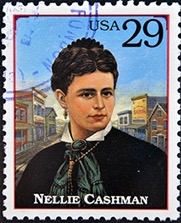
This was Nellie Cashman (1845–1925), also known as Ellen Cashman, an Irish immigrant who became a legendary prospector, entrepreneur and humanitarian known across the Wild West* as the “Angel of the Cassiar” and the “Angel of Tombstone”.
Born in Midleton, a town in south-eastern County Cork, Ireland, Nellie survived the Great Famine before immigrating to the U.S. with her mother and sister in the 1850s. Legend has it that while working as an elevator operator in a Boston hotel — a job then reserved for men — for 15 years, she met General Ulysses S. Grant**, who encouraged her to go west for better opportunities.
By 1872, she was in Pioche, Nevada, where she opened the Miner’s Boarding House. Her reputation for hospitality and kindness earned her the nickname “Nellie Pioche”.
In 1875, upon hearing that 75 miners were stranded and dying of scurvy in the Cassiar Mountains, Nellie organised a six-man rescue team. They hauled 1,500 pounds of supplies (including vitamin-C-rich potatoes and limes) through deep snow for 77 days. She survived an avalanche during the trip, digging herself out before her companions could reach her. Her arrival saved nearly 100 lives, cementing her status as a frontier hero.
Nellie moved to Tombstone, Arizona, in 1880 during its silver boom, where she became a prominent and respected figure. She opened The Russ House hotel and restaurant there, reportedly hiring future oil tycoon Ed Doheny*** as a dishwasher. She raised funds for the town’s first Catholic church and hospital, often collecting donations from saloons and outlaws alike.
She famously thwarted a lynch mob by sneaking a local mine superintendent out of town under cover of night. She ministered to the “Bisbee Massacre” convicts before their execution.
In 1898, at age 53, she joined the Klondike Gold Rush to Canada’s Yukon territory, hauling her own 900 lbs of provisions over the Chilkoot Pass. Even in her late 70s, she operated the northernmost gold mine in the world and set records as a champion woman musher (a female driver of a sled dog team), once traveling 750 miles in 17 days by dog sled.
In 1912, she became the first woman known to cast a ballot in an Alaska-wide election, a year before it was officially legal for women there.
Nellie Cashman died of pneumonia on January 4, 1925, in St. Joseph’s Hospital in Victoria, British Columbia — the very hospital she had helped fund with her mining profits 50 years earlier. She never married, once famously remarking to a reporter, “Why child, I hasn’t had time for marriage. Men are a nuisance anyway… They’re just boys grown up”.
The January 15, 1925 Wrangell Sentinel republished her obituary, which said:
“As Service says, ’twas not the gold but the excitement of finding it, that lured Nellie Cashman, and in every camp she ever visited she was a veritable angel of mercy, nursing the sick, steeping spruce boughs# for those afflicted with scurvy, and diffusing sunshine wherever she happened to be.”
Nellie Cashman’s adventurous life has been captured through television and documentaries. She was portrayed by Randy Stuart in the series The Life and Legend of Wyatt Earp and featured in the Death Valley Days episode “Angel of Tombstone,” played by Grace Lee Whitney. Her legacy as a prospector and humanitarian is also detailed in the documentary Nellie Cashman: Goldhunter by Little Road Productions.
* The “Wild West” refers to the Western United States during its frontier period in the late 19th century. It was characterised by rapid expansion, lawlessness and limited government, featuring iconic, often romanticised, figures like cowboys, outlaws and gunfighters.
** Ulysses S. Grant (1822–1885) was the 18th president of the United States, serving from 1869 to 1877. He previously led the Union Army to victory in the American Civil War in 1865 as commanding general.
*** Edward L. Doheny was a pioneering American oil tycoon who transformed the industry by drilling the first successful well in Los Angeles in 1892 and creating a massive petroleum empire in California and Mexico.
# Steeping spruce boughs is a versatile way to extract their aromatic oils and high vitamin C content for teas, syrups or therapeutic baths. Spruce (genus Picea) refers to a group of about 35–40 species of coniferous evergreen trees found in the Northern Hemisphere.
Image: United States issued a postage stamp in 1994 featuring Nellie Cashman to honour her contributions to the development of the American West. It was part of the ‘Legends of the West’ stamp series. Image courtesy goldprospectors.org