The greatest journeys in human history can be engineered without ever leaving the comfort of a library chair. Shaped by a childhood vow to travel only in his imagination, legendary author Jules Verne transformed himself into a meticulous “stay-at-home traveller” whose fictional blueprints built the future. By weaving existing scientific theories with painstaking research, he masterminded the iconic Voyages Extraordinaires series long before the technology to realise them existed. Explore the fascinating life of the true father of science fiction, and discover his astonishingly prophetic predictions—including electric submarines, helicopters, video-conferencing, and the moon landing—that leaped from the pages of his manuscripts directly into the modern world.
Did you know that Jules Verne— the legendary “father of science fiction”— was shaped by a childhood vow to travel “only in his imagination” ?
According to family lore, an 11-year-old Verne, born in the port city of Nantes in western France in 1828, once attempted to run away to sea as a cabin boy to find a coral necklace for his cousin. He was caught by his father and forced to swear off literal travel, a moment that transitioned him into a meticulous “stay-at-home traveller.”
Although he initially studied law to appease his father, Verne abandoned the profession in 1852 to pursue literature and theatre. His career was launched in 1863 when he met publisher Pierre-Jules Hetzel, who serialised his first major novel, Five Weeks in a Balloon, and commissioned the famous Voyages Extraordinaires series. Verne spent his life in libraries, using scientific journals and geography maps to architect these stories. His work became legendary for its “prophetic” nature, as he used existing scientific theories to imagine meticulously researched technologies that would not exist for decades.
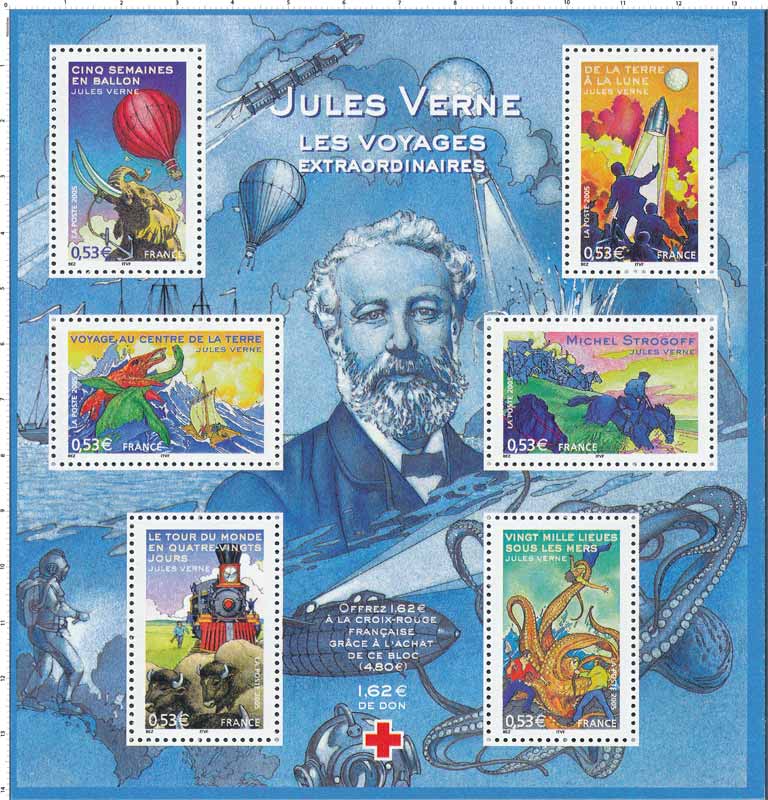
A 2005 French souvenir sheet commemorating the 100th anniversary of the death of author Jules Verne. It features six stamps highlighting his “Extraordinary Voyages” series, including “Twenty Thousand Leagues Under the Sea” and “Around the World in Eighty Days”. Courtesy WikiTimbes.
List of Predictions that Came True
Verne’s dedication to accuracy allowed him to describe the farthest corners of the globe — and even the deep sea — with such vivid detail that many readers believed he had actually visited the places he wrote about:
Electric Submarines: In Twenty Thousand Leagues Under the Sea (1870), Verne described the Nautilus, a high-speed, battery-powered vessel. This inspired later inventors like Simon Lake, who credited Verne as the “director-general” of his life.
The Moon Landing: In From the Earth to the Moon (1865), Verne predicted a Florida launch site, a three-man crew, and an ocean splashdown, over a century before the Apollo 11 mission.
Video Conferencing: In his 1889 short story In the Year 2889, he described the “phonotelephote,” which allowed people to see each other while speaking over long distances.
The Internet and Computers: His rejected 1863 manuscript, Paris in the Twentieth Century, envisioned a global network of “mechanical calculators” that could communicate, foreshadowing modern computing and the internet.
Helicopters: In Robur the Conqueror (1886), he imagined a flying machine with high-speed rotors, inspiring aviation pioneers like Igor Sikorsky.
Tasers: Verne described “electric bullets” that delivered a high-tension shock to incapacitate targets, a clear precursor to the modern electronic control device.
News Broadcasting: He predicted that instead of printed newspapers, people would listen to a spoken daily chronicle of news from reporters—the foundation of television and radio news.
Postage stamps of Romania celebrating Jules Verne Centenary (1905–2005), depicting his fictional works, The Castle from the Carpathians, The Pilot From the Danube, Claudius Bombarnac and The Stubborn Kéraban. Courtesy Wikimedia Commons