This classic Taoist parable reveals how a master woodcarver achieves a state of spiritual concentration, letting his own Heaven-given faculties align seamlessly with nature to fashion a work of art so perfect it seems to be made by spirits.
Khing, a worker in rottlera wood, carved a bell-stand. When it was completed, all who saw it were astonished as though it were the work of spirits. The Prince of Lu went to see it and asked: “What mystery is there in your art?”
“Your subject is but an artisan,” replied Khing. “What mystery should I be possessed of? And yet there is one thing: When your servant had undertaken to make the bell-stand, he guarded against any waste of his vital power. I fasted to reduce my mind to quiescence. After fasting for three days, I did not presume to think of any reward or rank to be gained. Five days and I had forgotten all about myself – my limbs and my body. By this time, my skill had become concentrated; everything from without that could divert my mind had disappeared. Then I went into the forest and looked at the natural forms of the trees. When I saw one of a perfect form, then the figure of the bell-stand rose up in my mind, and I applied my hand to the work. Had I not met with such a tree, I must have abandoned the task. I let my Heaven-given faculty cooperate with the Heaven-given qualities of the wood. What was believed to be the work of spirits in the bell-stand was due solely to this.”
Courtesy: Taoist Tales by Raymond Van Over
Raymond van Over is an award-winning American author and editor who has written and compiled over thirty books ranging from mainstream speculative fiction and horror anthologies to scholarly studies of global folklore. He is highly regarded in Eastern philosophy circles for editing widely read collections of classical Asian literature, including Taoist Tales and Chinese Mystics.
The bell stand is a feature in the Poem of the Woodcarver from Chuang Tzu, a Taoist text. Chuang Tzu is a collection of Taoist thought that critiques conventional categorisations and evaluations. It encourages a flexible and fluid way of understanding that is not committed to a fixed system.
Wu wei is a core Taoist philosophical concept that literally translates to “non-action” or “effortless action,” advocating for living in spontaneous alignment with the natural flow of the universe rather than forcing results through aggressive human willpower.
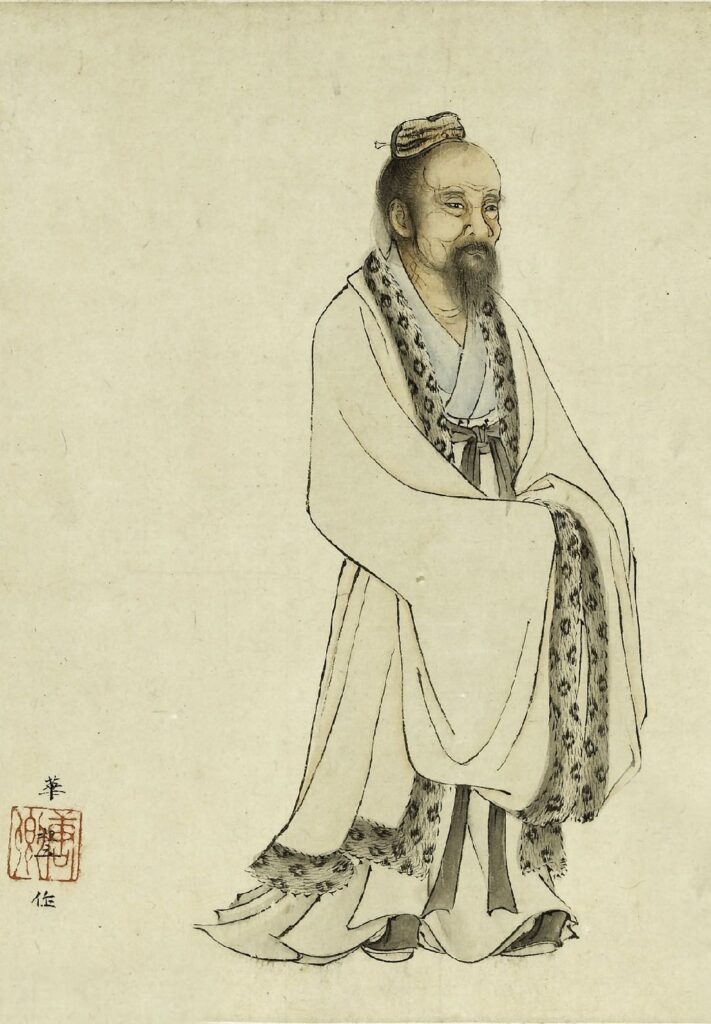
Chuang Tzu (also Zhuang Zhou or Zhuangzi, literally “Master Zhuang”) was an influential Chinese philosopher who lived around the 4th century BCE in a period of great development in Chinese philosophy, the Hundred Schools of Thought. He is credited with writing—in part or in whole—a work known by his name, the Chuang Tzu or Zhuangzi, which is one of the two foundational texts of Taoism, alongside the Tao Te Ching.
Image courtesy Hua Zili , Wikimedia Commons.
Taoism is a diverse philosophical and religious tradition indigenous to China, emphasising harmony with the Tao (way, road, path or technique). Taoist thought has informed the development of various practices within the Taoist tradition and beyond, including forms of meditation, astrology and feng shui. A common goal of Taoist practice is self-cultivation, a deeper appreciation of the Tao, and more harmonious existence. Taoist ethics emphasise such virtues as effortless action, naturalness, simplicity, and the three treasures of compassion, frugality and humility.