Human thought often finds itself trapped within the invisible boundaries of the words we choose to speak. By mistaking the tools of expression for absolute mirrors of reality, the mind becomes entangled in deep, self-made intellectual mazes. True clarity emerges only when we realise that meaning is not an inherent property fixed in stone, but a living game played within our shared everyday interactions.
The architect of ordinary language
Ludwig Josef Johann Wittgenstein (1889–1951) stands as one of the most enigmatic and influential giants of 20th-century philosophy. Born into one of Europe’s wealthiest families—a dynasty of Jewish industrial magnets in Austria—he spent his life actively retreating from the burdens of immense wealth. Choosing a life of strict austerity and simple living, he famously gave away his entire inheritance to live in small, minimalist rooms, dedicating his intense focus entirely to the mechanics of logic, mind and human speech.
Wittgenstein’s intellectual journey fundamentally reshaped analytic philosophy, leaving a permanent mark on thinkers ranging from his mentor Bertrand Russell to G.E. Moore and Martin Heidegger. His unique genius even rippled outward into early computer science, leaving a profound impression on Alan Turing’s pioneering work in artificial intelligence. Beyond the lecture halls, his precision extended into physical design; in the 1920s, he meticulously designed a stark modernist house for his sister, Margaret, in Vienna. It still stands today as an architectural masterpiece, reflecting a man who demanded absolute perfection from every window frame, door handle and sentence.
Fact, reality and the war
Wittgenstein’s philosophy is broadly split into two distinct eras, both borne out of intense personal experiences. During World War I, he served on the front lines with the Austro-Hungarian Army, earning decorations for profound bravery. It was amidst the trauma of trenches and sub-zero military campaigns that he drafted his first major work, the Tractatus Logico-Philosophicus (1918).
In this seminal treatise, he famously declared: “The world is everything that is the case.” For the young Wittgenstein, reality was the sum total of existing facts—states of affairs that currently are, and nothing more. He believed that the purpose of language was to cleanly “picture” these facts. If a statement could not be logically mapped to a factual state of affairs, it fell into the realm of the unsayable.
The shift to language games
However, true genius lies in the capacity for relentless self-criticism. In his later years, Wittgenstein grew deeply dissatisfied with his own earlier theories, realising that human life is far too rich to be squeezed into rigid logical equations. This fierce introspection resulted in notes that were posthumously published as Philosophische Untersuchungen (Philosophical Investigations, 1953).
In this second era, he introduced a series of revolutionary concepts that defined ordinary language philosophy:
Meaning as Use: He discarded the idea that words hold static, inherent properties. Instead, he argued that the meaning of any word or phrase is entirely determined by how it is actively used in everyday human life.
Language Games: Language, he realised, functions like a series of evolving games. Just as the rules of chess or tennis only make sense within the context of the game itself, our words change meaning based on the social context and actions they accompany.
Family Resemblance: He challenged the old philosophical requirement for strict definitions. He proposed that complex concepts do not share a single, mandatory trait; rather, they are connected by a shifting network of overlapping similarities—much like features shared across members of a human family.
The Private Language Argument: Striking a heavy blow against historical Cartesian dualism (the absolute separation of mind and body), Wittgenstein proved that a completely “private language” cannot exist. Because language requires shared public standards and social criteria to establish what is true or false, our inner mental states are inextricably intertwined with outward, physical behaviour.
An intense, enduring legacy
Wittgenstein’s presence at Cambridge University was legendary for its staggering intensity. He was an unorthodox educator who would regularly arrive late, dismiss prepared notes, and simply choose to think aloud in front of his class, expecting his students to follow his gruelling, silent pauses of deep contemplation.
He was a man of fierce conviction, illustrated beautifully by the infamous 1946 “Poker Incident” at the Cambridge Moral Science Club. During a heated debate regarding whether moral rules truly exist, an agitated Wittgenstein allegedly brandished a hot fireplace poker at fellow philosopher Karl Popper, demanding a real-world example of a moral law. Popper famously quipped back, “Not to threaten visiting lecturers with pokers,” prompting an enraged Wittgenstein to storm out of the room.
Though he once remarked, “I am not a religious man, but I cannot help seeing every problem from a religious point of view,” his pursuit was always oriented toward ultimate clarity, meaning and the human condition. In his later years, he became highly reclusive, seeking solace away from academia in the company of a few chosen companions before passing away in 1951.
Acknowledging his irreplaceable contribution to the human story, UNESCO officially inscribed his entire philosophical legacy into the Memory of the World Register in 2017. He remains a timeless reminder that to understand our world, we must first learn to navigate the beautiful, complicated boundaries of our words.
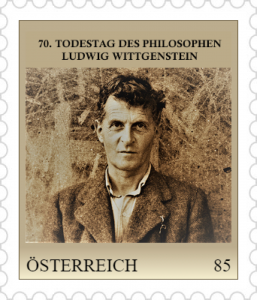
Image: A postage stamp issued by Austria in 2021 to commemorate the 70th death anniversary of Wittgenstein. More at the Wittgenstein Initiative, Vienna. Please visit https://wittgenstein-initiative.com/