
To lose the subtle textures of sound is to slowly feel detached from the vibrant symphony of human connection. For centuries, repairing the microscopic, delicate instruments hidden within our sensory architecture remained an elusive medical challenge. Today, the marriage of advanced precise engineering and biocompatible design is opening up revolutionary horizons to bring the gift of hearing back to silent worlds.
Dr. Mashudu Tshifularo is a renowned South African otolaryngologist and educator who made history by leading the first team to use 3D-printed bones for reconstructive middle ear implants.
Born on June 18, 1964, in South Africa, he grew up as a herdsman in a rural village and knew he wanted to be a medical doctor by age 13.
Dr. Tshifularo’s team successfully performed the world’s first middle ear transplant using 3D-printed bones in 2019, providing a potential cure for certain types of deafness.
His work focusses on using 3D printing technology to create customised implants for patients with conductive hearing loss, making treatment more accessible and affordable. Using a 3-D printer, Dr. Tshifularo creates implants that replace the ossicles: the hammer (malleus), anvil (incus) and stirrup (stapes) during middle ear reconstructive surgery, or tympanoplasty, that are more affordable compared to the traditional titanium implants. The implants are fabricated with biocompatible material that reduce the chances of rejection and boost long-term success rate.
As the head of the Department of Ear, Nose, Throat, Head and Neck Surgery at the University of Pretoria, Dr. Tshifularo has made significant contributions to the field of otorhinolaryngology (ENT), with expertise in treating tonsillitis, allergies, sinusitis, snoring and deafness.
Dr. Tshifularo’s groundbreaking work has opened up new possibilities for treating hearing loss and has the potential to improve the lives of millions of people worldwide.
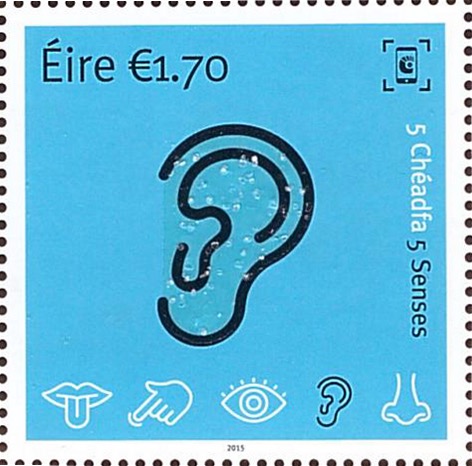
Image: A postage stamp issued by Ireland in 2015 featured hearing with thermography so that when the stamp is rubbed, it creates a sound. It was one of a set of multi-sensory stamps focussing on the five senses – sight, touch, smell, taste and hearing. Image courtesy https://philaquelymoi.blogspot.com/2015
Visit https://philaquelymoi.blogspot.com/2015/10/multi-sensory-stamps-sets-update.html for browsing througn the full set of Irish multisensory stamps sets. Philaquely Moi is home to a unique philately collection.
As the link https://www.anpost.com/Media-Centre/News/Tasty-Stamps-are-also-pleasure-to-See,-Hear,-Smell-Touch! mentions, 4th Class pupils from the Central Model Primary School in Marlborough Street, Dublin 1 ‘sense-checked’ the multisensory Irish stamps set at the GPO at the time of their release.