Conversations on wisdom, life and the human condition
The conversations between Siva and Parvati belong to the rich world of Hindu scripture, philosophy and storytelling. In their traditional settings, these exchanges are sacred and philosophical, yet they also speak to deeply human questions—of knowledge, doubt, pride, suffering, responsibility and the art of living with one another.
In the stories that follow, Siva is not always the teacher, nor Parvati always the student. One asks, the other responds; one challenges, the other listens. Through curiosity, disagreement, humour, correction and mutual respect, their relationship invites us to wonder about how wisdom can move in both directions between two people.
There are conversations in which the distinction between teacher and learner begins to shift—first one way, then the other—until wisdom seems to belong not to either person alone, but to the space created between them.
The stories of Siva and Parvati invite us into such a space.
Their conversations range across consciousness, conduct, desire, suffering, knowledge and the nature of reality. They are ancient stories, yet the questions they raise remain surprisingly close to our own.
Perhaps this is one reason Siva and Parvati continue to fascinate us. They are not interesting because they are always in agreement, but because they can remain in relationship while questioning, correcting and sometimes unsettling one another.
Sometimes wisdom arrives through a question. Sometimes through disagreement. And sometimes through the quiet recognition that another person knows something we do not.
Two extraordinary personalities
1
Siva is one of the most paradoxical figures in the Hindu imagination.
He is the ascetic who lives beyond convention, yet also the intimate companion and householder. He is the silent yogi, yet also a teacher of profound insight. He is associated with destruction, yet destruction can make renewal possible. He can seem remote from the world and, at the same time, deeply compassionate towards those who suffer within it.
He can appear detached and intimately involved at once.
Parvati, too, cannot easily be contained within a single role.
She is the daughter of the mountains, a figure of determination and discipline. She is also a companion who observes closely, asks difficult questions and is not satisfied merely because an answer has come from someone revered.
Their relationship has its roots in familiar Puranic stories of persistence, devotion and union. But union does not end the story. It creates another possibility: that the ascetic and the householder, the solitary seeker and the participant in life, must learn to live with one another’s different ways of seeing.
That difference matters.
Parvati is not simply there to make Siva more human.
Siva is not simply there to give Parvati access to higher knowledge.
Each represents something the other cannot entirely become.
Siva brings the perspective of detachment, inwardness and transcendence.
Parvati brings another kind of attention—the attention of one who remains close to life, relationship, consequence and embodiment.
Yet neither perspective is complete when isolated from the other.
Perhaps that is why their conversations are so interesting.
They do not merely exchange answers.
They reveal the limits of answers.
Parvati asks about reality
2
One of the most intellectually fascinating encounters appears in the Vijñāna Bhairava Tantra, a classical Shaiva Tantric text associated with the traditions of Kashmir Shaivism.
The text presents a dialogue between the Goddess and Bhairava, a form of Siva. The Goddess has heard teachings before, but she is not satisfied.
Her doubts remain.
She asks, in a widely used translation, about the true nature of reality.
It is a remarkable question.
She is not asking for another belief to memorise. She is asking what is actually true.
And there is something admirable in her willingness to say, in effect: I have listened. I have heard what you have said. But I am still not satisfied.
Doubt here is not the opposite of seriousness.
It is a form of seriousness.
Siva’s response does not reduce reality to one neat definition. Instead, he offers a large collection of contemplative approaches—traditionally counted as 112 methods—through which awareness may be explored.
Breath can become an object of attention.
Sound can become a doorway into silence.
Sensation can reveal the restless movement of the mind.
The interval between thoughts can become an opening into stillness.
The seeker is not necessarily asked to flee experience in order to find wisdom; experience itself can become the place of inquiry.
This changes the nature of the question.
Instead of asking only:
What should I believe?
the seeker is invited towards another question:
What can I learn to see for myself?
There are things we understand because someone has explained them to us.
And there are things we understand only when they become our own experience.
A map can tell us where a mountain is.
It cannot give us the experience of standing on it.
In the world of the Vijñāna Bhairava, reality is approached not merely as an idea to possess, but as something to be recognised through awareness itself.
Parvati’s question therefore remains alive even after Siva has answered.
A profound question does not always close with a final answer.
Sometimes it opens a hundred doors.
The meaning of Siva’s strange appearance
3
Another conversation between Siva and Uma—another name for Parvati—appears in the Anuśāsana Parva of the Mahābhārata.
Uma asks about the unusual features associated with Siva: his third eye, his different faces, his blue throat, his matted locks and his bow.
Why does he look as he does?
What lies behind these strange forms?
These are not merely questions about appearance. They are questions about meaning.
Siva explains his unusual characteristics in relation to his powers, deeds and cosmic role.
For a reader entering this world for the first time, the images can seem strange.
Why ash?
Why serpents?
Why matted hair?
Why a third eye?
Why a throat marked by blue?
The traditions surrounding these images have many layers, and not all of their meanings can be reduced to one modern interpretation.
Yet symbols invite us to look more deeply.
The third eye, for example, can be contemplated as an image of perception beyond ordinary sight—not simply seeing more things, but seeing more deeply: causes beneath appearances, consequences beyond the present moment, dimensions of reality that ordinary perception may not reveal.
The ash recalls mortality and the transience of embodied life.
The serpent can evoke danger, power and mastery.
The blue throat is connected, in wider Shaiva and Puranic tradition, with the poison that Siva holds rather than allowing it to destroy the world. As a symbol, it can also invite reflection on the difficult human capacity to encounter what is poisonous without passing it on.
That last interpretation is a reflection rather than a claim that the ancient text itself was written to teach a modern psychological lesson.
And perhaps that distinction matters.
A symbol does not have to have only one meaning to remain alive.
An image can belong to a religious tradition and still invite a reader to discover another layer of significance.
Parvati’s questions remind us of something simpler still:
We cannot always understand a person by looking at the outside.
A strange appearance may conceal a purpose.
An unusual habit may express a discipline.
A mark upon the body may preserve a memory.
And sometimes the only way to understand what something means is to have the courage to ask.
When Siva chooses to listen
Perhaps the most revealing reversal comes in another passage of the Anuśāsana Parva.
Here Siva does not simply speak.
He asks Uma to speak about strī-dharma—the duties and conduct traditionally associated with women.
And Uma does something unexpected.
She does not immediately give him an answer. Instead, she turns to the sacred rivers and seeks their counsel.
Her reason is quietly profound: she does not believe that any branch of knowledge can be mastered completely by one unaided individual.
There is humility in this—not the humility of someone who knows nothing, but of someone who knows that knowledge is never entirely one’s own.
There is something deeply attractive in this.
Imagine Siva—the great god, the teacher, the one to whom others turn for knowledge—asking someone else to explain.
And imagine Parvati, instead of rushing to demonstrate her own knowledge, saying in effect:
Let me listen to others before I answer.
There are two forms of humility here.
Siva’s humility is the humility of the listener.
Parvati’s is the humility of the person who knows that her own knowledge is incomplete.
Competence does not mean completeness.
A person may be learned, disciplined and experienced and still need another perspective.
Consultation is not necessarily a confession of weakness.
It can be a recognition of the scale of knowledge itself.
The passage also belongs to an ancient social world whose assumptions about women cannot simply be transferred into our own.
We need not turn it into a modern manifesto.
What is worth noticing is something quieter:
Siva is willing to ask.
Parvati is willing to listen to others before she answers.
Neither loses dignity by doing so.
Perhaps wisdom begins not when we know enough to speak, but when we know enough to recognise when we should listen.
When philosophy meets hunger
There is another story in which Parvati does not answer Siva with another argument.
She answers him through life itself.
In widely told Puranic and devotional traditions, Parvati appears as Annapurna, the goddess associated with food and nourishment. The familiar story circulates in more than one form, so it is best received here as a traditional narrative rather than as a single, fixed textual account.
The story exists in different forms, but its central movement is familiar.
Siva dismisses the material world as transient or illusory. In some retellings, food itself is included in what he regards as ultimately unreal.
Parvati withdraws nourishment from the world.
And suddenly an abstract question becomes painfully concrete.
People become hungry.
The body does not stop needing nourishment because the mind has declared matter to be secondary.
Eventually Siva must approach Parvati in her form as Annapurna.
The story can be received devotionally, as a story of the goddess who gives food.
It can also be read philosophically.
What happens when a beautiful idea meets an actual human need?
What happens when metaphysics encounters a hungry child?
What happens when an elegant theory meets a body that is weak, a family without food, or a person who depends upon the care of another?
A philosophy that cannot respond to such realities may be elegant, but it is incomplete.
This does not necessarily mean that Siva’s insight about impermanence is false.
The story asks a subtler question.
Can something be impermanent and still matter?
Can something be transient and still deserve our care?
Hunger is temporary.
So is the body.
So is childhood.
So is grief.
So is every meal.
Yet while these things are present, they are real enough to demand our attention.
Siva understands detachment.
Annapurna reminds him of embodiment.
Neither insight has to destroy the other.
Perhaps the deeper lesson is that transcendence should not become an excuse for indifference.
Food is not merely matter.
It is nourishment, labour, care, hospitality and survival.
To feed another person may sometimes be a more eloquent philosophical act than to offer an argument about the nature of reality.
When the wise person loses
There is another story, associated with the Kedāra-khaṇḍa of the Skanda Purāṇa, in which Siva and Parvati play a game of dice.
It is a playful story, but play has a way of exposing things that solemn conversation can hide.
Siva loses.
And he does not immediately accept the result.
Parvati insists that he has been defeated by her in the game.
The exchange is humorous, but something more serious is taking place underneath the laughter.
What happens when reality disagrees with the picture we have of ourselves?
A person may be wise in meditation and still become impatient in competition.
A person may speak calmly about detachment and still dislike losing.
A person may believe himself invincible until an actual result contradicts the belief.
The dice fall where they fall.
Reality does not always consult our self-image before giving us an answer.
That does not mean every result is fair.
Nor does losing make a person insignificant.
But when the result contradicts our certainty, we have a choice.
We can spend our energy arguing with the result.
Or we can look at it.
That is where learning begins.
The story also reveals something important about their relationship.
Parvati can challenge Siva without ceasing to honour him.
Siva’s dignity does not have to depend upon winning every argument—or every game.
Love need not eliminate disagreement.
Perhaps a mature relationship is one in which there is enough affection for laughter, enough trust for correction, and enough security for one person’s pride to be occasionally defeated without the relationship itself being defeated.
What each makes possible in the other
By now, the question is no longer simply:
Who teaches whom?
The more interesting question may be:
What becomes possible because they are different?
Parvati asks about reality.
Siva responds by opening many paths of contemplation.
Uma asks about the strange forms of Siva.
Siva gives meanings to what appears mysterious.
Then Siva asks Parvati to speak.
And Parvati reminds us, through her own example, that knowledge becomes richer when it is shared and tested with others.
As Annapurna, she brings Siva back towards the undeniable demands of embodied life.
In the game of dice, she reminds him that even the wise can be surprised by the world.
Seen this way, their relationship is not simply a reversal of roles.
It is an encounter between different ways of knowing.
Siva brings the possibility of stepping back from the immediate world and seeing beyond it.
Parvati brings the possibility of remaining close enough to life to notice what happens when an idea enters the world of bodies, relationships and consequences.
One looks towards the infinite.
The other reminds us that the finite is where human beings actually live.
Yet the distinction is not absolute.
Siva is also compassionate.
Parvati is also a seeker.
Siva is a householder.
Parvati is also a figure of profound spiritual discipline.
Neither can be reduced to one principle.
Perhaps that is the deeper reason their companionship is so compelling.
They do not complete one another by becoming the same.
They remain different.
And precisely because they remain different, each can reveal something the other might otherwise overlook.
A companion of real value is not necessarily someone who confirms what we already believe.
It may be someone whose presence reveals where our understanding is incomplete.
That kind of companionship requires something more difficult than agreement.
It requires respect.
It requires curiosity.
And sometimes, it requires the humility to say:
You may see something that I cannot yet see.
Ardhanarishvara: Two, yet not divided
4
There is perhaps no more striking image for this than Ardhanarishvara.
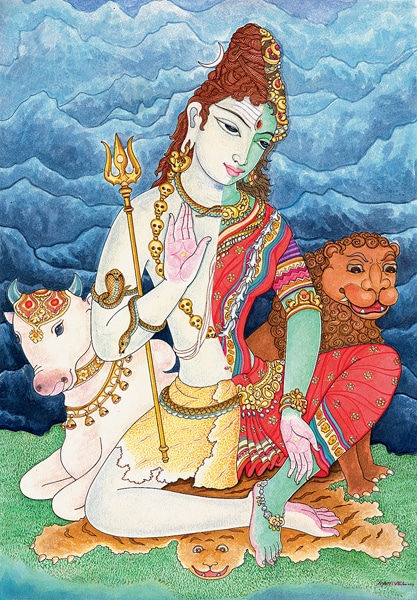
In this established Hindu iconographic tradition, Siva and Parvati appear joined in a single form: one side associated with Siva, the other with the Goddess.
It is not a literal conversation.
It is a visual meditation.
The image has been interpreted in many ways: as the joining of Siva and Śakti, consciousness and energy, stillness and movement, solitude and relationship, masculine and feminine principles.
But perhaps its quietest teaching is also one of its most powerful.
Difference does not have to mean separation.
Unity does not have to mean sameness.
One can remain fully oneself and still make room for another way of seeing.
One can honour another person’s strength without feeling diminished by it.
One can disagree without withdrawing respect.
One can learn without losing dignity.
Perhaps this is what the image allows us to contemplate.
Siva does not simply erase Parvati.
Parvati does not simply erase Siva.
Their differences remain visible.
Yet they are also inseparable.
The image therefore offers a way of thinking about companionship that goes beyond agreement.
A relationship need not become weaker because two people see differently.
Sometimes the difference is what makes the relationship capable of seeing more.
An invitation to reflection
The world from which these stories come is ancient.
Its language is not always our language.
Its assumptions are not always our assumptions.
Its ideas belong to religious and philosophical traditions that deserve to be encountered on their own terms.
And yet the questions continue to travel.
Can we distinguish knowledge from wisdom?
Can we recognise when an elegant idea has become indifferent to suffering?
Can we listen when another person knows something we do not?
Can we accept a result that challenges the image we have of ourselves?
Can love contain disagreement?
Can two people remain fully themselves while allowing one another to change the way they see?
Perhaps the enduring beauty of Siva and Parvati is not that one of them possesses all the answers.
It may be that neither does.
Perhaps wisdom appears in the movement between them—in the question that interrupts certainty, in the answer that opens another question, in the willingness to listen, and in the humility to discover that even a deeply held understanding may have another side.
Parvati asks.
Siva responds.
Siva listens.
Parvati reveals.
Life tests them both.
And somewhere between the question and the answer, between certainty and correction, between stillness and movement, something begins to happen.
We begin to see a little differently.
Perhaps that is what a good conversation can do.
Perhaps that is what a good companion can do.
And perhaps that is why, after so many centuries, it is still worth listening when Siva and Parvati speak.
Sources and further reading
The stories and reflections in this essay draw upon several different Hindu textual and devotional traditions, including:
the Vijñāna Bhairava Tantra, a Shaiva Tantric text associated with the traditions of Kashmir Shaivism;
selected Siva–Uma passages in the Anuśāsana Parva of the Mahābhārata;
the Siva–Parvati dice episode in the Kedāra-khaṇḍa of the Skanda Purāṇa;
Puranic and devotional traditions associated with Parvati as Annapurna;
and the established iconographic tradition of Ardhanarishvara.
These materials belong to different textual and cultural settings. They are therefore presented here as scriptural dialogues, epic passages, Puranic narratives, devotional traditions and symbolic interpretations—not as historical transcripts of conversations.
The reflections that follow the stories are offered in that spirit: not as definitive explanations of what every tradition means, but as an invitation to wonder about what these ancient encounters might still have to say to us.
Image captions:
Image 1: Siva and Parvati against a Himalayan landscape, featured on a customised postage label issued in 2010. Courtesy of Hindu Existence.
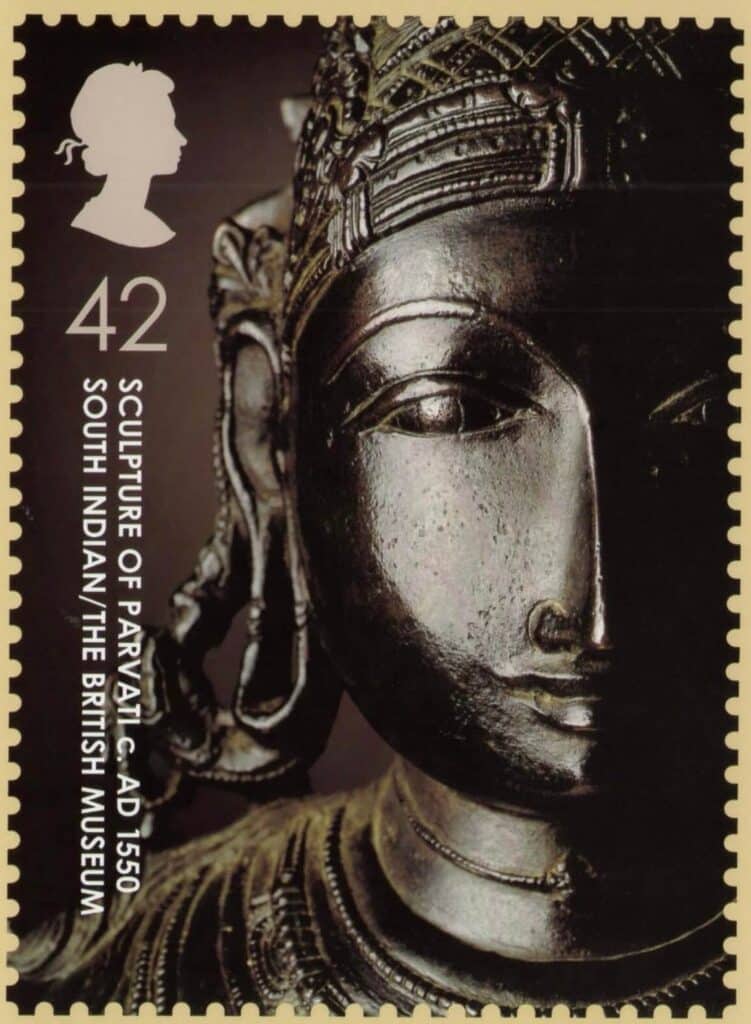
Image 2: A South Indian bronze sculpture of Parvati, attributed to the Vijayanagara period, depicted on a commemorative Royal Mail stamp issued in 2003. The original sculpture is in the collection of the British Museum.
Image 3: Siva as Nataraja, Lord of the Dance, depicted on an Indian postage stamp issued in 2016. Courtesy of Wikimedia Commons.
Image 4: Ardhanarishvara, the composite form of Siva and Parvati, by the Indian artist Jayadeva Sinha. Image courtesy of Wikimedia Commons.