
In our endless search for permanence, we often imagine that physical immortality would be the ultimate gift, protecting us from the finality of decay. Yet, without contrast, change, and impermanence, life loses its depth, beauty, and fundamental meaning. Alexander and Immortality shares a classic parable of Alexander the Great at a miraculous cave, illustrating how accepting our mortality allows us to truly cherish living.
“There is a story about Alexander the Great, that he was in search to find something which can make him immortal.
…He searched and searched, and once he reached the cave where some wise man has told him that, “If you drink the water of that cave — there is a stream in the cave — you will become immortal.”
…He reached the cave. Inside it, he was very happy: crystal clear the water was there; he had never seen such water. And he was going to drink the water…
Suddenly a crow who was sitting in the cave said, “Stop! Don’t do it. I have done and I am suffering.”
Alexander looked at the crow and said, “What are you saying? You have drunk, and what is the suffering?”
He said, “Now I cannot die and I want to die. Everything is finished. I have known everything that life can give. I have known love and I have grown out of it. And I have known success; I was a king of crows, and now I am fed up, and I have known everything that can be known. And everybody I knew has died; they have gone back to rest, and I cannot rest. I have tried all efforts to commit suicide, but everything fails. I cannot die because I have drunk from this condemned cave. It is better that nobody knows about it. Before you drink, you meditate on my condition — and then you can drink.”
It is said Alexander for the first time thought about it, and came back without drinking from that cave and that stream.
Life will be simply unbearable if there is no death. Love will be unbearable if there is no opposite to it. If you cannot separate from your beloved it will be unbearable; the whole thing will become so monotonous, it will create boredom. Life exists with the opposites — that’s why it is so interesting.”
Osho – “Yoga: The Alpha and the Omega”
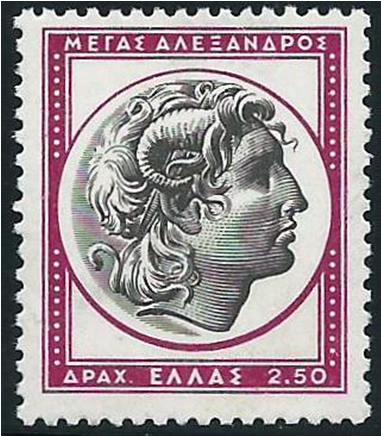
Image 1: A vintage Greek postage stamp from the “Ancient Greek Art” series (circa 1954–1959) depicts the profile of Alexander based on ancient coin imagery, bearing the inscription “ΜΕΓΑΣ ΑΛΕΞΑΝΔΡΟΣ” (Alexander the Great).
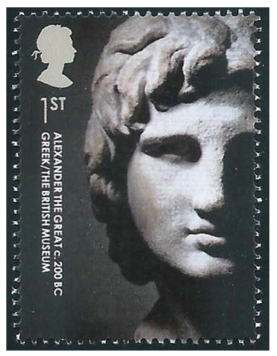
Image 2: This postage stamp, issued in the United Kingdom in 2003, commemorates the 250th anniversary of the British Museum. It features a marble portrait head of Alexander the Great, dating back to approximately 200 BC.
Images courtesy: https://mathematicalstamps.eu/
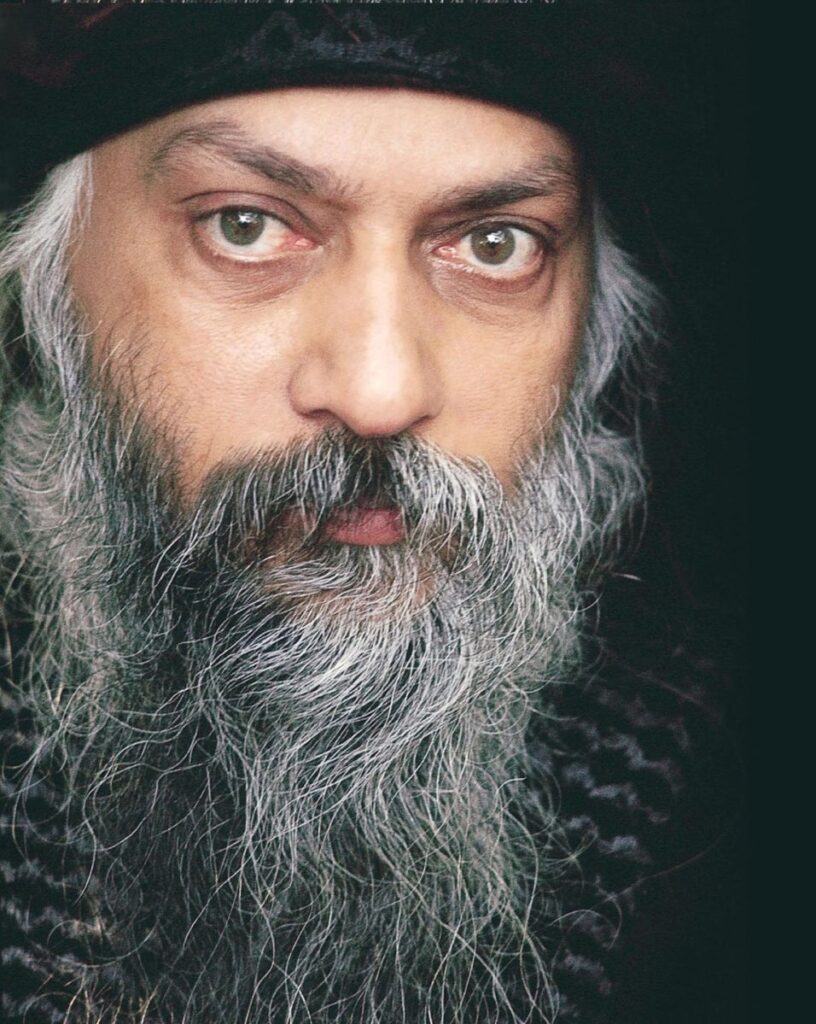
Acharya Rajneesh (1931-1990), known later as Osho, was an Indian godman, philosopher, mystic and founder of the Rajneesh movement. He was viewed as a controversial religious leader during his life. He rejected institutional religions, insisting that spiritual experience could not be organised into any one system of religious dogma. He advocated meditation and taught a unique form called dynamic meditation. Rejecting traditional ascetic practices, he asked his followers to live fully in the world but without attachment to it. Pic courtesy: https://www.sannyas.wiki/