
When we think of the boundaries of life, we tend to think of them as rigid lines—creatures of the air stay in the sky, and creatures of the water stay beneath the waves. Yet, the natural world thrives on defying expectations. In the shaded, slow-moving river basins of South America lives a tiny tropical fish that challenges our fundamental understanding of how aquatic species survive—and the story of Copella arnoldi is a beautiful reminder that when it comes to protecting the next generation, nature will always find a way to break the barriers of its own world.
In the slow-moving, shaded streams of the Amazon and Orinoco basins, life generally stays bound beneath the surface. Yet, hidden among the flooded forests, a tiny tropical freshwater fish breaks the laws of its environment to pull off one of nature’s most dramatic acts of survival. Known as the splash tetra (Copella arnoldi), this remarkable creature has evolved a parenting strategy that seems entirely impossible for a fish: it raises its young out of the water.
The process begins with a synchronised, blind leap of faith. Needing overhanging vegetation to breed, a male and female pair align themselves vertically just beneath the surface. Flicking their tails in perfect harmony, they launch themselves entirely out of the water, clinging tightly to the underside of a low-hanging leaf. In a fraction of a second, the female deposits a small clutch of five to eight sticky eggs, which the male instantly fertilises before they both drop back into the water. They repeat this exhausting aerial dance dozens of times, eventually anchoring up to 200 eggs safely away from the ravenous predators waiting in the river below.
But the real marvel of Copella arnoldi lies in the father’s gruelling, relentless vigil. Left completely in the air, the eggs are highly vulnerable to the dry tropical breeze. To keep them damp, the male takes up a solitary post in the nearby vegetation. Calculating his strikes with perfect rhythm, he uses his specially shaped tail fin to splash water up to 38 times every single hour. For nearly three long days—flicking his tail thousands of times without a break—the tiny father keeps the embryos alive.
Once the 36-to-72-hour marathon ends, the eggs hatch, and the tiny fry drop back down into the Amazon waters. Their arrival back in the river signals the immediate end of the father’s duty. The fry instinctively scatter into the shadows of the fine-leaved vegetation, left to navigate the vast river world on their own, carrying the legacy of a species that literally jumps out of its world to protect its next generation.
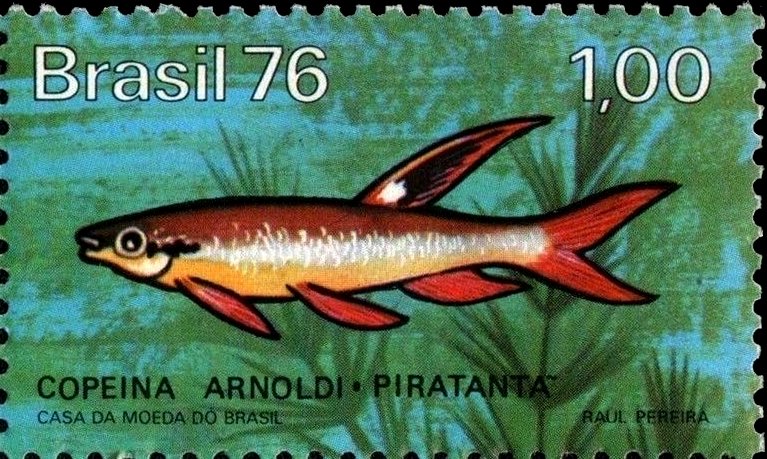
Image: Postage stamp of copella arnoldi issued by Brazil in 1976, courtesy Wikimedia.