
When hostility and harsh words are directed our way, our instincts often urge us to defend, react or internalise the pain. Emotional harm requires our implicit consent—without our acceptance, unkindness remains entirely with the one who offered it. Inner peace comes from recognising that we cannot control another person’s anger, but we hold complete authority over whether we choose to receive it.
“One day, the Buddha was walking through a village teaching Dhamma, when a very angry and rude young man belonging to another group of believers came up to him and began insulting him. “You have no right teaching others,” he shouted. “You are as stupid as everyone else. You are nothing but a fake.”
Buddha was not upset by these insults. Instead he asked the young man, “Tell me, if you buy a gift for someone, and that person does not take it, to whom does the gift belong?”
The man was surprised to be asked such a strange question and answered, “It would belong to me, because I bought the gift.”
The Buddha smiled and said, “That is correct. And it is exactly the same with your anger. If you become angry with me and I do not get insulted, then the anger falls back on you. You are then the only one who becomes unhappy, not me. All you have done is hurt yourself.” …. …“If you want to stop hurting yourself, you must get rid of your anger and become loving instead. When you hate others, you yourself become unhappy. But when you love others, everyone is happy.”
The young man listened closely to these wise words of the Buddha. “You are right, o Enlightened One,” he said. “Please teach me the path of love. I wish to become your follower.”
The Buddha answered kindly, “Of course. I teach anyone who truly wants to learn. Come with me.”
So the young man began to walk the path of Buddhism.”
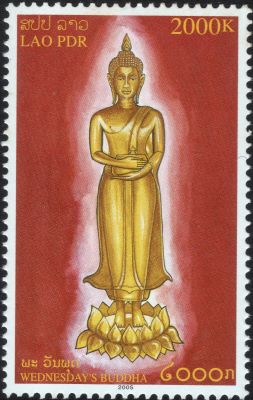
Image: A postage stamp of Laos (2005) depicting standing Buddha. Courtesy https://www.buddhiststamp.com/
Note: This story comes from an ancient Buddhist text called the Akkosa Sutta. The man who insulted the Buddha is named Akkosaka Bharadvaja (which means “Bharadvaja the Scolder”). Touched by the Buddha’s peaceful reaction, he chose to become a monk and later achieved spiritual enlightenment.