
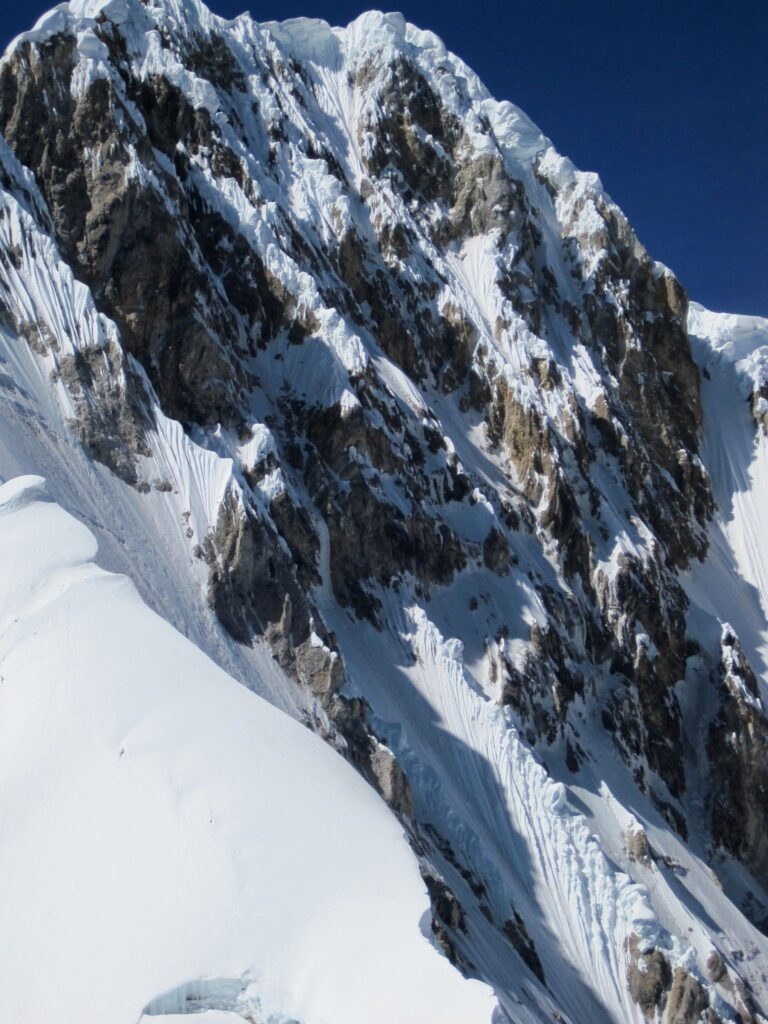
Discover the incredible true story of mountaineer Joe Simpson’s survival on Siula Grande and the mindset shift that can help you beat impossible odds
What does it take to survive when every logical outcome points to death? In our day-to-day lives, we often talk about resilience, but true human endurance is rarely tested at the absolute absolute edge of human limits.
The story of British mountaineers Joe Simpson and Simon Yates is not just a historical climbing event; it is the ultimate psychological blueprint for surviving when hope is entirely gone. If you are struggling with a seemingly insurmountable challenge right now, this legendary account of human will serves as a reminder that the first step to survival is simply deciding to try.
The perilous climb of Siula Grande
In June 1985, long before their story became a global phenomenon, two ambitious young climbers set out to conquer the Peruvian Andes. Joe Simpson and Simon Yates targeted the West Face of Siula Grande, a massive 6,344-metre (20,814 ft) snow-capped peak notorious for its treacherous ice walls and unpredictable weather.
They completed the gruelling ascent successfully, making history. However, the real battle began on the descent, proving that the journey down can be far more dangerous than the climb to the summit.
The Disaster and the Cord That Binds
Disaster struck early in their descent when Joe Simpson fell down an ice face, shattering his right knee. In high-altitude mountaineering, a broken leg is often an automatic death sentence for the entire party. Defying the harsh unwritten rules of the peak, Yates tied two ropes together and began the painstakingly slow process of lowering his injured partner down the mountain, battling blinding snowstorms and freezing temperatures.
The situation deteriorated from desperate to fatal. As visibility plummeted, Simpson accidentally dropped over the edge of a massive, hidden crevasse. Suspended in mid-air, his weight began dragging Yates down into the abyss along with him. Hours passed in the freezing darkness. With his own anchors slipping and facing certain death, Yates made the agonising, impossible decision to cut the rope. He returned to camp, heartbroken and utterly convinced that his friend was dead.
Confronting death: A mindset shift
But Simpson was not dead. He had survived the fall, landing on an ice ledge deep within the glacial crevasse. Crippled, freezing, and entirely alone, he faced a choice: wait to die in the dark, or crawl deeper into the unknown.
In his critically acclaimed memoir, Touching the Void, Simpson captured the precise moment his terror transformed into radical acceptance:
“As I gazed at the distant moraines, I knew that I must at least try. I would probably die out there amid those boulders. The thought didn’t alarm me. It seemed reasonable, matter-of-fact. That was how it was. I could aim for something. If I died, well, that wasn’t so surprising, but I wouldn’t have just waited for it to happen. The horror of dying no longer affected me… It wasn’t a bleak dark terror any more, just fact, like my broken leg and frostbitten fingers, and I couldn’t be afraid of things like that.”
Crawling six miles to freedom
What followed defies medical science and stands as one of history’s greatest survival stories. Over the course of 12 agonising hours, Simpson miraculously climbed out of the crevasse using his remaining good leg and arms.
For three days and three nights, without a single drop of water or crumb of food, he dragged and crawled his body across six miles of brutal, boulder-strewn terrain. By the time he collapsed into the base camp—just hours before Yates was scheduled to pack up and leave—Simpson had lost over three stone (42 lbs) and was suffering from severe, life-threatening ketoacidosis.
Against all planetary odds, his sheer refusal to wait for death kept him moving. Following six complex surgeries and two intensive years of rehabilitation, Simpson returned to the mountains to climb again.
The power of “micro-targets”
When we look at Joe Simpson’s miraculous survival, it is easy to view it as an extraordinary anomaly. However, the psychological tool he used is something any of us can apply to our personal or professional hardships.
When Simpson was crawling across those six miles of Peruvian rock, he didn’t look at the distant base camp; looking at the grand scale of his problem would have caused despair. Instead, he picked a rock just three feet ahead of him and told himself to reach it in twenty minutes. When he reached it, he picked another.
When a crisis hits you, break the disaster down into immediate, bite-sized tasks. Do not try to solve the next year of your life; simply survive the next twenty minutes.
Source: “Touching the Void” by Joe Simpson
Source:
http://www.rogerdarlington.me.uk/
Siula Grande is a prominent 6,344-meter (20,814 ft) mountain peak located in the Huayhuash mountain range of the Peruvian Andes—the central section of the world’s longest continental range that runs north-to-south through western South America, dividing the arid Pacific coastal plain from the vast Amazon Basin. Known for its sheer vertical ice faces, unpredictable weather patterns, and treacherous knife-edge ridges, Siula Grande remains one of the most technically demanding and formidable ascents on the continent.
Sept. 2026 update: Following his harrowing 1985 ordeal on Siula Grande, Joe Simpson underwent six major surgeries and defied medical expectations by returning to high-altitude mountaineering for several years. He channeled his experience into the bestselling 1988 memoir Touching the Void, which was later adapted into a critically acclaimed, BAFTA-winning 2003 docudrama and a West End stage play. Today, Simpson continues to write and actively works as an author and international keynote speaker. He has always maintained a steadfast defence of his climbing partner Simon Yates’s decision to cut the rope during the blizzard, citing it as the only logical choice that saved a life under extreme conditions.