
Curiosity and purpose are not bound by age or past triumphs. Decades after pioneering the lithium-ion chemistry that powers our modern world, Nobel laureate John B. Goodenough dedicated his later years to engineering an all-solid-state glass battery—proving that extraordinary innovation stems from a lifelong commitment to human progress.
2017: At the age of 57, John B. Goodenough invented the lithium battery which powers all our smart phones, tablets and laptops – as well as electric cars.
37 years later at the age of 94, John has unveiled a new, ultra-efficient, low-cost battery that uses a sodium or lithium-coated glass electrolyte. It will dwarf his original invention and make it redundant.
The new glass battery will allow electric cars to go three times the distance, and recharge in minutes instead of hours. It’s also far safer as it won’t explode and can operate in sub-zero temperatures.
The new glass battery will power our future solar-powered and electric vehicles, homes and industries.
But John isn’t finished yet. He still works every day as a Professor at the University of Texas.
John believes humanity has a 30-year window to come up with an even more powerful ‘super battery’ to take us entirely off fossil fuels, before the environmental damage we are creating becomes irreversible, and says, “I want to solve this problem before my chips are in ….. I still have time to go.”
So if you ever think it’s too late to be successful, just remember John B. Goodenough.
More details at https://news.utexas.edu/2017/02/28/goodenough-introduces-new-battery-technology
August 2026 update: In 2019, two years after unveiling his solid-state glass electrolyte research, John B. Goodenough was awarded the Nobel Prize in Chemistry alongside Stanley Whittingham and Akira Yoshino. At 97 years old, Goodenough became the oldest person in history to receive a Nobel Prize. The Nobel Committee recognised his decade-spanning contributions to solid-state chemistry and materials science, noting that his early breakthrough with lithium-cobalt-oxide cathode materials had laid the essential foundation for a rechargeable, fossil-fuel-free world.
On June 25, 2023, just one month shy of his 101st birthday, Professor Goodenough passed away in Austin, Texas. True to his core philosophy, he never formally retired. Well into his late nineties, he could still be found in his office at the Cockrell School of Engineering at UT Austin, mentoring students, debating electrochemistry, and encouraging young scientists to pursue fundamental energy solutions with unrelenting enthusiasm.
The “glass battery” concept he championed in his nineties continues to drive global research in next-generation solid-state energy storage. Today, major automotive manufacturers, tech ventures, and research laboratories around the world are actively advancing solid-state battery architecture—building upon the foundational principles of safety, thermal stability, and fast-charging capabilities that Goodenough relentlessly pursued in his final decades.
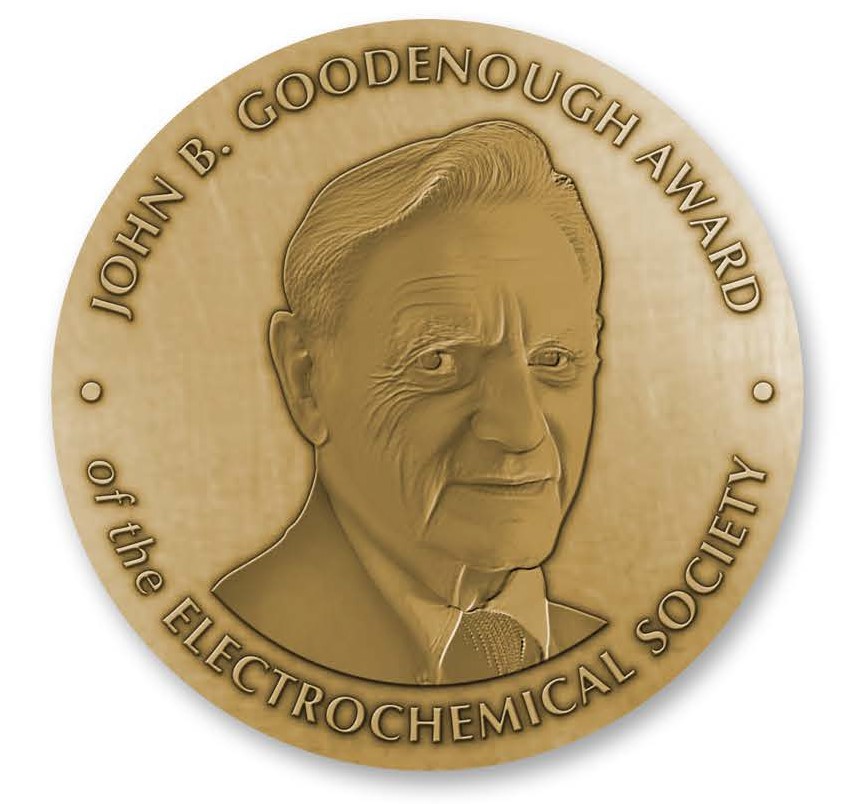
The John B. Goodenough Award was established by The Electrochemical Society, USA, in 2022 to recognise distinguished contributions to the fundamental and technological aspects of electrochemical materials science and engineering. The award recognises outstanding contributions to materials innovations in the areas of batteries, solid ion conductors, fuel cells, transition-metal oxides, and/or magnetic materials.