
When a creative mind driven by a deep passion for poetry is compelled into the rigorous world of medicine, the resulting convergence of imagination and methodology can alter the course of history. Behind the sterile walls of late-nineteenth-century research stations, it was this unique combination of a writer’s observant eye and a researcher’s persistence that meticulously traced a hidden, deadly transmission cycle. By viewing microscopic anomalies through a lens of profound perseverance, an unexpected pioneer unraveled a global affliction, permanently proving that the ultimate healing of humanity often begins in the quiet depths of a dedicated soul.
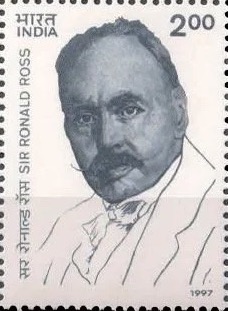
The history of medicine is filled with accidental heroes, but few match the sheer determination of Sir Ronald Ross. In 1897, working out of a sweltering hospital room in Secunderabad, India, Ross discovered the transmission mechanism of malaria. This breakthrough won him the 1902 Nobel Prize in Physiology/Medicine and a knighthood in 1911.
However, his journey was defined far more by frustrating failures, unorthodox experiments, and a deep artistic soul than by sterile laboratory victories. Today, his 19th-century discovery serves as the foundation for modern global health initiatives, which have evolved from simple mosquito nets to historical vaccine rollouts and cutting-edge genetic engineering. Ross was a British medical doctor who made groundbreaking contributions to the field of medicine, particularly in the area of malaria research. He was awarded the Nobel Prize in Physiology/Medicine in 1902 for his work on malaria disease and knighted in 1911 for his contributions to medicine.
From reluctant doctor to tropical pioneer
Born on May 13, 1857, in Almora, India, Ross was the son of a British Indian Army General. Sent to England at age eight for his schooling, young Ronald showed absolutely no initial interest in medicine. His true passions lay in music, mathematics, literature and poetry.
Though he dreamed of becoming a writer, his father insisted on a stable career, enrolling him at St. Bartholomew’s Hospital Medical College in London.
Ross complied, graduated, and in 1881 entered the Indian Medical Service as a surgeon. Over the next decade, his military postings took him across the Indian subcontinent, including Madras, Burma (Myanmar), Baluchistan, The Andaman Islands, Bangalore and Secunderabad.
The breakthrough mentorship: Confronting the “King of Diseases”
In 1894, a chance meeting changed the course of global health. Ross met Sir Patrick Manson, a Scottish physician and pioneer in parasitology. Manson introduced Ross to the devastating reality of malaria research.
At the time, malaria was rightly feared as the “King of Diseases.” In India alone, it claimed over one million lives every single year. Manson believed mosquitoes played a role in the disease, but he lacked the field data to prove it. He challenged Ross to find the missing link.
Unorthodox methods: How Ross tracked the malaria vector
Returning to India, Ross combined rigorous microscopy with relentless, often creative field observation. His research in Secunderabad and Calcutta (Kolkata) showcases a masterclass in scientific persistence.
Finding volunteers willing to risk infection was incredibly difficult. Ross famously paid a malaria patient named Husein Khan 10 annas (a significant sum at the time) to allow himself to be bitten by laboratory-bred mosquitoes. It was from these specific mosquitoes that Ross gathered his most critical data.
Ross was a master of environmental tracking. While living in Bangalore, he noticed his own bungalow was plagued by far more mosquitoes than his neighbours’ homes. He traced the source to an overlooked water tub just outside his window—a simple observation that solidified his understanding of mosquito breeding habits.
During a research trek to Sigur Ghat near Ooty, Tamil Nadu, Ross spotted a mosquito with a strange, tilted resting stance. He documented it as the “dapple-winged” mosquito. This insect was later identified as part of the Anopheles genus—the exact vector responsible for human malaria.
1897: The discovery that saved millions
Working in the suffocating heat of the Begumpet Quarantine Station in Secunderabad, Ross spent hours hunched over a failing microscope, his own sweat rusting the instrument.
On August 20, 1897, his persistence paid off. Dissecting the stomach tissue of an Anopheles mosquito that had fed on Husein Khan, Ross spotted microscopic, pigmented spheres. These were oocysts—the malaria parasite growing inside the mosquito vector.
He had successfully charted the life cycle of the malaria parasite. Ross proved that malaria was not caused by “bad air” (miasma), but was transmitted directly from human to human via the bite of a mosquito.
Beyond the microscope: Math, music and poetry
When Ross resigned from the Indian Medical Service in 1899 to return to England, his scientific career evolved, but his artistic soul remained intact.
He helped establish the Liverpool School of Tropical Medicine, serving as its professor and later as Director of the Ross Institute and Hospital for Tropical Diseases.
Decades ahead of his time, Ross used complex mathematical equations to model how diseases spread through populations, laying the groundwork for modern epidemic tracking.
Ross never stopped writing. He habitually composed poems to process major life events. Immediately after his August 1897 breakthrough, he penned a passionate poem capturing the exhaustion and triumph of his discovery:
This day relenting God
Hath placed within my hand
A wondrous thing; and God
Be praised. At His command,
Seeking His secret deeds
With tears and toiling breath,
I find thy cunning seeds,
O million-murdering Death.
I know this little thing
A myriad men will save.
O Death, where is thy sting?
Thy victory, O Grave?The evolution of the battle: Malaria after Ronald Ross
Ross gave the world the blueprint for malaria eradication: control the mosquito, control the disease. Over the next century, medicine evolved rapidly, turning his foundational science into global health campaigns.
The age of synthetic drugs and DDT (1930s–1960s)
In 1934, researchers synthesised chloroquine, which quickly became the global gold-standard antimalarial drug. Simultaneously, the discovery of DDT (Dichloro-Diphenyl-Trichloroethane) in 1939 gave the world a powerful chemical weapon against the Anopheles mosquito.
Backed by these tools, the World Health Organisation (WHO) launched the Global Malaria Eradication Campaign in 1955, successfully eliminating malaria from Europe and North America. However, the parasite and the mosquitoes eventually mutated, developing widespread resistance to both chloroquine and DDT.
As older drugs failed, Chinese scientist Tu Youyou discovered artemisinin extracted from sweet wormwood. Artemisinin-based combination therapies (ACTs) became humanity’s strongest line of defence against the deadly Plasmodium falciparum parasite, saving millions of lives and earning Tu Youyou a Nobel Prize in 2015.
2026: The dawn of the vaccine era
For over a century after Ross’s discovery, a major piece of the puzzle was missing: a viable vaccine. Because the malaria parasite changes shapes multiple times during its lifecycle, creating a vaccine was notoriously difficult.
Today, global health has reached a monumental turning point with the widespread deployment of the world’s first malaria vaccines:
- The WHO prequalified two highly effective breakthrough vaccines: RTS,S/AS01 and R21/Matrix-M.
- Peer-reviewed data published in The Lancet confirmed that the large-scale public rollout of the RTS,S vaccine has averted 1 in 8 child deaths in highly endemic regions like Ghana, Kenya, and Malawi.
- Backed by Gavi, the Vaccine Alliance, malaria vaccination campaigns have aggressively scaled up across more than 25 countries, including major rollouts in Guinea-Bissau, Uganda, Burundi and Nigeria. Over 50 million children are projected to be immunised by 2030, preventing an estimated 170,000 deaths.
Next-gen frontiers: Rewriting vector control
Scientists are now testing “gene drives” to genetically modify Anopheles mosquitoes so they are unable to carry the malaria parasite, taking Ross’s original vector-control theory into the molecular age.
The United States is deploying advanced biological population control through corporate innovation. Alphabet’s life sciences unit, Verily, is scaling up its “Project Debug” initiative by seeking federal EPA approval to release up to 64 million non-biting male mosquitoes across Florida and California over a two-year span. Rather than altering genetic material directly, these lab-reared insects carry a naturally occurring bacterium called Wolbachia that acts as a form of birth control, preventing wild females from laying viable eggs after mating. Building on successful regional field tests that slashed pest numbers by over 90% in areas like Fresno County, this massive scaling operation aims to suppress local vector populations and curb domestic viral threats like West Nile and dengue without relying on chemical sprays.
Sir Ronald Ross began his journey as a reluctant medical student who wanted to write poetry. By the end of his life, he had used both science and art to conquer one of humanity’s oldest enemies. Today, as vaccines finally begin to tip the scales toward permanent global eradication of malaria, humanity draws closer than ever to fulfilling Ross’s dream: defeating “million-murdering Death”.
Image above: In 1997, the Indian postal service issued a postage stamp commemorating the centenary of Sir Ronald Ross’s discovery of the malaria parasite’s transmission by mosquitoes.
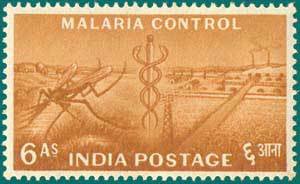
A postage stamp commemorating India’s National Malaria Control Programme was issued in 1955, and is related to the Five Year Plan. The highly successful programme launched in 1953 evolved into the National Malaria Eradication Programme in 1958. Image courtesy Wikipedia.
Visit Malaria Philatelists International for details of the United Nations ‘World United Against Malaria’ stamps campaign launched in 1962, with participation by as many as 80 countries.