
Genuine holiness operates without self-consciousness, quietly diffusing goodness and grace into the world while seeking neither attention nor reward.
“There once lived a man so godly that even the angels rejoiced at the sight of him. But, in spite of his great holiness, he had no notion that he was holy. He just went about his humdrum tasks diffusing goodness like the way of flowers — unselfconsciously, diffusing their fragrance like street lamps diffuse their glow.
The saint’s holiness lay in this – that he forgot each person’s past and looked at them as they were now, and he looked beyond each person’s appearance to the very centre of their being where they were innocent and blameless and too ignorant to know what they were doing. Thus he loved and forgave everyone that he met –and he saw nothing extraordinary in this for it was the result of his way at looking at people.
One day, an angel met him and said, “I have been sent to you by God. Ask for anything you wish and it will be given to you. Would you wish to have the gift of healing?”
“No,” said the man, “I’d rather God did the healing himself.”
“Would you want to bring sinners back to the path of righteousness?”
“No,” he said, “It is not for me to touch human hearts. That is the work of angels.”
“Would you like to be such a model of virtue that people will be drawn to imitate you?”
“No,” said the saint, “For that would make me the centre of attention.”
“What then do you wish for?” asked the angel.
“The grace of God,” was the man’s reply. “Having that, I have all I desire.”
“No, you must ask for some miracle,” said the angel, “Or one will be forced on you.”
“Well then I shall ask for this, let good be done through me without my being aware of it.”
So it was decreed that the holy man’s shadow would be endowed with healing properties whenever it fell behind him. So, everywhere his shadow fell – provided he had his back to it – the sick were healed, the land became fertile, fountains sprang to life and colour returned to the faces of those who were weighed down by life’s sorrow.
But the saint knew nothing of this because the attention of people was so centred on the shadow that they forgot about the man and so his wish that good be done through him and he be forgotten, was abundantly fulfilled.”
Author: Anthony de Mello
Anthony de Mello (1931-1987) was an Indian Jesuit priest and psychotherapist. A spiritual teacher, writer and public speaker, De Mello wrote several books on spirituality and hosted numerous spiritual retreats and conferences. He continues to be known for his storytelling, which drew from the various mystical traditions of both East and West.
Note: While the motif of a healing shadow directly recalls the biblical account of the Apostle Peter in Acts 5:15, this narrative adapts a classic European legend often titled “The Saint’s Shadow.” Anthony de Mello uses the allegory to highlight the purity of unselfconscious virtue—showing that true spiritual grace flows most freely when the ego is completely absent and unaware of its own light.
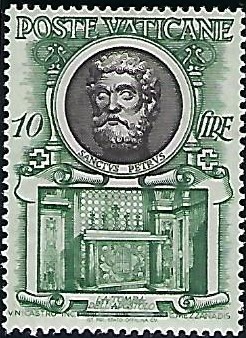
A vintage postage stamp issued by Vatican City (Poste Vaticane) on April 23, 1953. The design features a classical portrait medallion of Saint Peter (Sanctus Petrus) set above a detailed architectural vignette depicting the Tomb of the Apostle (La Tomba dell’Apostolo), commemorating the sacred heart of early Christian history and Apostolic succession. Courtesy Vatican Philatelic Society.