
Examine the strict, egalitarian foundation of life at Sabarmati Ashram through two deeply moving accounts of Mahatma Gandhi’s leadership. The first challenges a traditional monk to look beyond his saffron robes, redefining true spiritual renunciation as a commitment to ego-free community labour. The second reveals the depth of Bapu’s radical empathy as he personally welcomes and nurses an outcast suffering from advanced leprosy, demonstrating that real service knows no boundaries.
A sanyasi (monk), Swami Satydev, spent a day at Gandhiji’s Sabarmati Ashram and then expressed his wish to stay there.
“I like the work you do here,” he told Gandhiji.
Gandhiji said he was welcome to stay as the ashram was meant for people like him, but added, “You will have to put away your saffron robes and dress like the others here.”
The monk did not like that. “I am a sanyasi!” he protested.
“I’m not asking you to renounce sanyas,” explained Gandhiji. “Sanyas is a state of mind. Dress has nothing to do with it. If you wear your ochre robes here, people will not allow you to do work out of respect for your robes. Instead, they will serve you, and that would be contrary to the principles of this ashram. We are here to serve, not to be served.”
The sanyasi thought the matter over and decided to join the ashram.
On another occasion, a man in an advanced state of leprosy came to the ashram and asked for shelter.
“I’ve come to shed me skeleton here,” he said. “I won’t go even if I’m pushed out.”
“How can I say there’s no shelter for you here?” said Gandhiji. “You’re welcome.”
Nursed by Gandhiji, the man spent several days in the ashram before succumbing to the disease.
More at www.motivationjet.com
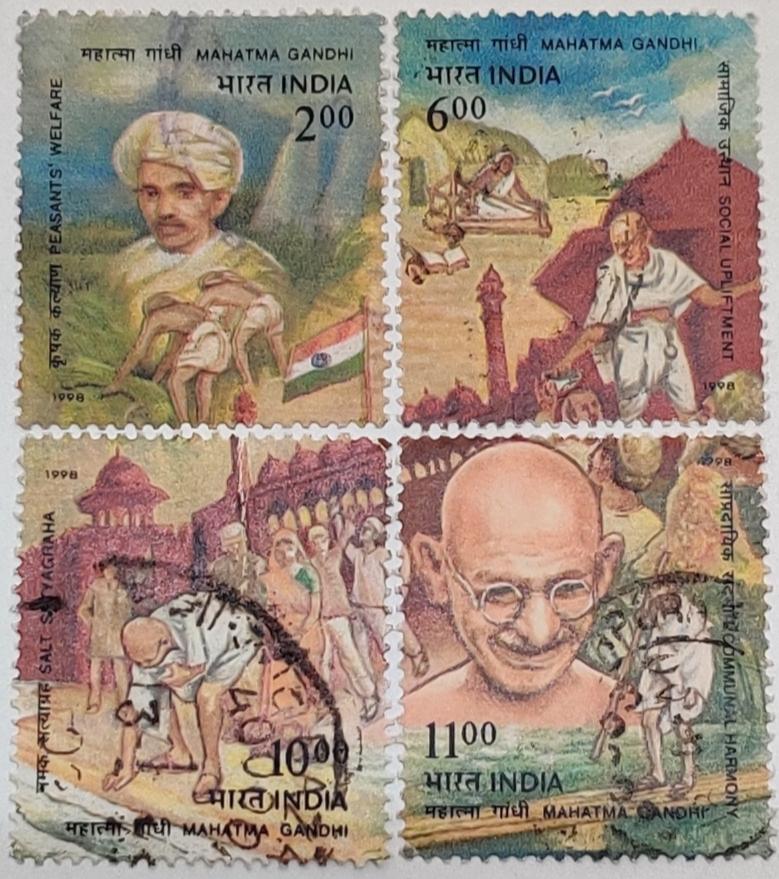
Image: This 1998 commemorative issue from India marks the 50th anniversary of Mahatma Gandhi’s death. Released on January 30, 1998, this distinctive se-tenant block of four stamps features various scenes that illustrate different aspects of his life, philosophy and historical legacy.