
From the tiniest particles to the vastness of the cosmos, atoms connect everything we know about life, matter, and the universe. They are the building blocks of stars, planets, oceans and our own bodies, reminding us that our story is also the story of the material world around us. In this journey through atoms and molecules, we discover not only how matter is put together, but also how the universe has quietly assembled the ingredients of existence itself.
One of the most famous and profound ideas about atoms comes from Richard Feynman, the Nobel Prize-winning American physicist, who once asked his students to imagine a single sentence that could preserve the most important scientific truth if all knowledge were lost.
His answer was simple and unforgettable: All things are made of atoms — tiny particles that are always in motion, attracting one another when they are a little distance apart, and repelling when squeezed too close together.
That thought reaches back to Democritus, the ancient Greek philosopher who proposed that matter is made of indivisible units and empty space. He did not have laboratories or instruments, only imagination, but his idea helped plant the seed of atomic theory.
What makes this idea so powerful is not only that atoms are small, but that they are the basis of everything familiar to us: water, air, stone, blood, fire, thought and memory. The same building blocks that shape a leaf also shape a mountain, a raindrop, and a human being.
Feynman often used vivid comparisons to make this scale feel real. If you could enlarge a tiny piece of matter to the size of something familiar, the atoms inside would still remain astonishingly small. A drop of water, a grain of salt, or a piece of metal would all still be mostly empty space, held together by invisible forces.
That is why science sometimes sounds like poetry. Niels Bohr once remarked that when it comes to atoms, language itself begins to behave like metaphor. We cannot see atoms directly in the way we see a tree or a chair, so we reach for images: dances, clouds, spheres and waves.
Feynman’s deeper point was not merely that atoms exist, but that the world is a pattern of relationships. Atoms are not dead pellets. They move, vibrate, attract, collide and combine. Life, in this view, is not something added to matter from the outside. It is matter behaving in extraordinarily organised ways.
That is what makes the old line from Carl Sagan so moving: We are made of star-stuff. Long before Earth existed, earlier generations of stars forged many of the elements now inside us. Carbon in our bodies, oxygen in our lungs, and iron in our blood were all cooked in the furnaces of stars and scattered into space when those stars died.
So when we say that atoms tell the story of our existence, we are saying something literal. We are not just observers of the universe. We are part of its long chemical autobiography.
Atoms and molecules
To understand this story more clearly, it helps to begin with the basics.
An atom is the smallest unit of an element that still keeps that element’s identity. A molecule is a group of two or more atoms bonded together.
Think of atoms as letters and molecules as words. Or think of atoms as LEGO bricks and molecules as the structures built from them. The analogy is not perfect, but it helps us understand how simple pieces can form complex things.
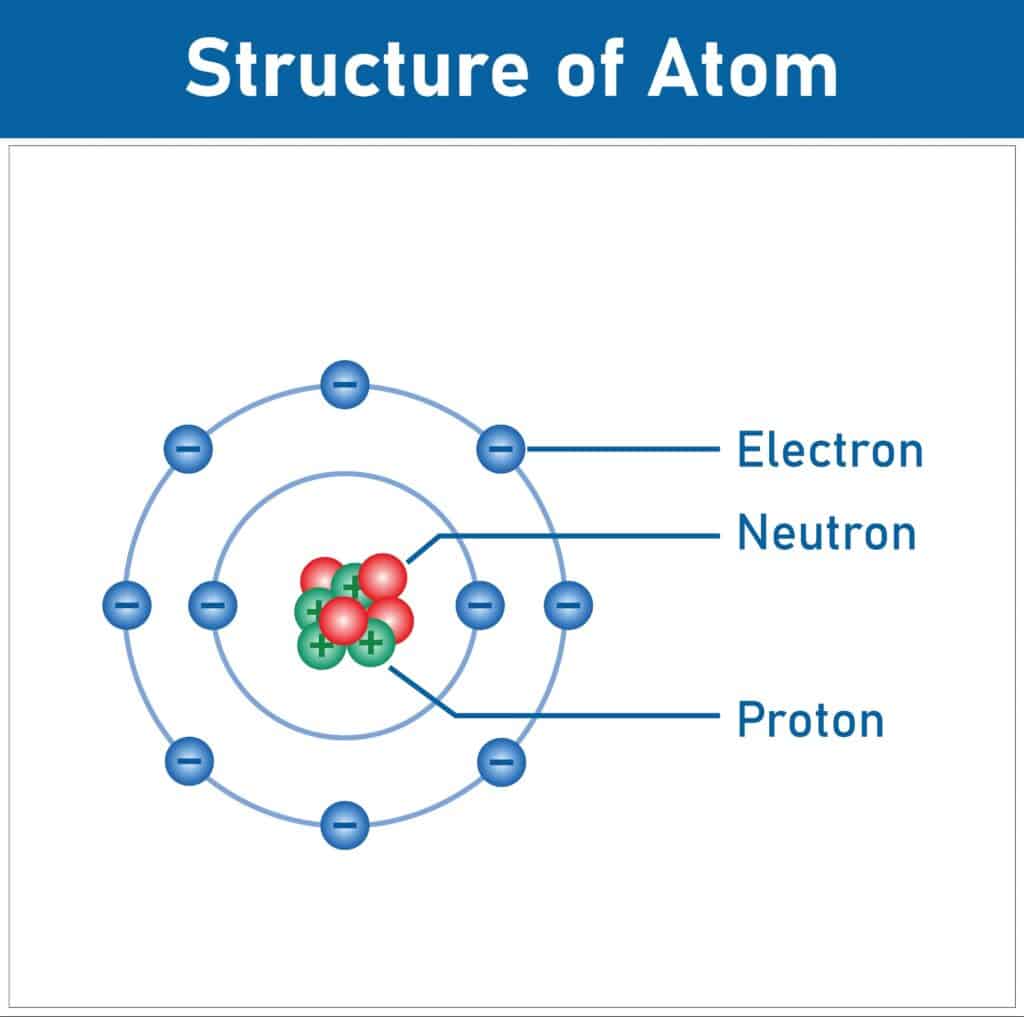
An atom is mostly empty space. At its centre is a nucleus, a dense core containing protons and neutrons. Around it are electrons, which form a cloud rather than neat little planetary paths. Older books sometimes compare atoms to miniature solar systems, and that image is useful as a first approximation, but modern physics tells us the reality is more subtle.
The nucleus carries almost all the atom’s mass. Protons have positive charge, neutrons have no charge, and electrons have negative charge. The attraction between opposite charges helps hold atoms together and gives matter its structure.
How molecules form
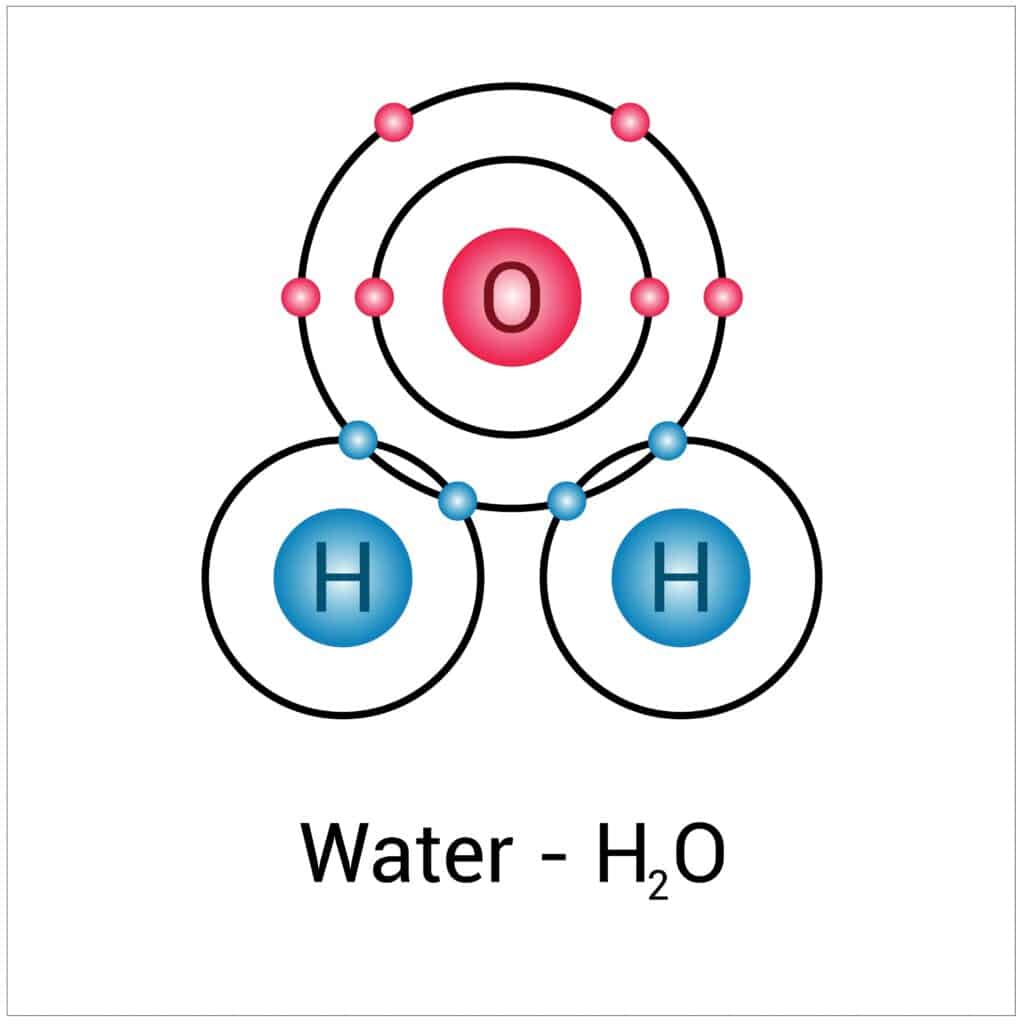
Atoms become molecules when they bond. In a covalent bond, atoms share electrons. In an ionic bond, one atom transfers electrons to another, and the opposite charges then attract.
Water is a classic example. One oxygen atom combines with two hydrogen atoms to form H₂O. Oxygen gas is another: two oxygen atoms join to make O₂.
These bonds are not random. Atoms tend to arrange themselves in ways that lower their energy and make them more stable. That simple tendency shapes chemistry, biology, and ultimately life itself.
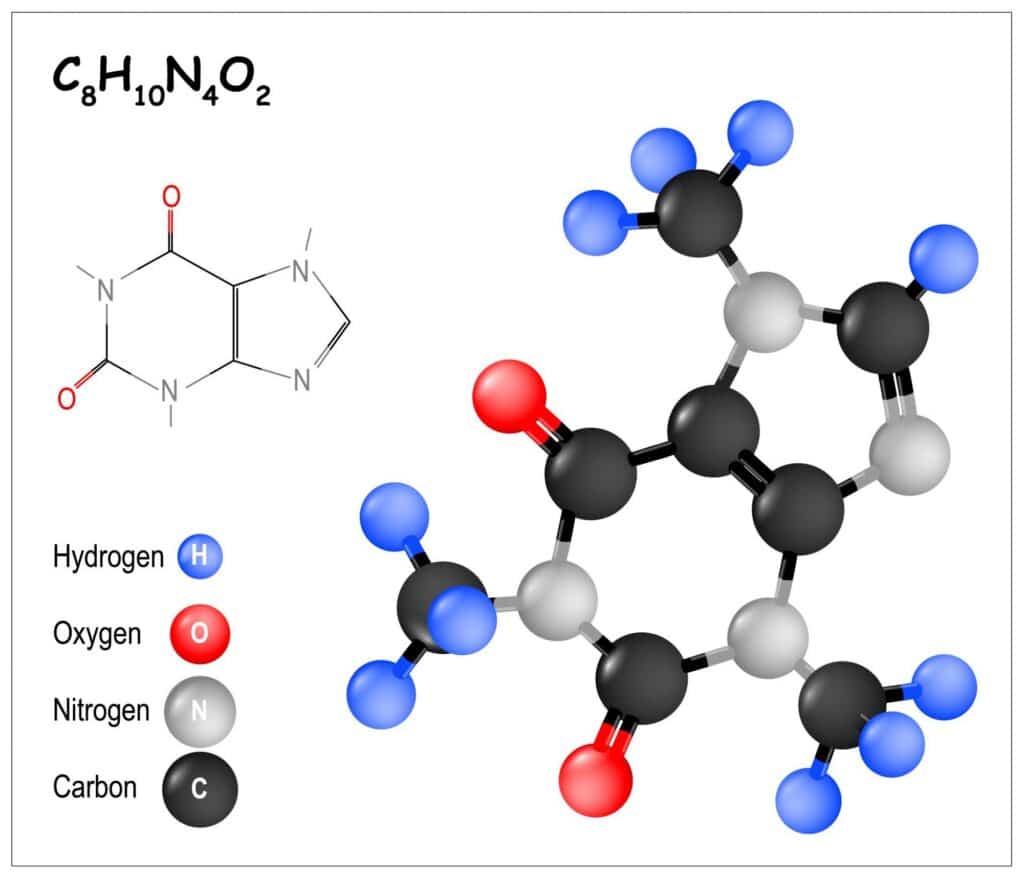
The same principle explains the variety of substances around us. Carbon dioxide, sugar, caffeine, salt, and DNA are all made from atoms, but arranged in different ways. The arrangement matters as much as the ingredients.
Elements and isotopes
An element is a pure substance made of one kind of atom. What makes one element different from another is the number of protons in the nucleus.
Hydrogen has one proton. Oxygen has eight. Gold has seventy-nine. The Periodic Table of emements is essentially a map of all these atomic identities and how they behave.
Atoms of the same element can still differ in mass if they contain different numbers of neutrons. These versions are called isotopes.
Carbon-12, carbon-13, and carbon-14 are all carbon because they have six protons. But they differ in neutron number, which changes their mass. Carbon-14 is radioactive and useful for dating ancient remains.
States of matter
Atoms and molecules also explain why matter exists as solids, liquids and gases.
In solids, particles are held tightly in place and can only vibrate. In liquids, particles remain close together but can slide past one another. In gases, particles move freely and spread out.
Heat changes how those particles behave. Add enough energy, and a solid can melt into a liquid. Add more, and the liquid becomes a gas. In every case, the matter is still made of the same atoms; only their arrangement and motion change.
This is why water can be ice, liquid water, or steam. The substance is the same, but the behaviour of its atoms and molecules is not.
Reactions and change
Chemical reactions happen when atoms rearrange themselves into new combinations.
Sometimes bonds break and new ones form. Sometimes energy is released, as in fire. Sometimes energy is absorbed, as in photosynthesis. The atoms are not destroyed in ordinary chemical reactions; they are simply reorganised.
That is why the world can change so dramatically while its basic ingredients remain the same. A match burns, a leaf grows, food cooks, metal rusts, and all the while atoms keep moving from one arrangement to another.
Catalysts help some reactions happen faster by lowering the energy barrier. They do not create the reaction, but they make it easier for it to occur.
Deeper than chemistry
When we move below chemistry, we reach particle physics.
At that level, matter is made of smaller constituents such as quarks and leptons, and the interactions between them are carried by force particles called bosons.
Quarks combine to form protons and neutrons. Electrons belong to the lepton family. Photons carry electromagnetic force. Gluons hold quarks together inside protons and neutrons. The W and Z bosons are responsible for the weak nuclear force.
The Standard Model of particle physics is the framework that describes these pieces and the forces between them. It does not explain everything, but it explains a great deal of the visible universe with remarkable precision.
The Higgs boson is part of that picture too. It is associated with the Higgs field, which helps explain why some particles have mass.
The forces that shape everything
Four fundamental forces govern the universe: gravity, electromagnetism, the strong nuclear force, and the weak nuclear force.
The strong force binds quarks together and holds atomic nuclei together. Electromagnetism governs light, electricity, magnetism and chemistry. The weak force enables certain kinds of radioactive decay and helps power the nuclear reactions inside stars. Gravity shapes planets, stars, galaxies and the large-scale structure of the cosmos.
These forces are invisible, but they are never absent. Every step we take, every breath we draw, and every object we hold is possible because these relationships are constantly at work.
Why this matters
The beauty of the atomic story is that it connects the smallest things to the biggest ones.
The dust in the air, the water in the sea, the iron in our blood, and the light from distant stars all belong to the same physical universe. What seems separate at first glance is joined by common substance and common law.
That is why atoms feel so humbling. They remind us that we are made from ancient matter, assembled into living form by time, chemistry and cosmic history.
And that is also why they feel so hopeful. If matter can become life, memory, language and wonder, then the universe is not only a place of blind mechanics. It is also a place where pattern becomes meaning.
We are, in the deepest sense, a way for the universe to know itself.
Notes:
Democritus’s idea of “atomos” means indivisible, but modern science shows atoms are themselves made of smaller particles.
The miniature solar-system image for an atom is only an analogy; electrons do not literally orbit like planets.
Chemical reactions rearrange atoms, but nuclear reactions can change one element into another.
The Higgs boson is not a “God particle” in any scientific sense; that nickname is informal and controversial.
Sources:
Atoms in Motion 1 https://www.feynmanlectures.caltech.edu/I_01.html
The Feynman Lectures on Physics https://www.feynmanlectures.caltech.edu/info/flp.html
The standard model of particle physics – Nature https://www.nature.com/articles/nature06073
The Standard Model – Home | CERN https://home.cern/science/physics/standard-model/
The Higgs boson – CERN https://home.cern/science/physics/higgs-boson/
CERN and the Higgs boson https://home.cern/resources/faqs/cern-and-higgs-boson