The invisible workforce: Why it’s time to give germs the respect they deserve
Though modern society has long conditioned us to fear “germs” as invisible villains, a deeper look into the history of medicine and human biology reveals they are actually the essential caretakers of our planet. This microbial narrative traces why we must shift our perspective from fear to respect, highlighting when historic breakthroughs—like Mary Hunt’s wartime discovery of a penicillin-rich cantaloupe in 1941—shattered bottlenecks and saved hundreds of millions of lives. The text dynamically breaks down how these trillion-strong communities operate as vital internal lifelines, culinary masters, and environmental recycling crews that generate over half the world’s oxygen supply. Ultimately, by mapping out what these diverse organisms achieve—from building our immune memory through vaccines to driving biotechnology—this overview delivers a powerful argument for calling a truce with our microscopic allies and appreciating the beautiful, hidden ecosystems that keep us alive.
All of us grow up learning to fear the things we cannot see. From a young age, the word ‘germ’ is used as a warning—a synonym for sickness, dirt and danger. But as I dove into the history of medicine and the science of our own bodies, I realised how deeply we have misunderstood the microbial world. This piece is an invitation to look past the hand sanitiser and view these trillion-strong communities not as invisible villains, but as the quiet, essential caretakers of our health and our planet.
The cantaloupe melon that saved 500 million lives
To truly appreciate this hidden world, we must look back at a transformative chapter in medical history—a story centred around a common grocery store fruit.
1
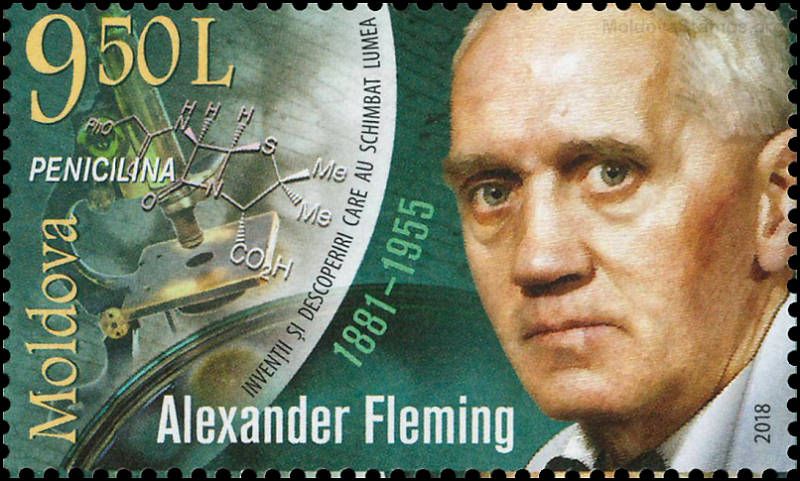
We all know the famous story of Dr. Alexander Fleming, who returned from a summer vacation in 1928 to find a messy lab bench. A stray, microscopic fungal spore—a “germ” named Penicillium—had drifted through an open window, landed on his Petri dish, and naturally wiped out the surrounding harmful bacteria. Fleming had discovered penicillin, the world’s first antibiotic.
But there is a second, much more human chapter to this story that history often forgets.
By the 1940s, World War II was raging. Soldiers were dying by the thousands, not just from combat, but from infected wounds. Scientists desperately needed to mass-produce Fleming’s miraculous penicillin, but the original strain of the mould was incredibly stubborn. It grew painfully slowly. Producing just a single, tiny dose of medicine required gallons of liquid broth. It was a heartbreaking bottleneck; the cure existed, but it was too slow to save the world.
2
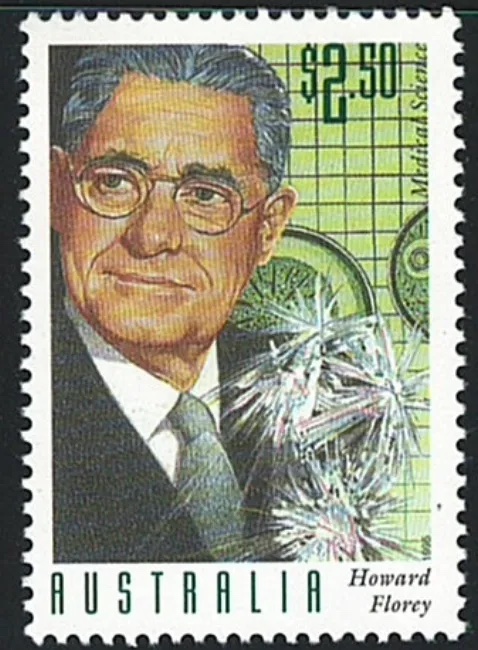
In 1941, an Oxford University research team, led by Australian pharmacologist Howard Florey and British biochemist Norman Heatley, relocated from England to Peoria, Illinois, USA, to find a way to mass-produce the stubborn penicillin cultures. They partnered with the U.S. Department of Agriculture’s Northern Regional Research Laboratory (NRRL) in Peoria because of its world-class expertise in agricultural fermentation. The team hired a local woman named Mary Hunt. Her unique job title? A mould hunter.
Mary spent months visiting local fruit markets, grocery stores and bakeries, searching for different strains of mould that might grow faster. One ordinary afternoon, she walked into a grocery store and spotted a bruised, rotting cantaloupe melon covered in a thick, golden-yellow mould. To anyone else, it was garbage; to Mary, it was a breakthrough.
She rushed the fruit back to the lab, where testing revealed a medical miracle: this specific strain (Penicillium chrysogenum) produced over 200 times the amount of penicillin as Fleming’s original mould. By bombarding it with X-rays, the Peoria team boosted that output to a staggering 1,000 times the initial rate.
Though locals affectionately mocked her with the nickname “Mould Mary,” her relentless search shattered the wartime bottleneck. Thanks to Mary’s cantaloupe and Peoria’s massive industrial fermentation vats, production skyrocketed from a few agonising drops to billions of units. By June 1944, a staggering 2.3 million doses were ready and waiting for the Allied forces hitting the beaches of Normandy on D-Day. Mary Hunt’s rotting fruit didn’t just revolutionise modern medicine; it fundamentally altered the course of World War II, transforming a neglected laboratory accident into a shield that saved millions of lives.
Remarkably, this powerful defence against microbial infections comes directly from a microbe itself, as penicillin is naturally produced by a strain of living fungus. The history of penicillin is considered a pivotal milestone in human health. It effectively divided medical history into two eras: the pre-antibiotic era and the modern era. Before its widespread use, life expectancy was dramatically shorter, and human populations had few defences against simple infections.
3
Penicillin is estimated to have saved over 500 million lives since World War II, fundamentally transforming human survival rates in three key areas. It eradicated the fatal threat of scarlet fever, diphtheria and infant bacterial infections. It plummeted battlefield pneumonia death rates from 18% in WWI to under 1% in WWII. It created a safety net against lethal infections, enabling complex surgeries, organ transplants, and cancer treatments.
The tragic reality of the microbial world
Imagine working a non-stop, 24-hour shift, entirely invisible, only to be feared and hunted by the very people you are protecting. This is the tragic reality for the trillions of microbes sharing our world.
We grow up viewing “germs” as microscopic villains to be scrubbed away. In truth, less than 1% of them mean us any harm. The rest are loyal, unsung heroes. They are the internal architects training our immune systems, the ancient chefs fermenting our food, and the planetary custodians recycling life on Earth. They do not want to attack us; they are simply trying to keep us—and the world—alive. It is time to call a truce, stop the mindless scrubbing, and give these microscopic marvels the respect they deserve.
Let me give you some examples from the real world:
Our internal lifeline: The loyal micro-citizens
Inside each of our guts and across our skins lives a bustling society of trillions of microbes. They are not invaders; they are our body’s most devoted caretakers.
The Gentle Guides: From the moment we are born, these microbes act as patient teachers for our immune systems. They gently train our bodies to recognise what is safe and what is a threat, shielding us from allergies and chronic disease.
The Unsung Chefs: Every day, they work tirelessly in our digestive tracts, breaking down complex fibres our own bodies cannot process. Without their daily labour, we could not have unlocked the full nutrition of the food we take in.
Our Micro-Pharmacy: They manufacture vital nutrients entirely from scratch, including Vitamin K for blood clotting and B vitamins for mental energy. They give us what we cannot make ourselves.
The Living Shield: Like a peaceful community protecting its neighbourhood, good bacteria crowd our skin and organs. By simply thriving there, they leave no room for harmful pathogens to take hold.
Food and agriculture: Microscopic culinary masters
Beyond our bodies, we rely directly on the metabolic wizardry of microorganisms to populate our pantries and sustain global food systems.
The Fermentation Craftsmen: Microbes are responsible for transforming raw ingredients into complex delicacies. Without the metabolic work of specific bacteria and yeasts, foods like cheese, yogurt, sourdough bread, kimchi and soy sauce would simply not exist.
Natural Fertiliser Networks: Beneath the surface of agricultural fields, soil bacteria form a quiet partnership with plants. They pull nitrogen gas from the air and chemically convert it into a water-soluble form that crop roots can actually absorb, serving as the planet’s primary organic fertiliser.
Microbial Bodyguards: Certain beneficial fungi and bacteria act as localised, eco-friendly pest control. By colonising plant root systems, they actively repel or destroy destructive agricultural pests and root-rotting diseases without chemical runoff.
Environmental recycling: The planet’s ultimate custodians
If microbial life were to go on strike tomorrow, the Earth’s natural cycles would grind to an immediate, catastrophic halt. Microbes are the ecological glue holding our biosphere together.
The Great Recyclers: Fungi and soil bacteria perform the sacred, necessary task of decomposition. They break down fallen leaves, dead wood, and organic matter, stripping them down to basic minerals and recycling those vital nutrients back into the soil for the next generation of life.
The Environmental Rescuers: When pollution threatens ecosystems, specialised bacteria step into the danger zone. Through a process called bioremediation, these hungry microbes consume toxic compounds, successfully neutralising devastating oil spills, breaking down microplastics, and purifying contaminated groundwater.
The Breath of the World: Floating in our oceans, microscopic cyanobacteria (blue-green algae) perform photosynthesis on a planetary scale. They exhale more than half of the oxygen available in Earth’s atmosphere. Every second breath we take is a direct gift from a marine microbe.
Medicine and biotechnology: Designing the future
Modern medicine has learned that the best way to fight human vulnerability is to recruit microbial allies to do the heavy lifting in laboratories.
The Source of Our Shield: In a beautiful twist of biological irony, nearly all of our primary tools against bacterial infections come from microbes themselves. Soil bacteria and fungi naturally secrete powerful chemical defences to protect their territory, which scientists harvest to create modern antibiotics.
Biomolecular Factories: Thanks to genetic engineering, we can teach harmless bacteria to serve as tiny medical manufacturing plants. By inserting specific instructions into their DNA, labs utilise bacteria to mass-produce precise human proteins, such as the life-saving insulin required by millions of diabetics worldwide.
The dark side: How and why microbes cause harm
While many microorganisms are vital allies, certain strains act as pathogens, causing disease across the living world. They do not cause harm out of malice, but rather as a byproduct of their biological drive to survive, replicate and colonise.
In Humans and Animals: Harmful microbes infiltrate the body through food, water, air or physical contact. Once inside, they cause sickness in two primary ways: cellular destruction (where viruses or bacteria hijack and rupture host cells to replicate) and toxin production (where bacteria secrete chemical poisons that disrupt vital bodily functions, as seen in tetanus or food poisoning).
In Plants:Fungal spores, bacteria and viruses attack agricultural crops by clogging their vascular systems, rotting roots, or destroying leaves. This disrupts photosynthesis, stunts growth, and can devastate entire food supplies, much like the infamous fungus-like microbe responsible for the Irish Potato Famine.
The pathogens responsible for these diseases span multiple biological groups—including bacteria, fungi, protista and non-living viruses—with only a select few multicellular parasites belonging to the animal kingdom.
The Ultimate Irony: Microbes as their own remedy
In a brilliant twist of natural history, humanity’s most powerful weapons against harmful microorganisms are harvested directly from the microscopic world itself. Microbes have spent billions of years competing with one another for limited resources, evolving highly sophisticated chemical warfare tactics to kill off their rivals.
4
The Fungal Shields (Antibiotics): Modern medicine unlocked this hidden armoury with the discovery of penicillin, an antibacterial drug naturally secreted by a living fungus to protect its own territory from invading bacteria.
The Bacterial Competitors: Many other life-saving antibiotics, such as streptomycin, are harvested directly from soil-dwelling bacteria (Streptomyces) that naturally produce toxins to eliminate competing bacterial strains.
The Viral Assassins (Phage Therapy): Scientists are increasingly using bacteriophages—specialised viruses that selectively target and destroy lethal bacteria without harming human cells—to cure antibiotic-resistant superbug infections.
Vaccines: The biological blueprint of immunity
5
A vaccine is a biological preparation that trains our immune system to recognise and fight specific pathogens by simulating an infection without causing the actual disease. Globally, there are active vaccines available to protect against 28 distinct, major vaccine-preventable diseases,representing roughly 100 individual approved vaccine products.
Vaccines work on the principle of biological imitation, training the human body to fight diseases without causing actual illness. When a vaccine is administered, it introduces a harmless element—known as an antigen—that mimics a specific virus or bacterium. The body’s immune system recognises this foreign material and launches a primary defence response. During this process, specialised cells generate targeted proteins called antibodies to neutralise the simulated threat, establishing a safe, controlled rehearsal of the body’s natural defence network.
The ultimate goal of this simulation is the creation of long-lasting immunological memory. Once the vaccine’s harmless components are cleared, specialised memory B-cells and T-cells remain dormant in the body for years. If the individual is ever exposed to the actual, dangerous pathogen in the future, these memory cells instantly recognise the invader. They launch a rapid, high-powered secondary response that neutralises the germ before it can replicate, effectively preventing severe illness or infection.
To trigger this memory, modern medicine utilises several distinct vaccine designs depending on the nature of the pathogen. Some vaccines use weakened or completely inactivated versions of a germ, while others use only tiny, specific fragments like proteins or sugars. Advanced methods, such as mRNA technology, skip the physical virus entirely and instead deliver a temporary genetic blueprint that instructs the body’s own cells to manufacture the target antigen. Regardless of the design, every vaccine relies on this same fundamental principle of safe exposure to build enduring immunity.
A layman’s peep into the microbial world
Now that we understand how microorganisms benefit us, we can explore their hidden world through a layman’s lens. This guide maps out essential everyday terms using clear examples and analogies, together with insights from pioneering scientists who dedicated their lives to uncovering these microscopic mysteries.
1. Microbe (Microorganism)
Definition: Any microscopic organism that is too small to be seen by the naked eye. This umbrella term includes bacteria, viruses, fungi, algae and protozoa.
Example: Saccharomyces cerevisiae (the common baker’s yeast).
Analogy: Microbes are like the software of Earth’s biosphere—mostly invisible to the user, but running every critical background process that keeps the system alive.
Quote: “The role of the infinitely small in nature is infinitely great.” — Louis Pasteur
2. Germ
Definition: A non-scientific, colloquial term used to describe any microscopic entity (usually a bacterium or virus) that can cause disease.
Example: Rhinovirus (the common cold germ).
Analogy: Germs are like digital malware. They represent only a tiny fraction of all existing code, but they get all the news coverage because they cause system crashes.
Quote: “We are living in a world of germs, and we are lucky to be alive.” — William Osler
3. Bug
Definition: An informal, slang term used by the public and medical professionals to refer to an infectious microorganism. (Note: In biology, a “true bug” is actually an insect belonging to the order Hemiptera).
Example: The “stomach bug” (often Norovirus).
Analogy: Calling a microbe a bug is like calling a smartphone glitch a ‘bug’—it is not technically an insect, but everyone immediately understands that it means something is causing trouble.
Quote: “If you think you are too small to make a difference, try sleeping with a mosquito.” — Dalai Lama (Captures the disruptive power of tiny “bugs”).
4. Pathogen
Definition: Any microorganism or biological agent capable of causing disease in its host. This is a precise scientific term that covers specific harmful strains of bacteria, viruses, fungi, protozoa and prions.
Example: Yersinia pestis (the bacterium responsible for the bubonic plague) or Influenza virus.
Analogy: A pathogen is like a professional safe-cracker. While millions of people (normal microbes) walk through a bank every day without causing trouble, a safe-cracker enters with the specific tools and intent to breach the security system and disrupt operations.
Quote: “A pathogen is an organism that has found a way to exploit our defences for its own survival.” — Unknown Biologist
5. Bacteria
Definition: Single-celled, prokaryotic organisms (cells without a nucleus) that exist in massive numbers in nearly every environment on Earth.
Example: Lactobacillus acidophilus (the beneficial bacteria that turns milk into yogurt).
Analogy: Bacteria are like single-cell Swiss Army knives. They are structurally simple, but they can eat oil, generate electricity, survive in volcanic vents, and duplicate themselves in minutes.
Quote: “Bacteria are the true rulers of this planet. We are just walking buildings for them to live in.” — Unknown Microbiologist
6. Virus
Definition: An infectious agent consisting of genetic material (DNA or RNA) wrapped in a protein coat. Viruses cannot reproduce on their own and must hijack a host cell to replicate.
Example: Bacteriophages (viruses that specifically hunt and destroy harmful bacteria).
Analogy: A virus is like a flash drive containing a rogue command script. It is completely inert on your desk, but once plugged into a computer (a host cell), it takes over the entire operating system.
Quote: “A virus is a piece of bad news wrapped up in protein.” — Peter Medawar
7. Fungi
6
Definition: Eukaryotic organisms (cells with a nucleus) that include yeasts, molds and mushrooms. They absorb nutrients from organic matter rather than producing food through photosynthesis.
Example: Penicillium chrysogenum (the mould that produces the life-saving antibiotic penicillin).
Analogy: Fungi are the recycling crew of the planet. They act like an environmental cleanup squad that dismantles heavy infrastructure (like dead trees) and returns the raw materials to the soil economy.
Quote: “Fungi are the grand recyclers of the planet, turning death into life.” — Paul Stamets
8. Algae
Definition: A diverse group of photosynthetic organisms that live primarily in water. Microscopic algae (microalgae) form the baseline of aquatic food webs.
Example: Phytoplankton or Spirulina.
Analogy: Microscopic algae are the solar panels of the oceans. They float on the surface, capture sunlight, pump out massive amounts of oxygen, and power the entire marine food chain.
Quote: “Every second breath we take comes from the ocean, largely thanks to microscopic algae.” — Sylvia Earle
9. Protozoa
Definition: Single-celled eukaryotic organisms that exhibit animal-like behaviours, such as motility (movement) and predatory hunting of other microbes.
Example: Amoeba proteus or Paramecium.
Analogy: Protozoa are the wolves of the microscopic safari. Unlike stationary microbes, they actively stalk, chase down, and swallow bacteria whole.
Quote: “In a drop of water, I found a world of creatures that moved with the agility of tigers.” — Antonie van Leeuwenhoek
10. Extremophile
Definition: Microorganisms (often belonging to the ancient domain Archaea) that thrive in extreme environments once thought completely uninhabitable by life.
Example: Thermus aquaticus, a bacterium thriving in the boiling geothermal waters of Yellowstone National Park.
Analogy: Extremophiles are the ultimate survivalists or ‘astronauts’ of the microbe world. They live comfortably in places that would instantly dissolve human cells, like pools of acid, deep-ocean volcanic vents, or radioactive waste.
Quote: “Extremophiles prove that life is not a fragile exception in the universe, but an unstoppable force.” — Unknown Astrobiologist
11. Biofilm
Definition:A structured community of microbes that stick to each other and to a surface, embedded within a self-produced slimy matrix of sugars and proteins.
Example: Dental plaque on your teeth, or the slippery slime on rocks in a stream.
Analogy: A biofilm is like a microscopic fortified city. Instead of living as vulnerable individuals, the microbes build walls, roads and defence systems out of slime, making them up to 1,000 times more resistant to threats.
Quote: “Bacteria are rarely lonely; they prefer to live in cities of their own making.” — Unknown Microbiologist
12. Microbiome (or Microbiota)
Definition: The complete community of microorganisms (bacteria, fungi, viruses) that inhabit a specific environment, such as the human gut, skin or soil.
Example: The human gut microbiome, which contains trillions of microbes weighing up to 2 kilograms.
Analogy: A microbiome is like a bustling tropical rainforest inside you. It is an entire, self-sustaining ecosystem where different species trade resources, protect territory, and keep the environment healthy.
Quote: “We are not individuals; we are walking ecosystems.” — Scott F. Gilbert
13. Symbiont (Symbiosis)
Definition: An organism living in a close, long-term physical relationship with another species. When both benefit, it is called mutualism.
Example: Rhizobium bacteria living in legume plant roots, trading nitrogen for plant sugars.
Analogy: Symbionts are like business partners with complementary skills. One partner handles the raw materials (like harvesting sunlight), while the other handles manufacturing (like turning raw chemistry into nutrients).
Quote: “Life did not take over the globe by combat, but by networking.” — Lynn Margulis
14. Probiotic
Definition: Live microorganisms that, when consumed in adequate amounts, confer a health benefit on the host.
Example: Bifidobacterium strains found in active cultures of yogurt and dietary supplements.
Analogy: Probiotics are like hiring a private security detail for your gut. You are intentionally importing highly trained, friendly forces to restore law and order to your digestive tract.
Quote: “Let food be thy medicine and medicine be thy food.” — Hippocrates (often quoted in modern probiotic research)
Calling a truce
Humanity’s greatest medical shield didn’t come from a sterile, chemically bleached laboratory. It came from a microscopic fungus living on a piece of discarded fruit. What we blindly label as “gross” or “dirty” is often just nature quietly holding the answers to our survival.
While washing our hands remains vital for stopping the rare bad actors, blasting our environments with harsh antibacterial chemicals does more harm than good. It is like destroying an entire peaceful ecosystem just to catch a single trespasser. By shifting our perspective from fear to respect, we can learn to appreciate the beautiful, invisible workforce keeping our body, our food, and our planet alive.
Image 1: Moldova celebrated the discovery of penicillin by Alexander Fleming with a postage stamp issued in 2018. Courtesy Wikimedia Commons.
Image 2: A 1995 Australian postage stamp honouring Nobel Prize-winning medical scientist/pathologist Howard Florey (1898–1968), who helped develop penicillin for mass production. The stamp was part of a 1995 “Medical Scientists” set.
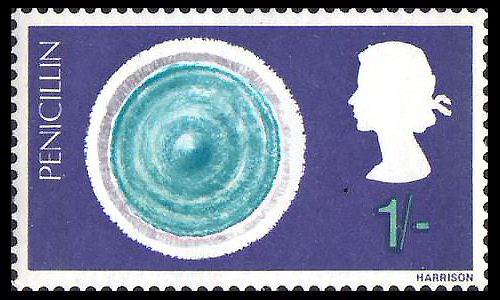
Image 3: This stamp on penicillin issued in Great Britain in 1967 was part of a set depicting great British discoveries. The other stamps showed radar, television and the jet engine. Courtesy: https://www.baus.org.uk/
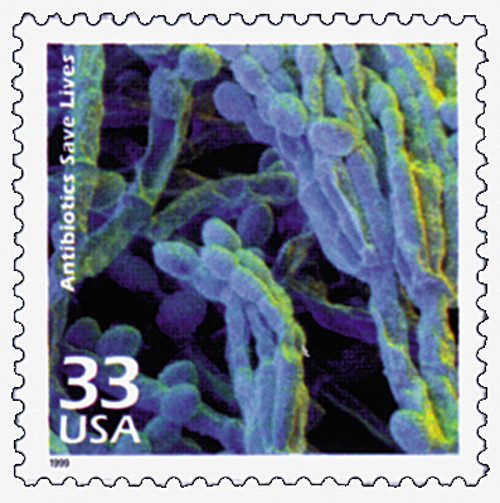
Image 4: A 1999 US postage stamp from the “Celebrate the Century” series depicting bacteria and bearing the text “Antibiotics Save Lives”. It was released to celebrate medical advancements during the 1940s.
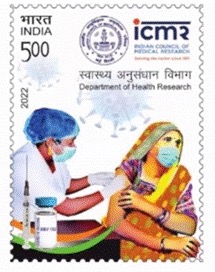
Image 5: A commemorative postage stamp issued by India Post in 2022 to mark the first anniversary of the country’s national COVID-19 vaccination programme. The stamp features the logo of the Indian Council of Medical Research (ICMR) and was released to recognise the efforts of frontline healthcare workers and scientists.
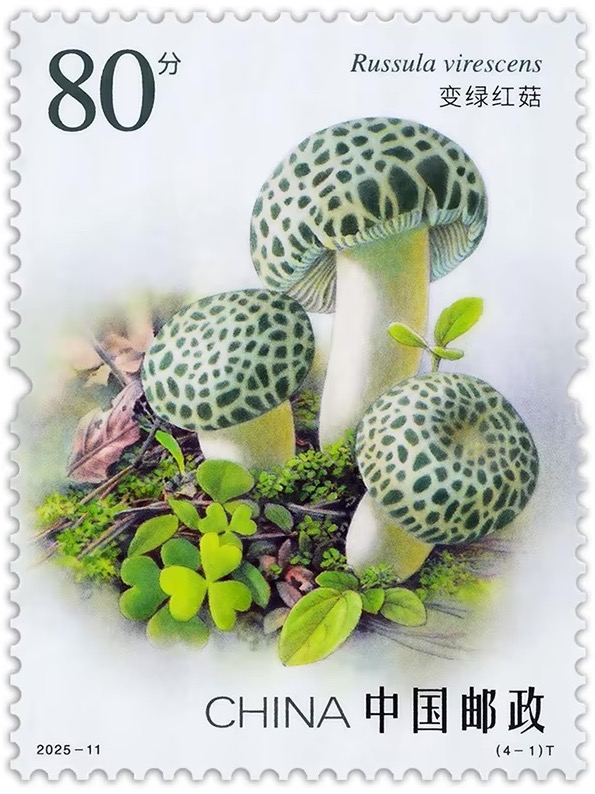
Image 6: A special stamp issued by China Post on edible fungi in 2025, depicting Russula virescens It is part of a four-stamp set featuring other fungi like Naematelia Sinensis and Tricholoma Matsutake. Courtesy Facebook post.