Navigating rapid global shifts, economic uncertainty, and digital overwhelm, today’s young generation carries a profound weight—yet their story is far from one of surrender. Across continents, young people are translating personal fatigue into collective courage, turning neighborhood group chats into crisis relief hubs and destigmatising mental health with radical honesty. Today’s Youth Around the World: Tired, Brave, and Still Showing Up explores how a generation under pressure continues to choose empathy, mutual aid, and active hope in building a more human future.
On a humid evening in a crowded Indian city, nineteen‑year‑old Aarav sat on the edge of his bed with one hand on a laptop and the other around a half‑cold cup of tea. He had just finished an online class, answered messages from two friends who were “doing badly but pretending not to,” helped his younger sister with homework, and submitted an application for a job that might never reply.
“It’s like we are always running,” he said, smiling without much joy. “Not because we want to race, but because if we stop, everything catches up with us.”
If that line makes you nod, you’re not alone. His story is not unusual. Across the world, young people are waking up to a century that promises possibility but delivers pressure just as quickly. They are studying, working, caregiving, creating, protesting, organising, healing and trying to make sense of a future that feels both open and uncertain.
The world is asking them to be resilient, inventive and calm in the face of crisis, even as it keeps producing new ones. Yet what stands out most is not how much they are struggling. It is how persistently they keep going—how often they say, “We’re tired, but we’re not done yet.”
A generation under strain, yet moving

Today’s youth are growing up in a world shaped by climate anxiety, political instability, economic insecurity, social media pressure, rising loneliness and rapidly changing technology. These are not separate problems. They overlap, feed each other and often land on young shoulders all at once.
“We are expected to adapt to everything,” said a university student from a middle‑income country. “But nobody asks what it costs us to keep adapting.”
You might know that feeling in your own way. In many places, young people are under pressure to perform well in school, support their families, build careers early, stay socially visible and remain emotionally composed. For some, the burden is painfully practical: lack of jobs, high costs of education, poor public services, unsafe neighbourhoods, or displacement. For others, especially in more affluent settings, the burden is quieter but no less real: perfectionism, isolation, burnout, identity stress and the fear of not measuring up.
A youth development expert could describe this as a generation growing up under “stacked pressures.” An academic might say the young are facing simultaneous structural, social and psychological stressors, with fewer guarantees than previous generations. But the plain truth is easier to understand: many young people are tired.
And still, they continue.
What they want (and what you might want too)
If you listen carefully, young people around the globe are not asking for impossible things. They are asking for fairness, safety, respect and the chance to build a life that means something.
“We just want a fair shot,” said a first‑generation graduate. “Not pity. Not speeches. A fair shot.”
That simple line carries a great deal. Across countries and communities, youth hope for good education, decent work, affordable living, mental‑health support, stable relationships and institutions they can trust. They want adults to stop speaking about them as a problem to be managed and start treating them as partners—with ideas, energy and judgement.
One mental‑health expert who works closely with young leaders put it this way: “Co‑creating with youth is not just ethical, it’s strategic. They’re already leading the conversation; our job is to listen and follow their lead.”
That is the heart of the matter. The desire for dignity is universal, even if the paths to dignity are not. In one place, it may mean access to internet and textbooks. In another, it may mean protection from violence. Elsewhere, it may mean being listened to at home or being taken seriously at work. But beneath all of it is the same wish: to be able to shape one’s own life.
Common fears, different realities
The world often talks about “the youth” as though it were one single category. It is not. A teenager in a war zone, a student in a wealthy city, a young farmer in a drought‑hit region, a tech worker in a global hub and a migrant trying to send money home – live very different lives.
Still, some fears are shared.
Will I find a job?
Will I ever feel secure?
Will I be able to support my family?
Will I be left behind by technology?
Will the planet still be liveable?
Will I ever feel understood?
These questions are not signs of weakness. They are signs of awareness. Young people are seeing what many older institutions have struggled to face honestly: that the future is not arriving in a neat, orderly line. It is arriving in fragments, often under pressure.
A youth climate volunteer put it plainly: “We’re not scared of hard work. We’re scared of inheriting a broken world and being told to fix it alone.”
That sentence could stand for many issues, not just climate. It speaks to the larger feeling that young people are expected to solve problems they did not create. Yet instead of turning away, many are stepping in.
What binds young people together
What binds young people across borders is not identical experience. It is recognition.
A student in the global north may know the pressure of achievement, the ache of loneliness, or the burden of endless comparison. A youth in the global south may know the daily uncertainty of employment, transport, safety or access to opportunity. One may worry about rent and career fatigue. Another may worry about food, conflict or migration. The details change. The emotional grammar often does not.
Many young people today are fluent in the language of uncertainty. They know what it means to be online yet disconnected, informed yet overwhelmed, ambitious yet cautious, hopeful yet guarded.
A young community organiser in East Africa said, “We all want the same thing in different accents—peace, work, respect and a future that does not collapse on us.”
That line captures the deeper truth of the age. Different contexts do not cancel shared aspirations. If anything, they make solidarity more necessary.
The 2026 International Youth Day theme explicitly frames this as “Different Contexts, Common Aspirations,” highlighting that young people’s lives differ, but their hopes for dignity, opportunity, participation and a sustainable future remain strikingly similar. It’s basically the world saying: your realities are different, but your dreams rhyme.
Who they feel let them down
The disappointment many young people feel is not random. It is often tied to the gap between what they were promised and what they received.
They were told education would unlock opportunity, but many find degree inflation, debt or underemployment.
They were told effort would be rewarded, but sometimes effort simply leads to exhaustion.
They were told adults would build a safer world, but many inherit climate disruption, conflict and political cynicism.
They were told institutions would protect them, but too often they find silence, delay or bureaucracy instead of timely support.
“We’re not angry because we want to rebel,” said a young worker in a large city. “We’re angry because we kept trying to do things the right way, and the right way kept not working.”
That frustration matters. It should not be dismissed as arrogance or impatience. It is frequently the result of seeing a system that does not fully reflect reality.
A gathering of youth and experts in Cape Town focussed on youth‑led frameworks for change concluded with a simple insight: when youth say “this is not working,” they are not just complaining—they are offering a diagnostic for systems that need to evolve.
And yet, even disappointment can become fuel for participation. Many young people are not stepping away from society. They are trying to repair it.
When public institutions fail to provide stability, young people naturally turn inward—seeking the authenticity, refuge and genuine understanding in their personal relationships and homes that the outside world struggles to offer.
Education, family and belonging
For many youth, family remains both a source of love and a site of tension. Parents often want security for their children, while young people increasingly want autonomy, emotional openness and room to choose their own lives. That can create friction, especially where economic strain or cultural expectation is strong.
An educator at a youth dialogue observed, “The generation gap is not only about values. It is also about the speed of change.”
That is an important insight. Older generations often grew up in slower‑moving systems. Today’s youth are navigating rapid technological change, fragmented media, unstable career pathways and, for many, identity battles played out in public arenas. They live in a world where identity is performed publicly, judgement arrives instantly and success is constantly compared.
At home, many young people still want what they have always wanted: to be understood, not merely corrected. To be guided, not merely controlled. To be loved without conditions that erase who they are becoming.
A college student put it in ordinary, unmistakable language: “Sometimes we don’t need advice. We just need someone to say, ‘I get it.’”
If you’re reading this and thinking, “Yeah, that,” know that you are naming something important. Wanting to be understood is not selfish; it is deeply human.
Youth power in action
And yet, amid all this strain, the energy of youth remains one of the brightest forces in the world.
Across countries, young people are tutoring children, running donation drives, building social enterprises, campaigning for justice, creating art, organising cleanups, supporting mental‑health awareness and speaking out on issues that matter to them. Their leadership often starts small.
– A group chat becomes a relief network.
– A campus discussion becomes a campaign.
– A simple idea becomes a community solution.
A youth leader from a civic network described it best: “We may not have the biggest platforms, but we have the fastest response.”
That speed, combined with empathy, is one of youth’s great strengths. They often move before institutions do. They notice what is missing. They experiment. They care in practical ways.
Silver linings are already visible everywhere: young volunteers responding to disasters, student collectives supporting mental health, peer educators challenging stigma, young entrepreneurs creating jobs, youth‑led movements making public life more accountable and youth storytellers turning lived pain into shared wisdom.
Global map of youth‑led transformation
To see how far this energy has travelled, look at where youth‑led breakthroughs are unfolding:
Part A: Geographic breakthroughs (Legal & policy wins)
1. Latin America: Amazon conservation & human rights

In Latin America, youth‑led action is erasing the line between environmental protection and fundamental human rights.
Colombia – The Rights of the Amazon
In ‘Future Generations v. Ministry of the Environment and Others’, 25 children and youth (aged 7 to 26) sued the Colombian government. They argued that deforestation in the Amazon violated their rights to life, health, food, water and a healthy environment. The Supreme Court of Colombia ruled in their favour, declaring the Colombian Amazon an entity of rights and ordering the government to halt Amazon deforestation to protect the living conditions of future generations.
Think about that: a forest recognised not just as land, but as a rights‑holder, because a group of kids and young adults refused to stay quiet.
Chile & Colombia – Inter‑American Court of Human Rights
Youth organisations joined forces with regional leaders to request a landmark advisory opinion from the Inter‑American Court, defining state human‑rights obligations under climate emergencies across the Americas. They are turning “future generations” from a vague phrase into a legal reality.
2. North America: Constitutions, transit and climate
In North America, youth are using state constitutions and administrative law to hold energy and transportation sectors accountable.
Montana, USA – ‘Held v. Montana’
Sixteen youth plaintiffs brought the first constitutional climate trial in U.S. history. They challenged state policies that prevented the consideration of greenhouse gas emissions in environmental reviews. The court held that these statutes violated Montana’s constitutional right to a “clean and healthful environment,” affirming that a stable climate is part of that right.
Hawaii, USA – ‘Navahine v. Hawaiʻi Department of Transportation’
In a historic settlement, Native Hawaiian youth forced the state’s Department of Transportation to establish a binding plan to achieve zero emissions across transit modes by 2045. It is the world’s first youth‑led climate victory targeted specifically at the transit sector. The agreement requires concrete steps: decarbonising ground, air and sea transport, redesigning streets for pedestrians and cyclists, and investing in electric infrastructure.
A young plaintiff said after the settlement: “We didn’t sue to be famous. We sued because we want to be old one day on an island that still feels like home.” That’s the kind of sentence you carry with you.
3. Europe: Rewriting climate laws and testing intergenerational justice
In Europe, young activists have forced national parliaments and courts to rewrite climate law with future generations in mind.
Germany – ‘Neubauer et al. v. Germany’
A group of young activists challenged Germany’s Federal Climate Protection Act. The Federal Constitutional Court found the law partly unconstitutional because its delayed carbon‑reduction targets placed an excessive burden on young people’s future freedoms. The Court insisted that climate policy must protect the rights of those who will live with its consequences, forcing the Bundestag to strengthen its targets and accelerate the path to net‑zero.
Portugal & 33 European nations – ‘Duarte Agostinho et al.’ (ECHR)
Six Portuguese youth brought a groundbreaking lawsuit against 33 European states before the European Court of Human Rights. They argue that cross‑border climate inaction violates their rights and constitutes intergenerational harm. Whatever the final ruling, they have already changed how international tribunals think about youth, responsibility and the future.
4. Asia & the Pacific: From classrooms to the International Court of Justice
In the Asia–Pacific region, youth have mobilised both at the highest international judicial level and at the local political grassroots.
Pacific Islands – World’s Youth for Climate Justice
What began as a classroom project in Vanuatu—students asking, “What if the world’s highest court had to answer for climate injustice?”—grew into World’s Youth for Climate Justice, a global campaign. They successfully lobbied the UN General Assembly to request an Advisory Opinion from the International Court of Justice on nations’ legal duties regarding climate obligations. The ICJ delivered its opinion in 2025, and in 2026 the UN welcomed and moved to implement it, marking a new chapter in global climate law.
One organiser said, “We used to think international law was something that happened ‘up there.’ Now it feels like something we can literally write ourselves into.”
South Korea – ‘Woodang Tangtang v. South Korea’
Young plaintiffs, including infants represented by parents, have challenged the sufficiency of national greenhouse‑gas reduction targets before the Constitutional Court. They argue that weak targets violate their fundamental rights and expose them to disproportionate climate risks.
Bangladesh – Student‑led governance reforms
Student movements led mass civic mobilisations that successfully dismantled discriminatory civil‑service quota systems and catalysed deep institutional governance reforms. Here, youth are not only protesting; they are redesigning who gets to work inside the state.
5. Africa: Civic tech, fiscal justice and local peace
Across Sub‑Saharan Africa—home to the world’s youngest demographic—youth are using technology and non‑hierarchical organising to redefine public governance.
Kenya – Gen Z and the Finance Bill
Gen Z citizens organised horizontal, leaderless movements using digital tools like X Spaces, translated open‑source documents and real‑time civic tracking to push back against a controversial Finance Bill. Thousands of young people discussed line‑by‑line tax proposals in live audio spaces, fact‑checked claims in real time and shared accessible summaries. The pressure forced the withdrawal of key measures and highlighted how youth digital fluency can check state power.
Pan‑African governance networks
From Nigeria to Uganda and the Democratic Republic of the Congo, youth groups under initiatives like UNDP’s youth governance stories and civic tech collectives are embedding open‑source tracking tools to audit public spending, monitor local corruption and run peer‑led community peacebuilding networks. They are turning phrases like “transparency” and “accountability” into daily practices.
Part B: Thematic Arenas (Mental Health, Equity, and Digital Rights)
1. Mental health: From hush‑hush to “How are you really?”

Alongside legal climate victories, youth are quietly rebuilding the emotional infrastructure of our age.
The Global Coalition for Youth Mental Health has launched global calls to action and open letters demanding that the world close the investment gap in youth mental health and include young voices in designing care systems. Organisations highlighted by the Global Mental Health Action Network—across Nigeria, Vietnam, the Caribbean and Indonesia—show youth using art, podcasts, school programmes and community circles to address depression, anxiety, self‑harm and trauma.

Youth‑led initiatives like Mind4Youth, Lighthouse International and Youth for Mental Health run campus campaigns, peer‑support groups and training sessions that treat mental health as a right, not a privilege. They challenge abusive practices, stigma and silence, and they insist that asking “How are you really?” should be normal, not awkward.
An expert working with young leaders in Brazil, South Africa and Greece observed: “When young people redesign mental‑health systems, they don’t just add services. They change the culture by making care and honesty feel normal.”
2. Social justice and inclusion: Gender, race, sexuality, dignity
Youth are at the forefront of movements for gender equity, racial justice, LGBTQIA+ rights, disability inclusion and migrant protections.
The Commonwealth Youth Gender and Equality Network (CYGEN) is a youth‑led coalition organising across all Commonwealth countries, advocating for LGBTQI rights, sexual and reproductive health, ending violence against women and girls and pushing for legal reforms under the #Reform53 campaign. UNESCO documents youth advocacy for LGBTIQ+‑inclusive education across Asia, where young people push schools to become safer and more affirming for diverse identities.

Youth‑based equity groups in schools and universities challenge curricula, demand stronger anti‑bullying policies and create spaces where queer, trans, Dalit, Black, Indigenous and disabled students can exist without being constantly on guard. In Bangladesh and beyond, students have used non‑violent mass mobilisation to overturn discriminatory quota systems and open public institutions to more diverse talent.
These movements often sound like simple demands—“We want safety,” “We want to be ourselves,” “We want laws that include us”—but they are rewriting who gets to belong.
3. Democracy, digital rights and truth‑telling
Beyond climate and social justice, youth are re‑engineering democratic practice and information ecosystems.
Youth councils and advisory boards—such as those at the SNF Global Center for Child and Adolescent Mental Health—embed young voices directly into discussions with experts and governments, shaping research priorities, campaigns and policy. Many youth networks push for transparent budgeting, citizen assemblies, participatory urban planning and honest elections, taking democracy from textbooks to timelines and streets.
In the digital sphere, youth‑led movements challenge misinformation, online harassment and surveillance, and advocate for safer, rights‑respecting tech environments. Campaigns like the Global Youth Call to Action on Mental Health use social media not just to vent, but to share reliable resources, normalise help‑seeking and reclaim online spaces as places of care.
They are, in short, hacking the system—not just in code, but in culture.
The language of hope (and why it’s not cheesy)
If you want to understand young people, listen to how they talk about hope. They rarely speak about it as a slogan. They speak about it as a practice.
“We are still here.”
“We are figuring it out.”
“We have each other.”
“We are tired, but we are not done.”
Those short lines may sound simple, but they carry the emotional truth of a generation trying to stay human in difficult times. Hope, for them, is not naïve. It is disciplined. It is something they make through study, solidarity, humour, creativity and persistence.
A professor of youth studies once said, “Resilience is not the absence of pain. It is the decision to keep building meaning in the presence of pain.” Many young people today live exactly at that intersection—knowing hardship, knowing uncertainty, knowing that not every dream becomes reality on schedule, but also knowing how to imagine and build anyway.
In the words of one youth participant at a global health gathering: “We don’t need you to call us ‘the future.’ We are also the present, and we’re already fixing things.”
Closing scene: the baton in your hand
Late one night, after a long day, Aarav walked back to the room he shared with two friends. One was sleeping with a textbook open on his chest. The other was editing a short video for a local awareness drive they had started together. On the wall above them hung a handwritten note that said: “Small things, done well, can still change things.”
Aarav looked at it for a moment and laughed softly. “That’s us,” he said. “Nothing fancy. Just trying.”
If you have ever felt like that—“nothing fancy, just trying”—this story is about you too.
You may not be filing Supreme Court petitions or speaking at the UN. You might be:
– checking in on a friend at 2 a.m.,
– translating a tough topic so your siblings can understand it,
– starting a tiny campus group chat to talk about mental health,
– correcting a harmful joke,
– sharing resources on climate, gender or rights in your language,
– or quietly deciding to be kinder than the world has been to you.
These are not small things. They are seeds.
A heart‑centred space like Wellsprings exists to remind you of this: you are allowed to be tired and still important; confused and still wise; afraid and still brave. You are allowed to build slow, human‑sized change, one conversation, one care, one act of courage at a time.
If the future belongs to those who can endure hardship without losing compassion, then this generation—‘you’—is already preparing for it better than many realise. The baton is not somewhere far away. It is already in your hand.
You don’t have to fix everything. But you can choose, today, one small thing to do well. And that, in the long run, is how everything changes.
Images:
Image 1: A postage stamp issued by India to commemorate 1985 as International Youth Year. The United Nations had proclaimed 1985 as the International Youth Year to focus on issues concerning youth. Courtesy Wikimedia Commons.
Image 2: A 2011 UK Royal Mail miniature sheet celebrating the 50th anniversary of the World Wildlife Fund (WWF). The four-stamp miniature sheet focusses on four species native to the Amazon Rainforest, aligning with 2011 being the UN Year of Forests and the theme of Post Europ. They are: spider monkey, hyacinth macaw, poison dart frog and jaguar. Courtesy Rainbow Stamp Club.
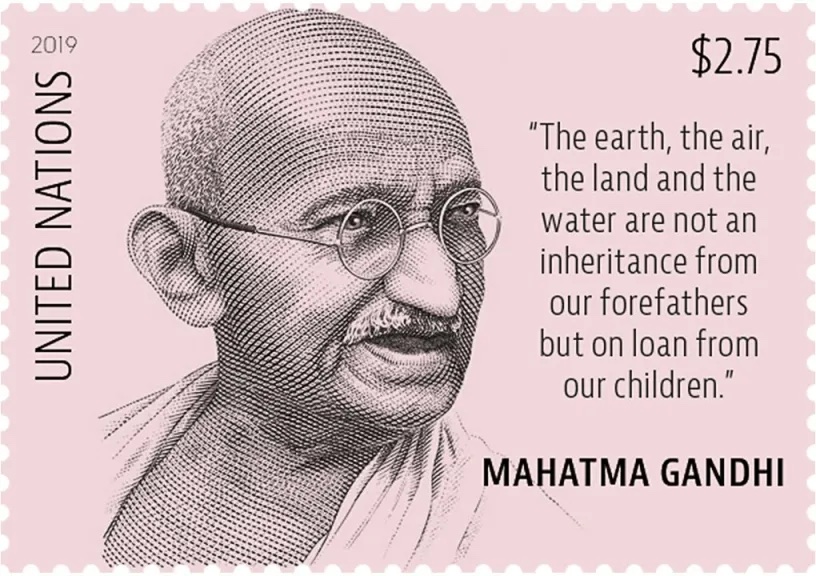
Image 3: A United Nations commemorative postage stamp issued in 2019 to mark the 150th birth anniversary of Mahatma Gandhi. The stamp features a portrait of Gandhi alongside a quote regarding environmental stewardship and sustainable heritage. Courtesy UNPA.
Image 4: These United Nations Postal Administration (UNPA) stamps were issued on October 10, 2023, to commemorate World Mental Health Day. The stamp set features three designs titled “Confusion”, “Rainy Days and Mondays”, and “Mood Swings”. The artwork was created by Sergio Baradat to raise awareness for mental health as a universal human right. Courtesy UNPA.
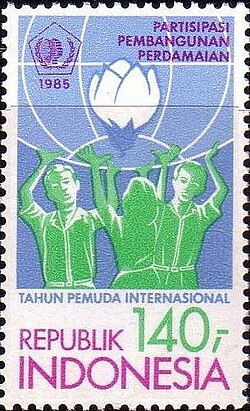
Image 5: A set of two stamps issued by Indonesia to commemorate 1985 as International Youth Year. The design depicts young people participating in “Development and Peace”. Courtesy Wikimedia Commons.
Image 6: A set of three UNPA definitive stamps on the themes Gender Equality, Migration and Sexual Exploitation, issued in 2019. Courtesy UNPA.

A United Nations Postal Administration stamp sheet featuring Climate Action Superheroes themed characters. It was issued to support the COP 28 Climate Change Conference held in 2023.
Sources:
Young Leaders Are Shaping Systems and Driving Change Around … https://childmind.org/blog/young-leaders-are-shaping-systems-around-the-world/
Our Work with Youth – Child Mind Institute https://childmind.org/global/snf-global-center/our-work-with-youth/
About Wellsprings https://wellsprings.in/about/
Cape Town Expert Gathering Brings Together Young Leaders and … https://childmind.org/blog/cape-town-expert-gathering-brings-together-young-leaders-for-mental-health-systems-change/
Future Generations v. Ministry of the Environment and Others – R2HE https://www.r2heinfo.com/summaries/future-generations-v-ministry-of-environment-and-others-aka-demanda-generaciones-futuras-v-minambiente/
German climate change law violates rights, court rules https://www.bbc.com/news/world-europe-56927010
Kenya’s Gen Z anti-tax revolutionaries https://www.bbc.com/news/articles/c2jj5mee1pmo
Child and Youth – United for Global Mental Health https://unitedgmh.org/child-and-youth/
Youth leadership in the global mental health sector: Insights from the #MHForAll Webinar — Global Mental Health Action Network https://gmhan.org/news/mhforall-youth-leadership
2024 Annual Report Global Coalition for Youth Mental Health https://bettercarenetwork.org/sites/default/files/2025-08/2024_Global_Coalition_Youth_Menthal_Health_Annual-Report.pdf
Youth Activists Lead Global Push: Climate Justice in … https://www.downtoearth.org.in/climate-change/how-young-people-have-taken-climate-justice-to-the-worlds-international-courts
The Journey to The Hague: Youth-led Campaign for Climate … https://sdg.iisd.org/commentary/generation-2030/the-journey-to-the-hague-youth-led-campaign-for-climate-justice-at-the-icj/
World’s Youth for Climate Justice https://www.wy4cj.org/unga-resolution
World’s Youth for Climate Justice https://www.wy4cj.org/our-story
Understanding the ICJ Advisory Opinion on Climate Change https://earth.org/the-biggest-climate-case-in-history-behind-the-campaign-that-inspired-the-icj-advisory-opinion-on-climate-change/
Youth-Based Gender, Sexuality, and Race Equity Work in Secondary Schools Purchased https://academic.oup.com/edited-volume/61768/chapter/553580088?guestAccessKey=
Commonwealth Youth Gender and Equality Network | United Nations https://www.un.org/en/civil-society/commonwealth-youth-gender-and-equality-network
Youth advocacy for LGBTIQ+ inclusive education in Asia – UNESCO https://www.unesco.org/en/articles/youth-advocacy-lgbtiq-inclusive-education-asia
EarthAction https://www.earthaction.org/current_affairs/page/2/
Future generations’ rights and climate change litigation: The Colombia https://www.taylorfrancis.com/chapters/edit/10.1201/b22619-3/future-generations-rights-climate-change-litigation-colombian-case-eslava-bejarano
Climate Change Litigation before the European Court of Human … https://gnhre.org/?p=17984
Held v. Montana – Wikipedia https://en.wikipedia.org/wiki/Held_v._Montana
Held v. State :: 2024 :: Montana Supreme Court Decisions – Justia Law https://law.justia.com/cases/montana/supreme-court/2024/da-23-0575-0.html
Decarbonisation by 2045 agreed: Youth-led climate lawsuit settled in Hawaii – Times of India https://timesofindia.indiatimes.com/home/environment/global-warming/decarbonization-by-2045-agreed-youth-led-climate-lawsuit-settled-in-hawaii/articleshow/111190115.cms
Held v. Montana: A Win for Young Climate Advocates … https://eelp.law.harvard.edu/held-v-montana/
Historic Agreement Settles Navahine Climate Litigation https://governor.hawaii.gov/newsroom/office-of-the-governor-news-release-historic-agreement-settles-navahine-climate-litigation/
Neubauer, et al. v. Germany – The Climate Litigation Database https://www.climatecasechart.com/document/neubauer-et-al-v-germany_0a3e
Neubauer v Germany – Wikipedia https://en.wikipedia.org/wiki/Neubauer_v_Germany
Duarte Agostinho et al. v. Austria et al. (“Portuguese Children’s Case”) https://climaterightsdatabase.com/2024/04/09/european-court-of-human-rights-youth-for-climate-justice-v-austria-et-al/
World’s Youth for Climate Justice https://www.wy4cj.org/
World’s Youth for Climate Justice https://www.wy4cj.org/legal-blog/worlds-youth-for-climate-justice-collaborates-with-youth-for-ecocide-law-and-discusses-important-issues
DOI: 10.38127/uqlj.v42i3.8641 https://journal.law.uq.edu.au/index.php/uqlj/article/download/8641/6749/26669
Homepage Global Coalition for Youth Mental Health https://www.youthmentalhealthcoalition.org/
Mind4Youth: The Global Youth Movement Redefining … https://www.channelkindness.org/mind4youth/
Initiatives https://www.youthformentalhealth.org/initiatives
Global Youth Call to Action on Mental Health (@gycam.you) https://www.instagram.com/gycam.you/
A Handbook for Youth-Serving Organizations https://iyfglobal.org/sites/default/files/TellingNewStoryWorldYouth_6.pdf
Young people led the way toward better health for all at SNF Nostos … https://www.snf.org/en/news-stories/news/announcements/young-people-led-the-way-toward-better-health-for-all-at-snf-nostos-2022-health/
Integrating Social Impact Storytelling in Youth Programs https://content.ces.ncsu.edu/integrating-social-impact-storytelling-in-youth-programs
home – Wellspring India http://wellspringindia.com/