
Step onto the cosmic trampoline. Discover how Einstein turned space and time into a flexible fabric, transforming gravity from an invisible force into pure geometry.
“Twinkle, twinkle, little star, how I wonder what you are.”

As children, we whispered this familiar rhyme while looking up from our backyards at the clear starry night sky, completely unaware that the nursery rhyme poses a literal scientific truth. When we look at those twinkling lights, we aren’t just wondering what they are—we are wondering when they are.
The truth is, every time we look upward into the night sky, we are looking backward into the depths of time.
All of us assume that the night sky is a live video feed, but it is actually a cosmic delayed broadcast. Light is the fastest thing in the universe, traveling at a staggering 300,000 kilometres per second, but the cosmos is impossibly vast. The twinkling glow arriving in our eyes right now began its lonely journey through the freezing void of space thousands of years ago. For some short-lived cosmic giants, the star that birthed that light has already run out of fuel, collapsed and died. We are in fact looking at a sky salted with cosmic ghosts.
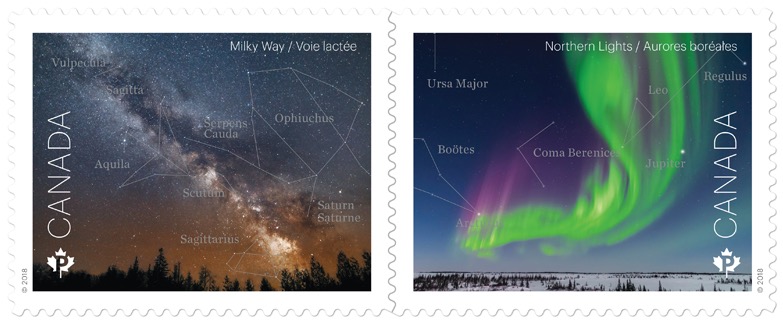
This historic delay affects everything we see, even within our own cosmic neighbourhood. Our Sun sits roughly 150 million kilometres away. If it somehow got extinguished this very second, our afternoon would remain completely normal and bright for another 8 minutes and 20 seconds. Even the Moon operates on a lag; the silver moonlight we see took 1.3 seconds to bounce off the lunar dust and cross the gap to Earth.
To understand this better on Earth, think of a thunderstorm. We see a flash of lightning instantly, but the rumble of thunder takes a few seconds to reach our ears because sound travels slower than light. In space, because the distances are so vast, even light suffers from this kind of delay.
Rewriting the cosmic stage
But these cosmic lags are merely the surface of a much deeper mystery. They force us to confront a reality where time is not a fixed background, but something deeply intertwined with space itself. A century ago, this realisation tore the scientific community apart. To unlock the secrets that once baffled the world’s greatest minds, we must challenge the very foundation of how we perceive reality:
What if space isn’t just an empty, passive room where things happen?
What if time isn’t a steady, universal river flowing at the same speed for everyone?
What if gravity isn’t an invisible pulling force?

Before Albert Einstein came along, humanity viewed the universe like a giant stage. Space was the floorboards, time was the ticking clock on the wall, and matter consisted of the actors moving around. The stage never changed.
Einstein shattered this framework by gluing space and time together into a single, dynamic, four-dimensional fabric called space-time. To visualise this, let us imagine a massive trampoline. If we place a heavy bowling ball (representing a star like our Sun) in the centre, the fabric stretches, sags and warps. If we then roll a small marble (representing a planet like Earth) onto the trampoline, it won’t be pulled by an invisible Newtonian pull; it will simply roll along the curved slope created by the bowling ball. This warped geometry is what we experience as gravity.
The secret club of three
When Einstein first published this radical theory of General Relativity in 1915, it was viewed with extreme scepticism. It mathematically upended centuries of absolute physics established by Sir Isaac Newton. To prove such a wild claim, scientists needed a truly cosmic scale.
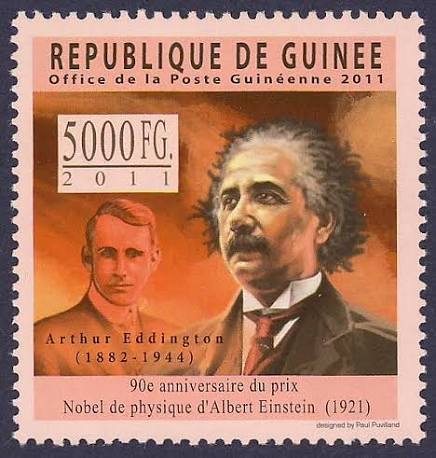
Enter the British astronomer Sir Arthur Eddington. In 1919, Eddington realised that if Einstein’s trampoline analogy was real, the immense mass of our Sun should warp the surrounding space-time fabric, forcing the light waves of distant stars to bend as they travel through the curve. The problem? The Sun is normally so blindingly bright that stars in its background are completely invisible during the day.
To bypass this, Eddington led a historic expedition to a remote island off the coast of West Africa to capture a rare total solar eclipse. As the Moon temporarily blocked out the Sun’s glare, Eddington photographed the surrounding stars. When he checked the data, the physics community was stunned: the stars had physically shifted positions on the film. The Sun’s gravity had bent their light. Einstein was right.
Sometime after this breakthrough, a prominent physicist named Ludwik Silberstein walked up to Eddington and confidently remarked,
“Professor Eddington, you must be one of only three people in the entire world who truly understand General Relativity.”
Eddington went completely quiet, refusing to answer. Thinking he had offended the astronomer, Silberstein quickly added, “Oh, don’t be so modest, Eddington!”
Eddington finally looked up, smiled, and replied,
“On the contrary, I’m not being modest at all. I am just trying to think who the third person is.”
Today, joining that exclusive club no longer requires a degree in advanced mathematics. To truly master how this flexible cosmic fabric allows planets to roll and clocks to change their speed, we simply need to do what Einstein did: deconstruct the universe into its foundational threads. By pulling apart the familiar concepts of space and time that we take for granted every day, we can begin to see exactly how relativity weaves them together.
Space: Our three-dimensional stage
To examine these threads, we first have to look at the stage where our lives play out: space. In our everyday experience, space is three-dimensional, meaning we only need three simple coordinates to pinpoint anything in the universe.
💡 Smart glossary: The 3D world
- Spatial Dimensions: The three physical directions of movement—length (left/right), width (forward/backward), and height (up/down).
- Coordinates: A set of numbers that determine the exact position of a point or object in space.
Think of it like navigating a city. To tell a friend exactly where we are to grab a coffee, we give them a street (left or right), an avenue (forward or backward), and if we are meeting in a skyscraper, a floor number (up or down). Every object, from the coffee mug on our desk to a planet orbiting a distant star, occupies a unique spot defined by these three physical coordinates.
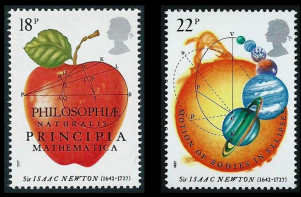
For centuries, science viewed this three-dimensional arena through the eyes of Sir Isaac Newton. Newton famously described space as a giant, unchanging, empty box—an absolute, passive container holding the planets and stars.
In his view, if we sucked all the matter out of the universe, the empty box of space would just sit there, completely unaffected. It is a highly intuitive way to see the world; when we walk across a bedroom, the walls do not bend, and the floor does not ripple. However, as 20th-century physics would later reveal, treating space as a rigid, static container misses the true, wildly flexible nature of our reality.
Time: The moving river
While space gives us a physical place to exist, time gives our universe a history. We experience time as a relentless, one-way street. This forward-only direction is what physicists call the “Arrow of Time.”
It ensures that cause always comes before effect. Imagine watching a video played in reverse: a shattered porcelain teacup spontaneously heals itself and flies back up onto a table, or spilled milk flows backwards into a glass. We instantly recognise such videos playing backwards because reality simply does not work that way.
💡 Smart glossary: The flow of history
- Arrow of Time: The concept that time flows in a single, irreversible direction—from the past into the future.
- Entropy: The scientific measure of disorder or randomness in an isolated system, governed by the Second Law of Thermodynamics, which states that entropy always increases. By nature, the universe is moving from order to disorder—like a dye dispersing in water, or perfume molecules escaping a bottle. This principle dictates why time only moves forward, as restoring order always requires an input of external energy.

For a long time, science agreed with our everyday intuition that time was absolute. Newton argued that time ticked away at the exact same rate for everyone, everywhere in the cosmos, regardless of how fast they were moving. He envisioned a master cosmic clock ticking uniformly in the sky.
This is why we treat time as the “fourth coordinate” in our daily schedules. Giving our friend the three spatial dimensions—the street, the avenue, and the floor number—is completely useless without specifying the crucial fourth marker: the time to meet.
But Einstein realised that Newton’s master clock was an illusion. As the German mathematician Hermann Minkowski—Einstein’s former professor—profoundly stated in 1908:
“Henceforth space by itself, and time by itself, are doomed to fade away into mere shadows, and only a kind of union of the two will preserve an independent reality.”
The cosmic fabric: Space-time

Einstein’s great breakthrough was realising that space and time are actually printed on the exact same sheet of paper. They merge into a four-dimensional continuum. To understand why they must be joined, we have to look at the ultimate cosmic speed limit: the speed of light (300,000 km/s). Light travels at this absolute speed through the vacuum of space, no matter how fast you run towards or away from its source.
💡 Smart Glossary: The Einsteinian Universe
- Space-Time Continuum: The unified, four-dimensional grid that weaves the three dimensions of space together with the single dimension of time.
- Time Dilation: The slowing down of time experienced by an object moving at very high speeds relative to a stationary observer.
- Length Contraction: The physical shortening of an object along its line of travel when it moves close to the speed of light.
To keep this speed limit perfectly constant for everyone, nature does something mind-bending: it alters space and time together like a cosmic seesaw. Imagine a futuristic spaceship flying across the galaxy at 99% the speed of light. If an observer on Earth watched it pass by through a telescope, they would see two bizarre things happen:
- Time Dilation: The personal clocks on the spaceship would slow down to a crawl compared to Earth’s clock.
- Length Contraction: The spaceship would physically shrink and flatten in the direction it is travelling.
If this sounds too abstract, consider a real-world example we use every day: the GPS on our smartphones.
Because GPS satellites circle the planet at immense speeds (14,000 km/h) and sit high above Earth’s surface, their onboard atomic clocks experience time differently than we do on the ground. To counter this, engineers built Einstein’s equations directly into the system’s software and pre-adjusted the clocks before launch. Without these automated relativistic corrections, our phone’s navigation map would drift by roughly 11 kilometres (7 miles) every 24 hours. Our phones work precisely because Einstein was right.
Gravity: Warping the fabric
Once we accept that space-time is a flexible fabric, we can finally understand the greatest magic trick in the universe: gravity. Newton thought gravity was an invisible, instantaneous pulling force between objects. Einstein realised it is actually geometry.
Physicist John Wheeler elegantly summarised this relationship in a famous quote:
“Space-time tells matter how to move; matter tells space-time how to curve.”
In the cosmos, massive objects like our Sun act as anchors that warp and bend the fabric of space-time around them. Earth doesn’t stay in orbit because the Sun is actively pulling on it with an invisible rope; it stays in orbit because it is simply rolling along the natural, curved geometry of this warped environment.
As the legendary science communicator Brian Greene explains:
“Gravity is the warp and weft of the space-time fabric.”
Because this cosmic sheet is flexible, it creates extreme environments where the slope becomes infinitely steep. If you pack too much mass into too small a space, the fabric curves towards infinity—creating a bottomless gravitational well known as a black hole.
Cosmic monsters: Understanding black holes
When things get incredibly massive, this warping becomes extreme. There are regions in space where gravity is so strong that nothing, including light, can escape its pull. These are called black holes.
💡 Smart glossary: Anatomy of a black hole
- Singularity: The infinitely dense point at the centre of a black hole where space-time curves infinitely and physics as we know it breaks down.
- Event Horizon: The boundary surrounding a black hole. It is the literal perimeter of the trap where the escape velocity matches the speed of light.
- Spaghettification: The literal stretching of an object into a long, thin string as it falls into a black hole, caused by extreme differences in gravitational pull.

To understand a black hole, imagine pressing an object of incomprehensible weight—like the mass of our entire Earth squished down to the size of a marble—onto the cosmic fabric. It would stretch the space-time canvas so aggressively that it would create a deep, bottomless funnel, tearing a hole right through the geometry of reality.
This is exactly what happens when a giant star dies and collapses under its own intense weight. It squishes all of its matter into an unimaginably tiny, dense point, creating a profound, inescapable dent in space-time.
This dent creates a cosmic trap with an outer boundary called the Event Horizon—the “point of no return.” Once an object crosses this border, the path through space-time curves so sharply inward that the speed required to escape is faster than light itself. Because not even light can climb back out of the funnel, the region appears completely black to our eyes.

Because mass warps time alongside space, a black hole acts as the ultimate time-distortion machine. If we were to safely park our spaceship just outside a black hole’s event horizon for what felt like one hour to us, we would find that decades or even centuries had passed on Earth when we returned home. Time near the heavy dent of a black hole slows down to a near-standstill compared to the flat, unwarped space-time of the rest of the universe.
If we fall into one, we would experience a phenomenon scientists humorously but accurately call spaghettification: the gravity at our feet would be so much stronger than the gravity at our head that we would be stretched out like a piece of pasta before ever hitting the centre.
Hearing the universe for the first time
For millennia, humanity’s relationship with the universe was entirely visual. We were like audience members watching a silent movie. To learn about the cosmos, astronomers had to look at the sky, collecting bits of light, X-rays or radiation through traditional glass telescopes. If a cosmic event didn’t glow, it was completely invisible to us.
When Albert Einstein introduced his theory of General Relativity in 1915, visualising space-time as a trampoline, he realised something even more radical: if space-time is a physical fabric, then violent cosmic events shouldn’t just sit there—they should make the fabric ripple.
Imagine dropping a heavy boulder into a still pond. The impact creates ripples that violently expand outward across the water’s surface. Einstein calculated that when massive objects accelerate rapidly through space—like two stars collapsing or colliding—they should send out invisible ripples through the universe. He called these gravitational waves. However, Einstein himself doubted we would ever detect them. He believed that the ripples would become so unimaginably faint by the time they travelled across the cosmos that human technology would never be sensitive enough to feel them.
For a solid century, these cosmic ripples remained nothing more than a ghost inside a math equation. That century of doubt ended on September 14, 2015.
The breakthrough came via the Laser Interferometer Gravitational-Wave Observatory (LIGO)—an engineering marvel consisting of two massive, L-shaped facilities located thousands of miles apart in Washington and Louisiana, USA. Inside these facilities, scientists bounce laser beams down ultra-pure vacuum tunnels spanning four kilometres long. If a gravitational wave passes through Earth, it will physically stretch one arm of the laser tunnel while compressing the other by a fraction of a hair, alternating back and forth.
To understand how difficult this is to catch, consider the scale: by the time those ancient ripples reached Earth, they were incredibly faint. LIGO had to detect a spatial distortion that compressed and stretched space by a margin a thousand times smaller than the width of a single proton. To put that in perspective, it is like measuring the exact distance from Earth to the nearest star outside our solar system down to the accuracy of a single human hair.
Yet, against all odds, the lasers twitched. LIGO had successfully recorded the direct passing of a gravitational wave.
What caused a ripple powerful enough to warp space across the universe?
Scientists traced the signal back to a cataclysmic event that occurred roughly 1.3 billion light-years away: the violent collision of two massive black holes.
For billions of years, these two stellar titans spiralled around each other in a
deadly cosmic dance, moving closer and closer until they crashed together into a single, monstrous black hole. The collision released more energy in a fraction of a second than all the stars in the observable universe combined. That explosive burst of energy warped the local space-time fabric, and the resulting ripples spent the next 1.3 billion years travelling through the freezing void of space—passing by newborn galaxies and dying stars—before finally washing over Earth on a quiet Monday morning in 2015.
This breakthrough fundamentally altered modern science forever. By tracking the physical vibrations of the space-time fabric, we didn’t just find another way to look at the stars; we effectively gave humanity a set of ears. We can now tune in, listen to the physical vibrations of reality, and hear the heartbeat of the cosmos for the very first time.
Conclusion
The realisation that space and time are joined as a single, flexible fabric completely upends our common-sense view of reality. We no longer live in a cold, rigid universe where space is a passive room and time is an independent master clock ticking away uniformly for everyone. Instead, we live in a dynamic, active and deeply interconnected reality.
This paradigm shift does more than just solve equations; it fundamentally changes our place in the cosmos. It proves that gravity is not an aggressive force pulling us down to the floor, but rather the universe gently cradling us in its geometric curves. It reminds us that we are all natural time travellers every time we gaze at the stars, staring directly into the past.
As Einstein himself once famously wrote in a letter of condolence to a friend’s family:
“For us believing physicists, the distinction between past, present and future is only a stubbornly persistent illusion.”
While the concept of space-time answers how the universe holds itself together, it also leaves the door wide open to even deeper mysteries. Scientists today are actively hunting for ‘quantum gravity’—a master theory that can merge the smooth, cosmic trampoline of space-time with the chaotic, microscopic rules of subatomic physics.
Until then, space-time remains a beautiful reminder that reality is far more fluid, interconnected and wonderfully strange than our eyes lead us to believe.
Sources:
- Albert Einstein, The Foundation of the General Theory of Relativity.
- Hermann Minkowski, Space and Time.
- NASA, “Gravity and General Relativity.”
- NASA, “Einstein’s Theory of Relativity.”
- European Space Agency, “Relativity and spacetime.”
- Encyclopaedia Britannica, “General relativity.”
- Encyclopaedia Britannica, “Spacetime.”
- LIGO Scientific Collaboration, “First Observation of Gravitational Waves.”
- LIGO Laboratory, “What are gravitational waves?”
- Caltech, “The science of gravitational waves.”
- Event Horizon Telescope Collaboration, “First image of a black hole.”
- Einstein Online, “Time dilation.”
- Einstein Online, “Length contraction.”
- CERN, “Special relativity.”
- Einstein Online, “Gravitational waves.”
- University of Oxford, Mathematical Institute, history of mathematics and scientific stamps.
- NASA Science, James Webb Space Telescope image resources.
- Max Planck Institute for Gravitational Physics, gravitational wave simulation resources.
Images captions:
Image 1: Two semi-postal stamps issued by the Soviet Union for Lenin Soviet Children’s Fund in 1973 feature paintings titled ‘The Universe’ and ‘Another Planet’ by Vitaly Lukyanets. Courtesy Wikimedia Commons.
Image 2: Canada Post issued a set of two postage stamps in 2018 to showcase the majestic splendour of two spectacular phenomena – the Milky Way and the Northern Lights – captured by Matt Quinn and Alan Dyer respectively. Thanks to the darkness created by the country’s vast wilderness, Canadians enjoy some of the greatest night sky viewing in the world. Courtesy Canada Post.
Image 3: A 2016 Jersey Post miniature sheet commemorating the 100th anniversary of Albert Einstein’s Theory of General Relativity. The stamps are designed to highlight Einstein’s scientific contributions and his most recognised theories. Courtesy philatelicly.com
Image 4: This 2011 postage stamp from the Republic of Guinea commemorates the 90th anniversary of Albert Einstein receiving the Nobel Prize in Physics in 1921. The stamp features portraits of both Albert Einstein and British astronomer Arthur Eddington. Courtesy Science on Stamps (http://www.jgiesen.de/).
Image 5: Two commemorative postage stamps issued by the United Kingdom’s Royal Mail on March 24, 1987. Designed by artist Sarah Godwin, this special set marks the 300th anniversary of the publication of Sir Isaac Newton’s groundbreaking scientific masterpiece, Philosophiae Naturalis Principia Mathematica(1687). Courtesy Mathematical Institute, University of Oxford. Visit https://www.maths.ox.ac.uk/node/13353 for Robin Wilson’s entire history of mathematics in one hour, as illustrated by around 300 postage stamps featuring mathematics and mathematicians from across the world. From Euclid to Euler, from Pythagoras to Poincaré, and from Fibonacci to the Fields Medals, all are featured in attractive, charming and sometimes bizarre stamps.
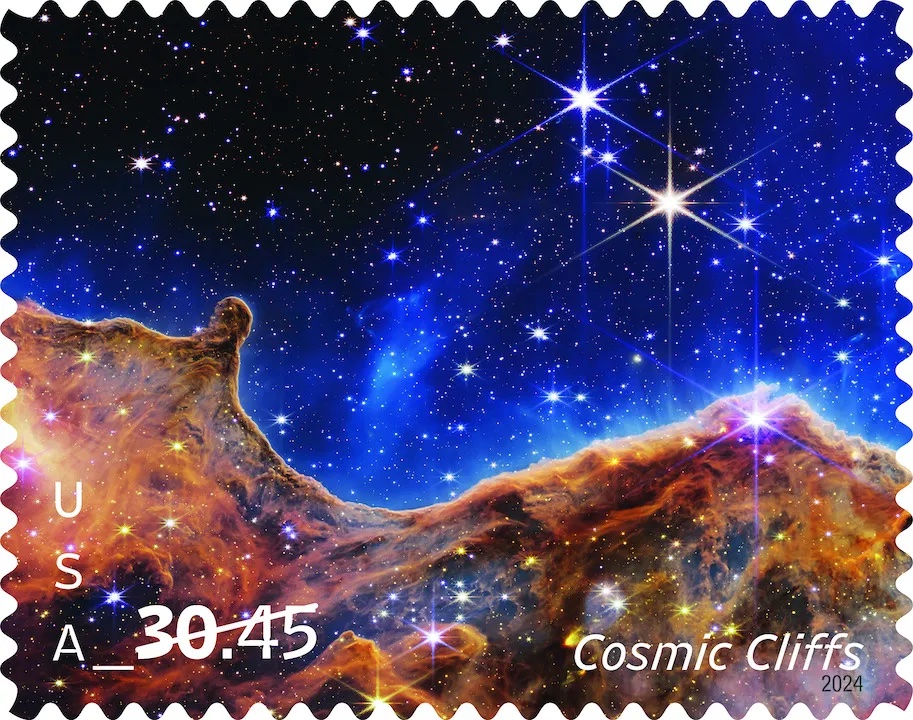
Images 6 & 7: The U.S. Postal Service issued two postage stamps in 2024, featuring images of the Pillars of Creation and the Cosmic Cliffs (of Carina Nebula) from NASA’s James Webb Space Telescope. Courtesy https://science.nasa.gov/
Image 8: The Visions of the Universe, a set of eight postage stamps were specially commissioned by the UK’s Royal Mail to celebrate 200 years of the Royal Astronomical Society (RAS). The stamps set issued in 2020 features astronomical phenomena discovered and investigated by the UK’s leading astronomers and was designed by True North brand consultancy. Courtesy https://www.dandad.org/
Image 9 : Isle of Man issued a set of six postage stamps in 2016 to celebrate 100 years of General Relativity. Designed by Glazier Design in association with the Isle of Man Post Office, the Stephen Hawking Foundation and Professor Hawking’s cosmology team at Cambridge University, the stamps set has images of two great minds, Albert Einstein and Stephen Hawking, and four highly detailed illustrations representing gravitational waves, black holes, black holes colliding and the Hawking radiation theory. The art style was based on mathematical theory visualisations and the colour palette was inspired by the cosmos. To accentuate the use of light and dark and the playful iridescence of light, the stamps carried holographic foil to make them shine with every colour of the visible spectrum. Courtesy https://glazierdesign.com/
Image 10: The German postal service issued a postage stamp in 2018 to honour the Illlustris simulation project, a supercomputer simulation of the universe that has provided astrophysicists with new insights into the formation and evolution of galaxies. The Illustris project is headed by an international collaboration of astrophysicists from MIT, Harvard University, the Heidelberg Institute for Theoretical Studies, the Max-Planck Institutes for Astrophysics and for Astronomy, and the Center for Computational Astrophysics, New York. Courtesy https://news.mit.edu/
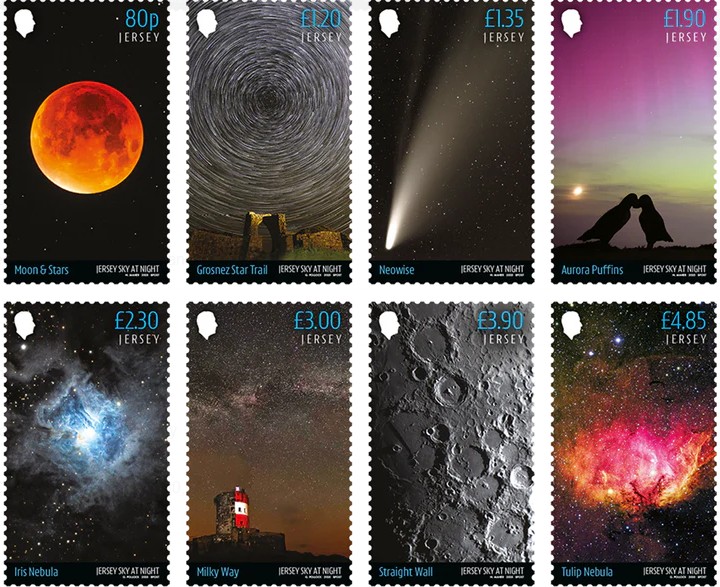
Image 11: In 2025, Jersey Post released a collection of eight postage stamps titled ‘Jersey Sky at Night’, which features photographs captured by Neil Mahrer and Gordon Pollock. Courtesy Bailiwick Express.
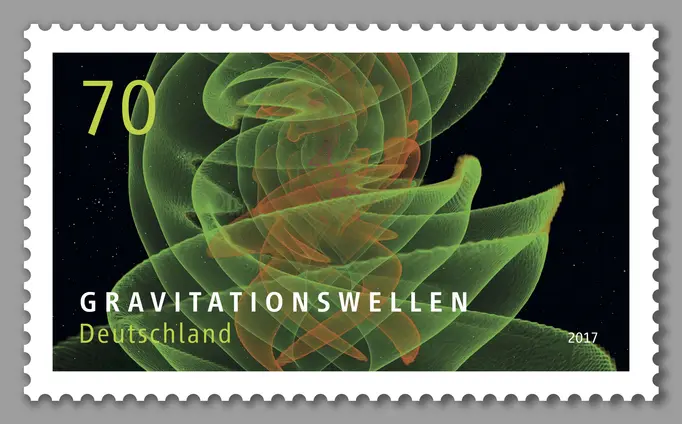
Image 12: A 2017 German postage stamp commemorating the first detection of gravitational waves, showing a numerical relativity simulation of two merging black holes developed at the Max Planck Institute for Gravitational Physics. Courtesy Max Planck Institute.