Religions of the world: Many lamps, one human longing
Religion has never been only about doctrine or division. Across time and place, it has been humanity’s way of answering the same deep questions: why we are here, how we should live, what suffering means, and whether there is a truth larger than ourselves.
To recognise these shared questions is not to suggest that all religions offer the same answers. They do not. Their understandings of God, ultimate reality, salvation, liberation, the human person and the destiny of life differ in profound and often irreconcilable ways. Yet they arise from recognisably human experiences—wonder, mortality, hope, gratitude, fear, love and the search for meaning. This essay follows the many forms of that search, and the common human longing that runs through them all.
A lamp at dusk
At dusk, in a quiet room somewhere in the world, a mother lights a lamp before a small altar. A child watches, half-curious and half-solemn. Elsewhere, a candle is lit before an icon, incense is set gently alight, prayer beads are turned through the fingers, a mat is spread for evening prayer, a scripture is opened, or a blessing is spoken before a meal. The names differ, the customs differ, the prayers differ—but the human gesture is recognisably the same.
Something in us has always reached towards the unseen. Something in us has always wondered what suffering means, where love goes when the body is gone, how a life should be lived, what is right and what is not, and whether the world is held together by chance or by purpose. Religion, in all its many forms, has long been one of humanity’s oldest responses to those questions—and perhaps also one of its most enduring ways of keeping the questions alive.
If the beginning of religion was wonder, then its long history is the story of wonder taking shape: in story, symbol, law, ritual, devotion, community and moral vision. Across the world, the sacred has worn many garments, yet it has never ceased to accompany humanity’s search for meaning.
Part I: The first questions
Before temples and scripture
Long before humanity built temples, composed scriptures, or argued over doctrine, people gathered around firelight and tried to make peace with the mystery of existence. A child looking up at the stars, an elder watching the monsoon arrive, a grieving family standing beside a burial ground—somewhere in experiences like these, religion began.
At its heart, religion may be understood as humanity’s earliest response to awe, mortality, belonging and meaning. It did not begin as a system of rules. It began as a human yearning—a reaching towards the invisible, an attempt to understand why we are here, why life ends, and what holds us together while we are still here.
The Latin root religare, often interpreted as “to bind together” or “to reconnect,” offers a beautiful clue. The idea finds echoes elsewhere too. In Hindu thought, one of the deepest spiritual aims is yoga—union, integration and inward harmony. Across traditions, religion has sought, in one way or another, to reconnect the seen with the unseen, the self with the community, and the moment with eternity.
In that sense, religion became humanity’s first great language of wonder—a language in which science, poetry, ethics, philosophy and ritual still flowed together in a single current.
Firelight, burial grounds, and the living earth
If we travel far back into the earliest chapters of human consciousness, we do not find cathedrals, mosques, temples or formal creeds. We find firelight, cave walls, burial grounds, and the desire to remain in conversation with mystery. In those first sacred spaces, the world was not yet divided into the religious and the ordinary; everything could still shimmer with meaning.
For the first human communities, the world was alive with presence. A river was not merely water. A forest was not only timber. A storm was not simply weather. Nature itself seemed full of powers worthy of reverence, caution, gratitude and dialogue.
This helps explain why animistic and shamanic traditions appear across so many cultures. Early societies did not see themselves as separate from the earth; they lived within a web of relationship with it. Rituals, offerings, songs and prayers became ways of honouring that living world and maintaining harmony within it.
At the same time, humanity’s care for the dead revealed another dimension of belief: love does not easily surrender to disappearance. Archaeological traces of burial customs—red ochre, beads, flowers, tools, ornaments and carefully arranged remains—suggest that even our earliest ancestors sensed that death was not simply an ending, but a threshold.
The obsequies performed for the departed reveal something deeply human. From the beginning, people did not merely dispose of their dead; they honoured them, accompanied them, and surrounded departure with ritual care. In many traditions, the relationship continued through annual rites, memorial gatherings, offerings and prayers that kept the departed present within the memory of the community.
1
The ancestor thus became more than memory. The dead were imagined as protectors, guides and continuing companions. Religion began not only in the fear of death, but also in the enduring faithfulness of love.
Many lands, many sacred languages
As human communities spread across deserts, river valleys, forests, mountains, islands and coastlines, their spiritual imagination took on local colours. Religion did not emerge in a vacuum; it grew from climate, landscape, memory, imagination and social life. Like a river flowing through different terrain, belief gradually assumed the shape of its surroundings.
In the harsh landscapes of the Middle East, where water was precious and survival demanded discipline, the sacred often came to be understood in terms of singularity, covenant, law and moral accountability. Time itself was increasingly imagined as a story moving from creation towards fulfilment. Within this cultural world, the great monotheistic traditions took shape, each developing its own distinctive understanding of God, revelation and human responsibility. One might say that the desert taught faith to listen for a single voice.
Across the fertile river valleys of the Indian subcontinent, where life unfolded in visible cycles of monsoon, growth, decay and renewal, spiritual reflection often moved in different directions. Questions of karma, dharma, liberation, compassion and awakening came to occupy the centre of religious life. Hinduism, Buddhism, Jainism and later Sikhism emerged from this rich intellectual and spiritual landscape, each offering its own vision of the human journey. Here, time often felt less like a straight road than a returning circle.
In East Asia, where social harmony and natural balance became enduring ideals, traditions such as Taoism and Confucianism emphasised alignment rather than conquest, humility rather than domination, and the cultivation of character within relationships. The Tao moved like water; Confucian ethics flowed through family, society and public responsibility. Together they helped shape civilizations that prized continuity, balance and inner order.
In Japan, Shinto preserved a luminous awareness of sacred presence in landscape, ancestry and seasonal rhythm. Mountains, rivers, forests and shrines were not merely settings for spiritual life; they participated in it. The memory of the kami remained woven into everyday existence.
Across Africa, the Americas, Oceania and the many indigenous cultures of the world, spirituality likewise remained deeply rooted in land, ancestry, ceremony and communal memory. Here too, the sacred was not distant. It lived in the soil, the drumbeat, the shared meal, the elder’s wisdom, the sacred fire and the changing seasons.
Different landscapes gave rise to different religious imaginations. Yet beneath this remarkable diversity lay a recognisably human desire: to live meaningfully within a universe that seemed larger, deeper and more mysterious than ourselves.
"Every religion begins somewhere.
Every faith, however, eventually asks questions that belong to everyone."
The great turning of the human spirit
Historians often refer to the period between roughly 800 BCE and 200 BCE as the Axial Age, a remarkable turning point in human thought when spiritual and philosophical insight deepened across several civilizations, often independently of one another. It was as though different parts of the world had begun asking the same enduring questions in their own accents.
In India, the sages of the Upanishads, the Buddha, and Mahavira turned inward, asking whether ritual alone could bring liberation. Their answers pointed towards ethical discipline, detachment, compassion and inner realisation.
In China, Lao Tzu and Confucius responded to social disorder by turning towards harmony, virtue and the cultivation of the self within society.
In Persia and the ancient Near East, figures such as Zoroaster, Isaiah and Jeremiah spoke of justice, truth, moral struggle and the responsibility of human beings before the Divine.
In Greece, Socrates, Plato and Aristotle explored virtue, truth, the soul and the good life through reasoned inquiry.
2
What emerged across these civilizations was not sameness, but a shared deepening of moral and spiritual reflection. Faith became more inward without ceasing to be communal; ritual was increasingly joined by conscience, and outward observance by inward transformation. Humanity was no longer asking only how to survive, but how to live well.
Perhaps this is one of the most hopeful chapters in religious history: the moment when wisdom, in many lands at once, began to turn the human gaze from mere existence towards character, compassion and the examined life.
From living insight to living tradition
As spiritual insight passed from teacher to disciple, from elder to community, and from generation to generation, it gradually took written and institutional form. Sacred words became scripture. Gatherings became traditions. Charisma became canon. Living memory became organised religion. What had once moved like a flame through conversation now sought vessels that could preserve it across centuries.
This was both a blessing and a burden.
On the one hand, institutions gave wisdom a home. They founded schools, monasteries, libraries, places of worship, hospitals, hospices and communities of service. They preserved sacred texts, nurtured scholarship, cared for the vulnerable and carried spiritual memory across generations. Without such continuity, much of humanity’s religious inheritance might simply have disappeared.
On the other hand, institutions can sometimes harden what was once living. The original flame of insight may become wrapped in rules, hierarchy, exclusion or fear. Traditions that began by inviting inward transformation may drift towards outward conformity. Communities created to nurture compassion may become preoccupied with defending boundaries.
Yet this tension belongs not only to religion but to every enduring human institution. The challenge is always the same: how to preserve a living tradition without imprisoning the living spirit that first gave it birth.
Perhaps every generation is called not merely to inherit its tradition, but to rediscover its deepest purpose.
And so religion remains, even now, not a finished monument
but a continuing conversation between memory and renewal,
inheritance and discovery.
Part II: The light, the shadow, and the universal thread
The many faces of religion
Religion has always revealed something profound about humanity. It has inspired sacrifice, tenderness, courage, art, service, discipline and hope. It has also, at times, been entangled with pride, cruelty, conflict, fear and the pursuit of power.
This double reality should not lead us towards cynicism. It should lead us towards humility and discernment. Like every powerful human creation, religion carries both the highest aspirations of human beings and the limitations of those who practise it.
The world’s traditions are not identical. They differ in their understandings of God, ultimate reality, salvation, liberation, authority and ritual practice. Yet many of them return, in different languages and forms, to questions of meaning, moral responsibility, compassion and transcendence. Their differences are real; so too are the ethical and spiritual aspirations they often share.
As S. Radhakrishnan observed, “In the mystic traditions of the different religions we have a remarkable unity of spirit.”
Religious history teaches another important lesson: human understanding is always partial. Individuals, communities and civilizations often see through the windows of their own experience. Wisdom begins when conviction is accompanied by humility—the recognition that our own perspective, however deeply held, may not encompass the whole of reality.
The world’s great faiths across the map
To speak of the religions of the world is also to speak of geography. Belief has always lived somewhere, and the journeys of faith have been shaped by migration, culture, language, history and place.
Today, Christianity is the world’s largest religious tradition, with major populations across Europe, the Americas, sub-Saharan Africa, parts of Asia and Oceania. Islam, the second-largest, has deep roots across North and West Africa, the Middle East, Central and South Asia, and major communities in Southeast Asia and many other regions.
Hinduism remains centred primarily in India and Nepal, while also flourishing through communities across Mauritius, Fiji, Southeast Asia, the Caribbean and the global diaspora. Buddhism continues to shape the spiritual landscapes of Sri Lanka, Southeast Asia, Tibet, China, Japan, Korea and Vietnam, while also finding new expressions across the world.
Among other globally significant traditions, Sikhism has its historic heart in Punjab and a widespread diaspora; Judaism continues to maintain ancient roots alongside vibrant communities across the world; Taoism and Confucian traditions remain influential in Chinese cultural life; Shinto continues to shape Japan’s relationship with ancestry, nature and ritual; Jainism preserves one of humanity’s most distinctive traditions of non-violence; Zoroastrianism survives through small but historically significant communities; and the Bahá’í Faith has developed a global presence across continents.
Religious traditions are not merely geographical markers. They are living streams carried by people—through migration, memory, practice and adaptation. A faith may begin in one landscape and, over centuries, find new expressions in many others.
World religions and indigenous traditions
It is useful to distinguish between “world religions” and “indigenous traditions”, but the distinction should never become a hierarchy of value.
“World religions” is a scholarly term generally used for traditions that are large in scale, widely distributed and historically influential across regions. They often possess scriptures, formal institutions, missionary movements and identities that extend beyond a single cultural setting.
“Indigenous traditions”, by contrast, are the living spiritual expressions of particular peoples, places and ancestral histories. They are often deeply rooted in specific landscapes and communities, preserving forms of knowledge about nature, kinship, healing, ritual and belonging that have developed over generations.
Their local character does not make them lesser. In many cases, they represent some of humanity’s oldest continuing relationships with land and memory.
The distinction may be useful for study, but it should never become a measure of spiritual worth. A prayer spoken in a cathedral, a chant offered beside a sacred river, a ceremony held beneath an ancient tree, or a blessing shared around a family fire all emerge from the same profoundly human desire: to honour what is greater than ourselves.
What religion has given the world
3
Across civilizations, religion has helped shape some of humanity’s most enduring moral, cultural and social achievements. It gave compassion a public expression. It widened the circle of care beyond family and tribe, turning concern for the vulnerable into organised acts of service. Hospitals, hospices, monasteries, dharamshalas, waqfs, langars and countless other forms of religious charity became ways through which communities transformed compassion into practical action
It gave humanity extraordinary artistic expressions of the search for the sacred. Temples, mosques, churches, stupas, shrines, carvings, chants, calligraphy, architecture, incense and music all emerged from the desire to honour what people considered highest and most meaningful. From Gothic cathedrals to Angkor Wat, from the Alhambra to sacred ragas and qawwalis, religion has often been one of humanity’s most powerful sources of beauty and imagination.
It contributed deeply to the moral language of justice and dignity. The Hebrew prophets’ call to defend the widow and the stranger; the Buddha’s challenge to superiority by birth; Hindu teachings on ahimsa and duty towards the vulnerable; Christian concern for the poor and suffering; Islamic teachings on justice, charity and care for the orphan, the needy and the traveller; Sikh teachings on equality and service—all became part of humanity’s continuing conversation about human worth.
It preserved knowledge across difficult periods of history. Religious communities copied manuscripts, maintained libraries, established schools and safeguarded philosophical, scientific and literary traditions through times of political upheaval and social change.
None of this means that religion alone created compassion, beauty, justice or knowledge. Human beings have always possessed these capacities. Rather, religions often provided communities, symbols, institutions and languages through which those aspirations could be expressed and sustained across generations.
The world’s religions differ greatly in form and belief, yet many have carried the same enduring human hunger: for the good, the true and the beautiful.
The common lamp within different houses
If one listens carefully, many of the world’s spiritual traditions sound like different expressions of humanity’s search for meaning. As Sri Ramakrishna observed, “God can be realised through all paths.”
This does not mean that all traditions make identical claims. They differ profoundly in their understanding of the Divine, ultimate reality and the human journey. Yet across many cultures, certain ethical intuitions appear again and again.
The Golden Rule—the call to treat others with the care and dignity one desires for oneself—appears in different forms across Hindu, Buddhist, Jain, Jewish, Christian, Islamic, Sikh, Taoist, Confucian and Bahá’í traditions. Across languages and centuries, the same moral insight returns: that the wellbeing of others is inseparable from our own.
Many religions also honour selfless service. Whether through zakat, dana, charity, hospitality or communal care, they transform compassion from an idea into an action. Buddhist compassion, Islamic charity, Christian love, Sikh seva and Jain ahimsa all reveal how spiritual insight can become practical responsibility.
Many traditions also ask human beings to quiet the ego. They use different languages—meditation, prayer, remembrance, contemplation, silence, surrender and devotion—but often point towards a similar transformation: becoming less governed by vanity, greed, anger and fear.
They hold grief with dignity. They ask what becomes of the dead, how the living should remember them, and whether love can endure beyond loss.
They create sacred rhythms. Pilgrimage, fasting, chanting, washing, kneeling, bowing, lighting lamps, sharing meals and marking holy days all transform ordinary time into moments of remembrance and meaning.
They build communities of belonging. They do not only offer ideas; they create shared stories, moral responsibilities and spaces where people can support one another.
They honour hospitality. The stranger, the guest, the traveller and the vulnerable person often become tests of our humanity.
They treasure silence and inner stillness. Beneath their many outward forms lies a recurring invitation towards humility, reverence and surrender.
Perhaps that is why spiritual life often feels less like acquiring something new and more like remembering something deeply true.
Religions did not create humanity's longing for goodness;
they gave that longing stories, symbols, communities
and practices through which it could endure.
4
The modern turn
In the modern age, science, secular governance, individual freedom and changing social structures have transformed the way many people relate to religion. Some seek meaning outside institutional boundaries. Some turn away from organised religion because of experiences of hypocrisy, rigidity or conflict. Others continue to treasure inherited traditions while interpreting them through conscience, compassion and contemporary understanding.
This has contributed to the widely discussed “spiritual but not religious” sensibility—a search for silence, ethics, mindfulness, awe and inner depth without formal religious affiliation.
Yet the human hunger remains. People still meditate, sing, pray, serve, reflect, gather and wonder. The forms may change, but the longing endures.
Stories that widen the heart
Stories have always carried wisdom across generations. They do not demand agreement before they invite reflection. A good story opens a door; it allows truth to enter quietly.
Swami Vivekananda’s “frog in the well” parable remains a beautiful reminder of perspective. Each tradition, like the frog, may inhabit its own world and mistake it for the whole of reality. The lesson is not that we must abandon our homes, but that we must learn to see beyond their walls.
The ancient story of the blind men and the elephant points towards a similar humility. Each person touches only one part of the elephant and believes that partial experience is the whole truth. The story reminds us that sincere conviction can coexist with incomplete understanding.
To recognise this is not to say that all beliefs are identical. Rather, it is to acknowledge that human beings often encounter reality through limited perspectives, shaped by history, culture and personal experience.
And then there is the old story cherished at Wellsprings itself: truth, naked and unadorned, may be turned away—but when clothed in a parable, it enters the village and is welcomed.
That is why stories matter. They do not merely carry information; they carry wisdom. They reach places in the human heart that arguments often cannot.
The common river
5
The religions of the world are not identical, and they need not be. Their diversity is part of the beauty of human civilization. Their languages, rituals, symbols and sacred memories reflect the many landscapes and communities through which humanity has searched for meaning.
Yet without erasing those differences, we may still recognise a shared invitation: to live with justice, humility, gratitude, compassion and courage. To serve those who suffer. To keep wonder alive. To remember that the deepest truths are often larger than any single human expression of them.
Perhaps this is one of religion’s most enduring gifts—not the power to make every question disappear, but the wisdom to keep the human heart open in the presence of mystery.
And so we return to the quiet scene at dusk.
A lamp is lit. A prayer is spoken. A name is remembered. A stranger is welcomed. A child asks another question.
The world, for a moment, feels less divided by its many forms and more united by its shared longing.
That, perhaps, is the common river flowing through the many landscapes of faith—a river worth following with humility, curiosity and reverence.
Further reading:
Pew Research Center, How the Global Religious Landscape Changed from 2010 to 2020. A clear, widely cited overview of the size and distribution of the world’s major religious groups.pewresearch+1
Pew Research Center, The Global Religious Landscape. An earlier landmark study that remains useful for understanding broad global patterns in religious affiliation.pewresearch+1
Pew Research Center, Religious Composition by Country, 2010–2020. A detailed country-by-country resource for readers who want to explore regional distributions
Encyclopaedia Britannica, Religion. A concise, authoritative introduction to religion as a human phenomenon and cultural category.
Encyclopaedia Britannica, World Religions. Useful for the broad scholarly framing of the major transregional traditions.
Encyclopaedia Britannica, Indigenous Religion. A helpful entry for understanding locally rooted spiritual traditions and their distinctive place in world religious life.
Encyclopaedia Britannica, entries on major traditions such as Christianity, Islam, Hinduism, Buddhism, Sikhism, Judaism, Taoism, Confucianism, Shinto, Jainism, and Zoroastrianism. Good for background reading on each tradition’s history and core ideas.
ReligionCompare,World Religions by Population. A simple visual resource for readers who want a quick demographic snapshot of the major faiths.
Image captions:
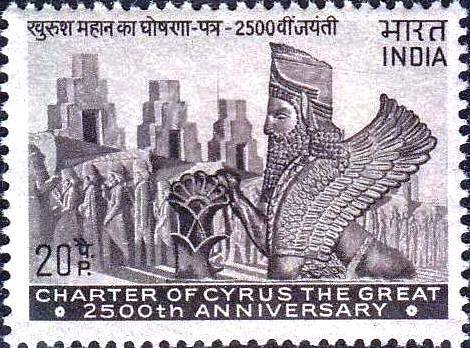
Image 1: India Post issued a stamp in 1971 to commemorate the 2500th anniversary of Cyrus the Great’s Charter of Human Rights. Depicting the relief from Persepolis, this stamp serves as a reminder that our search for peaceful coexistence is as old as civilization itself. Courtesy Wikimedia Commons.
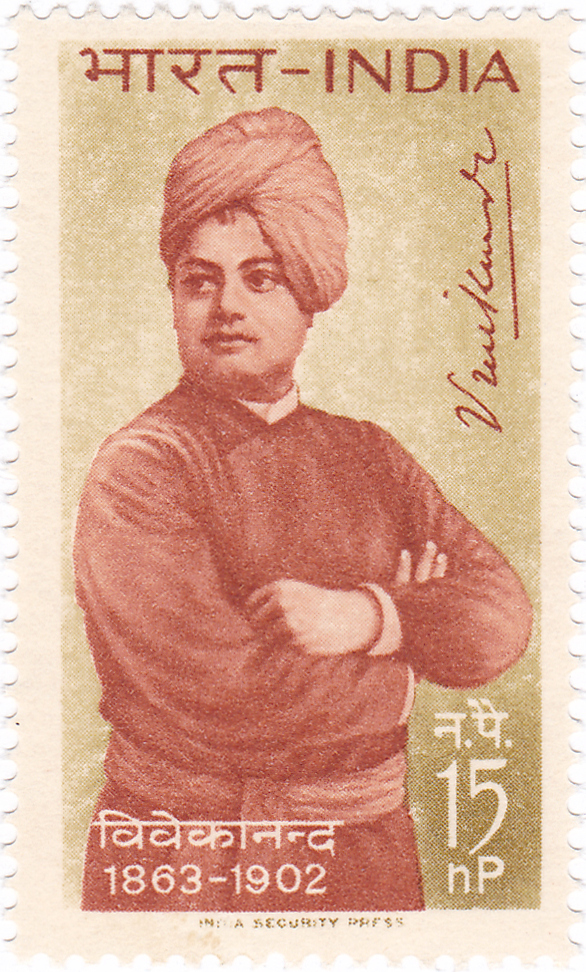
Image 2: India Post issued a stamp in 1993 to commemoreate the centenary of Swami Vivekananda’s Address at the World’s Parliament of Religions at Chicago in September 1893. Depicting Vivekananda against the Art Institute of Chicago, this commemorative issue marks the moment when Eastern and Western wisdom met on equal footing—reminding a fractured world that we are not frogs trapped in separate wells, but wanderers sharing the same boundless sky.Courtesy Ramakrishna Math and Mission.
Image 3: United Nations Postal Administration issued a commemorative postage stamp on Mother Teresa in 2021. When theological debate falls silent, selfless service speaks in a language everyone understands.
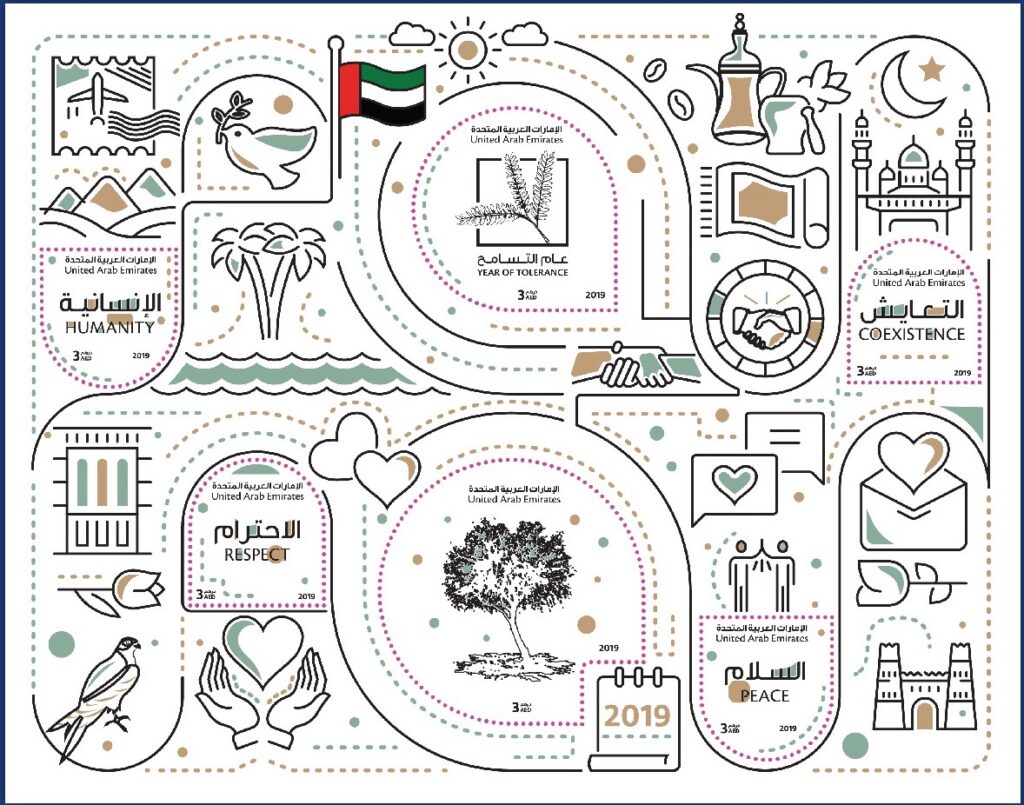
Image 4: Emirates Post issued a ‘Year of Tolerance’ commemorative miniature sheet in 2019 with the theme ‘Ten global religions, one fundamental truth: Treat others as you wish to be treated.’ Featuring the resilient Ghaf tree—an ancient symbol of gathering and refuge in the desert—this issue celebrates pluralism and peaceful harmony. It reflects the core insight of every sacred tradition: though our branches wear different leaves, our roots drink from the same deep earth.
Image 5: Universal Postal Union & UNPA jointly issued an embroidered “Dove of Peace” postage stamp in 2025, with a message of hope woven stitch by stitch. Jointly issued by postal nations across the world, this rare textile stamp depicts a white dove gliding forward across borders, faiths and ideologies.