While textbooks often treat physics as a cold collection of data, the universe’s tiniest components actually tell a deeply poetic story about human existence. This narrative seamlessly bridges ancient philosophy with modern breakthroughs, connecting the philosophical insights of Democritus to Richard Feynman’s iconic Caltech lectures and the revolutionary Miller-Urey experiment. By peering past everyday structures, the text unpacks a vibrant quantum world populated by matter-building fermions, force-carrying bosons, and the four fundamental interactions that keep reality from collapsing. Enriched by thought-provoking insights from luminaries like Carl Sagan, Niels Bohr and Bill Bryson, this guide reveals that you are not a static collection of permanent material, but a beautifully recycled, immortal pattern forged entirely from stardust.
One of the most famous and profound anecdotes about atoms comes from the legendary, Nobel Prize-winning American theoretical physicist, Richard Feynman (1918–1988).
In his famous introductory physics lectures (1961–63) at the California Institute of Technology (Caltech) in Pasadena, Feynman posed a fascinating thought experiment to his students: If all scientific knowledge were to be destroyed in some cataclysm, and only one single sentence could be passed down to the next generation of creatures, what statement would contain the most information in the fewest words?
His answer was: “All things are made of atoms—little particles that move around in perpetual motion, attracting each other when they are a little distance apart, but repelling upon being squeezed into one another.”
This radical simplicity echoes an ancient truth first captured by the Greek philosopher Democritus:
“Nothing exists except atoms and empty space; everything else is opinion.” — Democritus
To truly grasp the staggering scale of these “little particles,” Feynman loved to offer a striking visual comparison. If you were to take an ordinary apple and inflate it to the exact size of the entire planet Earth, the individual atoms inside that apple would only grow to be roughly the size of the original apple. Similarly, if you magnified a single drop of water to the size of a massive sports stadium, the molecules inside would still look like tiny, barely visible specks of dust zipping around in constant chaos. This cosmic scaling paradox brings to mind the famous words of Rumi:
“You are not a drop in the ocean. You are the entire ocean in a drop.” — Rumi
Feynman later expanded this atomic view into a beautiful, poetic realisation. This seamless blend of science and metaphor aligns perfectly with Niels Bohr’s observation on the limits of literal description:
“When it comes to atoms, language can be used only as in poetry. The poet, too, is not nearly so concerned with describing facts as with creating images.” — Niels Bohr
Originally delivered in 1955 to the National Academy of Sciences, Feynman’s words were deeply inspired by the groundbreaking Miller-Urey experiment, which had just proven that basic electrical sparks on a primitive Earth could spontaneously form the complex organic building blocks of life. Sitting by the ocean and reflecting on this cosmic bridge between chemistry and biology, he wrote:
“I stand at the seashore, alone, and start to think…” He saw the waves crashing and realised they were just “mountains of molecules” blindly churning. Yet, over billions of years, those exact same molecules rearranged themselves to create living organisms, ultimately constructing a human being standing on the beach. As Carl Sagan noted, the magic is in this organisational complexity:
“The beauty of a living thing is not the atoms that go into it, but the way those atoms are put together.” — Carl Sagan
Through vast stretches of time, this grand biological assembly continuous to recycle the universe’s oldest materials. As Bill Bryson reminds us:
“Every atom you possess has almost certainly passed through several stars and been part of millions of organisms on its way to becoming you.” — Bill Bryson
Feynman concluded his reflection with the famous line: “Here I stand, atoms with consciousness; matter with curiosity. A universe of atoms, an atom in the universe.” This striking paradox highlights the ultimate loop of cosmic self-awareness, which Bohr and Hawking later summarised:
“A physicist is just an atom’s way of looking at itself.” — Niels Bohr
“We are just an advanced breed of monkeys on a minor planet of a very average star. But we can understand the Universe. That makes us something very special.” — Stephen Hawking
What makes this anecdote so special is that it bridges the gap between cold chemistry and our own physical existence through three profound realities. It reminds us that our very substance connects us directly to the deep history of the galaxy:
“The atoms of our bodies are traceable to stars that manufactured them in their cores and exploded these enriched ingredients across the galaxy.” — Neil deGrasse Tyson
“The cosmos is within us. We are made of star-stuff. We are a way for the universe to know itself.” — Carl Sagan
Ultimately, we find that our existence is the peak of an incredibly long, patient material journey. As Sagan beautifully summarised in another context:
“We are the representatives of the cosmos; we are an example of what hydrogen atoms can do, given 15 billion years of cosmic evolution.” — Carl Sagan
Let us look at the three profound realities that Feynman referred to:
- The “Dance” of Memory: Feynman pointed out that the individual atoms in our brains are constantly being replaced by the food we eat and the air we breathe. The actual material we are made of changes completely every few years. Yet, we still remember our childhood. We are not the “stuff” (the atoms); we are the dance—the persistent pattern of how those molecules interact!
- Recycled Immortality: Because atoms are completely indestructible, they are perfectly recycled across Earth over deep time. A single glass of water contains roughly 1024 atoms—a number so vast it exceeds the total number of stars in the observable universe. Because these particles are constantly redistributed, mathematical probability guarantees that every time you drink a glass of water, you are swallowing atoms that once flowed through a dinosaur, Julius Caesar or a blooming ancient forest.
- Star Dust: Every single atom of carbon in our muscles, oxygen in our lungs, and iron in our blood was forged inside the blinding heat of a dying star billions of years ago. We are quite literally the universe experiencing itself.
When we look through this lens, atoms and molecules aren’t just dry topics in a textbook—they are the literal story of us.
Atoms and molecules in layman’s terms
So, in layman’s terms, and without going deep into the science of it and how it evolved over the centuries, let us try and gain some understanding of the atoms and molecules, which make up the universe.
An atom is the smallest individual building block of matter (the word atomos1 coined by Democritus means indivisible in Greek), while a molecule is a structure made of two or more atoms bonded together.
To put it simply, think of atoms as individual LEGO bricks, and molecules as the specific structures we build by snapping those bricks together.

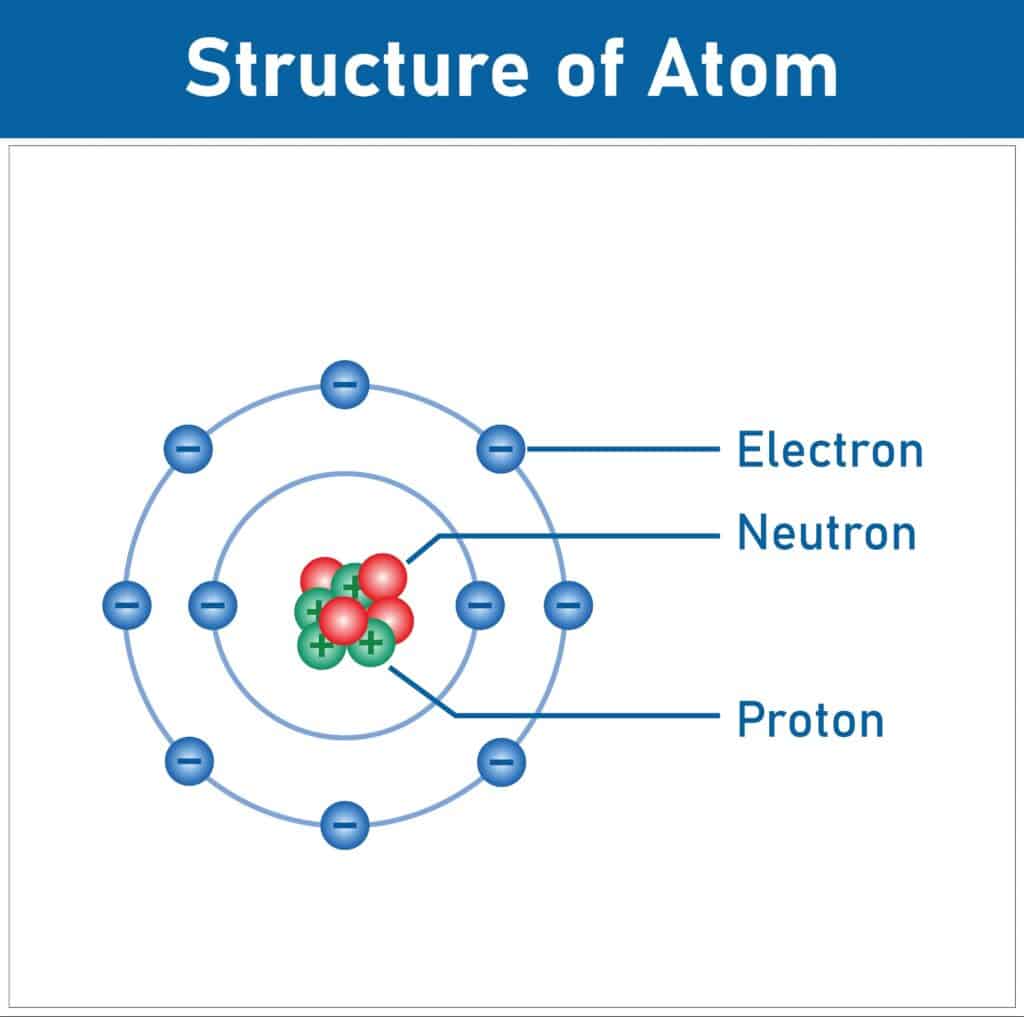
An atom is mostly empty space2 and looks a bit like a miniature solar system. It is made of three tiny particles (also called subatomic particles):
- The nucleus: The heavy, dense centre of the atom (like the Sun in our solar system). It contains protons (which have a positive electrical charge) and neutrons (which have no charge and are neutral).
- The electron cloud: Tiny particles called electrons (which have a negative electrical charge) zip around the nucleus at incredible speeds (like planets orbiting the Sun).
Because opposites attract, the negative electrons are held in place by the positive nucleus.

The structure of a molecule
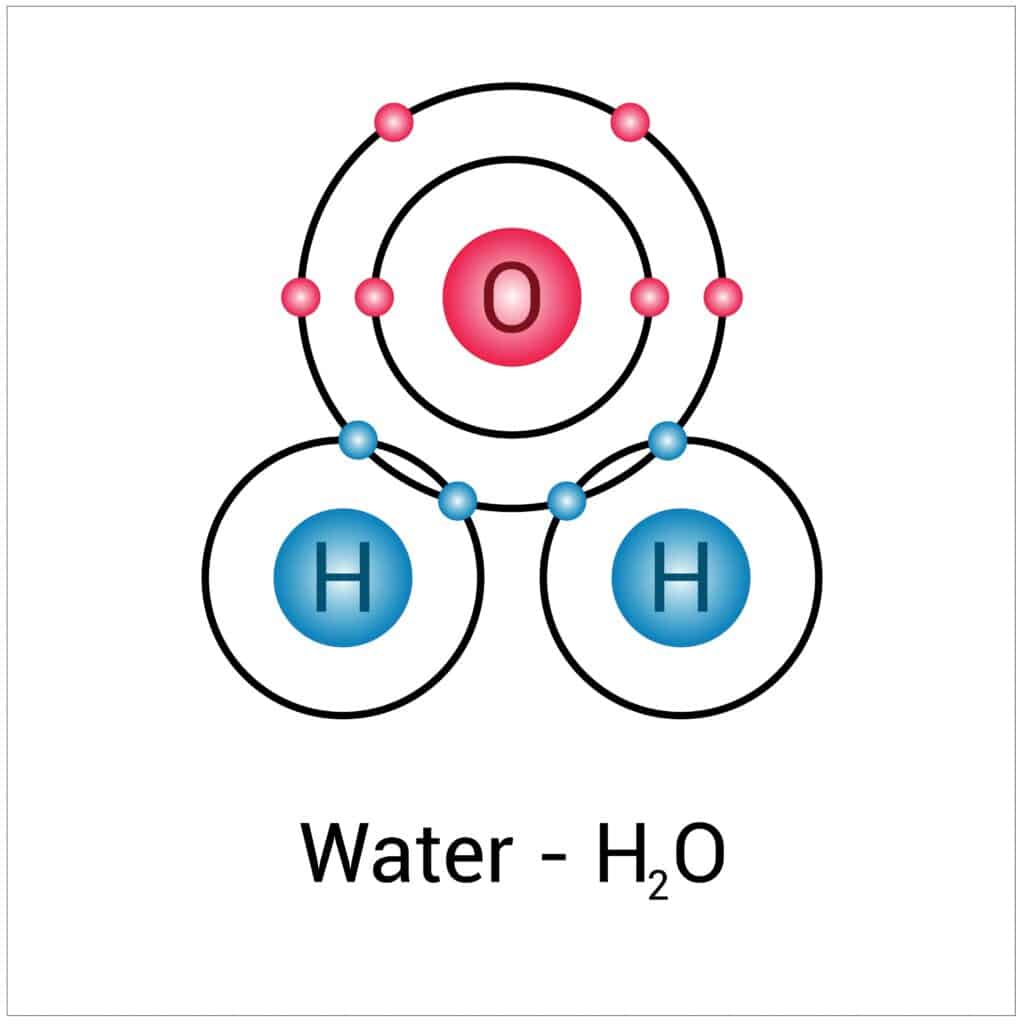
A molecule is formed when two or more atoms team up and share their electrons. This sharing acts like a chemical glue (called a bond) that holds them together.
- Same-atom molecules: Atoms can bond with their own kind. For example, two oxygen atoms bond together to make the oxygen gas (O2) we breathe.
- Different-atom molecules: Atoms can bond with different types to create entirely new things. For example, two hydrogen atoms bonded with one oxygen atom create a molecule of water (H2O).
A quick recap
| Atom | Molecule |
| A single particle of an element. | A cluster of atoms bonded together. |
| A single letter (e.g., “H” or “O”). | A whole word (e.g., “H2O”). |
| Cannot be broken down further by chemical means. | Can be broken back down into individual atoms. |
===
How the chemical bonds work
Chemical bonds are the “glue” holding molecules together. Atoms bond with each other because they want to be stable, which usually means having a full outer shell of electrons. For most atoms, a full outer shell means having 8 valence electrons (called the Octet Rule, except for Hydrogen and Helium, which only need 2). A valence electron is an electron located in the outermost shell of an atom that can participate in chemical bonding. By sharing or transferring electrons to complete their outer shells, atoms achieve a more balanced and lower-energy arrangement, which drastically reduces their chemical reactivity and increases their overall stability.
They achieve this in two main ways:
- Sharing electrons (Covalent Bonds): Two atoms both need more electrons, so they agree to share them. This keeps them locked together. Think of it as two people holding onto the same book. This is how water (H2O) forms.
- Stealing electrons (Ionic Bonds): One atom strongly pulls an electron away from another atom. This leaves one atom positively charged and the other negatively charged. Because opposites attract, they stick together like magnets. This is how table salt forms, when an electron transfers from Sodium (Na) to Chlorine (Cl), and both the atoms then bond to form Sodium Chloride (NaCl or Na+Cl–).
Molecules make up almost everything around us. Here are a few common examples:

- Carbon dioxide (CO2): One carbon atom bonded with two oxygen atoms. This is the gas we exhale and plants breathe in.
- Table sugar (C12H22O11): A much larger molecule made of 12 carbon, 22 hydrogen, and 11 oxygen atoms all locked together.
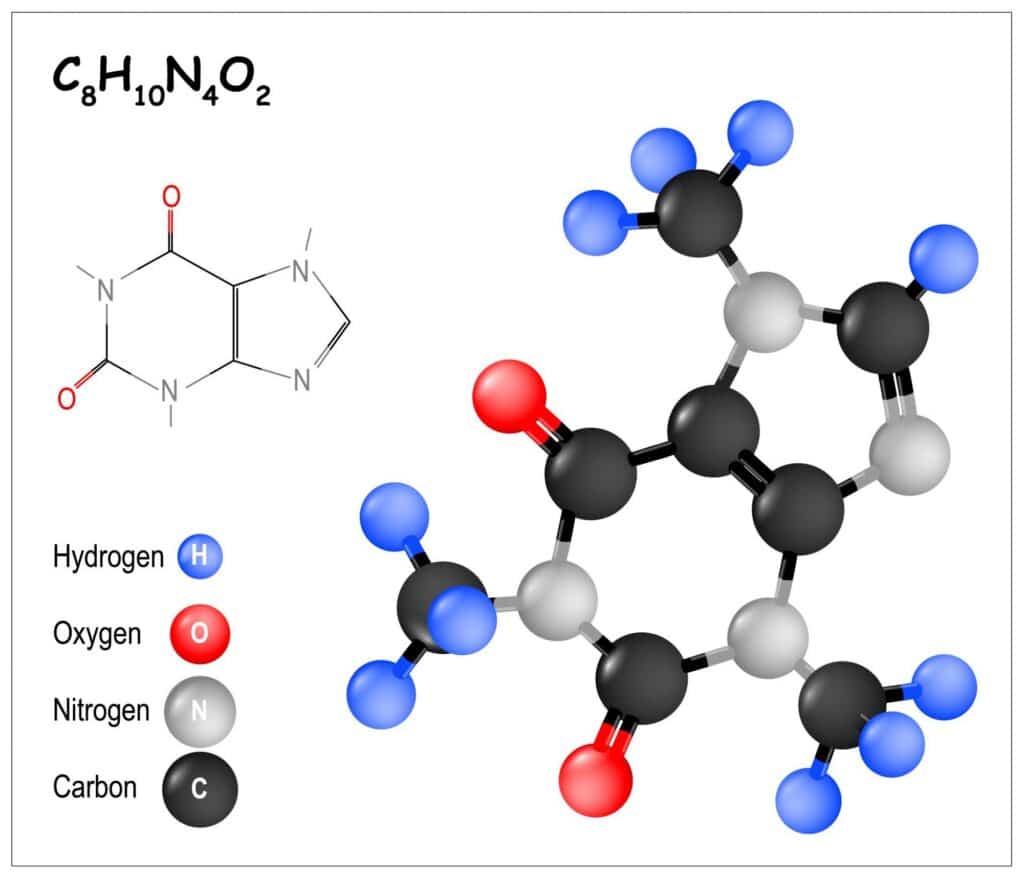
- Caffeine (C8H10N4O2): A complex structure of carbon, hydrogen, nitrogen and oxygen that gives you an energy boost.
The different types of atoms (Elements)
An element is a pure substance made entirely of one specific type of atom. The type of atom is determined solely by the number of protons in its nucleus.
- Hydrogen: The simplest atom, containing just 1 proton.
- Oxygen: A heavier atom containing 8 protons.
- Gold: A very heavy, dense atom containing 79 protons.
Scientists have discovered 118 different types of atoms so far, and they are all organised by weight and behaviour on the Periodic Table of Elements.
Atomic mass and atomic weight
Now let us digress slightly to understand the terms atomic mass and atomic weight.
Imagine you have a big basket of apples.
- Atomic Mass: Pick up a single apple and put it on the scale. Its weight is like the atomic mass.
- Atomic Weight: Now look at the whole basket. Some apples are big. Some are small. If we calculate the average weight of all of them, that is like the atomic weight.
But why are atomic mass and atomic weight not the same?
We have seen that every atom is built from three basic ingredients: protons, electrons and neutrons. As famously described by author Bill Bryson, “Protons give an atom its identity, electrons its personality.”
- The Proton Rule (Identity): The number of protons determines what element the atom is. For example, every single Carbon atom in the universe has exactly 6 protons. If you add a proton, it stops being carbon and becomes nitrogen.
- The Electron Rule (Personality): In a normal atom, electrons match the protons to control how it interacts and bonds with others.
- The Neutron Exception (Weight): Neutrons have no electrical charge and do not change how the atom acts chemically. Their only job is to sit at the core and add weight to the atom. Because nature doesn’t give every atom the exact same number of neutrons, atoms of the same element can have different masses.
Scientists call these non-identical atoms isotopes. They are different versions of the same element that weigh differently.
Consider the Carbon triplets found in nature:
- Carbon-12 (The Skinny Twin): Has 6 protons and 6 neutrons. This is the standard, most common variety.
- Carbon-13 (The Middle Twin): Has 6 protons and 7 neutrons. It behaves just like regular carbon but is slightly heavier.
- Carbon-14 (The Heavy Twin): Has 6 protons and 8 neutrons. It is so heavy and packed that it is unstable (radioactive) and is used by scientists to date ancient fossils.
Because a handful of carbon atoms will always contain a natural mix of these light, medium and heavy triplets, the element’s “atomic weight” on the Periodic Table displays a decimal average (12.011) rather than a clean, whole number.
How atoms and molecules shape the three states of matter
We know that matter mostly exists in three distinct states—solids, liquids and gases. A given state of matter is entirely determined by the energy, movement and spacing of its internal atoms and molecules. While the individual particles themselves do not change, the amount of heat energy they possess dictates how they behave. Adding heat speeds up these particles, forcing a substance to transition from solid to liquid, and finally to gas.
Solids are formed by heavy atoms or massive networks locked together by incredibly strong chemical bonds, such as the tightly packed grids of iron or the rigid ionic crystals of table salt. Because these particles have very low energy, they are locked firmly in place and can only vibrate on the spot. The powerful atomic connections prevent any free movement, giving solids a permanent, fixed shape.
Liquids are formed by medium-sized molecules or particles with uneven electrical charges that act like tiny magnets. A prime example is water, whose positive and negative sides create enough stickiness to hold the particles close together as a fluid. Because they gain more energy than solids, these particles successfully break free from rigid positions to slide and roll past one another, allowing the liquid to flow and take the shape of its container.
Gases are formed by lightweight, independent particles that have incredibly weak attractions to one another, including single atoms like helium and small molecules like oxygen and carbon dioxide. These high-energy particles completely overcome any forces holding them together and do not stick. As a result, they zip around wildly at high speeds, easily flying apart to separate and fill any available space.
What are chemical reactions?
A chemical reaction is a process where different molecules collide with enough speed and energy to shatter their existing chemical bonds, forcing the atoms to un-snap, shuffle around, and instantly rearrange into entirely new substances. This molecular transformation is clearly seen when lighting a match; the physical friction supplies a sudden burst of heat energy that forces the match-head atoms and surrounding oxygen molecules to violently crash together, swap partners, and ignite into fire.
Scientists control the speed of chemical reactions by changing how often and how hard the molecules bump into each other. Heating things up makes the particles zoom around faster for harder impacts, while crowding more particles into a tight space increases their chances of colliding. Special ‘matchmaker’ molecules called catalysts can also step in to grab the reacting particles and pull them into the perfect alignment, allowing the chemical transformation to happen much faster and with less energy.
From chemistry to quantum physics
Zooming past the atomic level of protons, neutrons and electrons shifts our perspective from traditional chemistry to the deeper realm of quantum physics. While chemistry focusses on how matter clumps together into various shapes, sizes and combinations to form physical structures like water or salt, particle physics exposes a more fundamental layer of reality. It explains the core nature of matter itself and the governing forces that allow those larger chemical structures to exist in the first place.
At this microscopic quantum level, scientists discovered that every single subatomic particle in existence belongs to one of two main families: fermions and bosons. Categorised by how they behave and their unique jobs in the universe, these particles serve as the fundamental sub-atomic ingredients that build and govern our entire reality.
Here is an architecture analogy of the two perspectives:
| Perspective | Analogy | Focus |
| Atoms & Molecules | Rooms and Walls | How spaces are organised and connected to make a house. |
| Fermions & Bosons | Bricks and Mortar | The exact physical properties of the clay and cement holding it up. |
From a layman’s perspective, we can think of fermions as the bricks (matter) and bosons as the glue (forces).
Fermions, Bosons and how they work together
Fermions are the particles that make up physical ‘stuff’ of the universe. Our bodies, the earth and the stars are all made of fermions.
- What they are: Electrons are fermions. Protons and neutrons are also made of smaller fermions called quarks.3
- Their Golden Rule: Fermions strictly obey the ‘Pauli Exclusion Principle.’ In plain English, this means two fermions cannot occupy the exact same spot at the same time.
- Why it matters: This rule is the only reason solid objects exist. It prevents atoms from collapsing into each other, allowing matter to take up physical space. It is why you can sit on a chair without falling straight through it.
Bosons do not make up solid objects. Instead, they carry forces and act as the messages passed between fermions to tell them how to move.
- What they are: The most famous boson is the photon (a particle/packet of light), as also Gluon (nuclear glue). Another famous one is the Higgs boson, also called God Particle4, which gives particles their mass.
- Their Golden Rule: Bosons love to crowd together. Infinite bosons can occupy the exact same spot at the same time.
- Why it matters: Because they can pile up on top of one another, they can create incredibly concentrated forces. For example, packing trillions of photons tightly together is how we get a laser beam. By piling up trillions of radio wave photons in the exact same manner, we can create a concentrated broadcast signal strong enough to travel across vast distances directly to our smartphones and car radios.
Inside a single atom, you can see both families of fermions and bosons working as a team:
- The electrons, protons and neutrons (fermions) provide the physical structure and weight.
- The photons and gluons (bosons) zip back and forth between those fermions like a game of catch, creating the magnetic and nuclear forces that hold the atom together.
The four fundamental forces
The bosons act as the glue of the universe from the sub-atomic level to the cosmic level, but all of them do not behave the same way. They operate through four fundamental forces—the ultimate universal rules of nature that dictate how everything in the universe interacts, how every particle in existence engages with every other particle. Without these forces, the atoms and molecules we had discussed about earlier would immediately fall apart, and the universe would be nothing but a chaotic cloud of floating subatomic dust.
Here is how these four forces work, ranked from the strongest to the weakest:
1. The Strong Nuclear Force (The ‘Super Glue’)
This is the strongest force in nature, but it only works over microscopic distances.
- Its Job: It holds quarks together to make protons and neutrons, and it holds those protons and neutrons together to form the nucleus of an atom.
- The Boson: The gluon (literally named because it acts like glue).
- Layman’s Analogy: Protons all have a positive charge, meaning they naturally want to repel each other like matching magnets. The strong force acts like industrial super-glue, overpowering that repulsion to lock them tightly inside the atomic nucleus.
2. The Electromagnetic Force (The “Daily Life” Force)
This force is much weaker than the strong force, but it has an infinite range. It affects anything with an electrical charge.
- Its Job: It causes opposites to attract (positive protons pulling negative electrons) and likes to repel. It is responsible for chemical bonds, electricity, magnetism and light.
- The Boson: The photon (particles of light).
- Layman’s Analogy: This is the force of everyday life. It keeps electrons orbiting the nucleus, glues atoms together into molecules, and is the physical resistance you feel when your hand pushes against a table.
3. The Weak Nuclear Force (The “Transformer”)
Despite its name, it is actually stronger than gravity, but like the strong force, it only works at sub-atomic distances.
- Its Job: It allows particles to change from one type into another. It is responsible for radioactivity (where unstable atoms fall apart over time) and plays a crucial role in causing the nuclear fusion that powers the Sun.
- The Boson: The W and Z bosons.5
- Layman’s Analogy: If the other forces are like glue, the weak force is like a shapeshifter. It can turn a neutron into a proton, which causes an atom to decay and release radiation. Without it, the Sun could not burn.
4. Gravity (The ‘Cosmic Sculptor’)
Gravity is by far the weakest force in the universe, but it has an infinite range and only attracts—it never repels.
- Its Job: It pulls objects with weight towards each other. It holds us to the Earth, keeps the Earth orbiting the Sun, and clumps stars together into galaxies.
- The Boson: Hypothetically called the graviton, but scientists have not actually discovered or proven it exists yet!
- Layman’s Analogy: A tiny refrigerator magnet can easily overpower the gravity of the entire Earth to pick up a paperclip. Gravity is incredibly weak for single atoms, but when you pile trillions of tons of matter together (like a planet), gravity becomes a giant cosmic anchor.
Summary of the Forces
| Force | What it Controls | Relative Strength | The Boson (Messenger) |
| Strong | Holds atomic nuclei together | (1) (Strongest) | Gluon |
| Electromagnetic | Atoms, chemistry, magnets, light | (1/137) | Photon |
| Weak | Radioactive decay, solar fusion | (1/100,000) | W & Z Bosons |
| Gravity | Orbits, planets, stars, galaxies | ((10-39) (Weakest) | Graviton (Theoretical) |
Conclusion: From subatomic seeds to cosmic consciousness
Today, modern particle science continues its profound journey. It bridges the microscopic abyss with the infinite cosmos. Inside our laboratories, colossal particle accelerators smash matter together. These machines peel back the layers of the atom. They reveal a vibrant subatomic zoo of quarks, leptons6 and the elusive Higgs boson. These fundamental ingredients are mapped beautifully by the Standard Model. Yet, this dance is not confined to Earth. Looking outward, advanced space telescopes trace these identical atomic building blocks across the cosmos. Astrophysicists have detected complex organic molecules drifting in interstellar clouds and swirling within the atmospheres of alien exoplanets. These celestial discoveries prove that the basic seeds of life are scattered widely across the dark space.
Ultimately, the story of the atom is a grand intellectual tapestry. It stretches from the ancient insights of Democritus to the interconnected reality championed by Richard Feynman. It reminds us that our solid, tangible world is largely a beautiful cosmic illusion. Our bodies are composed almost entirely of vast, empty space. We are held together only by invisible, microscopic fields of force. Yet, within that profound emptiness lies an enduring permanence. The very same stardust that forged ancient history continues to dance through our veins today. We are not merely isolated observers looking out at a cold, mechanical machine. We are a vibrant piece of the cosmos that has miraculously woken up to explore itself. In the end, understanding the atom changes everything. It transforms cold chemical data into a deeply poetic celebration of our shared physical existence.
Notes:
1 Around 400 BCE, the ancient Greek philosopher Democritus came up with a genius thought experiment: if you keep cutting an object in half repeatedly, eventually you must hit a baseline particle that can no longer be sliced. He coined the term “atomos” (meaning “indivisible”) to describe these ultimate, un-cuttable pieces of matter. Democritus boldly claimed that the entire universe consists solely of these tiny atoms and empty space, and that differences in shape and texture explain why objects look and feel different. While his ideas were purely philosophical and lacked experimental proof, his brilliant intuition laid the groundwork for modern atomic theory over two thousand years later.
2 Despite their solid appearance, atoms are actually 99.9999999% completely empty space; in fact, if we remove all the empty space from every human atom on Earth, the entire human race could fit inside a single sugar cube. This means that when we sit on a chair or touch a wall, we never actually make physical contact. Instead, the negative electrons in our body’s atoms strongly repel the negative electrons in the object, creating a microscopic electromagnetic cushion that ensures that we are effectively floating on fields of force.
3 Quarks are the tiny building blocks that make up the centre of every atom in the universe. Think of them as the smallest Lego bricks of nature. They group together in threes to create protons and neutrons, which form the core of all solid matter around us, from our coffee mugs to our own bodies. Quarks are unique because they are never found completely alone; they are always trapped together by a super-strong cosmic glue.
4 The Higgs boson is like a giant cosmic blanket that gives weight to everything in the universe. Imagine space is filled with a thick, invisible syrup. When tiny particles try to swim through it, the syrup slows them down, and gives them weight. It is much like trying to run through shallow water at the beach, where the water resists your movement and makes your legs feel heavy compared to moving freely through the air. Without this sticky field, particles would fly around at the speed of light, and they could never join together to build stars, planets, or humans. It is nicknamed the “God Particle” because it is so fundamentally important to creation of the universe, and because it was incredibly hard for scientists to find.
5 W and Z bosons act like tiny cosmic messengers that control radioactive decay and make the sun shine. While other particles build the structure of matter, these bosons carry the “weak force,” which lets particles change into different types. Imagine a neutron inside an atom getting a message from a W boson that tells it to turn into a proton. This shape-shifting process causes radiation, but it is also the exact engine that triggers nuclear fusion inside stars. Without these two messengers, the sun would not produce light or heat, and life on Earth could not exist.
6 Leptons are truly fundamental, structureless building blocks of matter that cannot be broken down into smaller components. This diverse particle family features the familiar electron, which drives electricity and chemical bonding, alongside nearly massless, ghostly neutrinos and heavier cousins like muons and taus. Because they are immune to the strong nuclear force, leptons interact only through electromagnetism and the weak force, playing a quiet but essential role in stitching together the universe’s material reality.