The day we lost the centre of the universe (and found our true shape)
This cosmic chronicle explores humanity’s epochal journey from comfortable illusions to profound truth, charting how we unlocked the shape and place of our world. By mapping out an epic, multi-millennium detective story filled with optical blindspots, mathematical genius, and paradigm shifts, the narrative reveals that losing our central position in the universe did not diminish our significance—it elevated our curiosity, transforming us into humble crew members aboard a fragile jewel spinning gracefully through the dark.
1
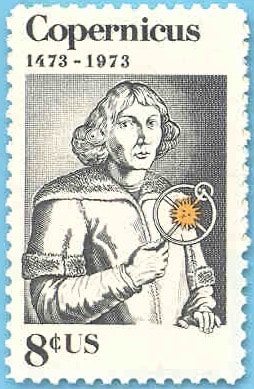
In a dimly lit bedroom in Frombork, Poland, in the late spring of 1543, a seventy-year-old mathematician named Nicolaus Copernicus lay taking his final breaths. For decades, he had kept a radical secret locked away in his desk—a set of mathematical equations proving that the Earth is not the holy, unmoving centre of creation, but merely a rock spinning around the Sun. Publishing this meant risking everything he had ever built.
As he slipped in and out of consciousness, his friends rushed into the room and placed a freshly printed, leather-bound book into his trembling hands. It was the very first copy of his life’s work. According to legend, Copernicus looked at the cover, closed his eyes, and passed away. He died knowing he had just set the universe on fire.
The spark from that fire caught slowly, but it was unstoppable. While his book, De revolutionibus orbium coelestium, initially circulated as a dense, mathematical curiosity among a small elite, its underlying truth quietly began to dismantle the foundations of human certainty. It fundamentally challenged the religious and philosophical status quo, forcing humanity to confront an unsettling cosmic reality.
Decades later, as bold thinkers openly championed Copernicus’s math, it triggered a fierce backlash from institutions desperate to defend the traditional view—ultimately setting the stage for the dramatic scientific revolutions, and heresy trials, that would reshape human history.
Today, we take our planetary home completely for granted. We look at stunning, high-definition satellite photos of our vibrant “Blue Marble” floating beautifully in black space, and we don’t think twice. But humanity’s journey to understanding the shape and status of our planet wasn’t a straight line. It was an epic, multi-millennium detective story filled with optical illusions, mathematical genius, and dramatic clashes of ego.
Let’s take a look at how we finally figured out the shape and place of our world
The trick of the horizon
For thousands of years, our ancestors trusted their eyes. And why wouldn’t they? If you stand in an open field, the horizon looks perfectly flat. And you don’t feel the ground spinning beneath your feet.
The brilliant evolutionary biologist Stephen Jay Gould once noted:
“Errors like geocentrism did not survive for centuries because people were stupid, but because the evidence of their daily lives supported it.”
To suggest the Earth was a sphere meant convincing people that somewhere out there, on the other side of the ball, there were human beings walking completely upside down with their blood rushing to their heads. It defied all basic common sense and sounded completely insane.
Because of this daily evidence, early civilizations built beautiful, poetic myths to explain the cosmos. In ancient Egypt and Mesopotamia, humans looked up and saw the sky as a solid, metallic dome or a canopy held up by mountain peaks, stretching over a flat expanse of land floating on cosmic waters. Halfway across the world in ancient China, astronomers relied on the Gai Tian (“canopy heaven”) model. They lived by the philosophy of “Tian yuan di fang”—the belief that heaven is a round dome, but the Earth below is a flat, solid square – or a slightly curved disc.
It made perfect sense to the naked eye. But humans are uniquely defined by our refusal to let our senses have the final word.
Shadows and sailors: The Greek breakthrough
The shift from myth to math began in ancient Greece around the 5th century BCE. The philosopher Pythagoras first guessed that the Earth was a sphere, but he did it purely because he believed it was nature’s most perfect geometric form. A sphere does represent the ultimate expression of efficiency, symmetry, balance and aesthetic harmony. Figuring that the gods wouldn’t settle for anything less than absolute cosmic perfection, Pythagoras deduced that our world simply had to be a globe.
2
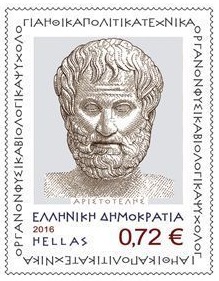
It was Aristotle, another Greek philosopher and polymath, who brought the hard receipts a century later. He didn’t use advanced telescopes; he just used his eyes.
First, he watched ships sail out to sea. On a flat Earth, a ship would simply get smaller and smaller until it became a tiny dot. But Aristotle noticed that the hull of the ship vanished over the horizon first, while the tall sails remained visible for a few moments longer. The ship was quite literally climbing over a curve.
Second, Aristotle looked at the Moon during a lunar eclipse. As the Earth moved between the Sun and the Moon, it cast a shadow. That shadow was always perfectly round.
As the American astrophysicist Neil deGrasse Tyson beautifully observed in our modern era:
“A disc can cast a round shadow, but only if the light shines straight at its face. A sphere is the only geometric shape in the universe that casts a perfectly round shadow from every single angle.”
💡How Aristotle proved the curve
The departing ship: The hull sinks below the horizon before the mast, proving a curved surface.
The lunar eclipse: The Earth’s shadow cast on the Moon is always a perfect, unbroken arc.
By the 3rd century BCE, the brilliant Greek polymath Eratosthenes—who served as the chief director of the Great Library of Alexandria—took this a step further, calculating the entire circumference of the Earth using nothing but a vertical stick, the midday sun, and a professional spacer.
He noticed that at noon on the summer solstice, the sun shone directly down a deep water well in the city of Syene, casting no shadow at all. But at the exact same moment in Alexandria, hundreds of miles away, a vertical stick cast a very distinct shadow. By measuring the precise angle of that shadow and hiring a professional spacer (bematist) to physically count his footsteps across the gruelling Egyptian desert, Eratosthenes calculated the Earth’s size. His math was so incredibly precise that he was off by less than a few percentage points of the actual modern value. He proved the curvature of our world long before anyone could ever see it.
The Indian and Islamic alignments
While Europe entered the Middle Ages, brilliant minds in Asia and the Middle East were taking the spherical model to breathtaking new heights.
3
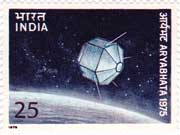
By the 5th century CE, the legendary Indian mathematician Aryabhatta looked up at the night sky and realised something completely radical for his time. He declared that the Earth was a sphere, but more importantly, he stated that it wasn’t the stars that were moving around us. Instead, our spherical Earth was spinning on its own axis every single day.
The ancient Indian astronomical text, the Surya Siddhanta, a Sanskrit treatise in Indian astronomy, attributed to Lāṭadeva, a student of Aryabhatta, even began grappling with how we don’t fall off a ball, noting that a force of attraction draws all objects toward the centre of the globe—a stunningly early intuitive blueprint for what Isaac Newton would later mathematically define as gravity.
🔄 The Indian Shift
The ancient cosmic view: The sky spins like a cosmic carousel while the Earth stands completely still.
Aryabhata’s radical view: The sky stands still; our spherical Earth spins on its own axis.
These radical observations failed to gain widespread traction at the time because they utterly defied everyday human sensory experience and clashed directly with the deeply entrenched geocentric traditions dominating mainstream science and philosophy across both the East and the West.
4
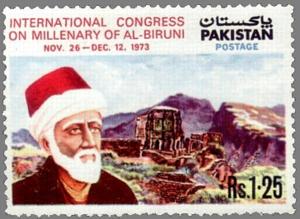
By the 10th century, the Islamic Golden Age pushed the boundaries of measurement even further. The Persian polymath Al-Biruni found a way to calculate the Earth’s radius using an astrolabe, a mountain and trigonometry. While Eratosthenes had to rely on measuring the massive physical distance between two distant cities, Al-Biruni’s elegant formula allowed him to measure the entire planet while sitting comfortably on top of a single hill.
Proving the shape: Blood on the open ocean
For centuries, almost every educated culture agreed the Earth was a globe. But they still clung tightly to one comforting ego-trip: the Geocentric Model. We believed our beautiful sphere sat perfectly still at the dead centre of creation, and the universe put on a show just for us.
Before mainstream science fully embraced the mathematical shifting of the cosmos, everyday humans went out and paid for the physical proof of our geometry with literal blood. In 1519, Ferdinand Magellan set out on a terrifying voyage to find a western route to the Spice Islands. This wasn’t a peaceful scientific cruise; it was a brutal saga of mutiny, starvation and violent clashes. To survive, the desperate crew resorted to eating sawdust and leather rigging.
Magellan himself was killed in the Philippines, but in 1522, his surviving crew, led by Juan Sebastián Elcano, limped back into Spain. Out of 5 ships and 270 men who left, only one single ship (the Victoria) and 18 ghost-like men survived. By sailing in one continuous direction and ending up right back where they started, they proved beyond a shadow of a doubt that they were living on a giant ball.
The ultimate demotion: Copernicus
5
The structural reality of our world was finally proven on the water, but the true spiritual comfort zone completely shattered back on land in 1543. As Copernicus’s life’s work finally left the printing presses, it flipped the cosmic map.
He didn’t change the Earth’s shape, but he completely destroyed its status. He proved that the Sun was at the center, and the Earth was just another rock orbiting a star.
🌌 Flipping the Cosmic Map
Ptolemy’s Geocentric Model: The Earth sits completely motionless as the holy, unyielding center of all creation.
Copernicus’s Heliocentric Model: The Sun claims the center, liberating the Earth to join the rest of the planets in a beautiful cosmic dance.
The odd couple of astronomy: Brahe and Kepler
Copernicus’s sun-centred model was beautiful, but it had one massive problem: the math didn’t quite work. Copernicus assumed that planets orbited the Sun in perfect, divine circles. Because of this, his predictions of where planets would appear in the night sky were often completely wrong.
To fix the universe, science needed a legendary, chaotic collaboration.
Enter Tycho Brahe (1546–1601), a flamboyant Danish nobleman who lost the bridge of his nose in a sword duel and wore a replacement made of gold and silver. Tycho built a state-of-the-art island observatory and spent decades meticulously tracking the movements of the planets with his naked eye, creating the most accurate, flawless treasure trove of data in human history.
6
But Tycho wasn’t a master mathematician. For that, he hired a brilliant, chronically anxious young German assistant named Johannes Kepler (1571–1630). The two clutched their secrets tightly and argued constantly. When Tycho died unexpectedly in 1601, his final words to Kepler were a desperate plea: “Let me not seem to have lived in vain.”
Kepler inherited Tycho’s data—though he practically had to steal it from Tycho’s protective family—and spent years trying to force it into Copernicus’s “perfect circular orbits”. It wouldn’t fit. Trusting Tycho’s flawless observations over centuries of religious dogma, Kepler finally made a radical breakthrough: planets do not travel in perfect circles; they orbit the Sun in ellipses (ovals).
Reflecting on the moment he finally unlocked the solar system with his Three Laws of Planetary Motion, Kepler wrote:
“I was thinking God’s thoughts after Him… The heavenly motions are nothing but a continuous song for several voices, to be perceived by the intellect, not the ear.”
Galileo’s lens and the grand finale
Shortly after Kepler solved the math, Galileo Galilei provided the physical, visual proof. In 1609, Galileo built his own modified telescope and pointed it at the heavens.
7
He looked at the Moon and saw mountains and craters. Before him, people believed the Moon was a perfectly smooth, divine, glowing pearl. Galileo proved it was a rough, rocky place—just like Earth. He also spotted moons orbiting Jupiter, proving that the Earth wasn’t the centre of all cosmic motion.
When hauled before the Roman Inquisition in 1633 and forced to kneel and swear that the Earth sat completely motionless, legend says Galileo stepped outside the courtroom, tapped his foot against the dirt, and muttered under his breath: “Eppur si muove” (“And yet, it moves”). The establishment feared that if the Earth wasn’t physically central, humanity would lose its meaning.
But as the legendary science communicator Carl Sagan later reflected:
“The clearing of our vision faces us with a universe that is vast and awesome. It does not diminish our significance; it elevates our curiosity.”
Kepler had proved how the planets moved in ovals, but the ancient question remained: why didn’t the oceans simply spill off into space? The final piece of the cosmic puzzle fell into place a few decades later with Sir Isaac Newton.
8
Newton used Kepler’s laws to formulate his Universal Law of Gravitation. In doing so, he mathematically finalised the invisible cosmic glue that global thinkers, from the ancient authors of the Surya Siddhanta to Kepler, had been chasing for centuries. He tied the whole story together, proving that the exact same invisible force that makes an apple fall from a tree is what keeps our spherical Earth spinning safely in its orbit around the Sun.
The view from above
The final chapter of this long detective story didn’t involve equations or telescopes—it involved leaving the planet entirely.
9
In 1946, scientists launched a camera on a rocket from the desert of New Mexico, capturing the first grainy, black-and-white image of our planet’s curve from 65 miles up. Then, in December 1972, the crew of Apollo 17 snapped the iconic “Blue Marble” photograph.
For the first time in human history, we didn’t have to deduce, calculate or argue. We could simply look out the window and see our home for exactly what it is: a beautiful, fragile, three-dimensional jewel spinning gracefully through the dark.
Our ancestors weren’t foolish for thinking the world was flat; they were simply standing too close to the canvas. It took thousands of years, a lot of courage, and the relentless curiosity of global thinkers to help us finally step back and admire the whole picture.
It is easy to look back and wonder how our ancestors couldn’t see what seems so obvious to us today. But it makes you think: what “obvious” truth about our universe are we standing too close to see right now?
So, let us recap our story in a table format for ease of grasping:
The cosmic detective story: Who unlocked our world?
The Thinker / Voyager
The Gift of Insight
The Legacy
Pythagoras
(5th Century BCE)
First envisioned the Earth as a sphere out of a deep belief in the harmony, symmetry and ultimate geometric perfection of nature.
He reminded us that tracking the truth often begins with a passion for cosmic beauty.
Aristotle
(4th Century BCE)
Provided the first hard physical proofs by observing how departing ship hulls sink over the horizon first, and noting the unyielding round shadow cast by the Earth during lunar eclipses.
He taught humanity to look closer at the everyday clues hiding right in front of our eyes.
Eratosthenes
(3rd Century BCE)
Calculated the entire circumference of the planet with breathtaking accuracy using nothing but a shadow-casting stick, the midday sun, and simple school-level geometry.
He proved that a curious mind can measure the infinite magnitude of our world without ever leaving home.
Aryabhata & the Authors of the Surya Siddhanta
(5th Century CE)
Radically declared that the sky stands still while our global Earth spins on its own axis daily, intuitively laying the blueprint for gravity centuries before the West.
They gave humanity its first taste of planetary motion, daring us to feel the world spinning beneath our feet.
Al-Biruni
(10th Century CE)
Perfected the measurement of the Earth’s radius using an astrolabe and a single mountain, elegantly substituting gruelling physical distance with pure mathematics.
He built bridges between the physical landscape and the infinite reach of human intellect.
Juan Sebastián Elcano & Magellan’s Surviving Crew
(1519–1522)
Navigated the terrifying, endless blue of the open oceans, surviving mutiny and starvation to physically seal the globe by returning right back to where they started.
They paid for the undeniable, geometric proof of our home with literal blood, sweat and unparalleled human grit.
Nicolaus Copernicus
(1543)
Realigned the entire cosmic map on his deathbed, revealing that the Sun rests at the centre and liberating the Earth to join the dance of the planets.
He sacrificed our comfortable, central ego to grant us something far greater: a true place in a vast universe.
Tycho Brahe
(1546–1601)
Devoted decades of cold, island nights to meticulously mapping the paths of the planets with the naked eye, capturing history’s most flawless data cache.
He left behind the flawless factual bricks with which the future architecture of the heavens would be built.
Johannes Kepler
(1571–1630)
Bravely cast aside centuries of circular dogma to unlock Tycho’s data, mathematically proving that planets orbit the Sun in sweeping, elegant ellipses.
He listened to the mathematical “song” of the solar system, teaching us to think cosmic thoughts after the creator.
Galileo Galilei
(1564–1642)
Pointed a lens at the heavens to show us a cratered Moon and moons orbiting Jupiter, whispering “And yet, it moves” against the crushing weight of institutional fear.
He gave us the courage to look through the glass, proving that the truth cannot be hidden by a judge’s decree.
Sir Isaac Newton
(1642–1727)
Formulated the Universal Law of Gravitation, blending Kepler’s planetary paths with the falling of an apple to mathematically bind the entire universe together.
He discovered the invisible, cosmic glue that keeps our oceans safe and our global home spinning securely in the dark.
The Crew of Apollo 17
(1972)
Snapped the iconic “Blue Marble” photograph from deep space, forever crystallising the multi-millennium detective story into a single visual masterpiece.
They handed us the final, luminous portrait of our home—reminding us that we are all crew members on a fragile, beautiful oasis floating together through the dark.
Sources:
MacTutor History of Mathematics, University of St Andrews, Nicolaus Copernicus and the Heliocentric Model, for the Copernican shift from geocentrism to heliocentrism.
Nature, Eratosthenes and the Circumference of the Earth, for the historical account of Eratosthenes’s calculation using shadows at Syene and Alexandria.
The Math Centre at Humber College, How did Eratosthenes calculate the circumference of the Earth?, for a clear explanation of the geometry behind the measurement.
Amartya Kumar Dutta, Aryabhata and Axial Rotation of Earth, for evidence of Aryabhata’s discussion of Earth’s rotation in the Indian astronomical tradition.
Rice University, Science | Copernican System, for a concise scientific summary of the Sun-centered model and its implications.
PBS Secrets of the Dead, The Center of the Universe, for the broader historical arc from Aristotle and Ptolemy to Copernicus and Galileo.
LibreTexts, Early Astronomers — Copernicus, Galileo, Kepler, and Newton, for the sequence of ideas connecting planetary motion to Newtonian gravitation.
The University of Chicago journal Isis, The Two Earths of Eratosthenes, for the scholarly discussion of Eratosthenes’s measurements and their interpretation.
Image captions:
Image 1: A 1973 United States postage stamp issued to commemorate the 500th anniversary of the birth of astronomer Nicolaus Copernicus. The stamp features a portrait of Copernicus holding an armillary sphere representing the sun at the centre of the universe. Courtesy Wikimedia Commons.
Image 2: Postage stamp issued by Greece in 2016 to mark 2400 years since the birth of Aristotle. Courtesy Hellenic Philatelic Society of The Netherlands.
Image 3: A postage stamp issued by India in 1975 celebrating the historic launch of Aryabhata, the nation’s first indigenous satellite. Named in honour of the legendary 5th-century Indian astronomer and mathematician, the pioneering spacecraft was successfully launched into space on April 19 from the Kapustin Yar rocket launch complex by the Soviet Union. Courtesy Wikimedia Commons.
Image 4: A Pakistani postage stamp issued in 1973 to mark the International Congress on the Millenary of the legendary Persian scholar Abu Rayhan al-Biruni. The design features a portrait of Al-Biruni alongside a historic depiction of the Nandana Hill ruins in present-day Pakistan. It was at this very fortress sanctuary that the medieval polymath utilised an astrolabe, a single mountain peak, and innovative trigonometry to calculate the Earth’s radius and circumference with astonishing accuracy. Courtesy The University of Maine, School of Marine Sciences.
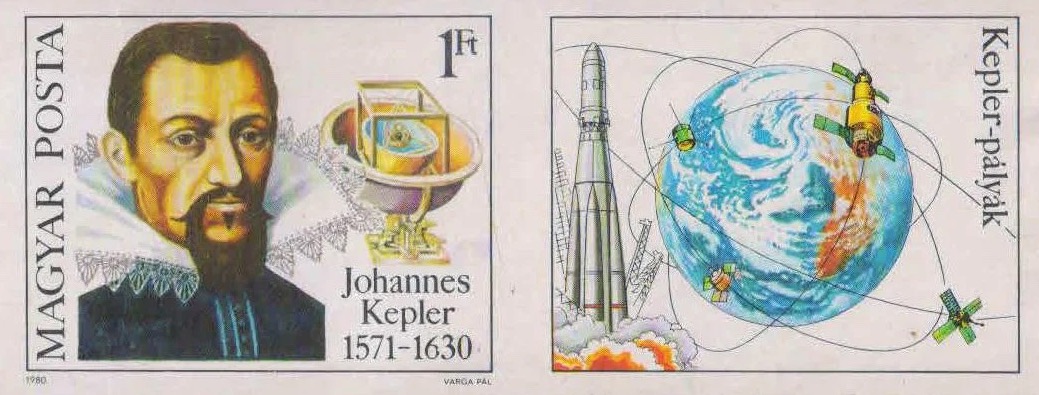
Image 5: A postage stamp issued by Hungary (Magyar Posta) in 1980 honouring the revolutionary German astronomer and mathematician Johannes Kepler (1571–1630). Alongside a depiction of his early Mysterium Cosmographicum model on the left, which famously attempted to use nested Platonic solids to explain the geometric distances of planetary orbits, the right panel depicts “Kepler-pályák” (Keplerian orbits) featuring a modern rocket and satellites orbiting the Earth—triumphantly highlighting how his 17th-century mathematical laws remain the foundational bedrock used today to calculate space flight trajectories and satellite paths. Courtesy Stampex India.
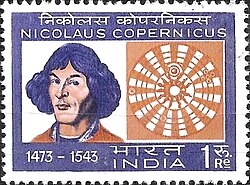
Image 6: A postage stamp issued by India in 1973 honouring the Renaissance-era mathematician and astronomer Nicolaus Copernicus (1473–1543) on his 500th birth anniversary. It was released on July 21 to mark the opening of the prestigious Indipex 73 International Stamp Exhibition. Courtesy Wikimedia Commons.
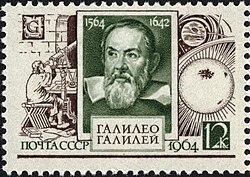
Image 7: A Soviet postage stamp issued in 1964 to commemorate the 400th anniversary of the birth of the legendary Italian astronomer, physicist and polymath Galileo Galilei. The design features a striking portrait of Galileo alongside a historic illustration of him peering through his early modified telescope to look at the heavens. Courtesy Wikimedia Commons.
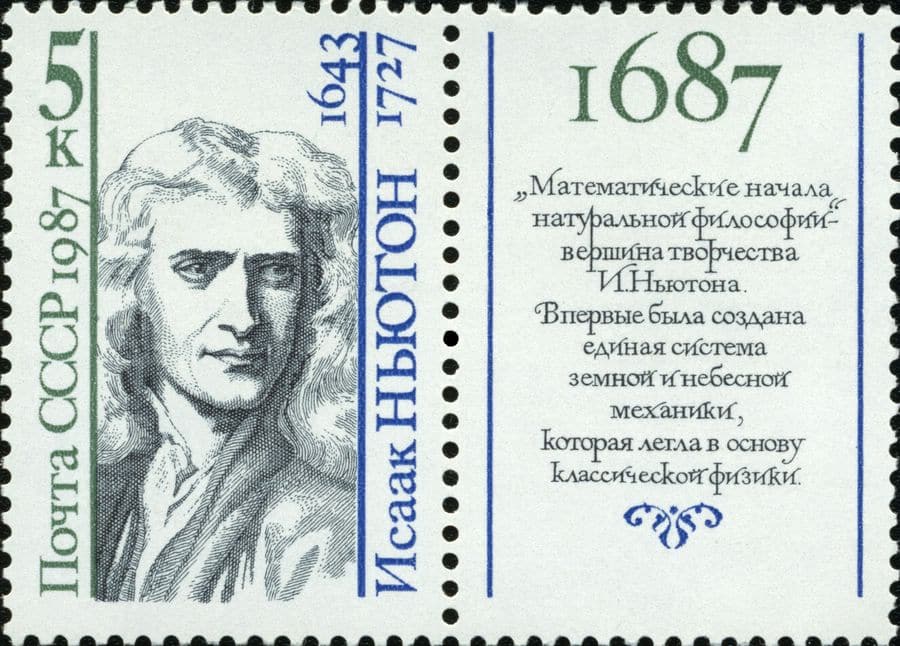
Image 8: A Soviet postage stamp issued on October 8, 1987, celebrating global scientific milestones on the 300th anniversary of the publication of Sir Isaac Newton’s masterpiece, Philosophiæ Naturalis Principia Mathematica (1687). The commemorative design features a detailed portrait of Newton alongside elegant Russian typography detailing his foundational contributions to classical mechanics and the laws of motion. Courtesy Wikimedia Commons.
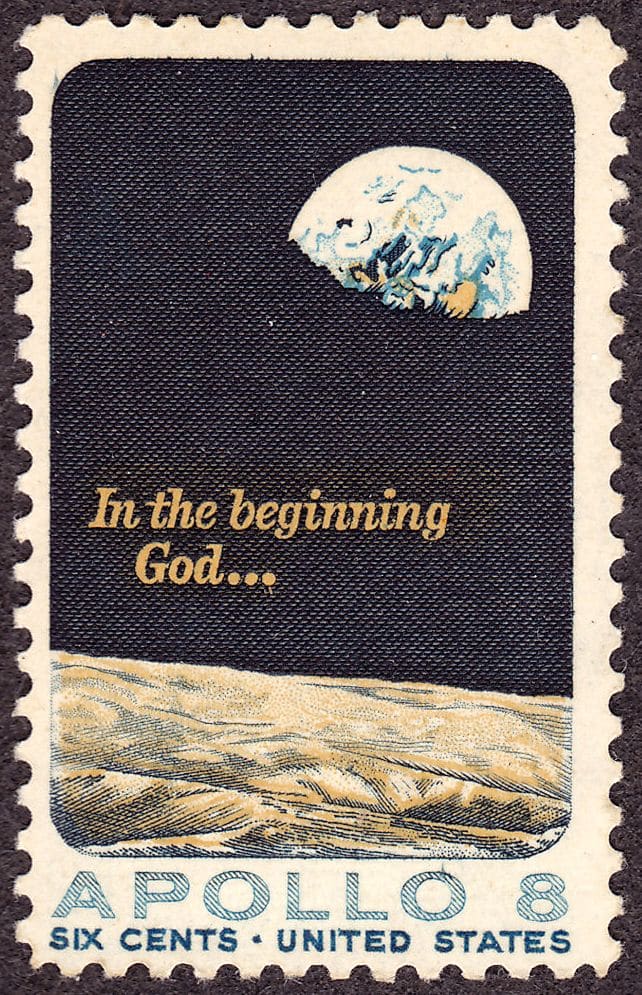
Image 9: A United States postage stamp issued in 1969 to commemorate the Apollo 8 mission features the famous “Earthrise” photograph taken by astronaut William Anders on Christmas Eve 1968. It includes the text “In the beginning God…,” referencing the crew’s live reading from Genesis during their lunar orbit. Courtesy Wikimedia Commons.