
The heavy responsibilities we willingly shoulder for others do not weigh us down; when carried with grace and willingness, our greatest burdens transform into the very wings that elevate our spirits.
An old legend relates that, long ago, God had a great many burdens which he wished to have carried from one place to another on Earth. So he asked the animals to lend a hand.
But all of them began to make excuses for not helping: the elephant was too dignified; the lion, too proud; and so on.
Finally the birds came to God and said, “If you will tie the burdens into small bundles, we’ll be glad to carry them for you. We are small, but we would like to help.”
So God fastened upon the back of each one a small bundle, and they all set out walking across the plain to their destination. They sang as they went, and did not seem to feel the weight of their burdens at all.Every day the burdens seemed lighter and lighter, until the loads seem to be lifting the birds, instead of the birds carrying the burdens.
When they arrived at their destination, the birds discovered that when they removed their loads, there were wings in their place, wings which enabled them to fly to the sky and the tree tops.
They had learned how to carry their burdens, and their loads had become wings to carry them nearer to God.
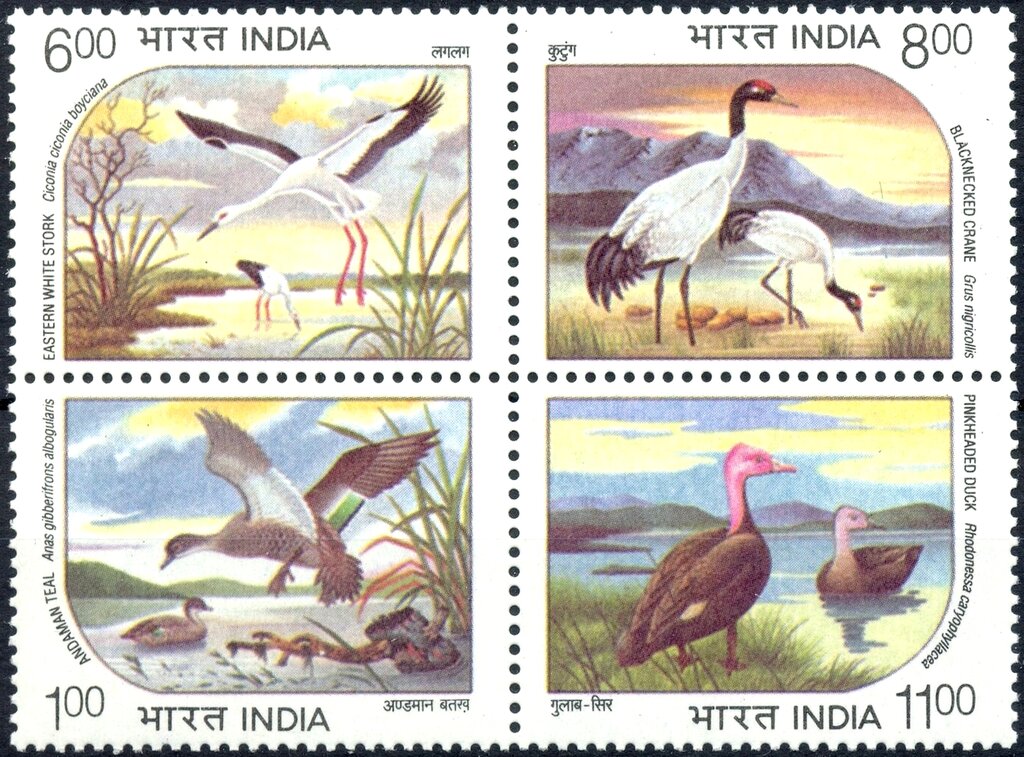
The burdens we carry for others may become wings of the spirit, to lift us into happiness such as we have never known.Image: A se-tenant block of four postage stamps brought out by India in 1994 features endangered water birds.
.More about birds and bird-watching at http://www.birdwatching-bliss.com/
Notes:
19th-century homiletic origins: The story of how birds received their wings originated as a popular late 19th-century sermon illustration, credited to devotional writers such as James Russell Miller (J. R. Miller) and popularised globally by Lettie Cowman in her 1919 classic devotional Streams in the Desert. The parable was constructed to explain how willingly accepting duty (dharma or service) builds spiritual capacity rather than exhaustion.
Evolutionary biology & high-power, low-weight physiology: In evolutionary biology, birds became efficient flying machines through an exquisite balance of maximum power output and structural weight reduction. Evolving from bipedal theropod dinosaurs, avian species developed specialised feathers for lift and propulsion, hollow (pneumatic) bones internally reinforced with struts, fused skeletons with a prominent keel bone (carina) to anchor massive pectoralis muscles, endothermic (warm-blooded) metabolism driven by a four-chambered heart, and a unique continuous-flow respiratory system utilising air sacs—demonstrating that structural capacity develops precisely to lift the organism above the ground.