When the mind wanders: Dreams, insight and discovery
A quiet kind of brilliance
Some of the most remarkable ideas in science and art have arrived not in moments of intense effort, but in the quiet spaces in between. A mind that has been wrestling with a problem all day may suddenly find an answer while drifting into sleep, taking a walk, or staring out of a window. The insight can feel almost magical. Yet more often than not, it is the result of a mind continuing its work beneath the surface.
This is one reason stories of dreams and sudden inspiration continue to fascinate us. They remind us that human understanding is not always linear. We do not solve every problem by force. Sometimes we arrive at an answer only after stepping away from it.
Kekulé and the snake
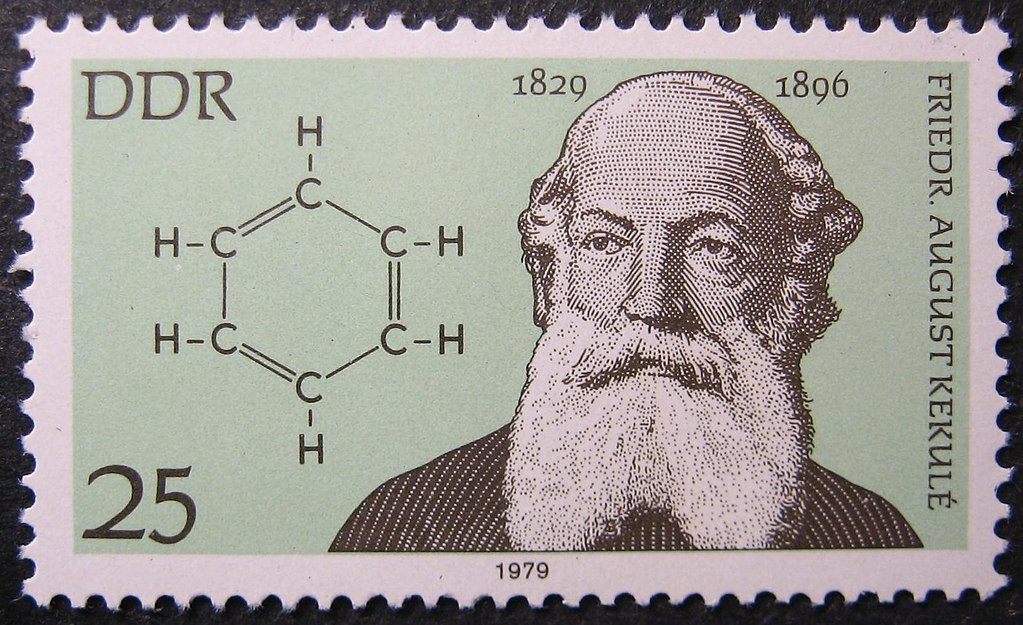
One of the most famous stories of this kind is that of August Kekulé, the German chemist associated with the structure of benzene. According to the story, Kekulé had struggled for some time to understand how the molecule might be arranged. Then, in a dream or half-dream state, he imagined a snake biting its own tail, forming a ring.
That image, whether taken literally or as a later retelling of a real insight, has become a lasting symbol of creative discovery. It captures something true about the way the mind works: when reason reaches its limit, imagination may show us a new shape. In Kekulé’s case, the image of the ring helped point chemistry toward a deeper understanding of molecular structure.
The story has endured not only because of what it says about benzene, but because it speaks to a wider human experience. Many of us know the feeling of struggling, pausing, and then suddenly seeing the problem differently. The answer does not always arrive as a polished argument. Sometimes it appears as a picture.
Inspiration in unexpected places
Kekulé is far from alone. Paul McCartney has often been associated with the melody of “Yesterday,” which he reportedly heard in a dream before shaping it into one of the most beloved songs of the twentieth century. Mary Shelley’s ‘Frankenstein’ is also tied to a vivid dreamlike vision, a moment that seems to have helped open the door to her novel’s unforgettable atmosphere.
Elias Howe, the inventor of the sewing machine, is said to have found inspiration for a key technical detail after a dream in which spears with holes in their tips suggested the position of the needle’s eye. Srinivasa Ramanujan, the extraordinary Indian mathematician, often spoke of mathematical insights arriving in dream states or through intuitive flashes of insight, which he interpreted through his spiritual life. James Watson later described a dream-related moment as part of the process that helped him think about the structure of DNA .
Not every one of these stories is equally well documented, and some have become more legendary with repetition. But taken together, they point toward a simple and powerful idea: creative work often depends on more than deliberate effort alone. It depends on incubation, patience, memory, intuition and the subconscious mind continuing to make connections when we are not fully aware of it.
What dreams may be doing
Modern psychology and cognitive science suggest that the mind remains active while we rest. During sleep and periods of relaxed attention, the brain can reorganise information, combine fragments of memory, and explore possibilities that may not emerge during focussed concentration. That does not make dreams a magical source of truth. But it does help explain why they can feel so productive.
In this sense, dreams are not mysterious interruptions of thought so much as another mode of thought. They can loosen rigid patterns, allow unexpected associations, and present problems in a new form. That is why artists, scientists and inventors across different periods and cultures have often described insight as arriving sideways, not straight on.
The subconscious does not always speak in logic. Sometimes it speaks in symbols, images, fragments, and stories. Yet those symbols can be enough to move a person toward discovery.
Why these stories matter
There is comfort in these accounts because they remind us that not every solution is found by pushing harder. In a culture that often rewards speed, output and visible productivity, the dream story offers a different wisdom: rest can be fruitful, and stillness can be active. The mind may need room to wander before it can see clearly.
This is not only useful for scientists and artists. It matters in ordinary life as well. We all carry questions that resist immediate answers — about work, relationships, grief, purpose and change. The example of Kekulé and others suggests that it can help to step back, sleep on a problem, or allow the mind time to rearrange what it has learned.
That is perhaps the deepest lesson these stories offer. Discovery is not always a sudden flash from nowhere. More often, it is the visible edge of a long invisible process.
A final reflection
Whether or not every famous dream story is perfectly literal, the larger truth remains. Human beings are not machines that think only when commanded. We are inward, imaginative and layered. Beneath conscious effort lies a quieter intelligence that stores, combines and reshapes experience.
Sometimes it speaks in a sentence. Sometimes in a melody. Sometimes in a molecule, a machine, a novel or a theorem. And sometimes it speaks in a dream of a serpent turning back upon itself, showing a chemist the shape of a ring.
The mind, it seems, has more than one way of knowing.
Image above: West Germany issued a postage stamp in 1964 to commemorate the centenary of the discovery of the molecular formula of benzene.
Friedrich August Kekulé (1829-1896) was, from the 1850s until his death, one of the most prominent organic chemists in Europe, especially in the field of theoretical chemistry. He was the principal founder of the theory of chemical structure and in particular the Kekulé structure of benzene. Image: A commemorative postage stamp on Kekulé issued by East Germany in 1979.