
The grandest secrets of mathematics can unlock themselves when a mind replaces formal instruction with relentless, independent curiosity. The extraordinary path of Srinivasa Ramanujan showcases a brilliant trajectory of growth, evolving from a penniless, completely self-taught youth solving equations on a slate into a globally revered titan whose birthday is proudly celebrated as India’s National Mathematics Day. Guided entirely by his own self-learning, intuition and formulas that arrived in dreams, he rose from isolation to the halls of Cambridge University, partnering with G.H. Hardy to revolutionise number theory. Explore the inspiring legacy of a self-made genius whose infinite series for pi, mock theta functions, and taxicab number 1729 continue to prove that a passion for independent learning can change the world forever.

Ramanujan was born in 1887 in Erode, now in Tamil Nadu. Growing up, he showed a passion for mathematics, but his family couldn’t afford formal education. He mostly taught himself, devouring math books from the local library.
One day, a friend lent him a copy of George Shoobridge Carr’s “A Synopsis of Elementary Results in Pure and Applied Mathematics.” This book became Ramanujan’s bible, and he worked through its 5,000 theorems, often proving them in novel ways.
In 1913, Ramanujan sent 120 of his theorems to Cambridge University’s G.H. Hardy, a prominent mathematician. Hardy was astonished by Ramanujan’s work, recognising the genius behind it. He invited Ramanujan to Cambridge, and in 1914, Ramanujan travelled to England.
Hardy and Ramanujan collaborated, with Hardy guiding Ramanujan in modern mathematical rigour. Ramanujan’s unconventional thinking often led to innovative solutions. When asked how he arrived at his theorems, Ramanujan would say, “They come to me in dreams.”
One famous story tells of Ramanujan’s visit to Hardy’s hospital bedside. Hardy mentioned the number 1729, which he called “dull.” Ramanujan immediately replied, “No, it’s a very interesting number! It’s the smallest number expressible as the sum of two cubes in two different ways.” The number 1729 has since become famous as the Ramanujan number.
This anecdote showcases Ramanujan’s incredible intuition and deep understanding of numbers. His work with Hardy led to ground-breaking papers and a fellowship at Cambridge. Though Ramanujan returned to India in 1919 due to illness, his legacy continues to inspire mathematicians worldwide.
Ramanujan’s story highlights the power of self-directed learning, intuition, and collaboration. His remarkable journey demonstrates that genius can emerge from unexpected places, and that the beauty of mathematics can transcend borders and cultures.
More about Ramanujan (from https://www.indiascienceandtechnology.gov.in/)

Srinivasa Ramanujan (1887-1920), the man who reshaped twentieth-century mathematics with his various contributions in several mathematical domains, including mathematical analysis, infinite series, continued fractions, number theory, and game theory is recognised as one of history’s greatest mathematicians. Leaving this world at the youthful age of 32, Ramanujan made significant contributions to mathematics that only a few others could match in their lifetime. Surprisingly, he never received any formal mathematics training. Most of his mathematical discoveries were based only on intuition and were ultimately proven correct.
Ramanujan’s major contributions to mathematics:
Ramanujan’s contribution extends to mathematical fields such as complex analysis, number theory, infinite series, and continued fractions.
- Infinite series for pi: In 1914, Ramanujan found a formula for infinite series for pi, which forms the basis of many algorithms used today. Finding an accurate approximation of π (pi) has been one of the most important challenges in the history of mathematics.
- Game theory: Ramanujan discovered a long list of new ideas purely based on intuition for solving many challenging mathematical problems that have given impetus to the development of game theory.
- Mock theta function: He elaborated on the mock theta function, a concept in the field of modular forms of mathematics.
- Ramanujan number: 1729 is known as the Ramanujan number which is the sum of the cubes of two numbers 10 and 9.
- Circle Method: Ramanujan, along with GH Hardy, invented the circle method which gave the first approximations of the partition of numbers beyond 200. This method contributed significantly to solving the notorious complex problems of the 20th century, such as Waring’s conjecture and other additional questions.
- Theta Function: Ramanujan theta function generalises the form of Jacobi theta functions and also captures general properties. It is used to determine the critical dimensions in Bosonic string theory, superstring theory, and M-theory.
Other notable contributions by Ramanujan include hypergeometric series, the Riemann series, the elliptic integrals, the theory of divergent series, and the functional equations of the zeta function.
Ramanujan‘s achievements were all about elegance, depth, and surprise beautifully intertwined. Unfortunately, he contracted a fatal illness in England in 1918. He convalesced there for more than a year and returned to India in 1919. His condition then worsened, and he died on 26 April 1920. One might expect that a dying man would stop working and await his fate. However, Ramanujan spent his last year producing some of his most profound mathematics.
It has been more than a century, however, his mathematical discoveries are still alive and flourishing. Ramanujan is important not just as a mathematician but because of what he tells us that the human mind can do.
Images above: Commemorative postage stamps issued by India to honour the memory of Srinivasa Ramanujan in 1962 and 2011 respectively.
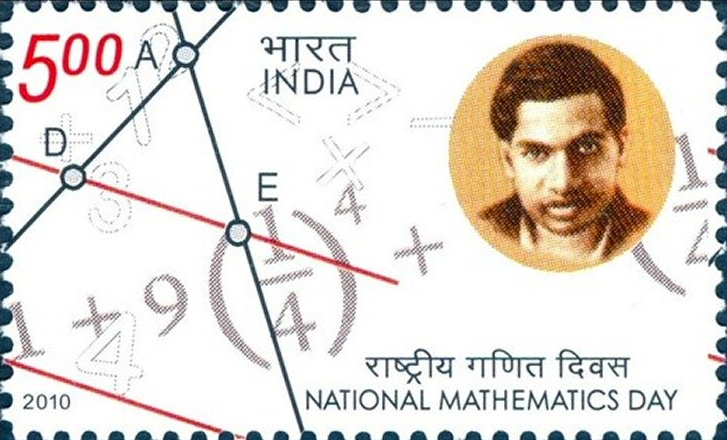
Beginning with 2012, every year, Ramanujan’s birth anniversary on December 22 is observed by India as National Mathematics Day.