
True self-worth is found not in comparing our journey to another’s, but in honoring the unique purpose and light we bring to the world in our own distinct way.

“A samurai who was known for his nobility and honesty, went to visit a monk to ask him for his advice.
When the monk had finished his prayers, the Samurai asked, “Why do I feel so inferior? I have faced death many times, have defended those who are weak. Nevertheless, upon seeing you meditating, I felt that my life had absolutely no importance whatsoever.”
“Wait. Once I have attended to all those who come to see me today, I shall answer you,” replied the monk.
The samurai spent the whole day sitting in the temple gardens, watching people go in and out in search of advice. He saw how the monk received them all with the same patience and the same illuminated smile on his face.
At nightfall, when everyone had gone, he demanded: “Now can you teach me?”
The master invited him in and led him to his room. The full moon shone in the sky, and the atmosphere was one of profound tranquillity.
“Do you see the moon, how beautiful it is? It will cross the entire firmament, and tomorrow the sun will shine once again. But sunlight is much brighter, and can show the details of the landscape around us: trees, mountains, clouds. I have contemplated the two for years, and have never heard the moon say: Why do I not shine like the sun? Is it because I am inferior?“
“Of course not,” answered the samurai. “The moon and the sun are different things; each has its own beauty. You cannot compare the two.”
“So you know the answer. We are two different people, each fighting in his own way for that which he believes, and making it possible to make the world a better place; the rest are mere appearances.”
https://alltimeshortstories.com/
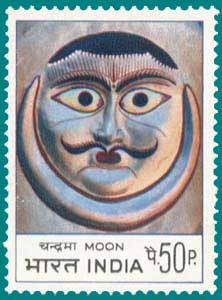
Images above: India postage issued a set of four postage stamps on traditional masks of India, including of sun and moon, in 1974. Images courtesy https://indiapicks.com/
Reflections: The gifts of Day and Night
Day is the world unveiled. In its generous light, distances become clear, faces emerge from shadow, and the ordinary assumes its quiet magnificence: a leaf trembling in the morning air, a road opening towards the horizon, a stranger whose eyes suddenly become familiar. Day gives us the courage of visibility—the chance to work, to wander, to build, to meet one another without the veil of darkness between us. It is the great revealer, lending color to the earth and direction to our footsteps, reminding us that life is not merely to be contemplated but entered, touched and lived.
Night offers a different mercy. Where day scatters the mind among a thousand particulars, night gathers it inward, wrapping the world in silence and giving the weary permission to cease striving. In the nurturing veil of darkness, the body remembers how to rest, the imagination learns to wander, and the soul finds room for dreams, memory and wonder. Night teaches us that obscurity is not emptiness, but a necessary interval in which life renews itself. Between the two—day with its clarity and night with its mystery—moves the ancient rhythm of existence: awakening and repose, revelation and reflection, the open eye and the dreaming heart.