
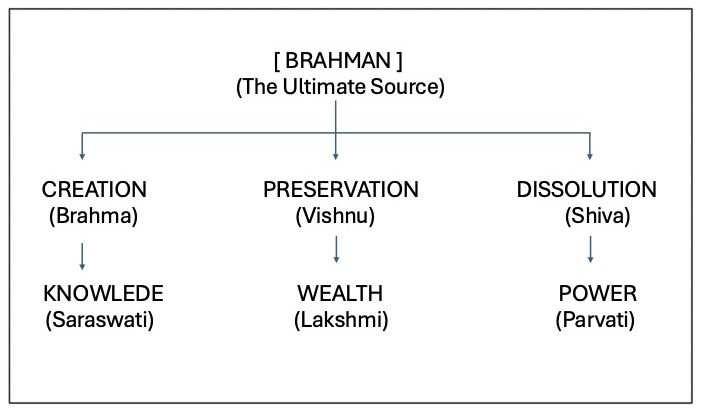
Hindu thought speaks of one ultimate reality, Brahman, which is seen at work in the world through three great functions: creation, preservation and dissolution. In popular tradition these are personified as the Trimurti, the triad of Brahma, Vishnu and Siva, and each is paired with a goddess. Together the goddesses are known as the Tridevi: Saraswati, Lakshmi and Parvati. This page looks at the three divine couples, and at what each pair may say about the course of a human life: birth and learning with Brahma and Saraswati, sustenance and prosperity with Vishnu and Lakshmi, and change and transformation with Siva and Parvati.

Brahman as a metaphysical concept refers to the single binding unity behind diversity in all that exists in the universe, that is, the essence of the universe. Major schools of Hindu philosophy describe it as the cause of all that exists, though they differ on how.
The word “trimurti” translates to “three forms” in Sanskrit. The three gods are often depicted as a single form with three faces, symbolising the universe’s many cycles. The Trimurti is a widely known concept in Hindu thought.
The three gods are not alone. Their consorts, Saraswati, Lakshmi and Parvati respectively, are equally divine, and together they are known as “tridevi”, or “three goddesses.”
Now let us look at the relationship of the three gods with their consorts.
Brahma and Saraswati
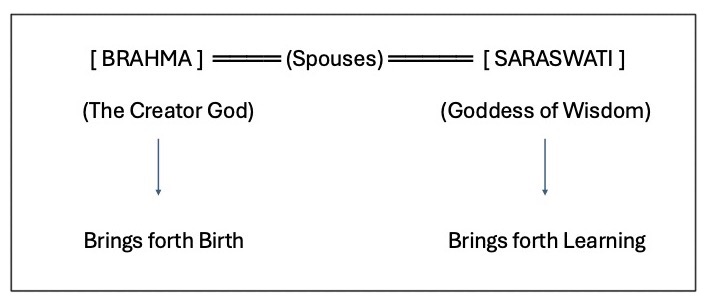
Let us first take the case of Brahma and Saraswati. To begin with, Brahma should not be confused with Brahman, mentioned above, or with Brahmana, an integral part of Vedic literature and also the name of the priestly class, one of the four varnas. Brahma was the first God (said in some accounts to have emerged from a golden egg, Hiranyagarbha) and he was tasked with the creation of the universe and all creatures in it. He is generally depicted as a genial fatherly figure with four heads and a white beard, an epitome of wisdom and compassion, who carries no weapons and seldom loses his equanimity. Weapons are of no use in the process of creation. Though highly respected as a wise, amiable god, he is not as widely worshipped, presumably because he is seen as having completed his task of creation.


In some accounts, Brahma’s consort Saraswati was born from his breath to bring order to the initial chaos of creation. Unlike Brahma, she is a pan-Indian deity revered as the goddess of speech, knowledge, education, learning, arts, poetry, music, language and culture. Saraswati is mostly portrayed as a serene Goddess in all-white attire, representing purity and knowledge, with four arms, each holding a book, a rosary, a water pot and a musical instrument (veena). Both Brahma and Saraswati are associated with the white swan, which represents purity, wisdom and truth.
Now let us ponder for a moment on what follows creation, the realm of Brahma, or birth in the human context. Birth is always followed by learning – becoming conscious of our surroundings, learning new things and skills that aid and enrich living, all of which again are the realm of Saraswati. It is as if Brahma supervises the birth of humans and hands them over to his consort to teach them how to lead a meaningful life. As the presiding deity of speech, knowledge and the arts, she is perfectly equipped to prepare us for a life of value, a life of meaning.
Let us now take the case of Vishnu and his consort Lakshmi.
Vishnu and Lakshmi
The name Vishnu, meaning “all-pervasive,” reflects his role as the preserver and sustainer of the universe and its living beings. He is considered the supreme being in Vaishnavism, one of the major traditions within Hinduism. Vishnu is known for his many forms, both benevolent and fearsome, especially his ten principal avatara (“descents” into the material world) to restore dharma (righteous living) and cosmic order.

Of these, the avatara of Rama and Krishna are considered important, and they figure prominently in the epics Ramayana and Mahabharata respectively. Vishnu, whose thousand names are invoked in the Vishnu Sahasranama, is typically depicted as a blue-skinned, well-dressed and bejewelled God, holding the shankha (a conch shell), chakra (war discus), gada (mace) and padma (lotus) in his hands. He is portrayed riding Garuda, the celestial bird.
Vishnu’s consort, Lakshmi, also named as Mahalakshmi and Sri, is highly revered as the goddess of wealth, success and good fortune. She was born from the churning of the milky ocean by the devas (gods) and the asuras (demons) in search of amrit (the elixir of immortality), on the advice of Vishnu. Lakshmi chose to marry Vishnu as the god she felt was most worthy of her. As a symbol of feminine purity and auspiciousness, she is said to have been born as Vishnu’s consort in a few of his avatara as well, for example as Sita with Rama and as Rukmini with Krishna.

Lakshmi is often portrayed as a beautiful woman in a red saree with a golden crown and four arms, sitting or standing on a lotus flower, with a pair of elephants anointing her with water from behind. Holding lotus flowers in two of her hands, she is shown blessing her devotees and showering gold coins with the other two. Lakshmi is also depicted as the ideal wife, sitting next to Vishnu who is reclining on a coiled serpent in the milky ocean, massaging his feet. As one of the principal goddesses of the Hindu pantheon, especially in Sri Vaishnavism, she is extensively worshipped as the bestower of prosperity and success. The eight prominent manifestations of Lakshmi, called Ashtalakshmi, symbolise the eight sources of wealth.
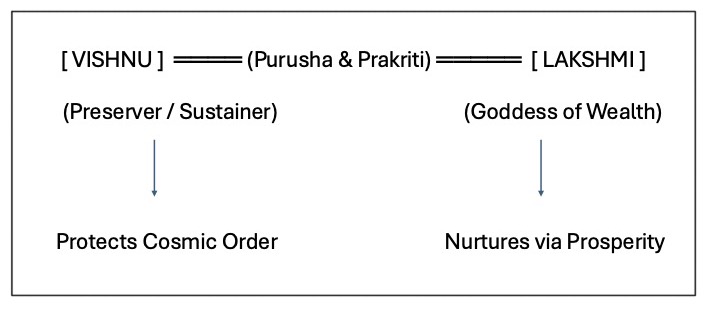
Now let us look at Vishnu’s relationship with Lakshmi in the context of the preservation or sustenance of the universe. In symbolic terms, Vishnu and Lakshmi are often seen as representing the harmony between masculine and feminine energies, the union of opposites (Purusha, the unchanging self, and Prakriti, the ever-changing nature). They both maintain cosmic order and balance. He protects and preserves the universe, while she nurtures and sustains it by bestowing prosperity and good fortune. Devotees worship Vishnu and Lakshmi as the ideal couple, embodying love and devotion.
Let us now take the case of Shiva and his consort Parvati.
Shiva and Parvati

Within the Trimurti triad, Siva (The Auspicious One), also known as Mahadeva (The Great God), is the Dissolver of the Universe at the end of every time-cycle. He is considered the Supreme Being in Saivism, another major tradition within Hinduism. Siva is depicted both as an omniscient ascetic living on Mount Kailas in the high Himalayas and as a householder, together with his wife, Parvati, and their two sons, Ganesha and Kartikeya. He is also revered as Adiyogi (the first Yogi), the patron god of yoga and meditation, and as the dance-loving Nataraja.

Like Vishnu, Siva too has fearsome forms. He is identified with Rudra, the Rigvedic God of Storms, and portrayed as the wrathful Virabhadra and as Kalabhairava, the fierce guardian of time. Mostly worshipped in the aniconic form of Sivalingam, Siva’s iconography comprises the serpent king Vasuki around his neck, the crescent moon as his head-crest, and the holy Ganga spouting from his matted locks. With a fiery third eye on his forehead that turns everything in front of it into ashes when opened, he wears a tiger skin, his body smeared with ash, and carries a trishul (trident) and a damaru (power drum). The sacred bull, Nandi, is his vehicle.

Siva’s consort, Parvati, is the daughter of king Himavan, a personification of the Himalayan Mountain (parvat). Also known as Uma and Gauri, she is revered as a goddess of power, energy, nourishment, harmony, love, beauty, devotion and motherhood. She is often equated with other goddesses such as Kali and Durga, with frequently overlapping stories. Parvati is recognised as the reincarnation of Sati, Siva’s first wife, who immolated herself after her father insulted her husband. In the stories, her rebirth as Parvati brings Siva back from his ascetic withdrawal into the realm of marriage and household life. Parvati is mostly depicted as the adoring wife seated beside Siva or on his lap, with or without their children. In most portrayals, she wears fine clothing and jewellery. In independent depictions, she has four hands either in mudra-s (symbolic gestures) or holding a mirror, a bell, prayer beads, or a lotus flower, and her animal vehicle is often the lion.
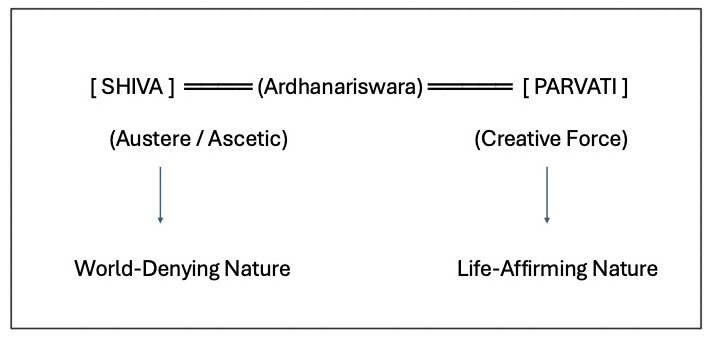
Parvati represents the life-affirming, creative force that complements Siva’s austere, world-denying nature, thus balancing the roles of an ascetic and a householder, which are considered poles apart. In the goddess-oriented Shakta tradition, she is regarded as the energy and creative power (shakti) and the equal complementary partner of Siva, leading to their portrayal as a composite deity, Ardhanariswara (the lord who is half-woman).
Now let us ponder for a moment on what follows sustenance, the realm of Siva, or change in the human context. Dissolution is not only death. It is every ending that clears the ground for something new: the close of a phase of life, the loss of a certainty, the letting go of a habit or a grief. Siva is the one who sees through what passes. Parvati is the one who reminds him that what passes is still worth loving. Together they suggest that transformation needs both: the detachment to let go and the care to begin again. For a closer look at how the two speak to each other, see our story “When Siva and Parvati spoke.”
Two other forms of Shakti
Two other goddesses, Durga and Kali, stand out as manifestations of the combined energy and power (shakti) of the gods and goddesses to combat evil. Both of them are invincible warriors credited with slaying many notorious demons.

Durga is often depicted riding a lion or a tiger, with between eight and 18 hands, each holding a weapon, in the act of killing Mahishasura, the buffalo demon, yet with a calm and serene face. She is worshipped as Navadurga, in nine forms.
Kali is dark-skinned (often shown blue or black), with dishevelled hair, bloodshot eyes, multiple arms wielding weapons, and an extended tongue. In this form, she is generally depicted standing on top of the prostrate body of Siva, wearing a garland of skulls and a skirt of arms.
Conclusion
Ultimately, the idea of the Trimurti and Tridevi suggests that the universe cannot function on raw power or passive existence alone. In the Shakta view, every masculine principle of creation, preservation and dissolution remains an unmanifest potential until it is activated by its corresponding feminine shakti: the drive of knowledge, wealth and transformative energy.
The same pattern runs through a single human life. Brahma gives us birth, and Saraswati teaches us how to live. Vishnu preserves the world we live in, and Lakshmi gives it abundance. Siva brings the endings that clear the ground, and Parvati brings the care that lets us begin again. Together, these cosmic couples remind us that true harmony, whether across the vast canvas of the cosmos or within the quiet corners of our daily life, relies on the balance and mutual respect of complementary forces.
Image 1: A postage stamp issued by India in 1949 depicts the giant sculpture of Trimurti in the Elephanta Caves near Mumbai. Courtesy Indian Philately Digest website.
Image 2: A postage stamp issued by French India in 1916 depicts Lord Brahma.
Image 3: A postage stamp issued by Indonesia for Baliphex 2024 depicts Goddess Saraswati. Courtesy https://indiastamp.blogspot.com/
Image 4: Another postage stamp issued by Indonesia for Baliphex 2024 depicts Lord Vishnu. Courtesy https://indiastamp.blogspot.com/
Image 5: A postage stamp on Vishnu issued by Nepal in 1959 showing Lord Vishnu.
Image 6: Diwali postage stamps issued by New Zealand in October 2021. The design shows Goddess Lakshmi on the miniature sheet selvage, honouring the festival as a sacred time of Lakshmi Puja, where prayers are offered to the goddess for prosperity and light. Image courtesy: Better Philately on X.
Image 7: A postage stamp issued by India in 1949 depicts Lord Shiva as Nataraja, the God of Dance. Courtesy Indian Philately Digest website.
Image 8: A postage stamp issued by Nepal in 1971 depicts Lord Shiva as Kalabhairava. Courtesy Stampex India.
Image 9: A postage stamp issued by the Czech Republic in 2007 depicting Shiva with Parvati and Ganesha. Courtesy https://www.academia.edu/
Image 10: A postage stamp issued by India in 2008 on Durga Puja, most famously celebrated as part of Dussehra festival in Kolkata. Courtesy: rainbowstampclub.blogspot.com.
Sources and further reading
This page draws on standard encyclopaedic references and traditional accounts, which sometimes differ in detail. For further reading: Wendy Doniger, Hindu Myths (Penguin Classics), and Anna Dallapiccola, Dictionary of Hindu Lore and Legend (Thames & Hudson).