
True spiritual stature is never measured by self-proclaimed closeness to the divine, but by an uncalculating love that places the comfort and honor of the beloved above all else.

“Pride once entered the heart of Arjuna, the beloved friend of Lord Sri Krishna. Arjuna thought that none equalled him in love and devotion to his Lord and friend.
The omniscient Lord, reading the heart of his friend, took him for a walk one day. They had not proceeded far when Arjuna saw a strange brahmana eating dry grass as food, but nevertheless had a sword dangling at his side.
Arjuna at once knew him to be a holy and pious devotee of Lord Krishna (an avatar of Vishnu), one whose highest religious duty was to injure no living being. As even grass has life, he would not eat it green but sustained his life by eating it dry and lifeless. Yet he carried a sword.
Arjuna, wondering at the incongruity, turned towards the Lord and said: “How is this? Here is a man who has renounced all ideas of injuring any living being – down to the meanest blade of grass; yet he carries with him a sword, the symbol of death and hatred!”
The Lord said, “You had better ask the man yourself”.
Arjuna then went up to the brahmana and here is their conversation:
Arjuna: Sir, you injure no living being and you live upon dry grass. Why then do you carry this sharp sword?
Brahmana: It is to punish four persons if I chance to meet them.
Arjuna: Who are they?
Brahmana: The first is the wretch Narada.
Arjuna: Why, what has he done?”
Brahmana: Why, look at the audacity of that fellow; he is perpetually keeping Lord Vishnu awake with his songs and music. He has no consideration whatsoever for the comfort of the Lord. Day and night, in and out of season, he disturbs the peace of the Lord by his prayers and praises.
Arjuna: Who is the second person?
Brahmana: The impudent Draupadi!
Arjuna: What is her fault?
Brahmana: Look at the inconsiderate audacity of the woman! She was so rash as to call my beloved Lord just at the moment he was about to dine. He had to give up his dinner and rush to the Kamyaka Vana forest to save the Pandavas from the curse of Durvasa. And her presumption went so far that she even caused my beloved Lord to eat the impure remnant of her own food.
Arjuna: Who is the third?
Brahmana: It is the heartless Prahlada. He was so cruel that he did not hesitate for a moment to ask my Lord to enter the boiling cauldron of oil, to be trodden under the heavy feet of the elephants and to break through an adamantine pillar to rescue him.
Arjuna: Who is the fourth?
Brahmana: The wretch Arjuna.
Arjuna: Why, what fault has he committed?
Brahmana: Look at his felony, he made my beloved Lord take the mean office of a charioteer of his car in the great war of Kurukshetra.
Arjuna was amazed at the depth of the poor brahmana’s devotion and love, and from that moment his pride vanished, and he gave up thinking that he was the best devotee of the Lord. “
– Tales and Parables of Sri Ramakrishna Paramahamsa

Images courtesy: The Sanskrit Philatelist (http://sanskritonstamps.blogspot.com)
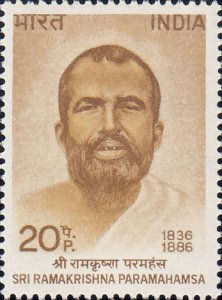
Sri Ramakrishna Paramahamsa (1836-1886) was a Hindu mystic from India whose parable-based teachings espoused the ultimate unity of diverse religions as being the means to enable the realisation of the same God. After his demise, his chief disciple Swami Vivekananda popularised his ideas and founded the Ramakrishna Order, which provides spiritual training for monastics and householder devotees, and the Ramakrishna Mission, which is involved in charity, social work and education.
Notes:
The divine in the ordinary
Arjuna began by measuring his devotion against that of others. He returned knowing that love for the Lord could take a form he had never imagined. The brahmana’s strange words expressed a tenderness so fierce that he could not bear the thought of his beloved Lord being troubled, even by another devotee. The story’s lesson lies not in the sword, but in the humbling of Arjuna’s certainty that no one could love Krishna more than he did.
That sense of a close, personal relationship with the Divine is at the heart of Bhakti, meaning loving devotion. What we call the Bhakti movement was a flowering of devotional traditions across India over many centuries, rather than a single organised movement. Its poets spoke of God not only as a distant power to be worshipped, but as a beloved presence in their lives. Among its formative voices were the Tamil Alvars and Nayanars, who sang to Vishnu and Shiva in their own language.
Such devotion was not confined to one social position or way of life. Kabir’s association with weaving and Ravidas’s with leatherwork place ordinary labour within this history. Mirabai brought to it a love for Krishna that challenged the expectations of her royal household. Scholars and renunciants also helped shape these traditions; the philosopher Ramanuja was one of their influential teachers. What matters here is not a contest between humble devotees and learned ones, but the refusal to make worldly standing the measure of devotion.
Janabai, who worked in a household in Maharashtra, gave this intimacy a particularly moving expression. In her poems, Vitthal comes to help with the work. God is not waiting elsewhere for her duties to end; he is beside her in the midst of them.
The brahmana in the story worries about the Lord’s comfort; Janabai imagines the Lord sharing her labour. In both, devotion makes the Divine personal and near. Arjuna’s pride gives way when he discovers a love beyond his own experience. Perhaps that is the invitation these stories leave us: not to ask who is the greatest devotee, but to recognise how quietly devotion may live in someone else’s ordinary day.