
Where the world often honours tools that divide, critique and separate, Sufi mystic Farid chooses the humble work of unification—reminding us that love is the quiet art of stitching scattered hearts into a single whole.
“It is reported in the life of a great Sufi mystic, Farid, that once a king came to see him. He brought a present for him: a beautiful pair of scissors, golden, studded with diamonds — very valuable, very rare and something unique.
The king brought those scissors to present to Farid. He touched Farid’s feet and gave him the scissors.
Farid took them, looked at them, and gave them back to the king, and said, “Sir, many many thanks for the present that you have brought. It is a beautiful thing, but utterly useless for me. It will be better if you can give me a needle. Scissors I don’t need; a needle will do.”
The king said, “I don’t understand. If you need a needle, you will need scissors too.”
Farid said metaphorically, “Scissors I don’t need because scissors cut things apart. A needle I need because a needle puts things together. I teach love. My whole teaching is based on love — putting things together, teaching people communion. I need a needle so that I can put people together. The scissors are useless; they cut, they disconnect. Next time when you come, just an ordinary needle will do.”
More at https://oshostories.wordpress.com/
Baba Farid, also known as Farīduddin Masʿūd Ganj-i-Shakar, was one of the great early masters of the Chishti Sufi tradition in South Asia. A mystic, poet and teacher, he made Ajodhan (present-day Pakpattan in present day Punjab province of Pakistan) a major centre of Sufi learning and inspired disciples such as Nizamuddin Auliya. His simple, deeply human verses—concerned with humility, longing, mortality and remembrance of God—helped establish Punjabi as a language of spiritual expression, and some of his verses are preserved in the Guru Granth Sahib.
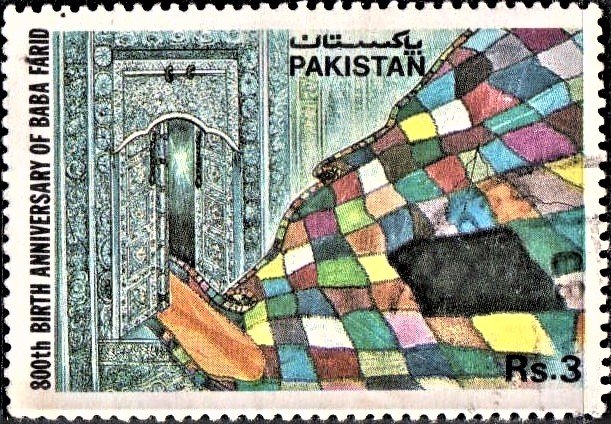
Image: A 1989 Pakistani postage stamp commemorating the 800th birth anniversary of Sufi mystic Baba Farid, juxtaposing the intricate architecture of the Bahishti Darwaza (Gate of Paradise) at his shrine in Pakpattan with his traditional patchwork quilt (godri)—a vibrant symbol of ascetic humility, inclusivity and Chishtiya heritage. Image courtesy: iStampGallery

Acharya Rajneesh (1931-1990), known later as Osho, was an Indian godman, philosopher, mystic and founder of the Rajneesh movement. He was viewed as a controversial religious leader during his life. He rejected institutional religions, insisting that spiritual experience could not be organised into any one system of religious dogma. He advocated meditation and taught a unique form called dynamic meditation. Rejecting traditional ascetic practices, he asked his followers to live fully in the world but without attachment to it. Pic courtesy: https://www.sannyas.wiki/