
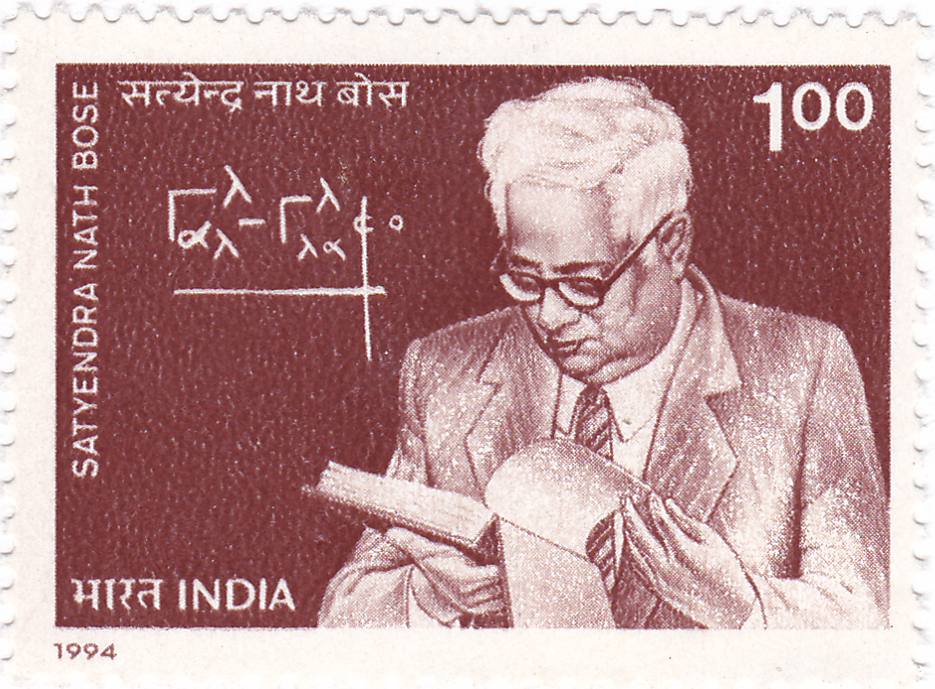
In the year 1924, Satyendra Nath Bose, a brilliant young lecturer in physics, was teaching a class of postgraduate students at Dhaka University, now in Bangladesh. He was demonstrating the prevailing classical physics theory of radiation, specifically focussing on Max Planck’s law of radiation. As he worked through the derivation on the blackboard, Bose made an inadvertent, mathematically ‘illegal’ statistical assumption.
According to classical physics, the calculation should have failed. However, when Bose looked at his final result on the board, he realised that this ‘mistake’ yielded the exact experimental reality that physicists had been struggling to explain for years.
The identical coin analogy
To understand why his mistake was actually a breakthrough, Bose re-examined the fundamental laws of probability. He realised that the rules governing our everyday world do not apply to the subatomic world.
If you flip two distinct coins (a quarter and a dime), there are four possible outcomes:
- Quarter Heads, Dime Heads (\(HH\))
- Quarter Tails, Dime Tails (\(TT\))
- Quarter Heads, Dime Tails (\(HT\))
- Quarter Tails, Dime Heads (\(TH\))
In classical physics, each outcome has a 25% chance of occurring, meaning a mixed result (\(HT\) or \(TH\)) has a 50% probability.
Bose boldly postulated that subatomic particles have no individuality. If you are flipping two photons, you cannot label one “Photon A” and the other “Photon B”—they are completely indistinguishable. Because they lack identity, the states \(HT\) and \(TH\) are not two separate possibilities; they are the exact same state.
Therefore, in Bose’s quantum world, there are only three true possibilities:
- Both Heads (\(HH\))
- Both Tails (\(TT\))
- One Heads, One Tails (\(Mixed\))
This meant that each state had an equal 33.3% chance of occurring. This shift in probability distributions changed physics forever.
The letter to Einstein
When Bose wrote down his new statistics, the leading peer-reviewed journals of Europe rejected his paper, believing his deviation from classical statistics was simply a mathematical error.
Refusing to back down, Bose sent a short, four-line letter directly to Albert Einstein. He wrote: “I have ventured to send you the accompanying article for your perusal and opinion… You will see that I have tried to deduce the coefficient… independent of the classical electrodynamics.”
Einstein immediately recognised the genius of the paper. He translated Bose’s work into German himself and submitted it to the prestigious journal Zeitschrift für Physik on Bose’s behalf. Einstein then extended the math to ideal atoms, creating the Bose-Einstein Statistics (as explained below).
Years later, Paul Dirac, British theoretical physicist who is considered one of the founders of quantum theory, used this framework to split the universe’s particles into two groups, naming the social, space-sharing particles “bosons” to permanently honour Bose’s brilliant classroom revelation.
Just for our understanding, the second group of particles consists of fermions, which are the rigid, exclusive building blocks of matter (More details on bosons and fermions given below).
The birth of a new state of matter
When Albert Einstein read SN Bose’s paper, he realised the young Indian physicist had unlocked something far greater than just a trick for counting light particles.
Einstein took Bose’s math—which was originally designed for weightless photons—and applied it to real, physical atoms that have mass.
Through this math, Einstein made a staggering prediction. He calculated that if you take a gas of certain atoms and cool them down to a temperature micro-degrees above Absolute Zero (-273.15°C), something bizarre happens. At this extreme cold, the atoms lose all their individual energy. Because they are bosons, they do not mind crowding together. Instead of bouncing off one another like billiard balls, thousands of separate atoms suddenly lose their individual identities. They collapse into the exact same low-energy quantum state, merging into a single, giant ‘Super-Atom.’
This became known as the Bose-Einstein Condensate (BEC), the official fifth state of matter.
For decades, this prediction of Einstein remained a purely mathematical theory. The technology to freeze atoms to such extreme temperatures simply did not exist.
It took over 70 years of technological advancement until 1995, when scientists Eric Cornell and Carl Wieman finally created a BEC in a lab using rubidium atoms. When they succeeded, the atoms behaved exactly as Bose’s 1924 math predicted they would. The discovery was so monumental that it was awarded the 2001 Nobel Prize in Physics.
More about Bose
Satyendra Nath Bose (1894–1974), the visionary physicist and polymath, was born in the then Calcutta, and his brilliant intellect was evident early on when he famously scored 110 out of 100 in a high school mathematics exam. After graduating at the top of his class from Presidency College, he became a physics lecturer at the University of Calcutta and later Dhaka University.
Over the years, Einstein acted as a mentor and champion for Bose, welcoming him warmly into his Berlin home, and securing him travel visas to collaborate with Europe’s top scientific minds. Their bond remained grounded in humility and intellectual camaraderie, with Bose always viewing Einstein not just as a collaborator, but as the master who gave his ideas a voice on the world stage.
Beyond his monumental contributions to quantum theory, Bose was a true Renaissance man who deeply loved the arts, literature and music. He was a master player of the traditional stringed instrument, the esraj, and translated complex scientific papers into Bengali, fiercely advocating that science should be taught in mother tongues to be accessible to all.
Despite his global fame and the fact that multiple Nobel Prizes were later awarded to scientists proving his theories, Bose himself was never awarded the Nobel Prize—a snub he dismissed with characteristic humility. He spent his later years as a revered national professor, a member of India’s parliament (Rajya Sabha), and a Fellow of the Royal Society, remaining a down-to-earth scholar who could solve impossible equations off the top of his head between naps.
More about bosons and fermions
As mentioned earlier, Bosons are a fundamental class of subatomic particles that carry forces and are allowed to occupy the exact same quantum space at the same time. They have the following defining characteristics:
- Force Carriers: They mediate the fundamental forces of nature (e.g., photons carry electromagnetism, gluons carry the strong nuclear force).
- Infinite Crowding: Unlike matter particles, an infinite number of bosons can pile into the same energy state, a trait that enables lasers and Bose-Einstein condensates.
- Integer Spin: They possess whole-number quantum spins (like 0, 1 or 2), mathematically dictating their social behaviour.
Fermions, on the other hand, are the fundamental class of subatomic particles that make up all stable matter in the universe. Named after the legendary Italian-American physicist Enrico Fermi (also coined by Paul Dirac to honour his contributions), they have the following defining characteristics:
- Matter Builders: They constitute all physical structures (e.g., electrons, protons and neutrons are either fermions or made of them).
- Strict Exclusivity: They obey the Pauli Exclusion Principle, meaning two fermions can never occupy the exact same quantum state at the same time.
- Half-Integer Spin: They possess fractional quantum spins (like 1/2, 3/2), which mathematically forces them to stay apart and give matter its volume.
Image above: A stamp issued by India Post in 1994 to commemorate the birth centenary of Satyendra Nath Bose. Courtesy Wikimedia Commons.
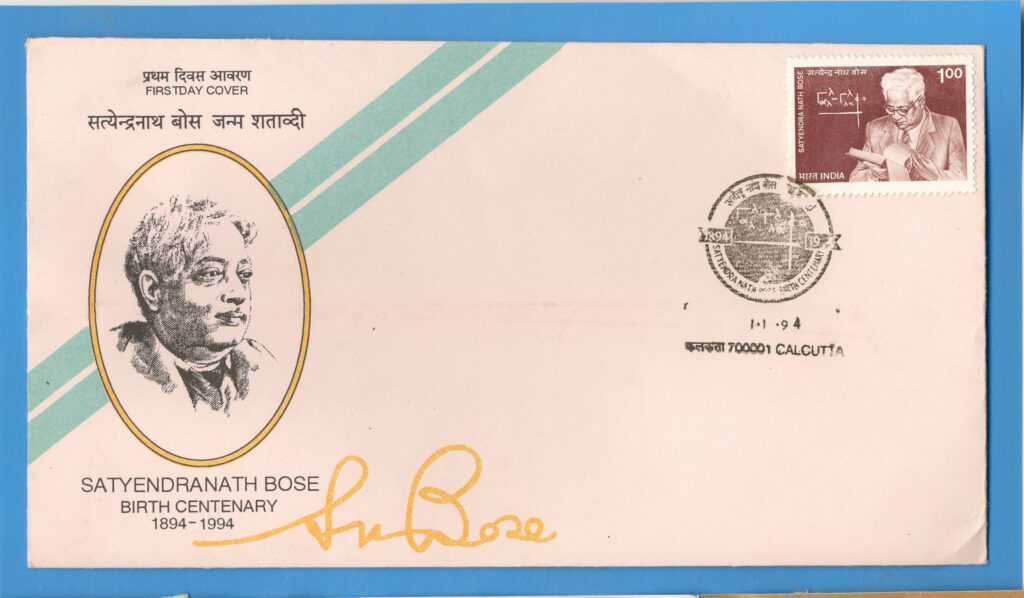
The first day cover and postage stamp issued by India Post on 1st Jan. 1994. Courtesy SN Bose National Centre for Basic Sciences, Kolkata (Please visit https://www.bose.res.in/ for more information/archives on SN Bose).