
The Ministry of Agriculture decreed that sparrows were a menace to crops and should be exterminated.
When this was done, hoards of insects that the sparrows would have eaten descended on the harvest and began to ravage the crops, whereupon the Ministry of Agriculture came up with the idea of costly pesticides.
The pesticides made the food expensive. They also made it a hazard to health. Too late it was discovered that it was the sparrows who, through feeding on the crops, managed to keep the food wholesome and inexpensive.
Anthony de Mello, Heart of the Enlightened
(Image; New edition edition,1997) page 148
Before rushing towards what you might think would be a better solution, consider what is already in place.
Source: philipchircop.wordpress.com
Anthony de Mello (1931-1987) was an Indian Jesuit priest and psychotherapist. A spiritual teacher, writer and public speaker, De Mello wrote several books on spirituality and hosted numerous spiritual retreats and conferences. He continues to be known for his storytelling, which drew from the various mystical traditions of both East and West.
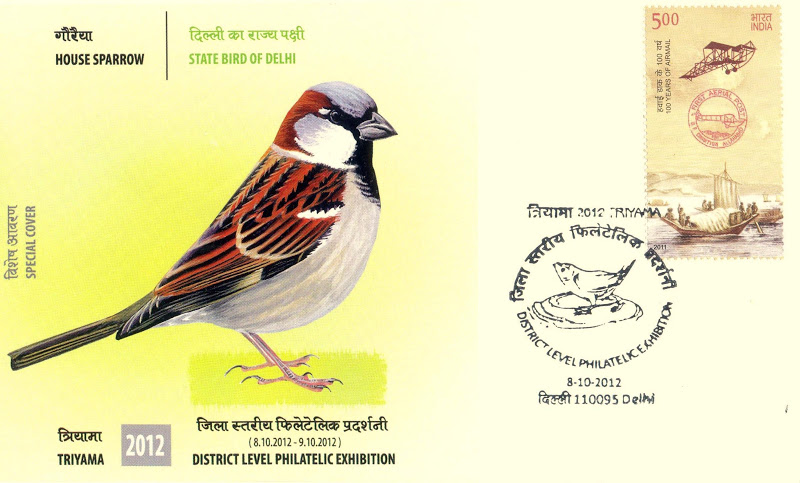
India Post released a special cover in October 2012 designed by Nature Forever Society to commemorate the decision of the Delhi Government to declare the House Sparrow as the State Bird of Delhi. The postal cover features a painting by UK-based Sue Tranter. The inclusion of the house sparrow on the Special Cover assumes significance especially when the species is fast declining due to urbanisation. Image courtesy https://annanagardaily.blogspot.com/
Did you know?
Here are some unique features of the sparrow:
- Human Symbiosis: They are “commensal” animals, meaning they have evolved over 10,000 years to live specifically alongside human civilization rather than in deep nature.
- Genetic Evolution: Unlike many birds, they possess a specific gene for starch digestion, allowing them to thrive on human-cultivated grains and scraps.
- The “Bib” Hierarchy: Male status is determined by the size of the black patch on their throat; larger bibs signal dominance and higher social standing.
- Urban Engineers: They prefer man-made structures—like eaves, signs, and holes in walls—over traditional nests in trees or forests.
- Tongue Anatomy: They possess a unique bone called the preglossale that helps them manipulate seeds with extreme precision.
- Social Intelligence: They are highly cooperative and learn through observation, often figuring out how to trigger motion-sensor doors or find food in complex environments.
- Dust Bathing: To keep their feathers clean and parasite-free, they engage in social “dust baths,” a communal grooming ritual.
- High Adaptability: They are found on every continent except Antarctica, successfully surviving in climates ranging from deserts to high-altitude cities.
- Cultural Icons: They hold deep symbolic value across history, appearing in everything from ancient Egyptian hieroglyphs to Greek mythology and Japanese folklore.
- Ecological Sentinels: Their recent decline in urban areas serves as a “canary in the coal mine” for environmental health, signaling issues like high pesticide use and loss of insect biodiversity.