
Henry Ford hired an efficiency expert to go through his plant. He said, “Find the non-productive people. Tell me who they are, and I will fire them!”
The expert made the rounds with his clipboard in hand and finally returned to Henry Ford’s office with his report.
“I’ve found a problem with one of your administrators,” he said. “Every time I walked by, he was sitting with his feet propped up on the desk. The man never does a thing. I definitely think you should consider getting rid of him!”
When Henry Ford learned the name of the man the expert was referring to, he shook his head and said, “I can’t fire him. I pay that man to do nothing but think – and that’s what he’s doing.”
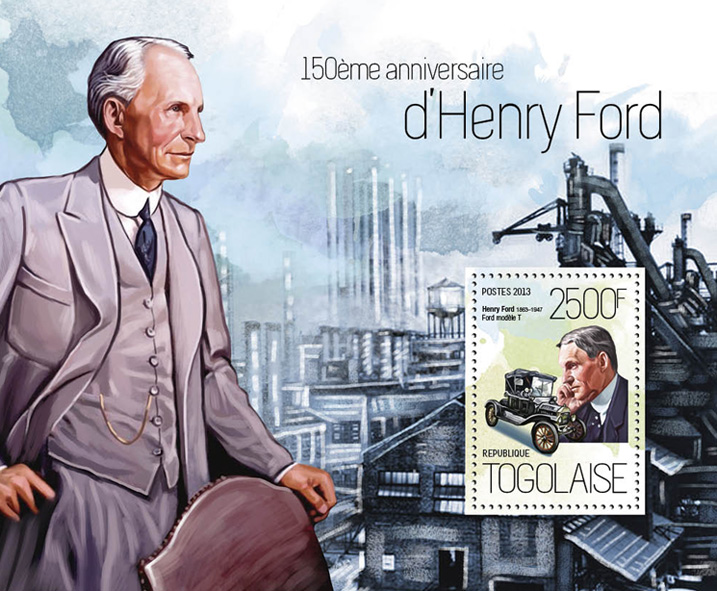
Henry Ford (1863-1947) was an American industrialist, the founder of the Ford Motor Company, and the sponsor of the development of the assembly line technique of mass production. Although Ford invented neither the automobile nor the assembly line, he developed and manufactured the first automobile that many middle class Americans could afford. As the owner of the Ford Motor Company, he became one of the richest and best-known people in the world. He is credited with “Fordism”: mass production of inexpensive goods coupled with high wages for workers. Ford had a global vision, with consumerism as the key to peace. His intense commitment to systematically lowering costs resulted in many technical and business innovations, including a franchise system that put dealerships throughout most of North America and in major cities on six continents. Ford left most of his vast wealth to the Ford Foundation.
Image of Togo Islands postage stamp (2013) of Henry Ford, courtesy: http://togo.post-stamps.com
Did you know?
The Ford Foundation is an independent, non-profit, and non-governmental organisation dedicated to advancing human welfare by reducing poverty and injustice. Established in 1936 by Edsel and Henry Ford, it originally functioned as a local philanthropy in Michigan using gifts of Ford Motor Company stock. However, since the mid-1950s, the foundation has been completely independent of the automobile company, eventually selling all its holdings to maintain an autonomous multi-billion dollar endowment. Today, it is governed by a diverse Board of Trustees and operates from its landmark Ford Foundation Center for Social Justice in New York City, though its impact is global with regional offices across Africa, Asia, and Latin America.
The foundation’s core mission focuses on strengthening democratic values, promoting international cooperation, and advancing human achievement. It achieves these goals through strategic grant-making, investing roughly $500 million annually in visionary individuals and frontline institutions. Its diverse portfolio of support includes major historical initiatives such as the development of the Public Broadcasting Service (PBS), the Green Revolution in agriculture, and fellowships for minority representation in higher education. Recently, the foundation has reoriented its global strategy to specifically combat inequality in all its forms, launching landmark programmes like BUILD to provide long-term stability for social justice organisations.