
Once Guru Nanak was on a visit to Banaras with his disciples.
As the night approached, he reached a village and decided to spend the night there. The people of the village treated them with a lot of respect and served them very well. The guru blessed them by saying, “May you all scatter” and then he proceeded with his journey.
The next night, he stayed at another village, where he was very poorly received. The people did not serve them anything and they also abused the guru and his disciples. While leaving the place, the guru told them, “May you remain where you are.”
One of his disciples got perplexed at this and asked, “Master, you have given them strange blessings. Those who served you very well, you want them to scatter. While the others who treated you ill, you want them to stay put at their homes.”
The guru replied, “If those who serve others get scattered, then by their example they will make others also good and they will spread their virtues wherever they go. On the other hand, if people who are inhospitable to others remain at one place, they will not corrupt others with their bad manners. So they will keep all the bad things confined to one place only.”
Read more about the rich philosophy, customs and traditions of Sikhism founded by Guru Nanak.
Read another anecdote about Guru Nanak by following the link: https://wellsprings.in/when-guru-nanak-visited-haridwar/
Read one more anecdote about Guru Nanak by following the link: https://wellsprings.in/guru-nanak-the-enlightened-householder-farmer/
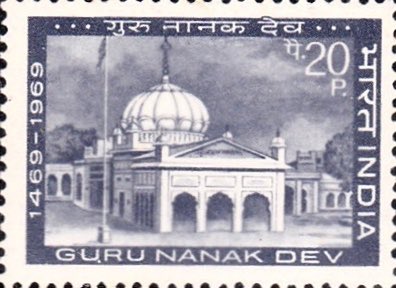
Image above: Postage stamp issued by India in 1969 to commemorate the 500th birth anniversary of Guru Nanak depicts Gurudwara Nankana Sahib located in Nankana Sahib (erstwhile Talwandi) , Pakistan, the birthplace of Guru Nanak.

Guru Nanak, the founder of Sikhism, was born in 1469 CE in Talvaṇḍi village (present-day Nankana Sahib in Punjab, Pakistan) in the Lahore province of the Delhi Sultanate. It was a time of significant socio-religious upheaval in the Indian subcontinent. The prevailing caste system, ritualistic practices and superstitions had distorted the original teachings of Hinduism and Islam. Amidst this backdrop, Guru Nanak’s spiritual experiences and revelations led him to develop a unique faith that emphasised the oneness of God, equality and the importance of living a truthful and honest life. Nanak travelled far and wide with the message of one God (Ik Onkar) who dwells in every one of His creations and constitutes the eternal Truth. With this concept, he set up a unique spiritual, social and political platform based on equality, fraternal love, goodness and virtue. Through his teachings, travels and interactions with people from diverse backgrounds, Guru Nanak laid the foundation of Sikhism, which would evolve into a distinct spiritual and cultural identity.
Guru Nanak’s words are preserved in the form of 974 poetic hymns in the holy text of Sikhism, the Guru Granth Sahib. It is part of Sikh religious belief that the spirit of Nanak’s sanctity, divinity and religious authority descended upon each of the nine subsequent Gurus when the Guruship was devolved on to them. His message of love, compassion and service to humanity continues to inspire millions worldwide.
Image above: A famous painting of Guru Nanak by Sobha Singh, an eminent artist from Punjab, India. It is said that it is impossible to find a Sikh home without a Sobha Singh art print of the revered Guru.

Guru Nanak’s birthday is celebrated worldwide as Guru Nanak Gurpurab on the full-moon day in the month of Kartika (October-November). India Post on Nov. 9, 2019, issued a set of 5 commemorative postage stamps and a miniature sheet portraying five sacred Gurudwaras on the historic occasion of the 550th birth anniversary of Guru Nanak. Image courtesy: postagestamps.gov.in/anak. Image courtesy: postagestamps.gov.in/