
This profound Zen anecdote highlights the vital tension between intellectual scholarship and authentic spiritual realisation through the early life of Jiun Sonja, a brilliant young Sanskrit scholar and Shingon monk of the Japanese Edo period.
Jiun, a Shingon master, was a well-known Sanskrit scholar of the Tokugawa era. When he was young, he used to deliver lectures to his brother students.
His mother heard about this and wrote him a letter:
“Son, I do not think you became a devotee of the Buddha because you desired to turn into a walking dictionary for others. There is no end to information and commentation, glory and honour. I wish you would stop this lecture business. Shut yourself up in a little temple in a remote part of the mountain. Devote your time to meditation and in this way attain true realisation.”
Courtesy: Zen koans in https://ashidakim.com
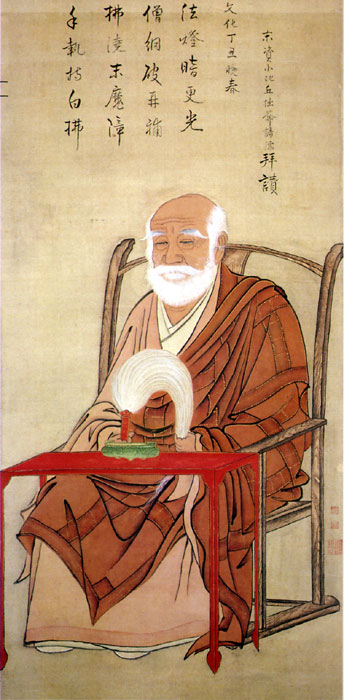
Jiun Sonja (1718–1804), also known as Jiun Onkō, was a transformative Buddhist monk and scholar of the Edo period who sought to reform Japanese Buddhism. He founded the Shōbōritsu (True Law Vinaya) movement, which advocated for a return to the strict monastic discipline and original teachings of the Buddha. He was uniquely academic for his era, mastering Sanskrit to study ancient texts directly and blending Shingon, Zen and Confucian thought into his spiritual philosophy.
Beyond his religious reforms, Jiun is celebrated as a master calligrapher whose work is prized for its raw, spontaneous energy. His “flying white” style, characterised by bold brushstrokes that leave uninked streaks, is seen as a direct reflection of his disciplined yet liberated spirit. Today, he is remembered as a rare figure who balanced rigorous intellectualism with an ascetic lifestyle, leaving a lasting impact on Japanese religious art and Sanskrit studies.
Image: Jiun Sonja, painted by Yamamoto Gisho, property: Kokiji Temple.. Courtesy https://mahajana.net/