The blue blood of horseshoe crabs: A living fossil’s vital gift to modern medicine
1
A prehistoric creature with copper-based blue blood holds the key to modern medical safety. For decades, the unique, bright blue blood of horseshoe crabs has been a boon to medicine, providing a vital protein called Limulus Amoebocyte Lysate (LAL)* that instantly clots to detect deadly bacterial endotoxins in vaccines and implants. From the surprising historical origin of the term “blue blood” to nature’s broader, colorful palette of green, purple, and transparent blood across the animal kingdom, dive into the incredible story of a prehistoric survivor’s vital gift to humanity—and our race to save them.
Horseshoe crabs are prehistoric arthropods that have remained virtually unchanged for over 445 million years,earning them the title of “living fossils.” Despite their name, they are more closely related to spiders and scorpions than to true crabs.
Unlike human blood, which is iron-based (haemoglobin) and red, horseshoe crab blood is copper-based (haemocyanin), giving it a distinct blue hue. Instead of white blood cells, they use amoebocytes for immune defence. When these cells encounter even trace amounts of gram-negative bacteria (as little as one part per trillion), they instantly clot into a gel, effectively “trapping” the threat.
The medical industry relies on LAL to ensure safety across nearly all injectable products:
Safety Testing: Every FDA-certified drug, vaccine (including COVID-19 vaccines), and intravenous (IV) solution must be tested for endotoxins using LAL.
Medical Devices: Implants, pacemakers, surgical tools, and needles are also screened to prevent “injection fever”.
Fungal Diagnosis: A version of the LAL test is used by doctors to rapidly diagnose invasive fungal infections in patients.
The harvesting process and its impact
The high demand for this “liquid gold”—valued at roughly $15,000 per quart—has led to significant ecological concerns:
Bleeding: Approximately 600,000 to 900,000 crabs are harvested annually along the U.S. Atlantic coast. Labs typically drain up to 30% of their blood before releasing them back into the ocean.
Mortality: While designed to be non-lethal, an estimated 15%to 30% of crabs die from the stress of the process. Survivors often face long-term behavioural changes, disorientation and reduced spawning success.
Ecological Ripple Effects: Dwindling crab populations affect migratory shorebirds like the Red Knot, which rely on crab eggs for fuel during their 9,000-mile migrations.
The shift to synthetics
With scientists developing a synthetic alternative called Recombinant Factor C (rFC) to reduce reliance on wild animals, global regulatory bodies are increasingly favouring lab-grown alternatives to protect these “living fossils.” The European Pharmacopoeia set the international benchmark by approving synthetic rFC in 2016. The U.S. Pharmacopeia too officially recognised rFC as an alternative to horseshoe crab blood in 2024. The native species of Japan have been given protection as a natural monumentsince 1928, and the Japanese Pharmacopoeia officially adopted rFC as a synthetic alternative in 2021 to conserve the endangered population. These policy changes are expected to significantly reduce the need for live harvesting in the coming years.
2
However, horseshoe crab populations in Asia continue to face a precarious situation. In countries like China and across Southeast Asia, the three native species are often subjected to lethal harvesting, where they are bled to death for TAL** (Tachypleus Amoebocyte Lysate, similar to LAL) before being sold for meat or industrial chitin (a natural, biodegradable nitrogen-containing polysaccharide widely used in biomedical, agricultural and industrial applications). This “double use” approach, combined with aggressive coastal development and habitat loss, has caused populations to plummet, leading to local extinctions and making the species critically endangered in several Indo-Pacific zones.
While countries like India have implemented strict legal protections under the Wildlife Protection Act to curb traditional medicinal poaching, the global medical industry is at a crossroads: either accelerate the shift to synthetics or risk the total extinction of horseshoe crab species that have anchored biomedical safety for decades.
* The scientific name of the Atlantic horseshoe crab species is Limulus polyphemus.
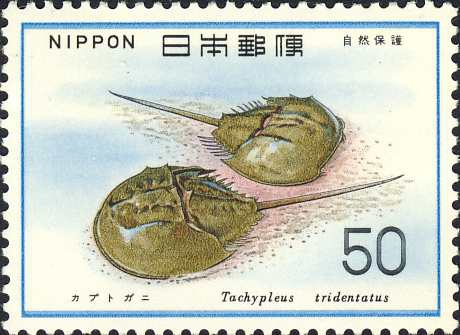
**The scientific names of the Asian horseshoe crab species are Tachypleus tridentatus and Tachypleus gigas.
Image 1: A Japanese postage stamp issued in 1977 features the tri-spine horseshoe crab (Tachypleus tridentatus).
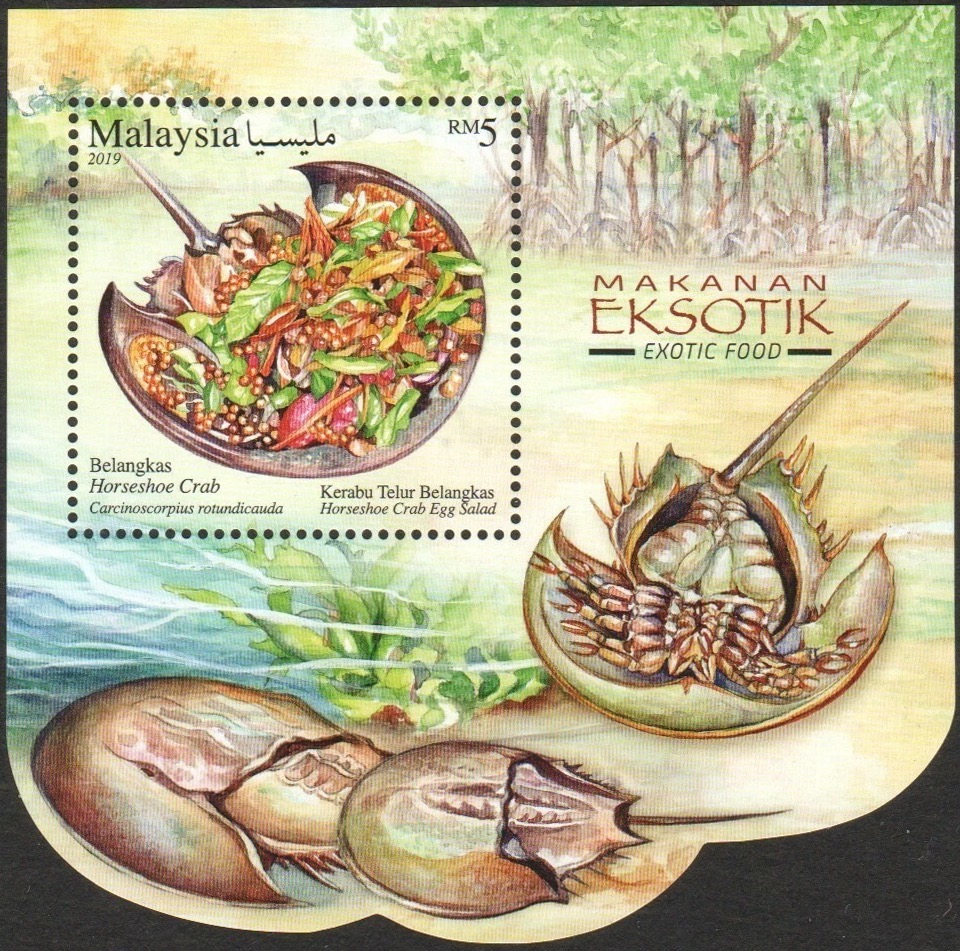
Image 2: A 2019 Malaysia postage stamp miniature sheet features the horseshoe crab found in mangroves (Carcinoscorpius rotundicauda) and its egg salad as exotic foods.
Good to know
In human society, a “blue blood” refers to a member of the aristocracy or a noble, socially prominent family. The phrase likely comes from medieval Spain (sangre azul), where aristocratic families claimed “pure” Gothic (east German) descent. Because they did not perform manual labour in the sun, their skin remained pale, making the blue veins beneath clearly visible compared to the tanned skin of commoners. By the early 19th century, the term was adopted into English and used as a general descriptor for the British Royal Family and other European nobilities.
Besides horseshoe crabs, cephalopods like octopuses and squids, and a few others in the animal kingdom have a copper-based protein called haemocyaninin their blood to transport oxygen, which turns blue when oxygenated. have blue blood helps octopuses and squids survive in cold, low-oxygen environments. Lobsters, spiders, snails and certain molluscs also possess blue blood or haemolymph.
Nature’s biological palette reveals a stunning spectrum of survival, where the familiar red of the human pulse is swapped for vibrant greens, royal purples and even ghostly transparencies. These chromatic shifts—found in the veins of earthworms, the tissues of skinks (a type of lizards), and the hearts of Antarctic icefish respectively—are the result of subtle mechanical tweaks to respiratory pigments. By simply altering a central metal ion or protein structure, evolution has engineered a kaleidoscope of life, proving that even the most fundamental biological blueprints can be reimagined for any environment.