
While modern digital algorithms and deepfakes continue to fracture our shared reality, the pursuit of truth remains the definitive bedrock for all human knowledge, social trust, and purposeful action. This analytical exploration traces the concept’s evolutionary path, charting its shift from a practical biological survival mechanism used by early humans into sacred, divine cosmic orders across ancient Egyptian, Indian and Chinese civilizations. The narrative dynamically breaks down the major philosophical frameworks—ranging from Aristotle’s Correspondence Theory to modern Constructivist models—to demonstrate how humans validate facts versus personal perspectives. Enriched by thought-provoking paradoxes and timeless insights from figures like Mahatma Gandhi, Rabindranath Tagore, and René Descartes, this comprehensive guide provides the intellectual tools necessary to reclaim sovereignty and discern baseline realities in a post-truth era.
What is truth?
Truth is a multifaceted and complex concept that resists a single, universal definition, as it is interpreted through the unique lenses of philosophy, science and theology. While various disciplines debate its nuances, at its most fundamental level, truth is understood as a state of agreement with fact or reality. This foundational alignment serves as the bridge between human thought and the actual world, providing a necessary standard for communication, discovery and belief. Whether it is sought through logical inquiry, empirical evidence or spiritual revelation, truth remains the essential anchor for understanding our existence.
Why Truth Is Important
Here are the fundamental reasons why humans care so deeply about the nature of truth:
A: Foundation of Knowledge:
Truth provides the essential bedrock upon which all reliable knowledge is built. Without a shared understanding of truth, consensus on basic facts in science, history and daily life becomes impossible.
Examples:
- Science: Scientific progress relies on objective truths verified through the scientific method. For example, the truth that the Earth revolves around the Sun is a foundational fact that enables further study of astronomy and physics.
- Education: A reliable education system requires a commitment to factual truth in history, mathematics and literature, ensuring that the students build knowledge on solid, verifiable information rather than misinformation.
- Engineering: Bridges and buildings are designed using the truths of physics and material science. A false truth about load-bearing capacity would result in catastrophic structural failure.
B: Guiding Action and Decisions:
Our actions and choices are largely based on what we believe to be true. Knowing the truth allows us to make effective and safe decisions; believing a false truth can lead to harmful consequences.
Examples:
- Medicine: A correct diagnosis of a disease (the truth about one’s health) is crucial for selecting the effective treatment. A false diagnosis can lead to incorrect, potentially harmful, medical interventions.
- Finance: Investment decisions rely on the truth about a company’s financial health (e.g., balance sheets, market conditions). Acting on false information (e.g., market manipulation) can lead to significant financial loss.
- Navigation: When using a map or GPS, the truth about your current location and the direction of your destination ensures that you arrive safely. Believing a false location leads you astray.
C: Trust and Society:
Truth is the currency of trust in human relationships and social institutions (government, law, media). A commitment to truth enables cooperation, fairness and a functional society.
Examples:
- Legal System: The justice system is built on the pursuit of factual truth to determine guilt or innocence. Witness testimony and evidence seek to establish what truly happened to ensure fair outcomes.
- Personal Relationships: Trust in a relationship is maintained by honesty. Discovering a significant lie or untruth can damage or destroy the bond between people.
- Democratic Governance: A functioning democracy requires a truthful flow of information so that citizens can make informed voting decisions. Widespread misinformation erodes public trust in institutions and electoral processes.
D: Ethics and Morality:
Many ethical systems rely on a concept of truth, particularly normative truths about what is right or wrong. Understanding truth helps us navigate moral dilemmas and judge the actions of others fairly.
Examples:
- Personal Responsibility: Acknowledging the truth of one’s actions, even mistakes, is essential for taking responsibility and making amends.
- Ethical Journalism: Journalists adhere to a professional ethic of truth-telling and fact-checking to inform the public responsibly, avoiding sensationalism or bias that misleads.
- Promise-keeping: The act of making a promise implies a commitment to a future truth (that the action will occur). Breaking that promise is seen as a moral failure.
E: Personal Fulfilment and Reality:
For many individuals, seeking the truth is an inherent human drive linked to understanding reality, personal growth and meaning in life.
Examples:
- Self-Awareness: Understanding the truth about our own strengths, weaknesses and motivations leads to greater self-awareness and personal growth.
- Existential Meaning: Many people search for the ultimate truth about the universe, our origins, or the purpose of life to find meaning and a sense of place in reality.
- Intellectual Curiosity: The simple act of satisfying curiosity by learning the truth about a topic can provide immense personal satisfaction and fulfilment.
Evolution of Truth
The concept of truth likely emerged as an adaptation to social demands. The evolution of the concept marks the transition of human consciousness from early survival-based instincts to sophisticated theological, philosophical and scientific frameworks across global civilizations.
A: Early Man: Truth as Survival and Utility
For the earliest humans, truth was a functional reality rooted in survival rather than an abstract concept.
- Practical Truth: It was synonymous with what “worked”—knowing food locations, predator behaviour, and the cycles of nature. In pre-human ancestors, this began as a biological mental approximation used to navigate the physical environment.
- The Social Origin: As Homo sapiens developed complex societies, the cognitive ability to distinguish “true” from “false” likely evolved as an adaptation to social demands. Unlike other primates, humans passed the “Ape Test,” evolving the cognitive capacity to distinguish between representation and reality.
- The Birth of Language: The emergence of declarative sentences allowed humans to share information about the world. These sentences acted as the first shared “truth-bearers,” evolving to transmit information about past actions to influence group beliefs and allowing for a binary system of denial or verification.
- Gossip and Trust: Early cooperation relied on “gossip” to build reputation. This created selective pressure for truthful communication, as misleading others carried significant social and reproductive risks.
- Mythic Narrative: In pre-literate societies, truth was further conveyed through oral myths. These explained the world’s origins and provided social cohesion, defining “truth” as whatever narrative effectively maintained the tribe’s survival and identity.
B: Theological Evolution: Truth as Divine and Universal Order (c. 3000 BCE – 500 BCE)
In early civilizations, truth was not merely “factual accuracy” but the very architecture of existence — a state of cosmic balance, moral law and divine harmony.
Ancient Near East and India: Truth as Cosmic Balance
- Mesopotamia & Egypt (Ma’at and Kittu): Truth was personified by the Egyptian goddess Ma’at, representing justice and the fundamental balance of the universe. A person’s ultimate truth was verified in the afterlife by weighing their heart against a “feather of truth”; only a heart “light” with truth could enter paradise. For both Egyptians and Mesopotamians (Kittu), it was a sacred duty for kings and subjects to maintain this divine order through justice and ritual.
- Ancient India (Satya and Rta): The earliest Vedic texts (c. 1500 BCE) defined truth as Satya—that which is real and unchanging. It formed the root of Rta, the natural and moral order governing everything from the seasons to social duties. Later, the Upanishads identified the ultimate truth as Brahman (universal reality), viewing the material world as Maya (illusion).
Ancient China: Truth as the Path and Social Harmony
- The Dao and Tian: Truth was understood as The Dao (also The Tao, the “Way”) — the natural and moral flow of the universe. In the Zhou Dynasty, the Mandate of Heaven (Tian) emerged as the ultimate standard for truth; a ruler’s legitimacy was conditional on their ability to maintain cosmic harmony.
- Confucianism vs. Daoism: Confucianism defined truth through Li (proper ritual) and ethical conduct to align the self with social order. In contrast, Daoism sought truth through Wu Wei (effortless action), emphasising a return to the spontaneous purity of nature and the “nameless” reality of the Dao.
Abrahamic and Islamic Traditions: Truth as Revelation and Reason
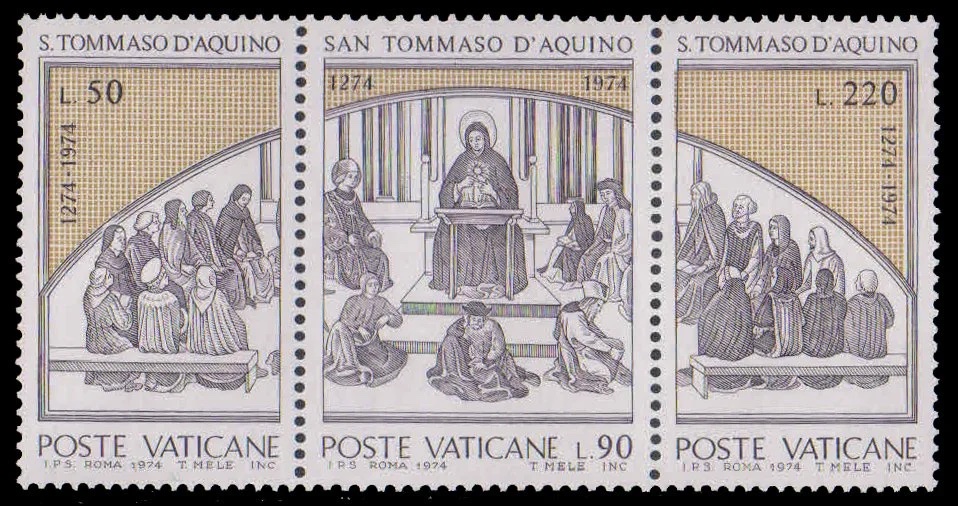
- Abrahamic Traditions & Scholasticism: Truth evolved from faithfulness to divine revelation. St. Thomas Aquinas bridged faith and reason, defining truth as “the conformity of the mind to reality” (Adaequatio rei et intellectus). He argued that human reason could access truth because the world was created rationally by God.
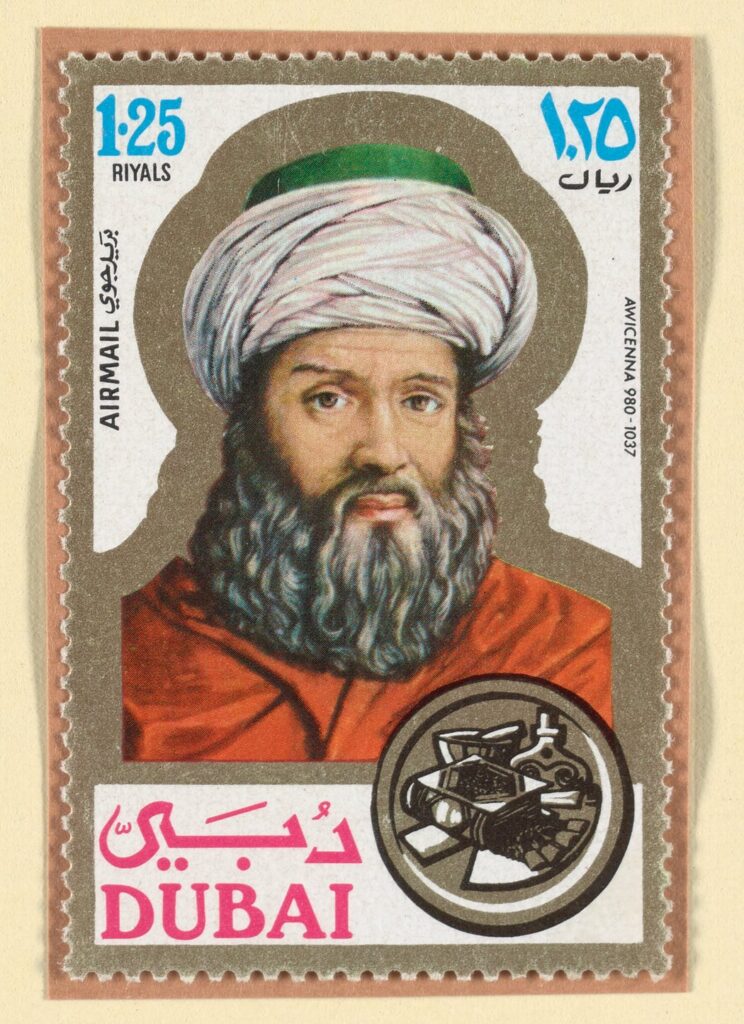
- Islamic Philosophy: Thinkers like Avicenna used logic to demonstrate truths of the self and the divine. His “Flying Man” thought experiment argued that a person suspended in a sensory vacuum would still possess an innate certainty of their own existence, demonstrating that the soul is a distinct, immaterial substance independent of the body.
C: The Axial Age: Logic and Personal Truth (c. 500 BCE – 200 CE)
During this period, a global shift occurred as truth moved from divine decree to a subject of human-centred inquiry, rational logic and personal realisation.
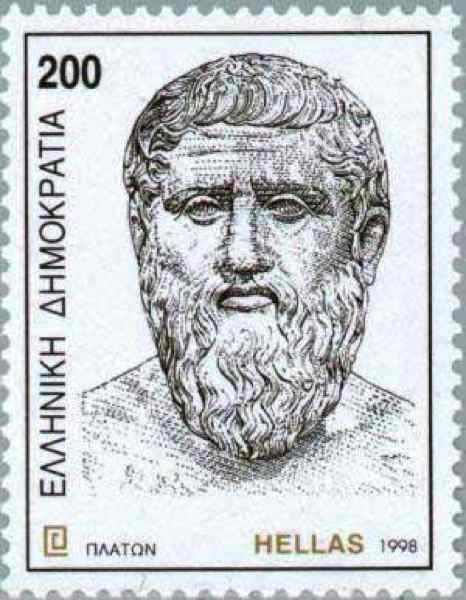
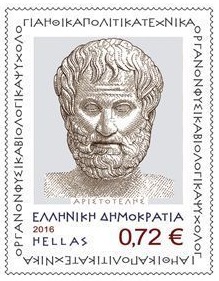
- Greece (Correspondence and Realism): Plato and Aristotle pioneered Classical Realism and the Correspondence Theory. They defined truth as a statement that accurately reflects a mind-independent reality —essentially, saying “of what is, that it is.” This established the foundation for Western analytical logic.
- India (The Two Truths): Buddhist philosophy introduced the “Two Truths Doctrine” to navigate different levels of reality: Samvriti-satya, the conventional truth of daily life, and Paramartha-satya, the ultimate truth of emptiness.
- Ancient China (Practical and Moral Truth): Truth was viewed through a social and natural lens. Confucius emphasised moral truth through righteous behaviour and loyalty, while Taoism identified truth as the Tao — the spontaneous, natural flow of the universe.
- Africa (Relational Truth): Pre-colonial African philosophy centred on communal truth (akin to the concept of Ubuntu). Here, truth was not an abstract logic but was verified through its tangible impact on social harmony and its alignment with ancestral lineage.
D: The Enlightenment: Scientific and Objective Truth (1600s – 1900s)
The Scientific Revolution transformed the concept of truth, shifting it from “revealed” religious authority towards a foundation of human reason and sensory experience.
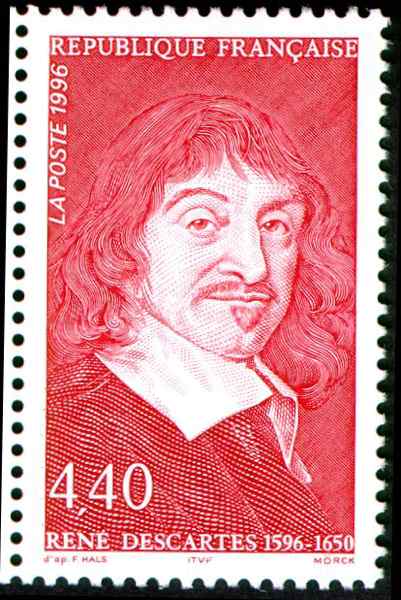
- The Pursuit of Certainty: This era introduced Methodological Doubt, popularised by René Descartes, who argued that only that which is beyond doubt can be accepted as true. This logic culminated in his famous principle, “I think, therefore I am” (cogito, ergo sum).
- The Great Debate: Rationalism vs. Empiricism: Philosophical inquiry split into two primary camps. Rationalism identifies pure reason and logic as the primary tests of knowledge. Conversely, Empiricism (championed by John Locke and David Hume) argues that all truth is derived from sensory data and evidence rather than innate ideas.
- The Scientific Method: Truth became synonymous with verifiability. For a phenomenon to be considered a “fact,” it had to be observable, measurable and repeatable.
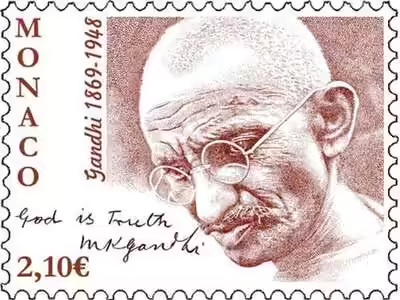
- India’s Moral Truth: Mahatma Gandhi redefined these concepts for the modern age by declaring “God is Truth.” For him, truth was not just an objective fact but a moral law as immutable as gravity, serving as a powerful political tool for liberation through Satyagraha (non-violent non-cooperation).
E: Contemporary Era: Relativism and Technology (1900s onwards)
In recent years, the pursuit of knowledge has entered a phase of extreme fragmentation. This era is defined by a shift from the search for objective reality to a focus on power dynamics and personal perspectives.
The Postmodern Critique: The 20th-century postmodern thinkers, such as Michel Foucault and Jacques Derrida, challenged the concept of “objective truth.” They argued that truth is not a universal constant but a construct of language, cultural perspective and power structures. In this view, truth is often “embedded within a given power structure” rather than being truly objective.
The Digital Paradigm and “Post-Truth”: The democratisation of information via the internet has evolved into a “post-truth” crisis. Today, AI-driven algorithms and deepfakes make it increasingly difficult to distinguish fact from fabrication. In this hyper-connected landscape, modern society often distinguishes between:
- Facts: Concrete, though sometimes disputed, realities.
- Truths: Fluid personal perspectives or judgments, often referred to as Subjective Realism.
The primary challenge of the 2020s has become reclaiming intellectual sovereignty to discern reality amidst this digital noise.
Scientific Evolution: From Absolute Law to Provisional Models
The understanding of scientific truth has evolved from a quest for “God’s unchanging laws” into a method of continuous, evidence-based refinement.
- Emergence of Empiricism: Early thinkers like Roger Bacon shifted the focus from ancient authorities and religious texts toward observation and experimentation, laying the groundwork for evidence-based reasoning.
- The Scientific Revolution: Figures such as Galileo and Newton advanced this further, viewing truth as immutable mathematical laws that describe a “clockwork universe.”
- Modern Science: Today, scientific truth is viewed as provisional and falsifiable. Rather than a final destination, it is the best current explanation supported by empirical data, always subject to revision as new evidence emerges.
Types of Truth
A: Objective Truth:
Objective truth refers to facts that exist independently of personal feelings, beliefs or interpretations, holding universally true for everyone. It is about reality as it is, verifiable and consistent, even if individuals perceive or understand it differently. These truths correspond to external reality and can be proven through observation and evidence, forming a bedrock for knowledge that isn’t swayed by human consciousness or bias, even if our models of them can be fallible.
Examples:
- Mathematical Fact: 2 + 2 = 4. This is universally true and doesn’t change with opinion.
- Scientific Principle: The Earth orbits the Sun. This describes a physical reality independent of human perception.
- Biological Reality: All living humans are mortal. This is a biological certainty for all individuals.
- Logical Definition: A square has four equal sides and four right angles. This is true by definition, regardless of how someone perceives a specific square.
- Physical Property: Water freezes at 0°C (32°F) at standard atmospheric pressure. This is a measurable, repeatable fact.
B: Subjective Truth:
Subjective truth refers to facts that are rooted in individual perspectives, feelings, experiences or interpretations, existing only within the context of a person’s own consciousness. Unlike objective truth, it is personal (my truth) and varies from one individual to another, as it is shaped by unique backgrounds, cultural influences and emotional responses. These truths are valid for the person experiencing them — such as preferences, moral judgments or sensory perceptions — but they cannot be universally verified or proven through external evidence in the same way as physical laws. Consequently, subjective truth reflects an internal reality that prioritises personal meaning and human bias over a singular, consistent and independent world.
Examples:
- Personal Preference: Chocolate ice cream is the best flavour. This is a matter of individual taste and will vary from person to person.
- Aesthetic Judgement: That painting is beautiful. This describes a personal perception of beauty, not an inherent, universal quality of the artwork.
- Emotional Experience: Touching a spider is scary. This is an internal, emotional response that differs based on an individual’s personal feelings and biases.
- Physical Sensation: The room is too warm. This statement is true for the individual experiencing the sensation, but others in the same room might feel differently.
- Opinion/Belief: Dogs are better pets than cats. This is a value claim based on personal opinion and cannot be verified as universally true.
C: Normative Truth:
Normative truth refers to standards, rules or values that a group or society agrees should guide behaviour, beliefs or actions. It is about what “ought” to be the case, rather than what simply “is” (objective truth) or what an individual feels (subjective truth). These truths are conventional and depend on shared human agreement or cultural context, such as rules of law, grammar or moral codes like “you should not steal”. While they may feel universal within a specific community, their validity is tied to that consensus and not to an independent, verifiable reality or individual emotion.
Examples:
- Legal Rule: Drivers ought to stop at a red light. This is a rule established by society to ensure safety and order.
- Moral Code: You should return a wallet you find. This is a shared ethical standard or value judgment within a community.
- Grammar Rule: A sentence should have a subject and a verb. This is a conventional standard for effective communication in a specific language.
- Etiquette: One ought to say “please” and “thank you.” This is a standard of polite behaviour agreed upon within a culture.
- Professional Standard: Doctors should prioritise patient well-being. This is an agreed-upon rule governing professional conduct.
D: Logical Truth:
Logical truth refers to a statement that is universally true solely based on the principles of logic and the meaning of its terms, regardless of any external facts or empirical evidence. These truths are tautological (something that is redundant, circular or repetitive in a way that provides no new information) or analytical, meaning they are true by definition and their falsehood is a contradiction. They do not correspond to physical reality in the way objective truths do, but form the necessary foundation for sound reasoning and valid arguments within a formal system, existing independently of human belief or observation.
Examples:
- Tautology: All bachelors are unmarried men. This statement is true by definition; the predicate is contained within the subject.
- Law of Identity: If a statement is true, then it is true. This is a fundamental principle of formal logic.
- Law of Non-Contradiction: A statement cannot be both true and false at the same time and in the same respect.
- Law of Excluded Middle: Any statement is either true or false; there is no third option.
- Logical Implication: If all humans are mortal, and Socrates is human, then Socrates is mortal. The conclusion necessarily follows from the premises.
Conclusion
In conclusion, understanding the four major types of truth — objective, subjective, normativeand logical — is essential for navigating the complex human interactions and systems of knowledge. Objective truth serves as the bedrock of facts and observable physical reality that remains true regardless of individual belief. Subjective truth acknowledges the validity of personal experience and individual perspectives. Normative truth represents the shared agreements and cultural standards that groups use to function and define their values. Finally, logical truth provides the necessary structure and consistency for reasoning from established principles. By recognising the distinct role each type plays, we can better harmonise different perspectives and make more informed decisions in both personal and professional contexts.
Table 1: Modalities of Truth
This matrix contrasts how different types of truth are verified and validated:
| Type of Truth | Source / Core Definition | Verification Method | Real-World Example |
|---|---|---|---|
| Objective | Independent of human feelings or beliefs | Empirical observation, evidence and measurement | Water freezes at 0o C at standard pressure |
| Subjective | Rooted in individual perspectives and emotions | Personal consciousness and internal experiences | “Chocolate ice cream is the best flavor.” |
| Normative | Standards and rules agreed upon by a society | Cultural consensus, laws, and collective agreements | Drivers must stop at a red traffic light |
| Logical | Universally true by definition and structure | Principles of formal logic and tautological analysis | “All bachelors are unmarried men.” |
Major Philosophical Theories of Truth
Philosophers categorise truth into several key frameworks to explain its nature:
A: Correspondence Theory:
The most widely accepted view, stating that a proposition is true if it accurately reflects an independent, objective reality or “fact”. The theory asserts that a statement or belief is true if and only if it accurately reflects or “corresponds” to a fact or state of affairs in the real world, meaning truth is a relationship between our thoughts/language and reality, where a true proposition “matches” the way things actually are. This intuitive idea posits that true sentences “picture” or “map” reality, aligning their structure and components with the actual world’s elements, but faces challenges in precisely defining “correspondence” and accessing reality itself.
Core Idea: Truth is achieved when a statement or idea aligns with objective reality.
Examples:
- “The cat is on the mat.” This statement is true if, and only if, there is an actual cat in the real world and it is in the state of being on an actual mat.
- “Water boils at 100°C at standard atmospheric pressure.” This is a true statement because scientific experiments and observations consistently confirm that water behaves this way under these specific conditions.
- “The Earth revolves around the Sun.” This astronomical statement is true because it corresponds to the actual, observable mechanics of our solar system.
- “Humans are mortal.” This is considered a universal truth because the fact that all human beings eventually die corresponds to the observed reality of human existence.
- “It is raining outside right now.” This statement is true if a person looks outside and observes the actual weather conditions, which include rain falling from the sky at that moment.
- “The chemical formula for water is H₂O.” This statement is true because it accurately reflects the molecular composition of water as determined by chemistry.
Mechanism: True propositions mirror the world; their parts (subjects, predicates) link to real entities, properties and relations.
Challenge: Defining this correspondence and verifying the “actual state of affairs” against our filtered experiences remains a philosophical hurdle.
Proponents: While Plato and Aristotle laid the foundational ideas of the Correspondence Theory by discussing truth in relation to reality and facts, its modern and contemporary proponents include Bertrand Russell, G.E. Moore, Ludwig Wittgenstein, J.L. Austin, Karl Popper, Edmund Husserl, F.W.J. Schelling, Karl Marx, Immanuel Kant and Wilfred Sellars.
B: Coherence Theory:
This theory posits that a proposition is true if it is consistent with, or “coheres” with, other propositions within a specific system of beliefs. Truth is not determined by a single fact in an external reality, but by the proposition’s fit within a larger, interconnected body of accepted statements. The system can be a set of all beliefs held by an individual, a group, or even a single, absolute system. The primary focus is logical consistency and mutual support among beliefs rather than a direct link to a non-conceptual reality.
Core Idea: Truth is achieved when a statement or idea is logically consistent with an established system of other beliefs.
Examples:
- Mathematical theorems: The truth of a mathematical theorem (e.g., the Pythagorean theorem) is found in its logical derivation and consistency with the axioms and rules of a larger system of mathematics (Euclidean geometry). It does not require real-world “usefulness” or correspondence to physical objects to be considered true within that system.
- A detective solving a case: A detective considers a hypothesis true if it fits all the collected evidence (fingerprints, witness testimonies, alibis, etc.) into a consistent and logical explanation, without contradiction. The “truth” is determined by how well the pieces of the puzzle cohere with each other.
- Legal reasoning: A legal argument is considered true or valid if it is consistent with established laws, prior court decisions (precedents), and the entire body of existing legal principles. Its truth isn’t based on an external, objective “fact” but on its fit within the legal system.
- Scientific paradigm: The truth of a specific scientific claim is judged by its consistency with the established body of scientific knowledge, theories and experimental results within the prevailing paradigm. For instance, a new biological finding is accepted as “true” if it coheres with cell theory, evolutionary theory, etc.
- A fictional world’s rules: Within the fictional universe of a novel or story, a statement (e.g., “magic wands require phoenix feathers to work”) is “true” if it is consistent with the other established facts and rules of that specific fictional world. Its truth depends entirely on its internal coherence within that system.
Mechanism: A proposition gains its truth value by its structural relations (like logical implication) to other propositions within a coherent system. The more a statement is supported by the overall system, the stronger its claim to truth.
Challenge: Defining which system of beliefs is the correct or definitive one, and addressing the possibility of multiple, mutually exclusive, yet internally consistent systems. A system can be entirely fictional (like a novel) but internally coherent.
Proponents: While thinkers like Spinoza, Leibniz and Hegel laid the early groundwork for Coherence Theory, proponents of its modern and contemporary version include idealists like F.H. Bradley, H.H. Joachim, Brand Blanshard, and philosophers of science who emphasise how scientific theories gain validity through their explanatory coherence within the overall body of scientific knowledge.
C: Pragmatic Theory:
A theory that a proposition is true if it is useful or works in practice, essentially focussing on the practical consequences and utility of beliefs for problem-solving and action. The theory asserts that a belief is true if and only if it “works” or has practical application in an individual’s life or a community’s experience, meaning truth is not a fixed, static correspondence to reality, but a dynamic property of successful ideas and inquiries. True propositions are those that enable effective prediction, problem-solving and action, aligning their value with their functionality rather than their ability to “mirror” an independent reality.
Core Idea: Truth is achieved when a statement or idea is practically useful or successful in guiding action and making accurate predictions.
Examples:
- Statement: “This path is safe.” Its truth is found if, by following the path, one reaches their destination without harm. Its truth is found in its successful outcome.
- Statement: “This medicine is effective.” Its truth is found if, by taking the medicine, a person’s symptoms are relieved and they recover their health.
- Statement: “Following this recipe will result in a delicious cake.” Its truth is found if, by following the instructions exactly, one produces a cake that tastes good.
- Statement: “The bridge engineering plan is sound.” Its truth is found if the constructed bridge safely withstands traffic and weather conditions without collapsing or developing critical faults.
- Statement: “This business strategy is viable.” Its truth is found if, by implementing the strategy, the company achieves profitability and long-term success.
- Statement: “The weather forecast for tomorrow is accurate.” Its truth is found if the actual weather conditions the next day match the predicted forecast.
Mechanism: True propositions are tools for thought and action; their value lies in their functional efficacy and their ability to resolve doubt and achieve practical results.
Challenge: Defining and measuring “usefulness” or “practical success” can be subjective and context-dependent, and the theory faces criticism for potentially equating truth with mere utility or consensus rather than a more robust notion of objective reality.
Proponents: While Charles Sanders Peirce laid the foundational ideas of the theory with the “pragmatic maxim,” its modern and contemporary proponents include William James and John Dewey.
D: Deflationary (also Semantic/Redundancy) Theory:
This theory argues that truth is not a substantive property but a mere “expressive convenience”. The word “true” does not name a real, analysable property (like the Correspondence Theory suggests) but is simply a linguistic tool used for convenience, primarily to form generalisations that would otherwise require infinite conjunctions.
Core Idea: The assertion that “P is true” is logically equivalent to the assertion “P” itself. The truth predicate “is true” is redundant in most contexts and adds nothing to the content of the statement.
Examples:
- ” ‘The sky is blue’ is true” means exactly the same as “The sky is blue.”
- “It is true that Paris is the capital of France” is identical in content to “Paris is the capital of France.”
- Saying “The statement ‘Grass is green’ is true” adds nothing substantial beyond affirming “Grass is green.”
- ” ‘The Earth revolves around the Sun’ is true” conveys no deeper secret about truth; it just asserts the core claim.
- ” ‘2+2=4’ is true” is redundant; it just means “2+2=4.”
- To say ” ‘This apple is red’ is true” is merely to agree with the sentence “This apple is red.”
- ” ‘I smell violets’ is true” carries the identical meaning as “I smell the scent of violets,” notes Gottlob Frege, showing truth adds no new idea
- ” ‘The dog barks’ is true” is just a way of asserting the fact “The dog barks.”
- ” ‘It is true that water is H2O’ “ is exactly equivalent to the simpler, factual claim“Water is H2O.”
Mechanism: The primary use of the truth predicate is to express general statements efficiently (e.g., “Everything John says is true” is a shorthand for an infinite list of conditionals).
Challenge: The main challenge of the theory is in explaining the apparent normativity of truth (why we aim for truth in assertions) and in dealing with semantic paradoxes, like the Liar Paradox (If the sentence “This sentence is false” is true, then it must be false; if it is false, then it must be true, creating a loop). This creates contradictions because deflationism struggles to handle self-referential, truth-apt statements without collapsing into inconsistency, suggesting that truth might be more than just a linguistic device.
Proponents: They include 20th-century philosophers like Alfred Tarski, Bertrand Russell, F.P. Ramsey, and W.V.O. Quine, who developed the concept, alongside modern figures such as Dorothy Grover, Nuel Belnap, and Paul Horwich, who refined and defended deflationism.
E: Constructivist Theory:
The Constructivist Theory of truth posits that truth is a human and social construction, not a discovery of a mind-independent reality. It rejects the objective reality claim of the Correspondence Theory, arguing instead that knowledge and truth are actively created through individual experiences, social interactions and cultural contexts.
Core Idea: Truth is constructed by social and individual processes, is historically and culturally specific, and is a product of collective agreement, negotiation and personal experience rather than a mirror of objective reality.
Examples:
- Statement: “This diet plan is healthy.” Its truth is found if, by following the diet, one achieves improved health outcomes like weight loss, lower cholesterol, or increased energy.
- Statement: “This mathematical formula is correct.” Its truth is found if, by applying the formula, one successfully solves a problem or accurately predicts a physical phenomenon.
- Statement: “This software update will improve performance.” Its truth is found if, after installing the update, the software runs faster and is more stable.
- Statement: “This negotiation strategy will lead to a fair agreement.” Its truth is found if, by employing the strategy, both parties reach a mutually beneficial and lasting agreement.
- Statement: “This bridge design is stable.” Its truth is found if, when the bridge is built according to the design, it safely carries the intended traffic load over time without structural failure.
- Statement: “This business plan is viable.” Its truth is found if, by implementing the plan, the business becomes profitable and sustainable in the market.
For all the above statements, their truth is found in the successful outcome of the stated.
Mechanism: Individuals build knowledge by integrating new information with their existing mental models (schemas) through processes like assimilation and accommodation. Social interaction, culture and power dynamics heavily influence this construction process. A statement is considered ‘viable’ or ‘true’ if it helps an individual or community function effectively in their environment and finds validation in shared understandings.
Challenge: The primary challenge is the potential for relativism: if truth is subjective or culturally specific, how can universal standards of truth be established, and how can conflicting viewpoints be judged? It also faces criticism for potentially reducing truth to mere utility or consensus, rather than a connection to what is real in an objective sense.
Proponents: Key figures associated with constructivism (though often in the context of learning theory/epistemology rather than a formal philosophical theory of truth) include Jean Piaget, Lev Vygotsky, Jerome Brunerand Ernst von Glasersfeld (radical constructivism). In a philosophical context, ideas from Giambattista Vico, Hegel and Marx can be seen as early influences on the premise of socially constructed truth, and later Thomas Kuhn in the philosophy of science.
Conclusion
In conclusion, the five major philosophical theories of truth—Correspondence, Coherence, Pragmatic, Deflationary and Constructivist— each offer a unique lens for defining the nature of what we consider “true”. The Correspondence Theory grounds truth in its alignment with objective, external reality, while the Coherence Theory sees it as the logical consistency within a system of beliefs. Pragmatic theories focus on the practical utility and successful consequences of a proposition, while Deflationary Theory argues that truth is not a substantive property at all, often viewing the term as a mere linguistic shortcut. Constructivist Theory suggests that truth is not discovered but actively built through social interactions, cultural contexts and individual experiences, meaning our “truth” is a model we construct to make sense of the world. Ultimately, no single theory fully encapsulates the complexity of truth; instead, a pluralistic approach acknowledging the strengths of each may provide the most nuanced understanding of how we perceive reality.
Table 2: Major Philosophical Theories of Truth
This matrix maps out the primary frameworks used to analyze truth claims, including their core mechanisms and inherent hurdles:
| Framework Theory | Core Dynamic | Validation Mechanism | Principal Challenge | Key Proponents |
|---|---|---|---|---|
| Correspondence | Alignment with factual reality | Matches or mirrors external, mind-independent facts | Defining “correspondence” through human filters | Aristotle, Russell, Wittgenstein |
| Coherence | Internal system consistency | Fits logically within an interconnected web of beliefs | Systems can be perfectly coherent yet entirely fictional | Spinoza, Hegel, Bradley |
| Pragmatic | Practical utility and function | Effectively guides actions and yields successful outcomes | Reduces abstract truth to subjective usefulness | Peirce, James, Dewey |
| Deflationary | Linguistic convenience | Redundant predicate; “P is true” equals asserting “P” | Struggles to address semantic loops like the Liar Paradox | Tarski, Russell, Frege, Horwich |
| Constructivist | Active social creation | Collective human negotiation, context, and power dynamics | Vulnerable to extreme cultural and individual relativism | Piaget, Vygotsky, Kuhn |
The Future of Truth
The future evolution of truth is expected to be largely influenced by the proliferation of information and communication technologies, particularly Artificial Intelligence (AI). This will likely make the concept of truth more complex and dynamic, as individuals and societies grapple with distinguishing fact from AI-generated fiction.
Key potential developments include:
Erosion of Trust:
The rise of deepfakes and AI-driven misinformation campaigns may further erode trust in traditional media and institutions, requiring individuals to be more critical of information sources.
Examples:
- A well-known instance of political manipulation was a deepfake video of Ukrainian President Volodymyr Zelenskyy circulated shortly after the 2022 invasion, appearing to show him calling for surrender. This was a clear attempt at psychological warfare designed to manipulate public perception and morale during a national crisis.
- In the realm of financial fraud, an employee at the engineering firm Arup was tricked into transferring over £20 million after participating in a video call with deepfakes impersonating the company’s CFO and other executives. The sophisticated use of synthetic likenesses and voices exploited the employee’s trust in authority to bypass security protocols.
Subjective Realities:
In an age of algorithmic filter bubbles and echo chambers on social media, people may increasingly inhabit personalised “truth” bubbles where information aligns with their existing beliefs, making a shared, objective consensus more difficult to achieve.
Examples:
- One early example of algorithmic filtering involved a Google search for “BP” during the 2011 Deepwater Horizon oil spill, where one user received investment news while another received information about the environmental disaster. These starkly different results, based on user history, show how algorithms can silently create personalised realities.
- A major real-world consequence is increased political polarisation, such as that observed during the 2016 U.S. presidential election, where users’ news feeds and search results primarily displayed content aligned with their existing political views. This self-reinforcing information environment contributes to a growing divide between people with differing opinions, making a shared, objective consensus more difficult to achieve.
New Verification Mechanisms:
There may be a push for technological solutions, such as blockchain-based authenticity markers or digital “birth certificates” for content, to verify the origin and integrity of information.
Examples:
- The C2PA (Coalition for Content Provenance and Authenticity) standard is used by companies like Adobe and news organisations to cryptographically sign media at the point of capture or editing. This process embeds secure, tamper-evident metadata that functions like a “nutrition label” for digital content, enabling consumers and platforms to verify the content’s origin and editing history.
- Blockchain technology is used in various applications, such as securing academic credentials or birth certificates, by storing a tamper-proof record (or hash) of a document on a decentralised ledger. This system allows anyone with access to instantly verify the integrity and authenticity of the document using a unique identifier or QR code, reducing fraud and increasing transparency.
Reimagining Human Knowledge:
AI’s ability to generate knowledge from massive datasets might challenge traditional ideas of human expertise and intuition, leading to new frameworks for how we validate information.
Examples:
- In healthcare, AI systems can analyse vast datasets of medical images and patient data to detect diseases like cancer with greater speed and sometimes accuracy than human radiologists. This predictive power forces a re-evaluation of traditional diagnostic processes and the human physician’s role in final judgment and validation.
- In finance, AI algorithms have outperformed seasoned human stock analysts by identifying complex patterns in real-time data, including social media sentiment and news headlines, to predict market movements. This demonstrates how machine processing of massive, diverse datasets can create insights that challenge human intuition and experience-based trading strategies.
Philosophical Debate:
Philosophers and ethicists will continue to debate the nature of truth in a post-authentic world, focussing on balancing technological advancement with human values and ensuring that AI is used for the public good.
Examples:
- The use of AI in court systems to predict recidivism rates raises fundamental questions about fairness and transparency, as the “black box” nature of some algorithms makes their decision-making unintelligible to humans. Critics argue these systems may perpetuate and amplify existing societal and historical biases present in their training data, leading to discriminatory outcomes in sentencing or parole decisions.
- The development of autonomous cars presents ethical dilemmas regarding life-and-death decisions, particularly in unavoidable accident scenarios (the “trolley problem”). Philosophers and ethicists debate whether an AI should be programmed to prioritise the lives of pedestrians or the occupants, highlighting the challenge of embedding complex human moral frameworks into machine code.
The trajectory of truth’s evolution will depend on human choices in developing critical thinking skills and demanding transparency in how information is produced and shared.
Impact on Theories of Truth
The proliferation of AI and synthetic media is fundamentally shifting truth from a static discovery to a dynamic, technological and pragmatic construct. The impact on philosophical theories and types of truth is outlined below:
- Correspondence Theory (Truth as Reflecting Reality): Traditionally, a statement is true if it matches observable reality. AI challenges this by creating “hyper-realistic forgeries” (deepfakes) that appear to reflect reality but lack a physical “truth-marker”. Correspondence is increasingly mediated by technological verification (e.g., blockchain-based digital “birth certificates”) because human senses can no longer reliably “match” media to reality.
- Coherence Theory (Truth as Internal Consistency): This theory holds that a statement is true if it fits logically within a larger system of beliefs. AI systems, such as chatbots, prioritise internal coherence over objective accuracy. This leads to “algorithmic filter bubbles” where information is accepted as true simply because it is consistent with a user’s existing personalised “truth bubble.”
- Pragmatic Theory (Truth as What Works): Pragmatists view truth as the “useful” or “expedient”. AI recommendation engines embody this by providing “truths” (like personalised song or movie suggestions) that are valid only because they work for the individual in the moment. This “useful truth” is being increasingly prioritised in AI alignment to ensure systems serve public interests and practical outcomes over abstract ideals.
Impact on Types of Truth
- Objective Truth: AI remains effective at handling facts (e.g., weather or disease diagnosis). However, “the liar’s dividend” allows actors to dismiss authentic objective evidence as “probably fake,” eroding the very concept of a shared objective reality.
- Subjective Truth: AI struggles with personal experiences but excels at mimicking them. This creates a “post-authentic” era where subjective human experience is often indistinguishable from AI-simulated sentiment.
- Consensus Truth: This type of truth relies on what a majority agrees upon. AI often replaces genuine consensus with “algorithmic consensus,” where the most viral or emotionally charged (rather than factual) narratives dominate public opinion.
Emerging Frameworks
- Synthetic Reality Threshold: A point where humans can no longer distinguish authentic from fabricated media without technological assistance, necessitating new “epistemic agency” — the capacity to engage with knowledge when traditional evidence fails.
- Knowledge Ecologies: A shift toward institutional architectures that reward information vigilance and verification over sheer efficiency to rebuild societal trust.
Other points to ponder
The Problem of Paradox:
The Liar’s Paradox—exemplified by the statement “this sentence is false”—challenges standard theories of truth by creating an inescapable logical contradiction where a statement is true if and only if it is false. This paradox directly undermines the Correspondence Theory, which requires a statement to match an external fact; here, the “fact” is the statement’s own falsity, leading to a circular loop. It also disrupts the Coherence Theory because the statement cannot be logically integrated into a consistent system of beliefs without causing that entire system to become inconsistent. Furthermore, the paradox violates the Principle of Bivalence, a cornerstone of classical logic which asserts that every statement must be exactly one of two values: true or false. To resolve this, some philosophers propose alternative frameworks, such as multi-valued logic (where a statement can be “neither true nor false”), dialetheism (where it can be both), or Tarski’s hierarchy, which forbids a language from referring to its own truth predicate to prevent such self-referential loops.
Examples:
- The Pinocchio Paradox: This is a modern, popular version of the Liar’s Paradox. Imagine Pinocchio says, “My nose will grow now”. If his nose grows, he was telling the truth, but his nose only grows when he lies. If it doesn’t grow, he was lying, which means his nose should have grown. This creates a “loop with no escape” where truth and falsehood collapse into each other.
- The Postcard Paradox: This example uses circular reference rather than direct self-reference. Imagine a postcard where the front says, “The sentence on the back is true,” and the back says, “The sentence on the front is false”. If the front is true, the back must be true, which makes the front false. If the front is false, the back must be false, which means the front is actually true. This “No-No paradox” demonstrates that even multiple sentences can create a truth-value contradiction when they refer to each other.
Truth vs. Knowledge:
In epistemology (the branch of philosophy that deals with the nature, origin, and limits of human knowledge), knowledge is traditionally defined as justified true belief (JTB), meaning that for a person to truly “know” something, they must believe it, it must be objectively true, and they must have adequate reasons or evidence for it. While truth is an independent, objective property of facts that exists whether or not anyone is aware of them, knowledge is agent-dependent, requiring a mind to comprehend that truth through justification. Justification acts as the “bridge” between subjective belief and objective reality, ensuring that a person’s belief is not a mere lucky guess but is instead based on a reliable process or solid evidence. However, the relationship is complex because one can have a justified belief that is false (fallibilism), or a true belief that is unjustified; furthermore, the “Gettier problem” demonstrates that even a belief that is both true and justified can sometimes fail to count as knowledge if the connection between the two is merely accidental.
Examples:
- The Stopped Clock: Imagine you look at a reliable clock tower that says it is 3:00 PM. You form a justified belief that the time is 3:00 PM because the clock is normally accurate. By pure coincidence, it is exactly 3:00 PM, making your belief true. However, unknown to you, the clock broke exactly twelve hours ago and has not moved since. Because your correct belief relies on a broken instrument and sheer luck, most philosophers argue you do not truly know the time.
- The Sheep in the Field: Suppose you look into a field and see a shaggy animal that looks exactly like a sheep, leading you to believe there is a sheep in the field. Your belief is justified by your clear visual perception. It turns out your belief is also true because there is indeed a real sheep in that field—but it is hidden behind a hill where you cannot see it. The animal you are actually looking at is a dog disguised as a sheep. Since your belief is only true by accident and not because of the “sheep” you saw, it does not count as knowledge.
Ethical Implications of Lying:
The ethical implications of lying centre on a fundamental tension between absolute moral duties and the practical consequences of our actions. From a deontological perspective(an ethical framework that judges the morality of an action based on its adherence to rules, duties and obligations, regardless of the consequences), most famously championed by Immanuel Kant, lying is considered intrinsically wrong because it violates the universal “Categorical Imperative” (an unconditional moral obligation or command that is universally and absolute binding on all rational agents, regardless of their personal desires or the consequences of their actions), undermines human dignity, and erodes the trust essential for a functioning society. Kant argued that truthfulness is an absolute duty, famously asserting that one should not lie even to a “murderer at the door”. In contrast, consequentialist theories like utilitarianism suggest that a lie may be justified if it leads to the “greatest good for the greatest number,” such as saving a life or preventing significant harm. While “white lies” are often seen as harmless social tools to maintain harmony, philosophers like Saint Augustine still viewed them as a perversion of the God-given gift of speech, though he categorised them as more pardonable than malicious lies. Ultimately, the morality of a lie often depends on whether one prioritises the intent of the speaker, the autonomy of the person being lied to, or the overall outcome for society.
Examples:
- The Murderer at the Door: In this famous thought experiment, a person seeking to commit a murder asks you if their intended victim is hiding in your house. A deontologist like Immanuel Kant would argue that you have an absolute moral duty to tell the truth, regardless of the consequence, as lying is intrinsically wrong and violates the rational dignity of all humans. Conversely, a utilitarian would insist that lying is the only ethical choice because the “greater good” — saving a human life — far outweighs any harm caused by a single lie. This aligns with the concept of āpad-dharma in Hindu philosophy that refers to the “dharma of emergencies” or the conduct permitted during times of extreme distress and calamity.
- The Medical Diagnosis (Therapeutic Privilege): Imagine a doctor has a terminally ill patient who is emotionally fragile and may give up hope if told they only have months to live. From a virtue ethics perspective, the doctor might justify a “white lie” as an act of compassion and benevolence, aiming to preserve the patient’s well-being in their final days. However, critics argue this violates the patient’s autonomy, as withholding the truth deprives them of the information needed to make final, informed choices about their own life and care.
The Nature and Power of Truth
To understand truth completely, we must look beyond rigid academic definitions. Throughout history, ancient traditions and eminent thinkers have viewed truth as a dynamic catalyst for personal liberation and societal change. The following insights explore the lived experience of truth—its beauty, its inherent struggles, and its undeniable power.
Eminent figures have offered varied insights into the nature of truth:
- Rabindranath Tagore viewed truth as singular, stating, “Facts are many, but the truth is one.” He also connected truth and beauty, noting, “Beauty is truth’s smile when she beholds her own face in a perfect mirror.”
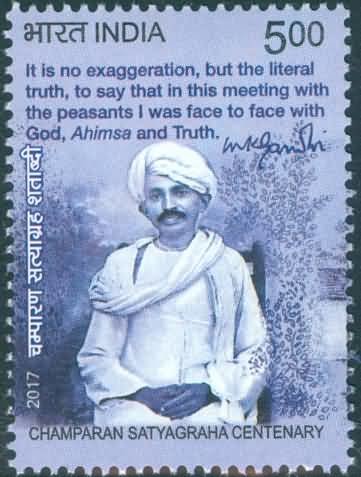
- Mahatma Gandhi emphasised the importance of truth regardless of popular opinion, saying, “Even if you are a minority of one, the truth is the truth.” He also asserted its supreme importance with “There is no god higher than truth.”
- Swami Vivekananda highlighted the non-negotiable nature of truth: “Everything can be sacrificed for truth, but truth cannot be sacrificed for anything.”
- Winston Churchill described truth as ultimately undeniable: “The truth is incontrovertible. Malice may attack it, ignorance may deride it, but in the end, there it is.”
- John F. Kennedy pointed out that the greatest adversary of truth is often not intentional falsehood but deeply ingrained, unrealistic beliefs, stating, “The great enemy of truth is very often not the lie — deliberate, contrived and dishonest —but the myth, persistent, persuasive and unrealistic.”
The Struggle to Accept Truth
The path to acceptance of truth can be challenging.
- Arthur Schopenhauer described a three-stage process: “All truth passes through three stages. First, it is ridiculed. Second, it is violently opposed. Third, it is accepted as being self-evident.”
- David Foster Wallace suggested that truth’s impact can be profound and transformative, noting, “The truth will set you free. But not until it is finished with you.”
- Oscar Wilde observed the complexity of truth: “The truth is rarely pure and never simple.”
- James A. Garfield also alluded to the initial difficulty truth can bring, stating, “The truth will set you free, but first it will make you miserable.”
- George Orwell highlighted the courage required to uphold truth in difficult circumstances: “In a time of universal deceit, telling the truth is a revolutionary act.”
Literary and Artistic Perspectives
Truth is a recurring theme in literature and art.
- William Shakespeare linked truth to integrity, saying, “No legacy is so rich as honesty.”
- Kahlil Gibran used a metaphor to describe how doctrines can act as a barrier to direct experience of truth: “Many a doctrine is like a window pane. We see truth through it but it divides us from truth.”
- John Keats famously equated beauty and truth, writing, “‘Beauty is truth, truth beauty,’ — that is all ye know on earth, and all ye need to know.”
- Antoine de Saint-Exupery suggested that essential truths are perceived not through logic but through intuition: “It is only with the heart that one can see rightly; what is essential is invisible to the eye.”
- Maya Angelou distinguished between facts and truth, noting that facts can sometimes obscure deeper reality: “There’s a world of difference between truth and facts. Facts can obscure the truth.”
Ancient Wisdom and Epics
Ancient texts and spiritual teachings also offer insights into truth.
- The Bible states, “And you will know the truth, and the truth will set you free.” (John 8:32)
- The Upanishads contain prayers acknowledging the power of truth, equating it with the ultimate reality, and seeking guidance towards reality:
- “Truth alone triumphs, not falsehood; by truth is laid out the path to the divine.” (Mundaka Upanishad)
- “That Which is True is Immortal.” (Mundaka Upanishad)
- “Lead me from the unreal to the real.” (Brhadaranyaka Upanishad)
- The Buddha taught that truth is ultimately discoverable, comparing it to natural phenomena: “Three things cannot be long hidden: the sun, the moon, and the truth.”
- Lao Tzu suggested that truth can appear contradictory, noting, “The words of truth are always paradoxical.”
- Confucius emphasised the pursuit of truth as a noble endeavour: “The object of the superior man is truth.”

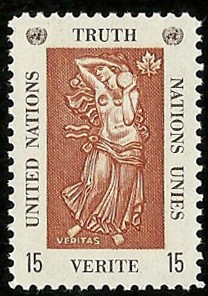
Image 1: A 1974 Vatican City postage stamp (se-tenant strip of three) commemorating the 7th centenary of the death of St. Thomas Aquinas. Courtesy Wikimedia Commons.
Image 2: A 1971 postage stamp from Dubai, featuring a depiction of Persian polymath Avicenna (circa 980 – 1037), also known as Ibn Sina, Abu Ali Sina and Pur Sina. Avicenna is regarded as one of the most significant physicians, astronomers and writers of the Islamic Golden Age, as well as the father of modern medicine. Courtesy Science History Institute, Philadelphia.
Image 3: Postage stamp issued by Greece in 1998 to commemorate Plato’s contribution to western philosophy. Courtesy https://mathshistory.st-andrews.ac.uk/
Image 4: A postage stamp issued by France in 1996 commemorating Rene Descartes, French Philosopher, mathematician and scientist.
Image 5: a commemorative postage stamp from Monaco featuring Mahatma Gandhi, released to mark his 150th birth anniversary in 2019. Courtesy Indiatimes.
Image 6: Postage stamp issued by Greece in 2016 to mark 2400 years since the birth of Aristotle. Courtesy Hellenic Philatelic Society of The Netherlands.
Image 7: A commemorative postage stamp issued by India Post in 2017 to mark the centenary of the Champaran Satyagraha, featuring a portrait of Mahatma Gandhi and his quote. Courtesy Wikimedia Commons.
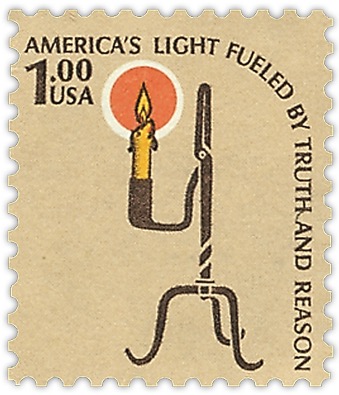
Image 8: A 1979 United States postage stamp, part of the Americana Series, featuring a 19th-century rushlight and candle holder, common for lighting homes before electricity. The text reads “America’s Light fueled by Truth and Reason”. Courtesy UNPA
Image 9: A United Nations postage stamp from the Expo ’67 issue depicts a sculpture representing Truth. Part of a five-stamp series issued by the UN, it carries text in English (“TRUTH”), French (“VERITE”), and Latin (“VERITAS”).
Image 10: A standard official/service postage stamp of the Government of India, featuring the capital of Ashoka Pillar (the national emblem) with the text ‘Satyameva Jayate’ (Truth Alone Triumphs) written in the official language, Hindi.