
While many view the open ocean as an empty expanse of water, Earth’s vast marine systems actually operate as the planet’s primary biological life-support machine. This breakdown spans the deep giant of the Pacific to the thermal engine of the tropical Indian Ocean, detailing how distinct chemical and physical landscapes work in tandem to generate half our oxygen and drive global weather systems. By analyzing the unique roles of vital carbon sinks, regional monsoons, and marginal seas, the text maps out the intricate watery web connecting deep trench ecosystems directly to human civilization. Enriched by historical maritime trade anecdotes and UN preservation highlights, this comprehensive guide underscores the urgent need to protect the unseen aquatic dynamics that keep our continents habitable.
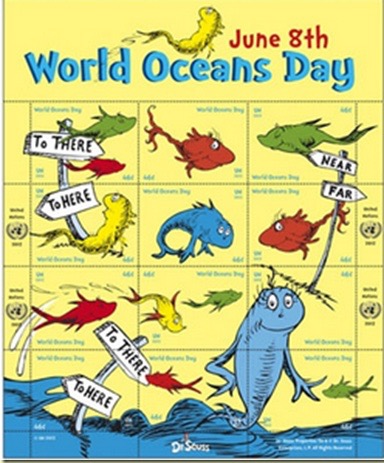
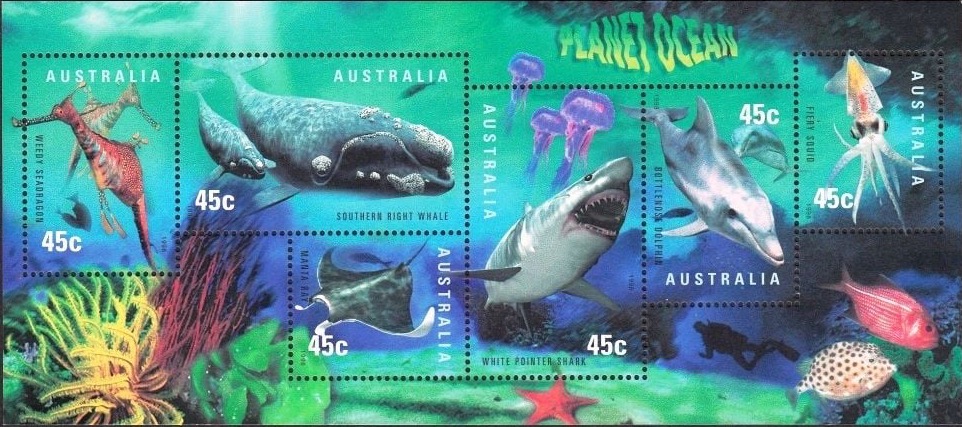
A postage stamps pane issued by the United Nations Postal Administration (UNPA) on the occasion of the World Oceans Day 2013. The stamps feature creative images from children’s book author, Dr. Seuss. Recognised by the UN since 2008, World Oceans Day is being observed on 8th June every year to raise awareness about the crucial role the ocean plays in our lives, and the important ways in which people can help protect them. The theme for World Oceans Day 2013-2014 was “Together we have the power to protect the ocean!” Courtesy Rainbow Stamp Club.
The Pacific Ocean: The Deep Giant
The Pacific is the largest and deepest ocean that could fit all of Earth’s continents inside it with room to spare.
Geographic extent and boundaries:
Surface Area: It covers 63.8 million square miles, roughly one-third of the entire planet and nearly half of Earth’s water surface.
East to West: At its widest (near the equator), it stretches 12,300 miles, reaching from Colombia/Panama in the Americas to Indonesia/Malay Peninsula in Asia.
North to South: It extends 9,600 miles from the Bering Strait (Arctic) down to the northern boundary of the Southern Ocean (Antarctica).
Global Reach: It spans both the Northern and Southern Hemispheres, as well as the Eastern and Western Hemispheres (crossing the International Date Line.
Continental Borders: It is bounded by Asia and Australia to the west and the Americas to the east.
Island Vastness: It contains over 25,000 islands (together called Oceania), more than all the other oceans combined.
Unique Features:
The Mariana Trench, located in the western Pacific, contains the Challenger Deep, which is the deepest known point on Earth at approximately 10,994 meters (about 36,070 feet) below sea level.
Encircling this ocean is the Ring of Fire, a 40,000-kilometre (25,000-mile) horseshoe-shaped belt that accounts for about 75% of the world’s active volcanoes and 90% of its earthquakes due to constant tectonic plate movement.
Support for Life:
The Great Barrier Reef: Provides a home for roughly 25% of all marine life.
Nutrient Upwelling: Strong currents bring nutrient-rich cold water from the deep to the surface, supporting massive fisheries.
Ecological Role: It acts as the primary heat engine for the planet, driving global weather patterns like El Niño and La Niña.
The Atlantic: The “Sea of Atlas”
The Atlantic is the second-largest ocean on Earth, but its influence is arguably the greatest in terms of human history and global weather regulation. Unlike the vast, circular Pacific, the Atlantic is an elongated, S-shaped basin that acts as the primary corridor between the “Old World” and the “New World”.
Geographic Extent and Reach:
A “Young” and Growing Ocean: Geologically, the Atlantic is younger than the Pacific and is still widening at a rate of about 1 to 4 inches per year as new seafloor is created.
The World’s Drain: It has the largest drainage area of any ocean, receiving water from many of the world’s most famous rivers, including the Amazon, the Mississippi and the Congo.
Polar Connection: It is the only ocean that stretches from the Arctic Circle in the north all the way to the Southern Ocean in the south.
One-of-a-kind Features:
The World’s Longest Mountain Range: Running right down the centre is the Mid-Atlantic Ridge, a 10,000-mile-long underwater volcanic mountain range.
The Saltiest Major Ocean: Due to high evaporation and low rainfall in certain regions, the Atlantic has the highest salinity of all the five oceans.
The Sea Without a Coast: It is home to the Sargasso Sea, a unique region in the North Atlantic defined not by land, but by rotating currents that trap massive mats of floating seaweed.
History’s Highway: For centuries, it has been the world’s busiest ocean for trade and was the site of the most significant early global explorations.
Support for Life and Climate:
The “Global Conveyor Belt”: The Atlantic drives the Atlantic Meridional Overturning Circulation (AMOC), a giant underwater current that moves heat around the planet, keeping Europe much warmer than it would otherwise be.
Hurricane Alley: It is the primary birthplace of hurricanes that form off the coast of Africa and travel toward the Americas.
Famous Fishing Grounds: It contains the Grand Banks off Newfoundland, where the meeting of warm and cold currents creates some of the most productive fishing areas on Planet Earth.
The Indian Ocean: The “Warm Heart” of the World
The Indian Ocean is the third-largest and geologically youngest of the major oceans. It is unique as an “embayed” ocean, almost entirely enclosed by land on three sides, which traps heat and dictates its one-of-a-kind circulation patterns. Being the warmest ocean in the world limits its ability to hold oxygen but fuels intense weather systems.
Geographic Identity and Boundaries:
A Landlocked North: Unlike the Pacific and Atlantic, the Indian Ocean does not stretch from pole to pole. Its northern end is entirely blocked by the Asian continent, meaning it has no connection to the Arctic and lacks cold, temperate zones.
Asymmetric Shape: It is roughly triangular, bounded by Africa to the west, Asia to the north, and Australia to the east. It only opens up fully in the south, where it merges with the Southern Ocean at 60°S latitude.
The “M” Outline: Its northern rim forms a giant letter “M,” with the Arabian Sea and the Bay of Bengal acting as the two “arms” separated by the Indian Peninsula.
Deepest Point: Its deepest known spot is the Java Trench (also known as the Sunda Trench), reaching a depth of approximately 7,290 meters (23,920 feet).
One-of-a-kind Features:
The World’s Warmest Ocean: Because it is mostly tropical and lacks cold-water inflow from the north, its surface temperatures can reach a staggering 30°C (86°F), making it the hottest large water body on the planet.
Reversing Currents: It is the only ocean where surface currents completely reverse direction twice a year. Driven by seasonal monsoons, the water flows toward Africa in the winter and back toward India in the summer.
Ninety East Ridge: It is home to the world’s longest and straightest underwater mountain range, which runs nearly perfectly north-to-south along the 90°E meridian for over 2,800 miles.
Support for Life and Human History:
The Monsoon Engine: It directly powers the strongest monsoon system on Earth, providing vital rainfall that supports the agriculture and livelihoods of billions of people across Asia.
Unique Marine Life: It is a sanctuary for “living fossils” like the Coelacanth—a fish once thought extinct for millions of years—and rare mammals like the Dugong (sea cow).
Mangroves and Seagrass: The warm coastal waters are hotspots for mangrove forests and seagrass beds, which are massive carbon sinks.
Ancient Trade Highway: Long before explorers crossed the Atlantic, the Indian Ocean was a bustling hub for trade. Ancient sailors used the predictable monsoon winds to travel between Egypt, Arabia, India and China.
Strategic Energy Route: Today, it is the world’s most critical route for energy, carrying nearly 40% of the world’s offshore oil production and two-thirds of all global oil shipments.
The Southern Ocean: The Carbon Sink
The Southern Ocean encircles Antarctica and is defined by the Antarctic Circumpolar Current, the strongest current on Earth.
Unique Features:
Circle flow: It is the only ocean that flows completely around the globe without hitting a landmass.
Icy Engine: It is incredibly cold and nutrient-rich, acting like a “global engine” that moves deep, fresh water to other parts of the planet.
Seasonal Shield: Every winter, parts of it freeze over, nearly doubling the size of the Antarctic continent.
Support for Life:
Krill Powerhouse: The massive blooms of Antarctic krill form the foundation of the food web for whales, seals, and penguins.
Polynyas: Areas of open water surrounded by sea ice that act as “biological refrigerators,” where intense oxygenation occurs.
Ecological Role: It is the world’s most effective carbon sink, absorbing a disproportionate amount of human-made carbon dioxide and heat from the atmosphere.
The Arctic Ocean: The Earth’s Mirror
The smallest and shallowest ocean, the Arctic is mostly covered by sea ice for much of the year.
Unique Features:
Lowest salinity: It has the lowest salinity (due to low evaporation and heavy freshwater runoff from rivers) and is the most sensitive to climate change.
World’s Widest Continental Shelf: It contains the largest continental shelf in the world—the Siberian Shelf—which extends over 900 miles (1,500 km) from the coast of Russia. These vast, shallow areas are incredibly productive, serving as major hubs for natural gas and oil reserves, while also acting as critical feeding grounds for marine life like walruses and whales.
Support for Life:
Ice Algae: Algae growing under the ice forms the base of a unique food chain that supports everything from cod to polar bears.
Benthic Richness: Because it is shallow, the seafloor is incredibly rich in nutrients, supporting massive populations of walruses and whales.
Ecological Role: It acts as the “Earth’s Mirror” (Albedo effect). The white ice reflects sunlight back into space, preventing the planet from overheating.
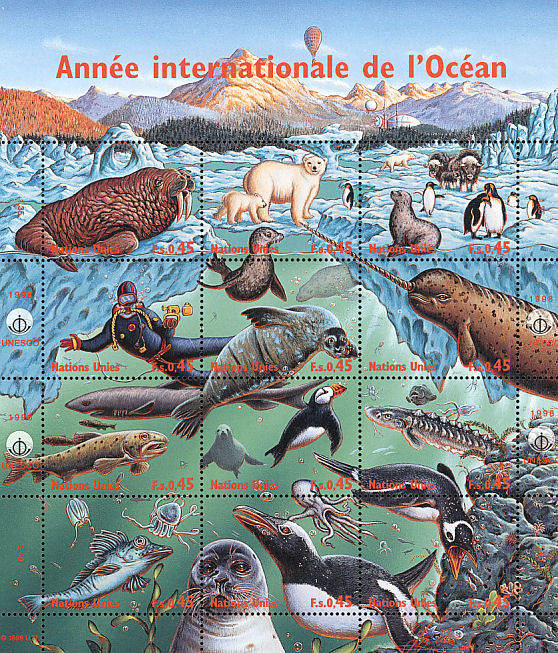
A commemorative miniature sheet of postage stamps issued by the United Nations Office in Geneva, Switzerland, to mark 1998 as the International Year of the Ocean. It features walruses, polar bears, seals, narwhals, and penguins. Courtesy birdtheme.org
The Seas: Marginal Giants and Inland Wonders
Building on the vastness of the five major oceans, the world’s seas represent a more intimate yet equally vital part of Earth’s hydrosphere.
While the five oceans form a continuous global body of water, the seas are smaller, shallower portions of these oceans, often found where land and water meet.
Number and Variety: There are approximately 50 to 100 named seas worldwide. Geographers traditionally spoke of the “Seven Seas,” a term that has evolved from ancient trade routes to now colloquially referring to the major oceanic regions (Arctic, North Atlantic, South Atlantic, North Pacific, South Pacific, Indian and Southern).
Geographical Extent: Seas are typically marginal, meaning they are partially enclosed by land, like the Mediterranean Sea or Caribbean Sea. Some, like the Caspian Sea, are entirely landlocked, technically making them massive saltwater lakes.
Importance to Humanity: Seas have been the primary theatre for human history. Their proximity to land makes them critical for 80% of global trade via shipping, as well as for local fishing, mineral extraction and tourism.
Unique Features: Unlike the deep open ocean, seas are generally shallower, often sitting atop continental shelves. This allows for higher light penetration, leading to varied salinity levels — ranging from the highly saline Dead Sea (approx. 33.7%) to the less salty Baltic Sea.
Support for Life: Because sunlight reaches deeper in these shallower waters, seas are biodiversity hotspots. They support complex ecosystems like coral reefs and mangroves, which house over 25% of all marine life despite covering a tiny fraction of the seafloor.
Climate Regulation: While oceans drive global patterns, seas exert a powerful influence on regional climates. They moderate temperatures in coastal areas and drive local weather systems, such as the monsoons influenced by the Arabian Sea.
Through their unique chemistry and location, the seas act as a bridge between the vast, deep oceans and the continents, sustaining both the planet’s ecological health and human civilization.
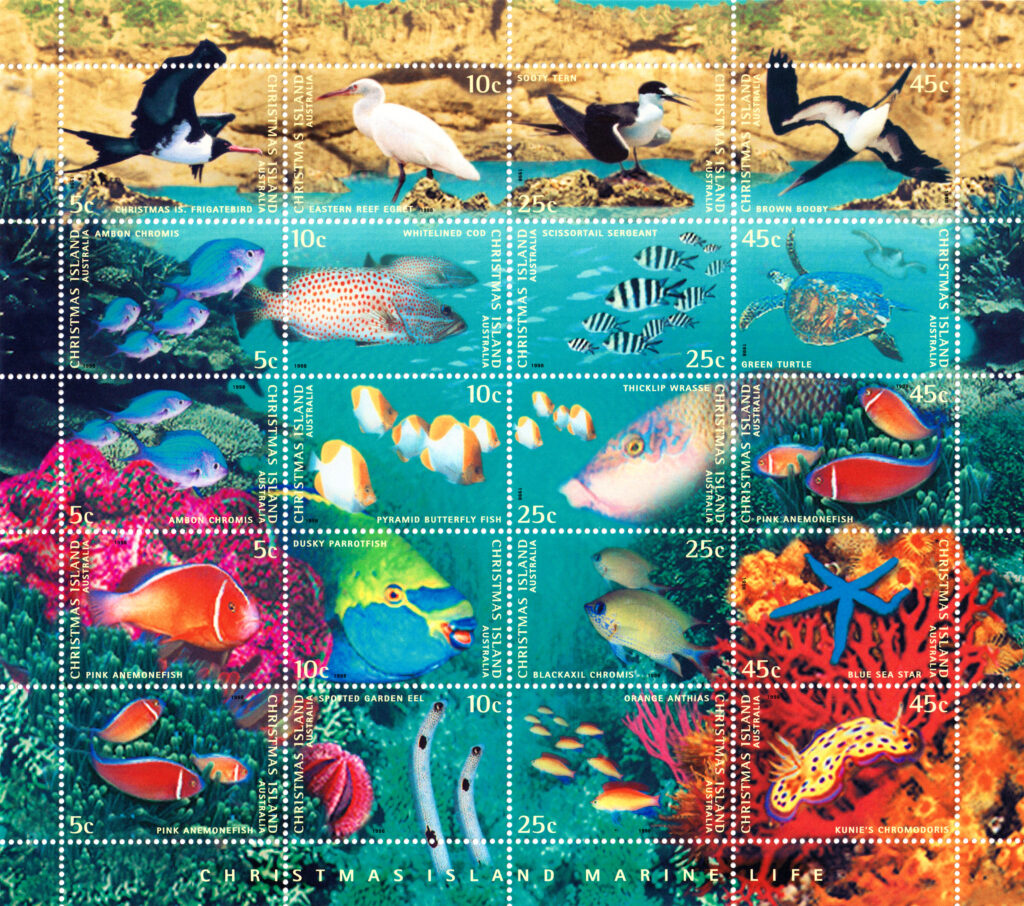
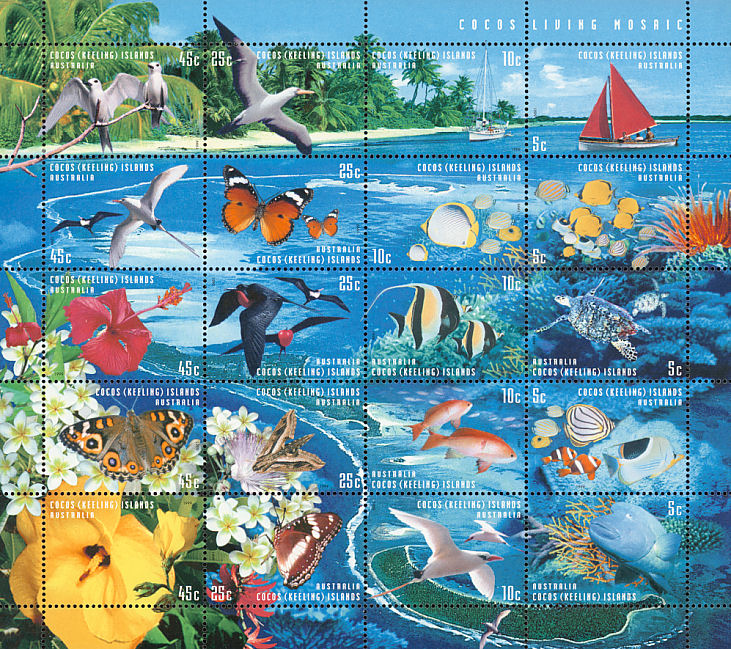
A ‘Marine Life’ sheetlet issued by Christmas Island in 1998 featuring 20 postage stamps showcases marine life endemic to the island, like the pink anemone fish and green turtle. Christmas Island is an Australian external territory in the Indian Ocean, located 350 km south of Java and 1,550 km northwest of mainland Australia. Courtesy Hakai magazine.