Genuine wealth in any organisation is never discovered readymade; it is unearthed through a deliberate, relentless process of polishing raw potential into lasting excellence.
“If you are looking for that one gem to help take your team to the next level, read this advice from Andrew Carnegie.
In today’s environment of high-velocity change, a business’s technology, product innovation or unique distribution are only fleeting advantages. In fact, the only sustainable competitive advantage is an organisation’s talent and how reliably they perform.
Andrew Carnegie (1835-1919) came to America from his native Scotland when he was a small boy, did a variety of odd jobs, and eventually ended up as the largest steel manufacturer in the United States.
At one time, he was the wealthiest man in America. To put his wealth into perspective, he built Pittsburgh’s Carnegie Steel Company, which he sold to J.P. Morgan in 1901 for $ 480 million. Today’s equivalent value is nearly $ 400 billion. He was also a great philanthropist donating the current equivalent of $ 79 billion to various charities, universities and libraries. At one point, he had 43 millionaires working for him. In the late 1800s, a millionaire was a very rare person.
A reporter asked Carnegie how he had hired 43 millionaires. Carnegie responded that those men had not been millionaires when they started working for him but had become millionaires as a result.
The reporter’s next question was, “How did you develop these men to become so valuable to you that you have paid them this much money?”
Carnegie replied that men are developed the same way gold is mined. When gold is mined, several tonnes of dirt must be moved to get an ounce of gold, but one doesn’t go into the mine looking for dirt – one goes in looking for the gold.
Some leaders find themselves sitting on a mountain of gold, and yet they feel poor because they don’t know how to mine the gold from their teams.
Excellent leaders coach good employees to become great people. They help them build better lives for themselves and others. They build their employees from the inside out… inspiring excellence at work and in life.
As the late, great UCLA basketball coach, John Wooden, said, “A good coach can change a game. A great coach can change a life.”
By Lee Colan, Co-founder, The L Group
Published on Sept. 23, 2016 in https://www.inc.com/
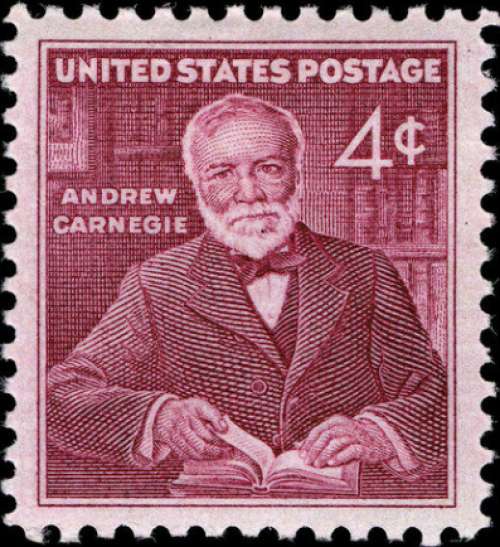
Image: A US postage stamp of 1960 commemorating Andrew Carnegie as an industrialist, philanthropist and founder of the Carnegie Endowment for International Peace. Courtesy https://geniuses.club/
Dr. Lee J. Colan is an organisational psychologist, executive coach, and the co-founder of The L Group, a Dallas-based leadership advisory firm. Alongside his wife and co-founder, Julie Davis-Colan, he has been advising CEOs and equipping corporate leaders with behavioral science models since founding the firm in 1999.
Notes:
Behind the famous mining metaphor lies the staggering reality of late 19th-century American industrialism and the unique management structure that built the world’s largest steel empire.
The 43 millionaires and the captains of industry: In an era before federal income tax, when a personal fortune of $1 million carried the purchasing power of roughly $30 million today, having 43 millionaires on a single corporate payroll was unprecedented. Rather than hiring pre-made executives, Carnegie practiced radical meritocracy and profit-sharing, bringing in young, ambitious men like Charles Schwab and Captain Bill Jones, granting them equity stakes, and empowering them to run entire mills with absolute autonomy.
Industrial scale and the $400 Billion legacy: Andrew Carnegie’s rise from an impoverished Scottish immigrant working as a telegraph messenger to the titan of Carnegie Steel redefined global commerce. When he sold his holdings to J.P. Morgan in 1901 for $480 million—an inflation-adjusted sum equivalent to nearly $400 billion today—he controlled a vertically integrated enterprise that commanded raw ore, railways, steamships and blast furnaces, producing more steel than all of Great Britain combined.
The economics of gold mining: Carnegie’s metaphor is grounded in hard geological reality: commercial gold ore grades in deep-rock mines typically yield less than 0.1 to 0.3 ounces of gold per ton of extracted rock. Moving thousands of tons of worthless aggregate (gangue) to isolate a tiny fraction of precious metal mirrors the intense managerial filter required to identify, test and refine exceptional human talent from a massive workforce.
Carnegie Endowment for International Peace: Established in 1910 by Andrew Carnegie through a $10 million gift, the Carnegie Endowment for International Peace stands as the oldest foreign policy think tank in the United States, created with the explicit mission to advance international cooperation and hasten the abolition of war. Functioning as a nonpartisan, global institution with centres operating across Washington, Brussels, Beijing, Beirut, New Delhi and Berlin, the Endowment provides independent analysis, policy research, and strategic dialogue to address complex geopolitical challenges, statecraft, democratic governance, and emerging global security threats.