
A group of friends, highly established in their careers, got together to visit their old university professor. Conversation soon turned into complaints about stress in work and life.
Offering his guests coffee, the professor went to the kitchen and returned with a large pot of coffee and an assortment of cups – porcelain, plastic, glass, crystal, some plain looking, some expensive, some exquisite – telling them to help themselves to the coffee.
When all the students had a cup of coffee in hand, the professor said:
“If you noticed, all the nice looking expensive cups were taken, leaving behind the plain and cheap ones. While it is normal for you to want only the best for yourselves, that is also the source of problems and stress. Be assured that the cup itself adds nothing to the quality or taste of coffee. In most cases, it is just more expensive and in some cases even hides what we drink. What all of you really wanted was coffee, not the cup, but you consciously went for the best cups…..And then began envying each other’s cups.
“Now consider this: Life is the coffee; the jobs, money and position in society are the cups. They are just tools to hold and contain Life, and the type of cup we have does not define, nor change the quality of life we live. Sometimes, by concentrating only on the cup, we fail to enjoy the coffee God has provided us.”
God brews the coffee, not the cups. The happiest people don’t have the best of everything. They just make the best of everything. They live simply, love generously, care deeply and speak kindly.
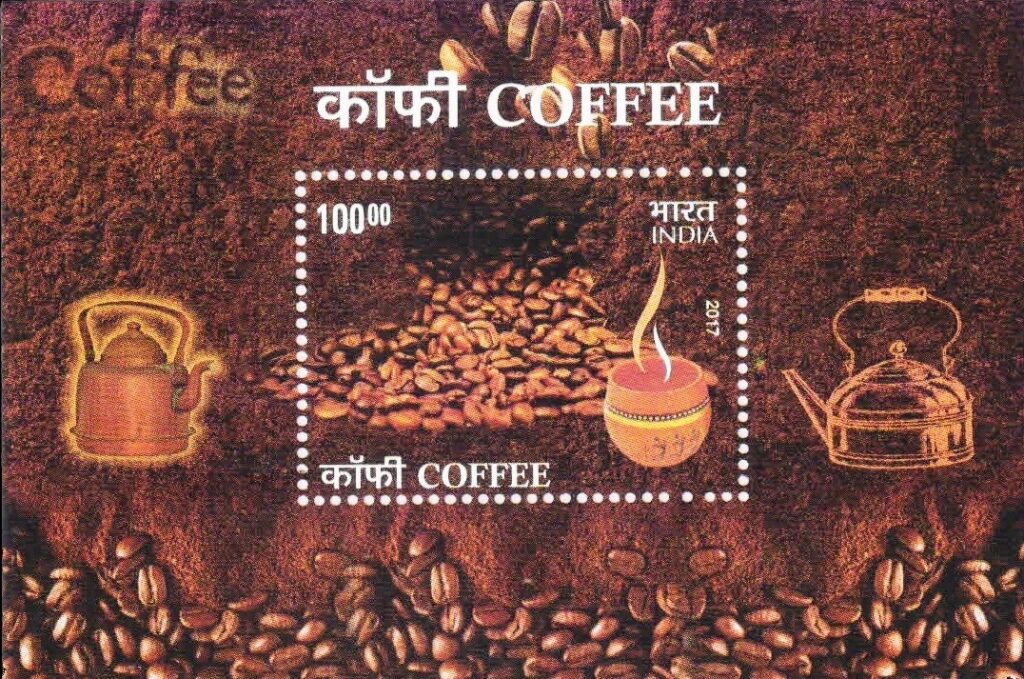
Image: India Post released a miniature sheet of postage stamps themed around coffee in 2017. The stamp featuring a fragrance that smells like coffee had a face value of Rs. 100.
Did you know:
- Coffee “beans” are actually the seeds found inside a bright red fruit called a coffee cherry.
- Legend says a 9th-century Ethiopian herder named Kaldi discovered coffee after noticing his goats became hyperactive and “danced” after eating certain berries.
- Coffee was once banned in several places, including Mecca (1511), Sweden (1746), and Prussia (1777), often because it was thought to stimulate radical political thinking.
- In the 16th century, Italian clergymen tried to ban coffee, calling it “Satan’s drink,” but Pope Clement VIII enjoyed it so much he “baptized” it to make it acceptable for Christians.
- High-end coffees like Kopi Luwak and Black Ivory are processed by animals —specifically civets or elephants — which eat and then excrete the beans.
- Finland is the world’s most coffee-obsessed nation, consuming approximately 12 kg per person annually — the equivalent of over four cups a day.
- Contrary to popular belief, lighter roasts typically contain more caffeine than dark roasts because the roasting process “burns off” some of the caffeine content.
- Adding cream to your coffee helps it stay warm about 20% longer than black coffee because the fat slows down evaporation.
- In some cultures, particularly in Turkey, a practice called tasseography involves interpreting patterns left by coffee grounds in the bottom of a cup to tell fortunes.
- In 1932, the Brazilian government couldn’t afford to send its athletes to the Olympics, so they sent them on a ship loaded with 50,000 pounds of coffee to sell along the way to fund the trip.