
Humanity thrives within a flawlessly orchestrated cosmic design, rather than on a random rock. Planet Earth’s precise placement in the Goldilocks zone, paired with its protective magnetic shield, reveals an interconnected system meticulously built to sustain and protect living beings. Its rhythmic rotations and colossal trek through the Milky Way demonstrate how a dynamic equilibrium balances the planet’s vast vulnerabilities. Contemplating this intricate cosmic backdrop awakens a deep sense of humility and a sacred duty to cherish our exceptional home.
Earth stands out as a remarkable life-sustaining planet in our solar system, boasting several unique features that harmonise to support diverse life forms.
Key features that support life on Earth
- Optimal Distance from the Sun: Earth’s location in the “Goldilocks zone” means it’s not too hot (like Venus) nor too cold (like Mars) — temperatures allow liquid water
- Atmosphere: Composition (N2, O2, CO2) supports respiration, protects via ozone layer (UV shielding)
- Liquid Water: Abundant oceans, rivers, lakes — water’s solvent properties vital for biochemistry
- Magnetic Field: Shields planet from harmful solar wind, cosmic radiation.
- Plate Tectonics: Recycles crust, regulates CO2 (via subduction), influences climate long-term
- Greenhouse Effect: Balances temperature; natural greenhouse gases (CO2, H2O, CH4) trap heat — though human activities impact this
- Oxygen-Rich Atmosphere: Result of photosynthesis by plants, cyanobacteria (blue-green algae) — critical for aerobic life
- Stable Axial Tilt (~23.5°): Contributes to seasonal cycles, climatic diversity
- Nutrient Cycles: Biogeochemical cycles (carbon, nitrogen, phosphorus) sustain ecosystems
Ecological and planetary harmonies
- Carbon Cycle: Balances CO2 through photosynthesis, respiration, geological processes
- Water Cycle: Evaporation, precipitation vital for climate, ecosystems
- Biodiversity: Diverse ecosystems (forests, oceans, etc.) contribute to resilience
- Photosynthesis: Foundation of most food chains, oxygen production
Protective mechanisms
- Ozone Layer: In Earth’s stratosphere, approximately 15 to 40 kilometres (10 to 25 miles) above the planet’s surface, absorbs harmful UV radiation
- Magnetosphere: Deflects charged solar particles
- Earth’s Core: Generates magnetic field via dynamo effect
Dynamic balance and vulnerability
- Climate Regulation: Delicate interplay of factors influences global climate patterns
- Anthropogenic Impacts: Human activities challenge balances (climate change, biodiversity loss)
- Resilience and Feedback: Systems like ice-albedo feedback illustrate complex interactions
Cosmic Context
- Rare Earth Hypothesis: Suggests combination of Earth’s traits might be uncommon in universe
- Comparative Planetology: Contrasts with inhospitable neighbors (Venus’ heat, Mars’ thin air) highlight Earth’s uniqueness
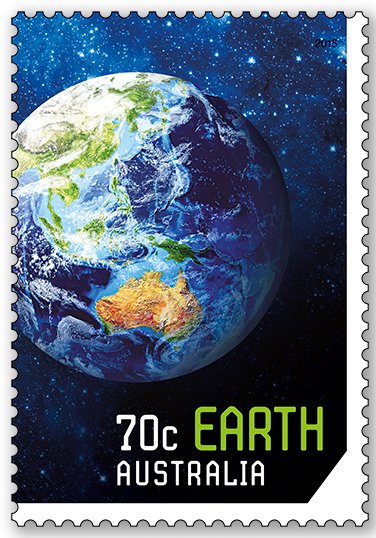
Image above: Postage stamp of Planet Earth, part of eight spectacular planets featured in Our Solar System set of Australia, 2015, courtesy Australia Post.
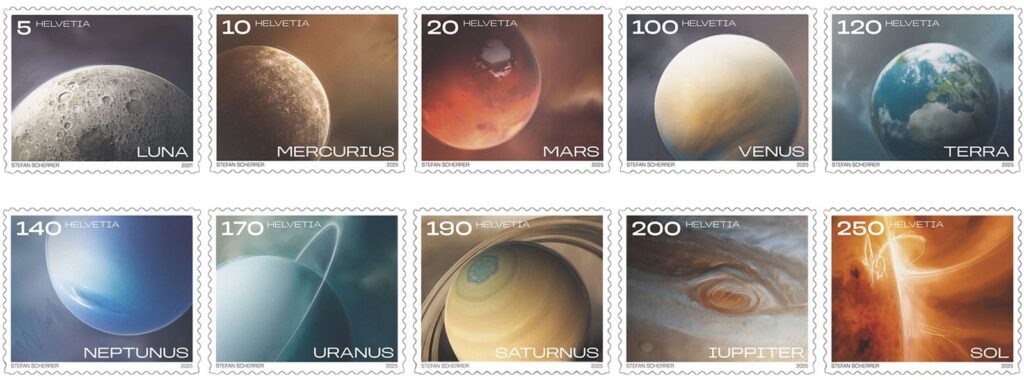
Image above: A new set of stamps from Switzerland in 2025 features our fascinating solar system in an impressive way. The designs in the set include the eight planets, the sun and the moon – the main representatives of our solar system. Courtesy Swiss Post.
Planet Earth as part of the universe
Most of us living on Planet Earth know very little about the unique place it occupies in the universe and the cosmos beyond. As we have seen above, no other known planet in the Solar System has the unique features that Earth possesses for sustaining and nourishing life. Let us, therefore, dive into the fascinating dynamics of Planet Earth’s rotation, revolution and its passage through space. And how impacts us in every possible way.
Rotation of Earth
- Axis Tilt: Earth’s rotational axis is tilted approximately 23.5 degrees relative to the plane of its orbit around the Sun (ecliptic plane). This tilt contributes significantly to seasonal changes
- Period of Rotation: Earth rotates on its axis once every 24 hours, causing cycles of day and night
- Rotation Speed: At the equator, Earth’s rotational speed is about 1,674 km/h (1,040 mph)
- Coriolis Effect: Earth’s rotation influences global wind patterns and ocean currents through the Coriolis effect, deflecting moving objects (like air masses) to the right in the Northern Hemisphere and left in the Southern Hemisphere
- Precession: Earth’s axis undergoes a slow wobble known as axial precession, completing one cycle roughly every 26,000 years
Revolution of Earth
- Orbit Around Sun: Earth orbits the Sun in an elliptical path, taking approximately 365.25 days to complete one revolution (solar year), and covering approximately 93 million miles (150 million kilometres)
- Orbital Speed: Earth’s average orbital speed is about 107,731 km/h (67,000 mph)
- Eccentricity: Earth’s orbit has slight eccentricity (~0.017 now), meaning its distance from the Sun varies (perihelion or closest point ~147 million km, aphelion or farthest ~152 million km), slightly affecting the solar energy received
- Seasons: A combination of axial tilt (~23.5°) and revolution leads to seasonal variations in sunlight exposure, causing winter, spring, summer and autumn cycles
Earth’s Passage Through Space
- Parent Galaxy: The Solar System, of which Planet Earth is a part, resides in the Milky Way, a spiral galaxy with an estimated diameter of 100,000 light-years
- Solar System Movement: The Solar System orbits the centre of the Milky Way galaxy at about 828,000 km/h (514,000 mph), taking roughly 225-250 million years for one galactic orbit (galactic year or cosmic year)
- Milky Way Orbit: The Milky Way galaxy itself moves through the local universe, partaking in large-scale cosmic flows
- Space Environment: As part of its space environment, Earth traverses the interplanetary medium (solar wind, cosmic rays) and interacts with solar phenomena like solar flares.
- Heliosphere: Earth’s journey is within the heliosphere, the Sun’s magnetic and particle influence bubble in space
- Observable Universe: Earth’s vantage point offers perspective into an observable universe of ~93 billion light-years diameter
- Planet Types: There are four types of planets in the Solar System: Terrestrial planets – Mercury, Venus, Earth and Mars; Gas giants – Jupiter and Saturn; Ice giants – Uranus and Neptune; and Dwarf planets – Ceres, Pluto, Quaoar, Sedna, Eris, Varuna, Makemake and many others
Additional Phenomena
- Climate Influences: Earth’s orbital parameters (Milankovitch cycles) involving eccentricity, axial tilt and precession impact long-term climate patterns on the planet over tens of thousands of years
- Seasonal Variation in Weather: The regular, predictable changes in weather patterns that occur throughout the year, such as temperature, precipitation and daylight hours, primarily caused by the Earth’s axial tilt as it orbits the Sun. These predictable patterns lead to distinct seasons like spring, summer, autumn (fall), and winter, with significant differences in weather experienced between them
- Polar Extremes: Polar regions experience extreme variations like polar days (continuous daylight) and polar nights. These polar extremes result from the Earth’s spherical shape and axial tilt, which cause the polar regions to receive sunlight at a low, indirect angle and for a shorter duration
- Tidal Effect: Ocean tides on Earth due to the Moon’s and Sun’s gravity. This force creates bulges of water on opposite sides of Earth, resulting in two high tides and two low tides daily as the planet rotates through these bulges
- Leap Year: Necessary to keep our calendar synchronised with the Earth’s orbit around the Sun, which isn’t exactly 365 days long. The Earth actually takes about 365 days and 6 hours to complete one revolution. Without adding an extra day every four years, this extra time would accumulate, causing our calendar to slowly drift out of sync with the seasons and astronomical events like equinoxes and solstices
- Magnetosphere: A giant, comet-shaped magnetic field that acts as a protective shield, extending far into space and defending Planet Earth from much of solar wind and cosmic radiation (cosmic rays) emanating from space. It is generated by the churning of molten iron in Earth’s outer core and is constantly changing shape in response to solar activity. This magnetic bubble is crucial for Earth’s habitability, deflecting charged particles and preventing the erosion of our atmosphere by the constant flow of solar wind
- Solar Wind and Cosmic Rays: Solar wind is a stream of low-energy charged particles (protons, electrons and alpha particles) ejected from the Sun, while cosmic rays are high-energy particles originating from beyond the Sun, such as from supernova remnants and other violent events in the galaxy and beyond. The key differences lie in their energy, source and the extent of the cosmos they come from
- Ozone Layer: A region in the stratosphere (10-50 km above Earth) that contains a high concentration of ozone (O3) molecules, which absorbs most of the sun’s harmful ultraviolet (UV) radiation, protecting life on Earth by preventing increased sunburns, skin cancer, and other environmental damage. This protective layer is crucial for life and is distinct from ‘ground-level ozone,’ which is a pollutant
- Auroras: Natural light displays in the Earth’s night sky, mostly in high-altitude Arctic regions, caused by solar wind interacting with gases in the Earth’s upper atmosphere, which are guided by the planet’s magnetic field toward the poles. These collisions release energy as colourful light, creating dynamic curtains, rays or spirals across the sky, famous as aurora borealis (Northern Lights) and aurora australis (Southern Lights)
- Geomagnetic Storms: Solar disturbances can impact Earth’s magnetic field, affecting tech like satellites, power grids etc. They occur when there is a very efficient exchange of energy from the solar wind into the space environment surrounding Earth
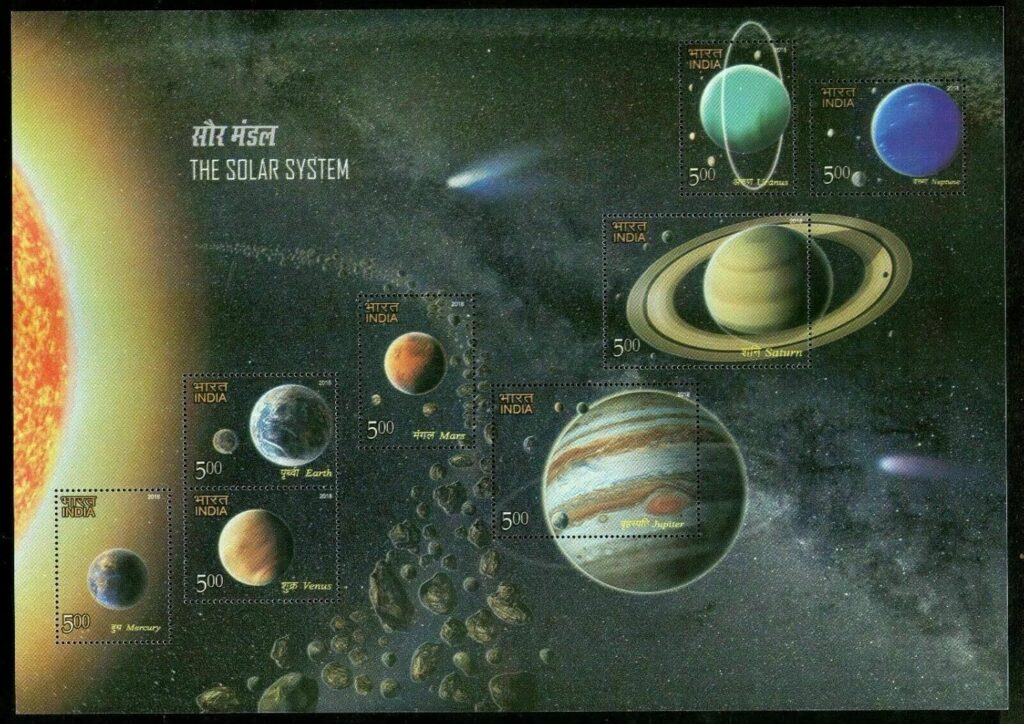
The Solar System, a miniature sheet containing eight stamps depicting the eight planets, issued by India Post in 2018.
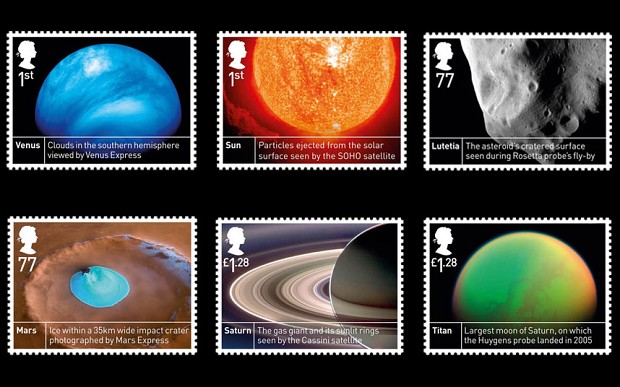
To mark the 50th anniversary of the launch of Ariel 1, UK’s first satellite, into space, the Royal Mail released a set of six commemorative stamps in 2012 showing images taken by various satellites of the European Space Agency (ESA). Courtesy The Curious Astronomer/Wordpress.